Archive for the ‘Ancient Text’ Category
What Did You Forget Today?
Welcome to Monday—what brings you here?
On your way to work—whether by train, plane or automobile (or stairs)—your mind raced ahead to anticipate the tasks needing attention. You passed by and through spaces not dedicated to the work you do: the incidental scenery along the way. Liminal spaces. Preoccupied with your onerous task (the meeting to conduct, the performance review, the estimate/report/files due by 11am), you may not have noticed those places. Anyway: aren’t they just the ugly, industrial infrastructure or detritus required to make the big commerce machine run?

Not really worth attention.
But those spaces have a way of releasing you and possibly preparing you for the very work you are doing just now. Those spaces—so regularly ignored as to become invisible—help your mind and body make the leap to the world of productivity. Moving forward through those spaces you shed thoughts and instincts from the weekend so you can adhere to hierarchy and care again about what your company cares about. Maybe those quickly-passing-spaces even erase the resolve and wonder built up over the weekend.
And welcome to Monday.
But it’s not good to forget lessons learned from the quiet of the weekend. Even hard-partying readers—I hope—found margin for reflection. Don’t leave those reflections and fresh understandings at home on the kitchen table. Bring them with you.
For me, a long conversation with this poet/psalmist has created a specific resolve that I hope will flow through this week. A boat-ride in the September sun and a story about a daughter in a far-away land cooking a Minnesota meal for the nationals—all these have a sort of sustaining power.
I’m eager to bring these with me into the week, right through the liminal spaces of my transit. In fact, now I wonder if the liminal spaces of experience are the very stuff of a full life.
###
Image credit: Kirk Livingston
Guns & God & GOP: Why Listen Beyond What I Know? (Dummy’s Guide to Conversation #20)
Why listen to a different viewpoint?
Q: I’m a passionate guy. I have strong beliefs and I know what’s true about the world. And yet coworkers and neighbors blather on with their ill-founded stupidities. Why won’t they listen to reason?

A: I’m glad you ask because we all fall into this state from time to time—often without realizing it. What stands as a clear and obvious reason to me looks like wishy-washy BS to you. And your clearly developed opinion looks like ideology-driven, fact-picking to me.
One guy in the Bible talked about an opportune time for everything: birth and death, crying and laughing, speaking and shutting your pie hole. Maybe there is a time to shout your opinion and maybe there is a time to listen to what someone else has to say.
We do a lot of shouting in this country.
What if we experimented with listening?
If there were a time for listening, it would happen in a conversation where we truly wanted to hear what someone else wanted to say. Perhaps we’re talking with someone we respect a great deal. Maybe we’ve purposefully sought out a friend with a different opinion—just to try to hear it clearly.
What if we listened intently to the pieces of reason and fragments of story our friend uses use to tell her side of things? What if we intentionally entered a conversation with the purpose of listening rather than doing battle or proving our point? We all know that the purpose we bring to a conversation has a big bearing on the outcome. We’ll get a fight if we want one. We may get an interesting eye-opener if we listen properly.
Note how different that intention is from the half-listening we typically do while we form our rebuttal. We’re all guilty of preparing a torrent of words to combat the wrong-headed notions spewing from our worthy debate opponent.
But what if it was not a debate we wanted? What if, after listening we tried to summarize what our conversation partner said to see if we could get it right? And only then, after hearing and summarizing, we formed a response. And what if we didn’t reach for the phrases we heard on TV or trot out the canned responses our club’s magazine produced? What if we stayed in the moment—with this friend—and voiced our disagreement even as we continued to listen?
Here’s what can happen: You and I can remain passionately eloquent about what we believe. But we also can say with certainty what our friend believes-though we disagree.
That kind of talk can feed your passion, feed a relationship as well as make for an interesting and engaging few moments of human connection.
That’s why we listen to a different viewpoint.
###
Image credit: Kirk Livingston
Brian McLaren’s Poke at Orthodoxy
Our blindness is one thing the emergent church may have right
Syncretism is the melding of different philosophies or religions or schools of thought. The term (“syncretism”) becomes a pejorative that casts some practice in a negative light. My Christian missionary friends will talk about, say, Hindus who have converted to Christianity. And they’ll notice that some of the Hindu practices have found their way into the expression of Christianity—maybe harmless. Maybe not.
Once upon a time fundamentalist preachers would decry drums as a pagan beat that has no place stirring up emotion in a church service (somehow they missed the use of percussion instruments in Old Testament singing—and dancing).
Are those examples of syncretism? Possibly. I doubt there is a black and white standard about such things—there’s no on/off switch for what’s right and what’s wrong. More likely there is a continuum. And at some point along that continuum we decide (that is, someone claiming authority arbitrarily decides based on their understanding) this other person has crossed the line. The convert has gone too far and now that person has mixed the gospel with paganism.
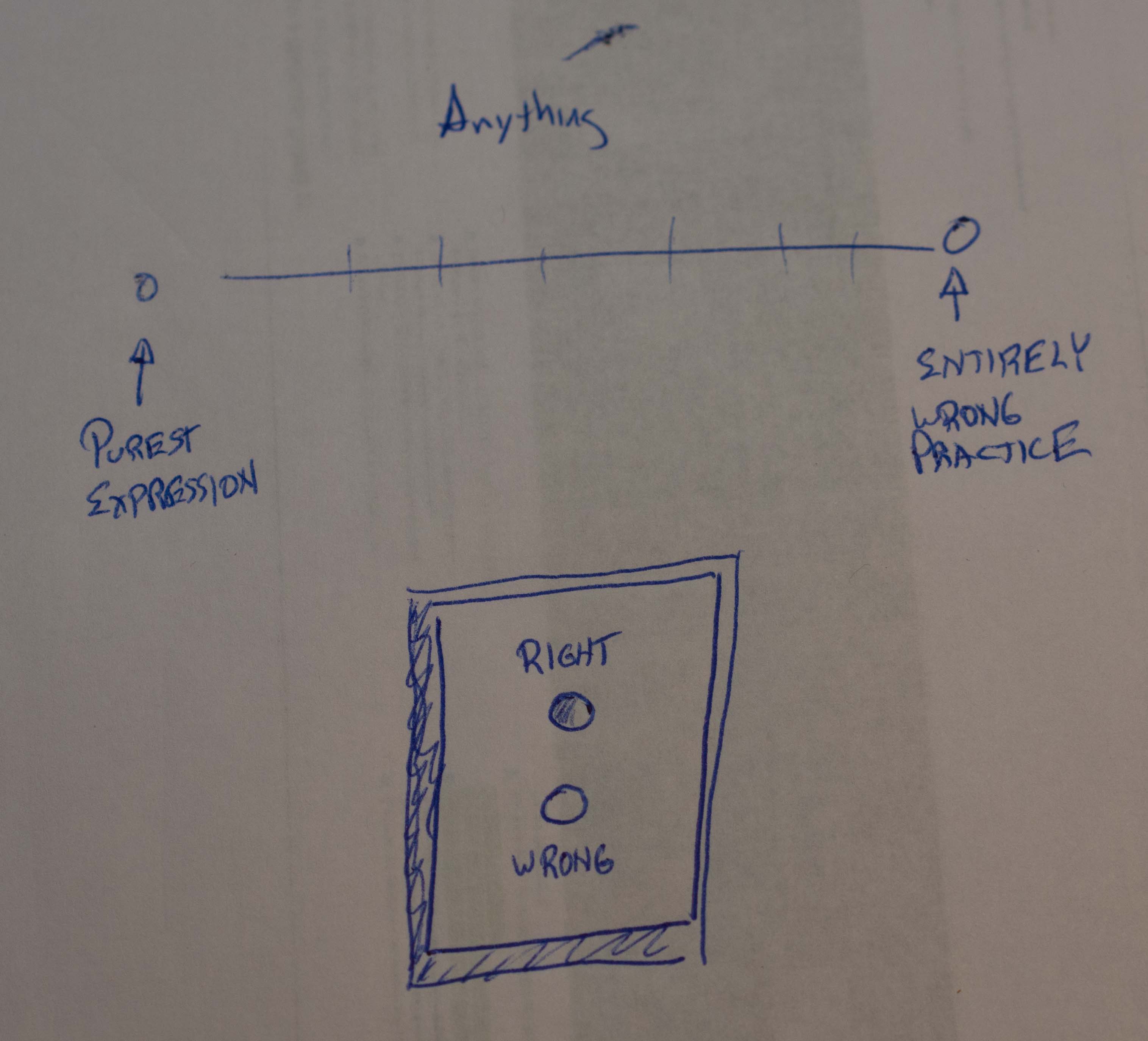
You’re doing it wrong?
Brian McLaren might say: “Not so fast.”
McLaren’s A New Kind of Christianity: Ten Questions That Are Transforming the Faith points out that modern reflections of Christianity (even/especially modern evangelicalism) may themselves owe a lot to this syncretistic impulse. In A New Kind of Christianity, McLaren argued that the reading of the Jewish Bible (the Old Testament) and the New Testament have been overtaken by platonic thinking. He describes a six-step formula that many Christians immersed in the Bible would subscribe to—and then he goes on to point out that formula owes much more to Plato than it does to the Torah. Some argue that McLaren’s is a naïve reading of Plato, which may be accurate: whenever we reduce this to that, we lose nuance and insert our own biases.
McLaren’s notion that we are at cross-purposes with the Bible when we read it as a constitutional law document rather than diligently seeking out (and sticking to) the purposes for which the documents were written also rings true for me. I’ve been on the giving and receiving end of too many interpretations that conveniently keep the people in power in power. But McLaren’s notion has lots of layers that require extensive teasing out and discussion.
Brian McLaren is a lightning rod. People love him. People hate him. It’s not hard to see why, when he accuses the entire ecclesiology industry of syncretism.
I like McLaren’s book because it is a beginning of trying to strip away our syncretistic impulses. Especially those impulses we are so embedded in that we can’t see them, sort of like the fish who doesn’t understand the concept of water. Sure—McLaren’s book has flaws. It turns reductionistic every so often. It makes huge leaps. Yes.
And yet we need real help to see where we have inserted our own thinking into a holy document and called it God’s word. Because this happens over and over again. And I think God doesn’t dig that tendency on our part. I would guess he would prefer the attitude behind, “I am blind. I would like to see.”
McLaren points out some of our blindness.
###
Image Credit: Kirk Livingston
Writing finds its own audience
Except: Even God had a hard time holding an audience for long
My cousin is a big cheese in the world of women’s studies. She’s published a number of books and teaches some pretty astute, high-level stuff to aspiring Ph.Ds. Once we talked about why anyone would write and what’s the point, after all, since fewer and fewer read. (By the way: I always say this to my classes, that even a paragraph of copy scares many of us. All those words, they’re just, well, so much work.)
My cousin said something to the effect that you’ve got to believe your writing will find its own audience. That is a perceptive statement and I’ve wrestled with it since. I think it is true. I hope it is true. And I know it is false—at least immediately.

Meh. Another Sunset.
Social technologies and search let more of us find our long-lost cousins and brothers and tribesmen—the ones we never knew existed. We find them because they speak our language, possibly with our own words. And we know them because they are passionate about our topics—the stuff we think on constantly. (“You write about garlic butter too? You are my brother!”)
It’s just that it may take a long, long time for that audience to co-locate to your web address or your part of the bookshelf. Of course we hear and read stories of the overnight success folks, who start a blog on Saturday and by Tuesday they are talking with Oprah. But for more of us, we tell our stories and organize our arguments and spin them out into silence. But we must continue on with diligence, continuing to tell the story, as if keeping the porch light on, waiting for that audience to show.
There’s an old story about God giving his words to a guy and telling him to say the words. But know that no one will listen—you’ll be banging your head against a brick wall most of the time. And it’s all going to end badly. But those words will take root. And those words will blossom.
Eventually.
And over time the audience did show up.
And we’re still reading those words today, lo, these thousands of years later.

###
Image credit: Kirk Livingston

Work: blessing or curse?
Make Your Own Meaning
Whether you’re on the people’s tram to join a raucous celebration with Socialist or Communist overtones or just sitting at your desk working the typical Thursday, it’s worth reflecting on the work we do every day.
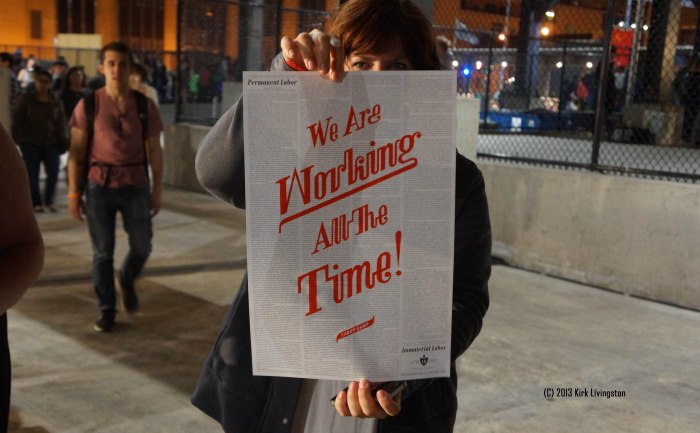 Sometimes we forget that the old story in Genesis placed work securely on the blessing side of the equation: Adam and Eve got to hang in the garden and work it. Their work had purpose. But after the curse, work changed. Painful became a key descriptive. And purposes got all crossed. It’s that painful, cross-purposed stuff we most often think on when we reflect on work.
I’m with the writer of Genesis on this one: work is way more blessing than it is curse. Learning to act in some purposeful way out in the world is a pretty good way to go through life. Picking up skills and using them to earn and help others and provide insight and move projects along—it’s all meaning-making stuff. I’m also of the opinion that we make our meaning as we go. We have to find our own reasons for working. And often those reasons come from somewhere deep inside (versus from a wallet-sized card produced by the public relations or human resources department).
When we start see how our work makes a difference, each day becomes something of an adventure.
###
Image credit: Kirk Livingston

“Just Exactly What Are You Up To?”
Then ask: “What is your point?”
We ask this of each other constantly: “What’s your point?”
We also ask it of poems and movies and op-ed pieces and windy monologues and sermons and sacred texts and profane screeching. Is this desire to quickly get to the nub a peculiarly American trait?
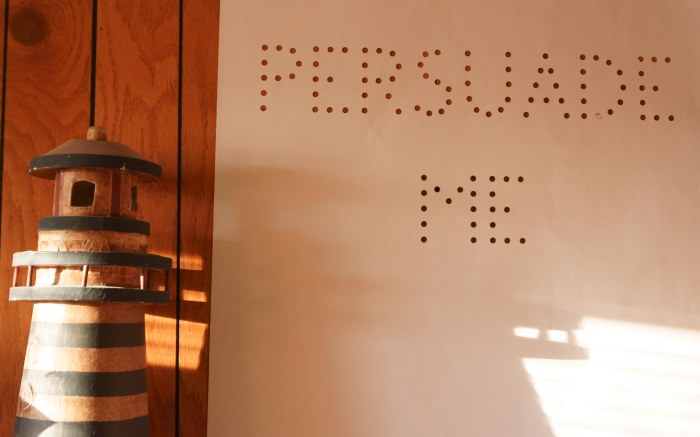 Maybe.
Or maybe it’s just a sign of these fast-paced, self-important times. Unfortunately, the question allows little room for dilly-dallying with ambiguity or gray.
Because we got stuff to do.
We want the point. And we want it now. So we can reject it. Or, possibly we’ll agree (but with provisos. Naturally).
Authors and friends who take time to really get to know a subject or to get to know another person’s thought are great counterweights to this tendency. Mortimer Adler’s How to Read a Book comes to mind, with his intense working-over of a text so as to master it. This is the opposite of reducing this to that. And I’m lucky enough to have people in my life who listen carefully without reducing. I’m trying to learn from them to do the same
I’ve just begun a book by Joseph Harris, Rewriting: how to do things with texts (Utah State University Press, 2006). Mr. Harris’ book has lots of wise and useful things to say about how to handle other people’s thoughts in ways that allows you to hear them, while allowing room for moving the topic forward. He advocates a generous approach with a text: trying to understand. The generous approach to another person’s thought reminds me of Wayne Booth’s notion of listening-rhetoric: looking for similarity of thought before blindly reducing and striking back with counter-arguments.
“Pursuing truth behind our differences,” is how Dr. Booth would say it.
One thought Mr. Harris puts forward is that rather than forcing a text to get to the point, it might make better sense to ask, “What is the author’s project?” This question is about the intention behind the text. What was this poem/movie/op-ed/monologue/sermon/text trying to accomplish? Why did [whomever] write it and what did they hope to persuade the reader of? After you guess at that you stand a better chance of understanding their point (if there is one point). And this is particularly helpful when an author is presenting multiple points—like in the back and forth of a conversation, when someone is trying an idea on for size. This appeals to me because I’ve sat through too many meetings and preachments where the speaker’s point was forced out of a text that had zero to say about the topic. I have also been guilty of this violent approach to a text.
I like the notion of being generous with the texts we read and the conversations in our lives.
I am also persuaded we are all in the business of persuading each other all the time. We all have projects.
###
Image Credit: Kirk Livingston
To My Friends Who Have Abandoned Faith
Kathleen Norris: Acedia and Me
If you’ve been turned off by the excesses of evangelicalism or the big-business, industrial mindset of a megachurch, or if you’ve become weary of a clergy-centric approach to faith, or if you are tired of trite, pat answer to life’s really thorny questions, consider reading Kathleen Norris’ Acedia and Me: A Marriage, Monks, and a Writer’s Life (NY: Riverhead books, 2008).
If you’ve turned your back on faith entirely and see no point in going back to the social club that seemed to promise transcendence, especially then, read Acedia and Me. If you’ve become weary of the automatic linkage between Republicanism and Christianity, well Kathleen Norris does not speak to that sorrow. But, patience: within a generation that unfortunate concatenation will be far less automatic.
Kathleen Norris is an engaging writer who addresses the life of one’s spirit wholly without the overweening sentimentality that usually comes with such discussions. Ms. Norris sought answers from an unlikely set of conversation partners: old dead guys who wrote when people could count the centuries on two hands or even one. Many of these old desert monks had abandoned the newly popular, powerful, and politically-connected church. Instead they sought the quiet of the desert to confront their demons.
Acedia, which is perhaps the heart of Ms. Norris’ book, is not easily translated. Some read it as depression. Some read it as sloth or boredom or torpor. Ms. Norris traces the word through the ups and downs of her own life as a writer. Her own marriage is a key player in the story and she seems to hold little back in illustrating her struggle.
I was particularly taken with her definition of sin, which had less to do with breaking a set of rules and more to do with recognizing that people are made in the image of God and there is something hopeful and fetching about aligning one’s direction to recognize that.
In the end, she has a fresh take on one’s faith. You may agree. You may disagree. But you’ll be engaged. And better yet, you may even hold off from tossing everything over.
###
Image credit: Kirk Livingston
How You Say: Not Just “What” But “When”
A word is a fuse. Light the fuse.
I’m teaching a freelance copywriting class at the University of Northwestern—St. Paul. Yesterday was our first day and I wanted the students to begin the shift from writing papers for professors to writing words to make a difference. I maintain that excellent copywriting is the very opposite of spewing malarkey and hype. Especially today, when anybody who can read and/or listen and absorb marketing messages has their BS meter set on high all day long.
The best copy doesn’t call attention to itself. The best copy is nearly invisible and absorbed without realizing it. The best copy latches on to or illustrates a larger idea and leads the reader to the idea threshold. The best copy is emotive and rational. If it can be silly too—all the better.
We talked about the differences we perceive in writing for non-profit, mission-driven organizations and for-profit organizations. At first glance we might think one organization is all about mission and the other is all about money. But that is a mistaken notion: for-profit organizations can be all about mission and non-profits can be all about fundraising. Examples abound in each category.
One of the things I love most about teaching these particular students is the sensitivity to mission. They are cool with the notion of using your writing skills to help others. Many are considering starting work with non-profits, but that is not unusual for many studying the liberal arts. These particular students are often eager to trace their motivations for helping others back to some of the ancient texts that drive much of this school’s mission.
But one thing that is not so clear is that mission-driven work exists in both non-profits and for-profits. One’s mission comes largely from within. Our job—that thing we get paid for—is an outward-focus of the mission we bring with us. A copywriter with a sense of wanting to help others can find a home in any number of organizations, whether for-profit or not-for-profit. And using that copywriting skill to bring a reader to a life-changing realization can be a primary motivation for the whole task of writing.
I would like to see more copywriters with that motivation.
My go-to example is the quiet laugh from the writer in this four-minute film. Listen for the laugh. Think about what that laugh says about delivering the right words at the right time:
###

 conversation is an engine