Archive for the ‘Hard Conversations’ Category
Q: My friend has lost all desire and curiosity.
What can I say to bring him to life again?–Lazarus’s friend
Dear conversation is an engine
My friend has lost all desire and curiosity. What can I say to bring him to life again?
–Lazarus’s friend

Dear Lazarus’ Friend:
Your friend may be depressed. Does he look at his smartphone a lot—that could be a sign. Tell your friend to hie unto a physician for a thorough physical–because it could be physical. It could require a counselor or mental health professional.
But from a friend’s perspective, find ways to be present. Take your friend out for coffee and get him to spill the beans: what’s going on? Friendship is about talking all the way through your friend’s understanding of life just now. Touch on what he fears and what he hopes. Touch on what next steps he might. This will take time—maybe many cups of coffee over a long time. Or take a long walk together–do something that takes the pressure off talking.
Being present with your friend may look like conversation. Or it may sound like silence. But being there, whether or not words show up, that is the first point.
Start there. Because showing up may be just the glimmer your friend needs.
###
Image credit: Kirk Livingston
Have That [fearful, painful, embarrassing] Conversation
It’s how humans move forward
We find all sorts of ways to not say something important.
I do this all the time: there are things I need to say to several people in my life—but I hold back, fearful of how my words might be received, questioning where the conversation will lead. Am I able to follow where this potential conversation might go? Do I even have the emotional capacity to stick with that conversation? Will I fall into weeping or fly into a rage?
I’m not talking about drive-by conversations that release a damning monologue and then run away. I’m talking about those sustained conversations with people we are close to, conversations begun with a desire to say and hear. True dialogue about something important—where our thoughts are modified by someone else’s—and something new arises.

Atul Gawande’s book Being Mortal: Medicine and What Matters in the End (Metropolitan Books, 2014) has reminded me of the need to get very specific when talking about end of life stuff—though the entire topic is crazy difficult. One simply does not know how much time anyone has left.
But it is not just death and life stuff that wants a conversation. There is life-direction stuff, talk about fears and hopes and dreams. Talk about how we understand something: what we think of faith now compared to what we thought 30 years ago.
Does that sound like a heavy conversation? It sure could be. But, in fact, we release bits and pieces of this stuff all the time. In conversation with those close to us we always find ourselves talking about these things. But sometimes those conversations need to be ramped up.
A couple years ago I wrote that it is better to have the conversation than not. More and more I think that is true. When we bring up a topic with a friend or family member or colleague, great things can happen. We can find new resolve, or new intimacy. Sometimes the talk conjures raw emotion. But on the other side is a movement forward.
What do you need to say today—and to whom?
###
Image credit: Kirk Livingston
A Confederacy of Onces
What could a national conversation look like?
Once upon a time mom and dad and kids gathered in the evening in front of the television to be entertained. This family, sitting patiently and expectantly, had three channels to choose from. Plus the boring public broadcast channel. Back when everyone watched the same variety show or mini-series or disruptive news special, national conversations occurred. Broadcasts that enraged or engaged would spur citizens to remark to each other. And since everyone watched the same channels, national conversations were born. So we talked about Selma or Vietnam or the moon landing or the most recent episode of “Roots.” Sometimes, not often, we talked about what was happening in Washington.
Before TV, radio did the same. Before that newspapers. Media has a way of spurring national conversations, though the attention lasts only so long, because the job of media is to immediately bring the next new thing. Day after day. That’s their revenue stream and business model.

When consolidated media ran the news business, it seemed to have more of a black and white/good or bad characteristic. With good guys and bad guys, a much better story emerged. And better stories sell more newspapers or generate better Nielsen ratings.
Social media removes some power from the established media. By hearing from different voices, context can be provided. Or not: Sometimes flame-throwing trolls dominate our inbox, just like on Fox News. The smart ones among us find ways to hear different voices, so we can see different ways to connect the dots. The rest of us relish getting riled with righteous rage by the people in our tribe who serve that function.
Lately for me and others, social media has connected dots and has turned a series of media one-offs into a bona-fide “thing.” Many find themselves paying attention and then cannot help but remark. Topics like the statistics around black deaths with police. It was blogs and tweets that explored nuance and connected the series of “onces” to show there is more—much more—than just a few one-offs. It was social media that kept the topic on the radar, not the established media.
Kerry Miller, on a recent The Daily Circuit, said she doesn’t like to use “national conversation” because it never happens. That is (I think she meant), national conversations never materialize. But I would argue that more and more often people are adding up the “one-offs” and putting them together in ways journalists and authorities had not predicted. It blindsided me that the Confederate flag flying over the South Carolina capital would prove a lightning rod. Gay marriage has taken the nation by storm right up to the point where it became the law of the land. And it was the call for statistics to be reported about deaths occurring in police custody. All of these have been explored by social media in detail.
All of this has proven fodder for national conversations. That is, new topics that we may never have dreamed we’d find ourselves talking about are now falling from our lips at the coffee bar or on the drive to work. And here is perhaps where today’s national conversation differs from those conversations mediated only by established media. Social media allows for nuance. It need not be black and white because we’re not selling newspapers here (some are, of course). But the nuanced voices are helping us talk without forcing one way or the other.
I see these conversations developing every day. And they move from online to offline to online again. I also see smart journalists from established media finding ways to bring in nuance at just the right time.
###
Image credit: Kirk Livingston
How to Tell Yourself the Truth (Hint: Start with an insult)
Where’s John the Baptist when you need him?
John’s task was to prepare the way of the Lord. That looked and sounded like insults to a crowd already well aware of the law and prophets and how to navigate the ancient texts. It’s just that the crowd’s navigation allowed them to do what they wanted while ignoring the invigorating spirit of the texts.
Thus John’s insults.

It’s easy and natural to take insults as insults (that is the intention, after all). But to see them as opportunities? That actually happens to most of us: insults become opportunities…ten years later. It takes ten years, or maybe twenty, to see the truth of what that busybody meddler said. And then in conversation with a friend or your grown-up kid or spouse you find yourself saying, “They were actually spot-on, though I denied it at the time.”
A few days ago an acquaintance called me out on one my typical innocuous and benign conversations about copywriting and communication—he resisted my assertions and would not back down. His insult landed wide of the mark and made no sense to anyone else either, but it got me thinking about my approach to a particular set of clients I work with. In fact, my acquaintance’s sharp barb started to reveal a truth about my approach that has since proved quite useful.
This is atypical.
I usually spend a decade stewing on an insult and devising comebacks and elaborate retributions. But what would life be like if I/we could be more open-handed about criticism?
That might help us grow beyond our blind spots—which might prove useful.
###
Image credit: Kirk Livingston
Editorial Cartoon vs. Rough Sketch
Pique a place to begin.
Charlie Hebdo meant to disrupt and paid dearly. That is what every editorial cartoonist wants, well, not so much death as to disrupt. I’m a fan of Steve Sack at the StarTribune, who every day tips some social issue on its ear.
The contribution of the editorial cartoonist is to change the status quo conversation by putting forward an opinion in whatever outrageous way that gets attention and is instantly understandable. Most of their work is an image that evokes a passionate response. The editorial cartoon is typically polarizing, immediately dividing those in violent disagreement from this in violent agreement.
In contrast, the rough sketch is presented to people who are already with us. They may not agree with our nuanced vision of a project, but they at least have the project on their radar.
We use the rough sketch to present our vision for the project, to show more precisely what we mean and to invite discussion. The whole undone sketchy ethos of it can accomplish all those things.
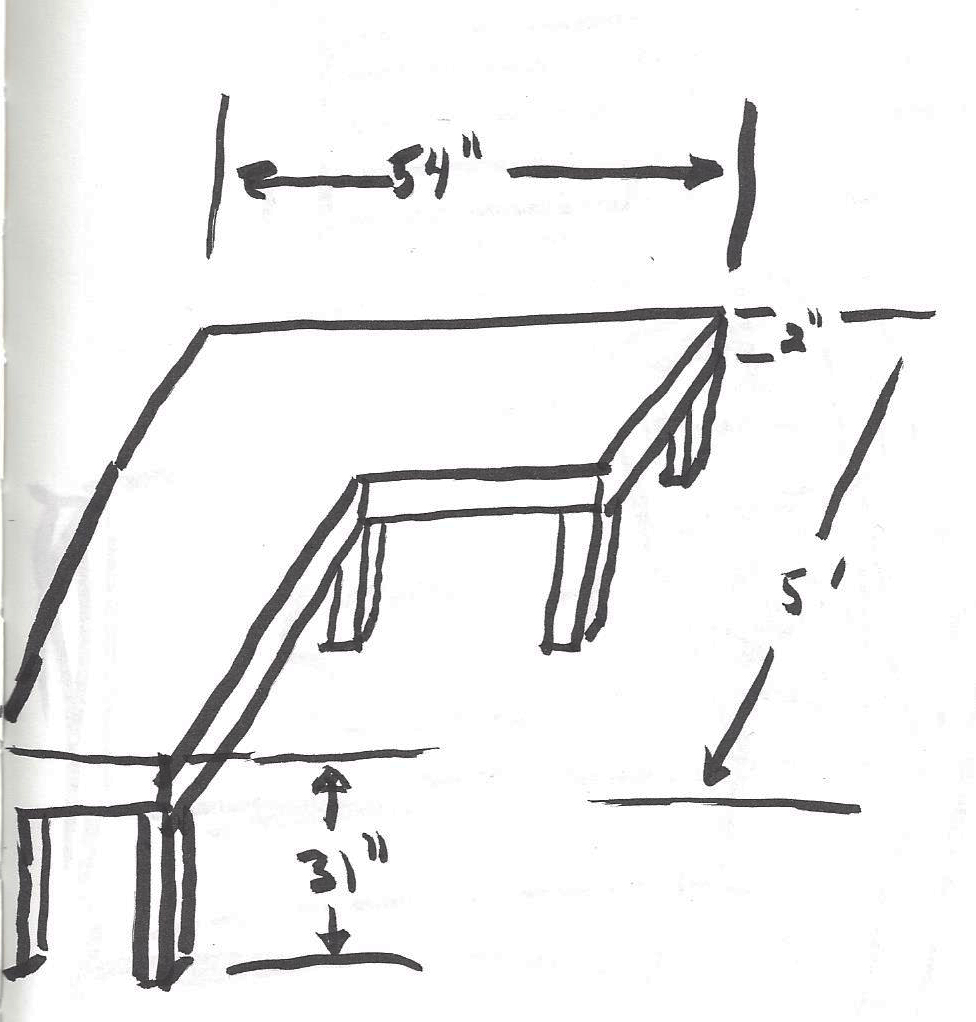 Sometimes we need a rough sketch to present our idea in the easiest possible way—so our friend or client cannot misunderstand us. And sometimes we need to disrupt a status quo conversation and risk passionate ire.
###
Image credit: Steve Sack, StarTribune
Dumb sketch: Kirk Livingston
DBT: When Does Talk Become Therapy? (Shop Talk #9)
Can a conversation save your life?
I recently met a therapist who practices dialectical behavior therapy (DBT). She and her team work with clients who may struggle with a number of issues including borderline personality disorders and thoughts of suicide, among other things. As we talked it seemed to me that her practice was very much focused on, well, talking. Her practice of therapeutic talk has a pretty good track record of helping people find ways through each scary personal wilderness.
In Doing Dialectical Behavior Therapy: A Practical Guide (NY: The Guilford Press, 2012), Kelly Koerner describes some pieces of how this therapy works:
Emotion dysregulation is the inability, despite one’s best efforts, to change or regulate emotional cues, experiences, actions, verbal responses, and/or nonverbal expression under normative conditions.
Gaining control is a matter of recognizing biologically-based contributing characteristics, focused regular therapeutic conversations, skills training, self-monitoring and a host of other strategies and tactics.

As a non-therapist outsider, I am simply curious as to how far conversation can go to help people become well again. And I am very curious as to what a therapeutic conversation looks like. While we may or may not suffer the particular illnesses that Koerner notes, I am reasonably certain anyone reading this can testify to the clarifying power of a conversation with a good friend and the long-term impact conversations have on keeping us…sane.
In ListenTalk: Is conversation an Act of God? I try to show what happens in our simple and ordinary conversations. I found a few philosophers to talk with some ancient texts (pre-order ListenTalk here), and what they ended up saying together continues to surprise me. It’s a book that will be interesting to people of faith, but the big idea is that since people matter, our talk together matters. And more than that, we actually come alive in tiny ways when in conversation.
I’ve begun tracing the different paths where conversation is truly an engine for some particular outcome. I’ve noted the product place of conversation in many business settings. I’ve wondered about the role of conversation in connecting any/all of us to God. And now here is another example of using the ordinary tool of talk to uncover and possibly address deep-seated need.
Talk. It’s a marvel.
Other Shop Talks you may find interesting:
- Writing with Sheet Metal (Shop Talk #2)
- Is Your Job Fulfilling? (Shop Talk #3)
- Power Distance Vs. Skunkworks (Shop Talk #8)
###
Image credit: Kirk Livingston
Jargon: Just Say No. (DGtC #28)
Make a human happy—speak to be understood
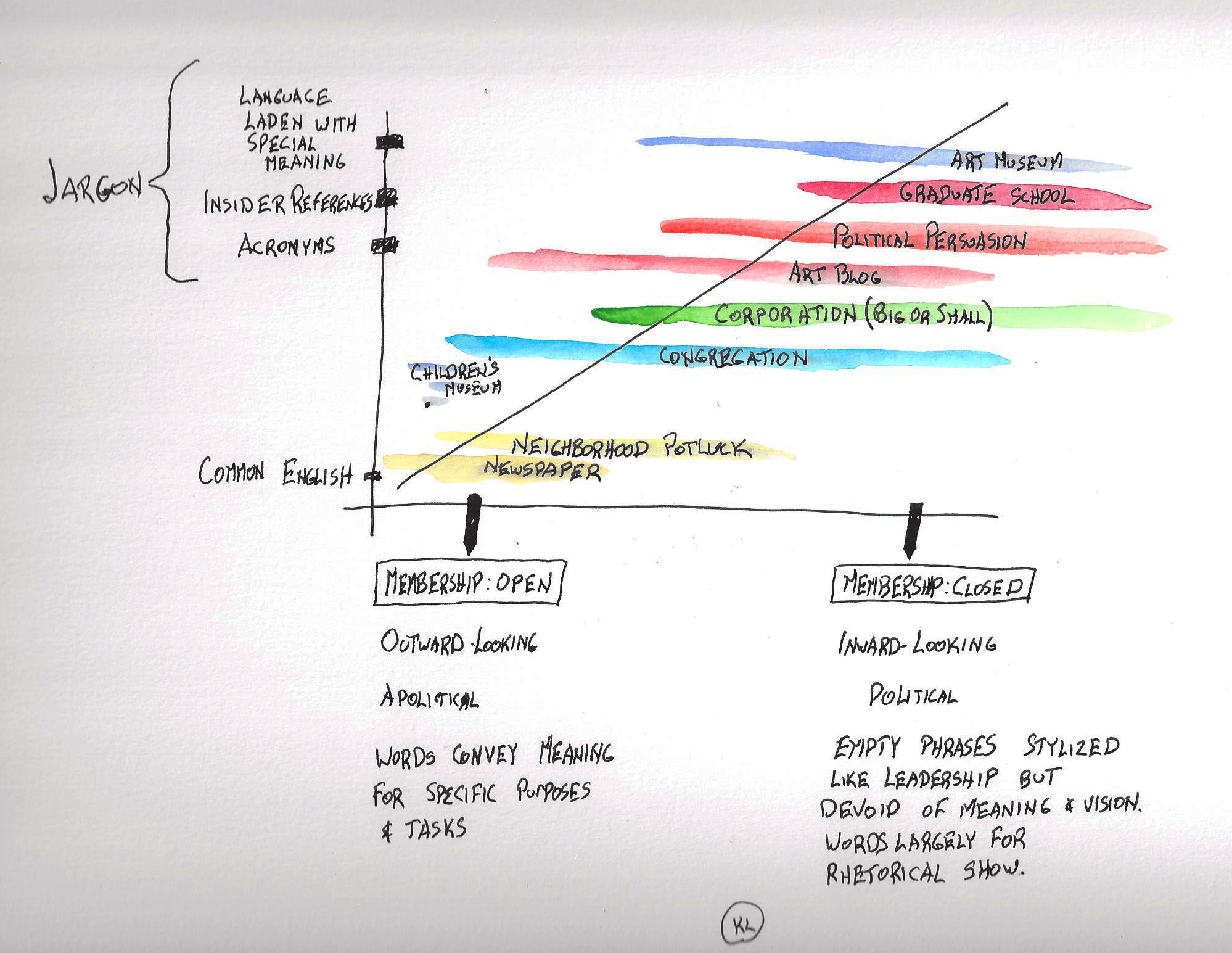
No matter what organization you are in, there are choices to be made about how you talk with the people around you. No matter what gathering you attend, you speak to communicate or you speak to impress.
We’re never rid of rhetorical flourish and persuasive intent, but can we at least work at speaking to be understood?
You don’t have to be obscure, you know—choose your own space on the continuum.
###
Dumb Sketch: Kirk Livingston
What about those hard conversations? (DGtC #27)
Are explosive words better from an authority or friend?
I am convinced that where people gather: a classroom, a department, a congregation, discussion is a more effective use of time than all of us listening to monologue. Many teachers explore the flipped classroom, where their time together is in discussion and the preachy monologues and lectures slide to a different time, place and pace. In general I am attracted to collaboration and many voices speaking. I keep hoping coherence will show up.
We may want to collaborate, but obstacles arise. We may want to be walking catalysts, but something stands in the way. Unsaid obstacles can block collaboration. And sometimes we need to have hard conversations, the kind where we not only disagree, but our different positions are emotionally charged. To assert my position will cut at my conversation partner’s position and vice versa. There may be anger. There may be tears. There may be power-plays. This conversation could be explosive.
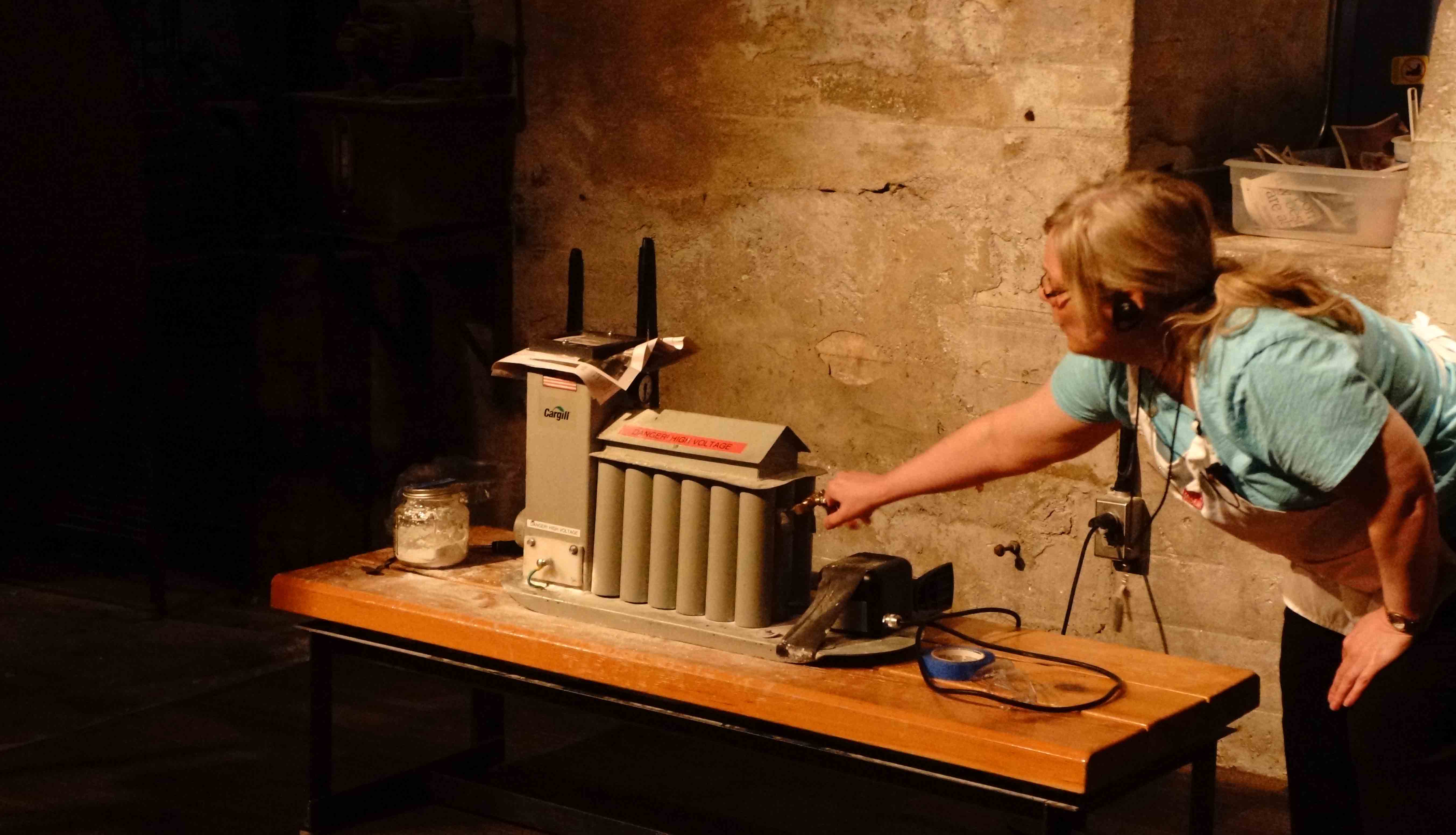
Demonstrating the explosive past for Minneapolis flour mills.
The late Wayne Booth advocated a kind of listening-rhetoric: listen intently enough to your conversation partner to faithfully tell their position (without denigration) while still holding to your own. This would not be the place for win-rhetoric, where your goal is to beat your message into someone else. Emmanuel Levinas might say we have an obligation to watch out for the person before us—this conversation partner. In fact, he might advocate that this person before us is our first priority. Martin Buber might say we continue to hold that person in high regard as a person, inviting them to consider this different perspective rather than trying to force our viewpoint. Even Jesus modified the law with love and compassion (he actually said love was the fulfillment of the law).
So…
- Say we take the listening seriously as we approach the hard conversation.
- Say we take seriously our commitment to the growth and personhood of this conversation partner (stay with me here). And we recognize this person as a person (versus an employee or student or lesser-being).
Given a kind of love for the person before us, we say the hard thing. And the explosion happens. No guarantees, but that blow up can be a worthwhile communication event. Good things can come from that, hard as they are.
Personally, I shy away from these explosive conversations.
But is shying away from a potentially explosive conversation doing a disservice to the thing that needs to happen between us?
###
Image credit: Kirk Livingston

 conversation is an engine