Archive for the ‘Prayer’ Category
Words Work as Stepping-Stones
“…Words work as stepping-stones through confusion to resolution.” — Marilyn Chandler McEntyre in Caring for Words in a Culture of Lies
 This happens in ordinary conversation: I start my explanation with one set of words and end up in quite another place. Often the conversation takes me from confusion to resolution. But more often I come to the end of what I’d never planned on saying with a new insight or a new question that needs answering (if only in my own mind).
But Marilyn Chandler McEntyre was actually talking about the way prayer works in the above quote. She had been quoting a poem by Gerald Manly Hopkins. Here’s how she finished the quote:
“What begins as argument ends in an act of vulnerability and self-yielding. The words we encounter along the way [from GHM’s poem]—just, contend, plead, disappoint, friend—offer stopping points for reflection upon our paradoxical situation before God: familiar and strange, bound by law and freed by grace, fulfilling and frustrating, longing satisfied.”
I had not been familiar with Hopkins’ poem. But the words I encounter in the Psalms offer movement from argument to self-yielding with stopping points for reflection—and the entire Psalter functions like a bolus of spot-on conversation.
###
Image via 2headedsnake: Cem Ulucan
Try This: Wait
Waiting has a silver lining: breathing space

but remember to breath
Years ago my wife and I met friends living in a developing country. We hung around for a few days to see what life looked like. Turns out life looked like lines. Long lines. Hours to pay an electric bill in person. Hours more for the water bill. This country was known for layer after layer of bureaucracy to handle the red tape, so the lines kept people employed even as they drove me crazy. I wondered aloud how my friend could stand it—especially knowing he tended toward a Type A personality who relished getting things done. He said, “That’s just the way it is.”
It’s hard to see any benefit in waiting. We work hard to eliminate waiting every day. I pull ahead of drivers focused on phone conversations rather than the road. I seek out the shortest line at the grocer. I click elsewhere when a web page loads too slowly. I don’t like waiting. I bet you don’t like waiting.
But my friend used his waiting time wisely. There was no plugged or unplugged then. Unlike today when most people waiting are looking into a screen, he brought a book. He prayed. He talked with people in line. My friend was a smart guy (still is) and he made a lot of connections between different parts of life. He ran a printing business, started a college and a home for families whose children were in the local hospital—even as he waited in long lines for the business of everyday.
Two recent books advocate intentional unplugging from the web, if only for short times: The Shallows by Nicholas Carr and Hamlet’s Blackberry by William Powers. Both books look at the effect of a mind crowded with stimulus and hint at what might happen with a bit of mental breathing space, which is a kind of waiting. Waiting is also a time-honored means of reflection and forward-movement in the Bible. I just finished reading the book of Psalms and saw how author after author waited for God to do something. They prayed. And they waited. And they watched (and waited).
Waiting comes with the capacity to sharpen our interest, our eyesight and our appetite. Waiting also has a purifying effect on our long-term goals. We become more realistic as we wait (or perhaps we become more insistent). But know for certain that something will change as we wait.
I’m working at waiting. Today I’ll look for an opportunity to stand around and wait. It will be hard to not pull out my phone with its checklists and documents. But waiting may allow me to connect the dots in a fresh way.
###
Photo Credit: We Love Typography
Riot, Restart and Scrubbed Minutes: The Bradlee Dean Prayer
But really…what happens when someone prays?

Say more.
Last Friday Bradlee Dean gave the opening prayer at the Minnesota House. His words caused such uproar that Speaker Zeller apologized and had the prayer scrubbed from the historical records of the day. The session was restarted and Rev. Grady St. Dennis, the house chaplain gave the new prayer.
Was it a prayer Mr. Dean offered or was it a speech intended as a burr under the saddle of the gathered legislators? I don’t know all that Mr. Dean stands for, but his rhetorical mix seems misdirected. Yesterday I wrote about mixing an ancient form with something of today. In Mr. Dean’s prayer, the result from mixing an ancient form and using it as a rhetorical bully pulpit is repellent. The communication seems more speech than prayer, and seems to have been interpreted that way by the humans in attendance. And yet it is possible Mr. Dean was sincere in his conversation with God.
The notion of a public prayer is actually kind of complicated, and is perhaps a mix of forms from the beginning. One person speaks aloud. The person implores God’s attention and action. Perhaps the person seeks wisdom and mercy, or help with any of the myriad needs finite beings have. Listeners listen and agree. Or disagree. Rather than praying along and seeking the same things, the potential prayers in the House rose in disagreement shouted the guy down (figuratively, I think).
I agree with Rev. Dennis Johnson writing about the work of guest chaplains in saying “We have a special burden to include all people in our prayers….” But I’m not so sure about the last part of the quote in Lori Sturdevant’s op-ed: “…and to make the prayers nonsectarian.” Because real prayer must come from somewhere, some belief in God. It is true that belief in God need not highlight a specific brand of religion, but any prayer must be grounded in belief that God exists and hears—that alone will be offensive to some. Otherwise the prayer is just good wishes and positive vibes—not bad stuff, just not, well, real. And not that useful in seeking help from the Eternal.
King Solomon got the form right (1 Kings 8.22ff) and set a lasting example and practice. Of course, Solomon’s prayer was spoken among a set of like-minded people. So the context helps the prayer stay as a prayer: spoken to God from a bunch of people going a similar direction.
If we’re going to have prayer in the Minnesota House, there needs to be some elasticity in allowing people to pray for real. And people praying need to examine their intentions before uttering word one. But let’s continue the notion of conversing publicly with the Creator.
###
Image Credit: Buramai
Verbatim: Where will you stumble on mystery today?
Stuff Lingers Just Outside Our Explanations
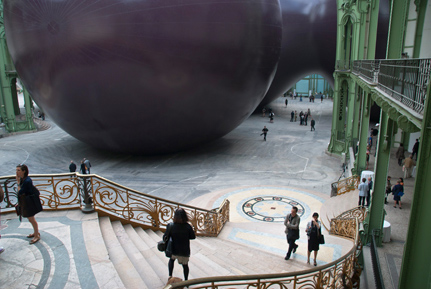
Leviathan: Run. Or not.
Him: “Our biker friend crashed pretty bad. We went to see her in the ICU.”
Her: “All the bikers said they were praying and thinking about her. One gal wrote on the web page she was ‘sending her best wishes’.”
Him: “You know, ‘We’re sending you energy.’”
Her: “But we came in with words from the Spirit. They know we are Christians and bikers. Lots of people ask us to pray because it’s no big churchy thing. We just stop and pray for people wherever we are.”
Him: “We just try to tune in to what God is saying when people ask us to pray.”
Her: “We spent time with her. We prayed. We hung around.”
Him: “It felt substantial. Like something had happened.”
What happens in a conversation? What happens when God shows up?
###
Photo credit: Caroline Claisse for Art Observed

 conversation is an engine
Copyranter’s Dad is Dying
leave a comment »
Copyranter, my favorite, consistently profane and truth-speaking advertising blogger, today wrote about his father dying of cancer. “Asshole commenters” have been lining up to sympathize and pray and weep. All great responses.
or does prayer have much deeper capacity?
Prayer is like wishing, right?
Mention “prayer” and people mostly nod in agreement—what is there to disagree with? My colleague’s husband fell down a set of stairs and broke his neck. Her email from intensive care told the full story. People responded—as they will—with kind wishes and promises of prayer, among other things. Later she updated all concerned with the good news that he would fully recover, and went on to thank people for their positive energy, prayers and good wishes. Her update-—it seems to me—caught the primary understanding of prayer for most people, monotheists of most stripe and Christians included. Prayer, positive energy, good wishes, wishing on a star—all sort of the same thing. There is mystery in the words spoken in silence and the desire and the pain and the faith. Maybe something happens when someone prays. Maybe not. Prayer is hard to characterize.
Probe with a few questions—even among staunch believers and practiced pray-ers—and the mystery only deepens. “Prayer works,” someone might say. And they point to a prayer they prayed and then some related action that occurred. Did their prayer work? Possibly. Is there power in prayer? Maybe. And maybe not like we think. Certainly God has power—complete, entire power over all that is and ever was. And certainly God is under no obligation to fill our order, answer our requests, or even hear us—unless as He obligates himself.
We ask things of God from all sorts of motives with all sorts of expectations. The truth is we know very little about what happens when we pray. But we know prayer is the example and model the Bible holds to out for interacting with God. What does the Bible say about the connection between prayer and action?
Bible people were always talking with God. The list of praying people is extensive and includes those who were face to face with God (Adam and Eve, Moses), sometimes hand to hand (Jacob), as well as those who sat through years of silence in their prayer (Abraham, Hannah), and everyone in between. We typically think of prayer as a solitary, passive activity of last-resort. And yet the Bible routinely shows action following people praying. And not just small stuff, but game-changing action. Action that shifts a story to an entirely different place.
I’m trying to learn more about prayer. And I’m praying for Copyranter and his dad and his family.
###
Image credit: stopping off place via this isn’t happiness
Share this:
Written by kirkistan
March 3, 2012 at 1:18 pm
Posted in Ancient Text, Communication is about relationship, Prayer
Tagged with asshole commenter, copyranter, God