Archive for the ‘Rhetoric’ Category
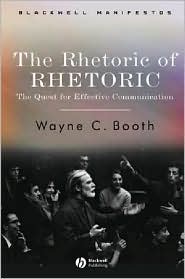
The Rhetoric of Rhetoric: The Quest for Effective Communication by Wayne C. Booth
Readable.
Wayne C. Booth’s The Rhetoric of Rhetoric: The Quest for Effective Communication (Malden, MA: Blackwell Publishing, 2004) was published in a series called “Blackwell Manifestos.” Booth’s passion is equal to the series’ task, whether he is preaching the gospel of “listening-rhetoric” (really getting at underlying truths in conversation versus “bargain-rhetoric” where your goal is to mediate a truce or “win-rhetoric” where your goal is to engage in monologue and so browbeat the conversation partner into submission) or ranting about the rhetorical missteps of the George W. Bush government, there is no lack of passion.
But perhaps the clearest message and the one I take with me is the notion that every piece of communication carries (furthers?) some rhetorical purpose. Every communication has a purpose. And to sit passively receiving without considering what the author/rhetor hopes to accomplish is to allow myself to be taken advantage of. Whether I’m watching a commercial on TV (even a good one), listening to a sonata, hearing a preacher or even reading the prophet Amos or some other ancient text, I’m at my best when I consider—and possibly reject or even accept—the message coded into the communication.
A text wants a response.
###
We Need Your (Creative) Briefs

Unsettle the brain and spirit to move forward.
Don’t just paste in your purpose from the last creative brief. Don’t fill your creative brief with numbers and trivia that aren’t sharpened to make your point. Especially don’t dump in the jargon your client prattled on about. Make your brief work first as a communication tool and then as a community-building tool, because (you know this already) you’ll get the best work from your creative team by engaging them with more than facts. You’ll want them excited. Not excited about a tactic, but excited about what this communication (and what this product) will accomplish out in the world.
Don’t let your creative brief be just another check mark on your ever-expanding list of things to do to get a project started (and thus off your desk). Make your creative brief a thing of beauty and curiosity, like Cicero made his speeches: put in an exordium to get the team riled up about the opportunity. Put in some narrative that explains the full scope of the issue at hand, but sharpen it so your copywriter feels the pain the audience feels (and also feels the opportunity revving up your client). Confirm the why of your point: what are the salient details your copywriter can use? Then refute your point: what reasons will your detractors trot out to show how wrong you are? Then send the team off with a stirring conclusion (peroratio) that sums things up and blends pathos (emotion), ethos (your own sterling character) and logos (reason) in the most unsettling way. I always write my best copy when something isn’t sitting right in my soul.
Some of these ancient guys (like Aristotle and Cicero) have a few things to tell communicators today. How to rouse a team to action is one of those things. We need that.
###
Great Moments in Rhetoric: Climate Change and the IPCC Mission

Good communicators are transparent about their purpose.
The Wall Street Journal reported yesterday on the Intergovernmental Panel on Climate Change (IPCC) mission to take “sophisticated and sometimes inconclusive science, and boil it down to usable advice for lawmakers.” The article speculates (via scientists working with the IPCC) that institutional bias toward oversimplification is what lies behind the erroneous projection that Himalayan glaciers could melt by 2035.
If there is anyone out there who still believes in truly objective science—or truly objective anything—I’d like to meet them. It should surprise no one that we constantly arrange facts to meet our pet goals. And we infuse those facts with the urgency that fits our purpose rather than an urgency arising from the facts themselves. This is a human trait and we should expect it in every communication. Facts are facts, yes. But facts are also small pieces of a rhetorical puzzle that can (and will) be built together in a number of different ways. Is there ever a time when we experience facts in isolation—without some rhetorical flourish—that is, without some political aim that wishes to move us toward a favored action?
No.
But persuasion is not wrong. It is a necessary piece of human life on this planet. All our actions, all our thinking, all our communication, all our learning, all of most everything is organized by political pulls. That’s not overstatement: even the best among us are always motivated by partisan or self-serving objectives. Rather than resist this fact of human life, it makes more sense to look closely at the objectives that drive us. Of course, there are two sides to every story, including this large story on climate change. Sure the WSJ is written from a conservative perspective and this article was meant to shine light on hypocritical methods of their opponents, which always makes for good reading and sells newspapers.
It’s just important that we keep in mind what stake our communication partners have in moving us one way or another. And perhaps as communicators, we do best when we state our goals early. In fact, I think our audiences are put in a positive state of listening when they hear our disclosures up front.
###

 conversation is an engine