Archive for the ‘Ancient Text’ Category

How to Hold God Accountable
3 Surprises About the Almighty

There is an old story of a wealthy man whose seven sons and three daughters continually held rounds of parties. The sons and daughters would meet at one son’s house to eat and drink. Next day they all met at the next son’s house for more food and drink. And so it went, day after day until all had hosted. Then they began again.
The wealthy man was pleased at their joy but worried that some son or daughter might curse God in a fit of exuberant boasting or perhaps just deep in her or his heart. So he took steps: after every cycle of feasting and drinking, he would rise early in the morning and make offerings. In this way he consecrated his children.
The wealthy man was known far and wide for his wealth but also for being a blameless and upright man. Everything seemed to go the right direction for this man and his family.
Until it didn’t.
In this old story, the man absorbed a one-two punch: he lost all this wealth and his children. Then he lost his health. Like any absorbing movie, that’s where the story really begins.
You may recognize the story of Job. A lot of people read themselves into Job’s story: things are going well and then whammo—the winged monkeys descend outa nowhere. And then as one professor liked to say, you are left to “sit with” the problems, the questions and the profound distress, scraping your sores with broken pots. If you can make it through all 42 chapters of Job, you’ll notice some surprises.
- Surprise #1: Job’s pals comforted him with arguments any of us if-we-do-good-we’ll-receive-good theorists might use. In each case they were sorta right but mostly wrong.
- Surprise #2: Life is full of a fair amount of un-knowing. Well that’s no surprise. But it’s worth repeating in our culture where we demand black and white answers to most of life’s vexations. Sometimes stuff happens and we never really know why/how/who/what.
- Surprise #3: God can be held accountable—at least as far as our questions go. Which is not to say we’ll receive answers. But the questions…it’s the questions that spur conversation. And in Job’s story God was interested in the conversation.
Wait–stay with me:
This third surprise is tricky and I’ve added a gloss that does not quite ring true. We may want to hold God accountable for the bad stuff that happens, but there are a lot of reasons why we cannot (just) do that. We could talk more about that and have a thrilling conversation. But what I can say after living with Job for a couple months is that conversation with God is, well, it just may well be everything. The most important thing. The central thing—especially after the winged monkeys and sitting with job loss or death and the scraping of open sores with broken pots—the central thing may be this conversation.
###
Image credit: Lara Shipley and Antone Dolezal via Lenscratch
Westgate Centre: The New Old Face of Affliction
Jihad, Jabs, Jobs and Job
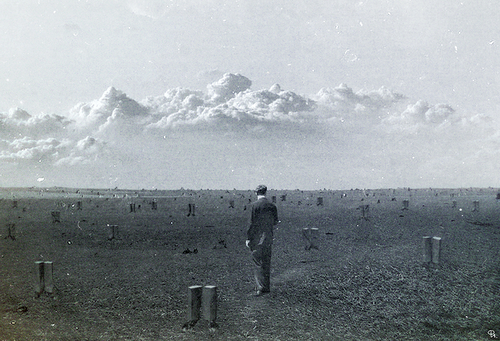
Affliction is the bad stuff that happens. Today affliction looks like Westgate centre in Nairobi. It also looks like colleagues laid off after five, ten, 35 years of high-performance work for a company. Affliction can look like old age, like a shoulder with a pinched nerve, like legs becoming less-than-steady. Affliction looks like a chronic condition (heart, pain, fatigue). All the stuff that showers down on individuals and groups. All the bad and regrettable stuff, minor and major. All the stuff we would never choose (in a million years).
My new favorite old guy is Job. I’ve been dwelling with the story of his life and times and find his persistence, presence and engagement remarkable. One of Job’s friends, in a fit of knowing what to say (which passed for all the players in this drama) said this about Job’s affliction:
[God] delivers the afflicted by their affliction and opens their ear by adversity. He also allured you out of distress into a broad place where there was no cramping, and what was set on your table was full of fatness.
Elihu, the young buck who waited for all the old guys to finally shut up, also didn’t get it right. His words did not adequately describe the complex of Job’s predicament. Still his words (quoted above) contain wisdom: looking for deliverance in the middle of the affliction. In the end, his words proved true: Job sat at that table. And Job was thoroughly changed when he did so.
Is there deliverance in the horribleness at Westgate centre? I’m praying so. Is there deliverance after a loyal career? Yes, though the former careerist will be changed in the process. Is there deliverance from pinched nerves, unsteady legs, chronic conditions? Is there deliverance from old age? No. And Yes. And ultimately…yes.
And justice? That’s the very large conversation Job insisted on having—right up to where he fell silent. But affliction: is it somehow a way forward?
###
Image credit: Philipp Igumnov via MPD
When Twitter Visited Third Baptist Church
What Church can learn from Business #1: Acknowledge the Pain
Scene from a Sunday Service
Pastor Smith: We’ve jumped into the 21st century today with our projector up there tuned to the Twitter Channel! Today: don’t silence your smartphones. And you Twitterites, dial in your Twitter smart app and shoot your questions, comments and tweets to At ThirdBaptistRightNow. And remember to use the hash ticket number sign SubmitAndLove!

Acknowledge questions to unlock the door you’ve invited your audience to walk through
Pastor Smith: Open up your Bibles to Ephesians 5 and let’s get right down to the text and how wives need to submit to their husbands and husbands should love their wives.
@ElderEli: You’ll acknowledge how the passage has been abused for years, right? ThirdBaptist is just as guilty as anyone.
Pastor Smith: Now let’s start reading right from verse…what’s that? AtElderEli—I sort of mention that, but I’ll not spend a lot of time on it. Wait—let me see if I can work that in. Now, let’s start with verse…
@SingleSally: Go to the Bahamas in my mind or the coffee shop with my feet? Either way is more interesting than another sermon about marriage.
Pastor Smith: Now you stick around AtSingleSally, I can promise you’ll find something interesting in…
@ILikeBigBibles: Preach it! Submit and love!
@MsBankCEO: Before you go all gender-wars, can you at least acknowledge that in Christ there is no male or female (Gal 3.28). Seems worth mentioning.
Pastor Smith: Well now, AtMsBankCEO, this passage is pretty specific about the ancient household code, but, well. Let me think for a moment how that verse from Galatians might augment my comments about roles. But turn to verse 22 and…
@BlancheWife: You’ve got to start with 5:21! Mutual submission turns your old role argument on its head!
@BlancheWife: All that follows is an outworking of 5:1-21! Please at least acknowledge that!
Pastor Smith: Hoo boy. Preaching and Twitter make an uneasy couple. Let me do something different today. Blanche, why don’t you come up here and let’s start with an old-fashioned conversation. Just you and I and the microphone and all these fine friends out here. Let’s do something new and get your perspective…
@ILikeBigBibles: No! That’s not right. The brother should preach!
@SingleSally: You have my attention.
Consider Starting with People Rather than Texts
This is not heresy. This is basic pedagogy: when explaining an ancient text, gently help people over the hurdles by showing what it meant as well as how it has been understood over the years. Because your audience is thinking these thoughts already.
Twitter is a huge help in the work of naming the things people are already thinking. While churches are not likely to employ Twitter for anything beyond amplifying their monologue, they should begin to see that the conversations they once directed are happening without them.
Learning to listen and then getting at the truth together—that’s worth exploring.
###
Image credit: Kirk Livingston
How do you know what you know?
What you know once belonged to someone else
When I was 19 I knew everything there was to know.
I had been plopped—fully formed—into a pair of sneakers to walk the earth. And so I did, learning and responding as one does, with fresh enthusiasm and proper disdain for the less-knowing who gadded about my footsteps.
A decade later I began to notice how much of what I knew came from the people around me. A decade after that I could locate some sources of my own knowing: family and friends. Professors, pastors and prisoners. Institutions and anarchists. Sacred texts and ephemeral whispers.
Some conversations were limiting. Some texts opened new ground. And vice versa. Gradually I came to understand how little I knew. About most anything. Especially the stuff I studied in school. Especially the stuff for which I would give my life.
And these connections: some electric knowing transmits when we connect.
These connections are not to be missed. These connections should not be easily dismissed.
And no one arrives fully-formed.
###
Image credit: William Heick via MPD
You Don’t Have to be a Professor to be a Professor
Rock Your Otium With Purpose
Australian philosopher Damon Young’s Distraction cites the fascinating example of Dutch philosopher Benedict de Spinoza. An able, talented and academic-class thinker, he did much of his work outside the academy. But in 1673 Spinoza was offered a position at Heidelberg University where he would teach while earning the salary of a full professor—opening for him a “life worthy of a philosopher.”
Spinoza refused.
He preferred to continue to practice his craft: grinding optical lenses for short-sighted friends. Spinoza wanted to earn his own income and use his free time (his otium) to uncover the mysteries of the universe and sort out how people should treat each other. Teaching would be a distraction from his primary work of writing and thinking. He refused the distraction, though the job seems a much easier route for what he was already doing.
Young wondered if there was something of the work of the mind in the crafting of the lenses that helped Spinoza move his thinking forward. That connection between thinking and craft is something Matthew Crawford (Shop Class as Soulcraft) would likely agree with. Spinoza’s lenses were renowned and admired—he did good glass work. But his philosophical writings are why we remember him.
We still read Spinoza today. Young points out that while Spinoza’s prose makes for boring reading, it is among those unusual texts that have passed the test of time.
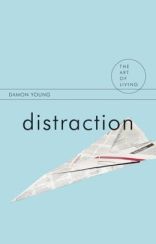 The truth is there are only so many hours in a day. If you’re an adjunct professor, you are basically volunteering your time, which might have gone toward research. If you are a full-time professor, you must diligently make clean breaks from distraction to do the research you studied for.
I relish Spinoza’s example for the intrinsic motivation that led to his colossal works. I am also intrigued by the relationship between his daily lens grinding and the sight he brought to his writing. I very much enjoyed Damon Young’s book.
###
Image credit: Philippe Ramette via Frank T. Zumbachs Mysterious World
Going to Church Today? Consider This.

expect a conversation that will help sort things
Probably someone will speak to the group—that’s typically what happens. And there will be singing. Prayers will be offered. You’ll shake a few hands. Maybe you’ll learn something new. Maybe you heart will be lightened. Your load lifted.
If heart-lightening or load-lifting happens, stop and think why. Was it because of magic words spoken from the pulpit? Not likely, as there are no magic words. But there are words that find a home in a person’s conscious thought and get absorbed there to do some work. One of the tests the old church fathers used to determine if a letter or text should be included in the Canon (our Bible today) was whether it had the power to change people—did the text speak with authority into a people’s lives? Did something happen because of hearing the text? When those old words get uttered from the pulpit today—they are not magic—but their truthiness has sticking power.
Just as likely: you meet someone who says something that affects you. Makes you think. Makes you reconsider an impending decision. And perhaps that same heart-lightening or load-lifting occurs. Sometimes we meet people who speak truth and it has the same effect.
And consider this: perhaps you go into that time expecting to hear something. What I mean is, sometimes we move into a situation actually expecting to hear something that could have the power to change how we think or act. You might call this listening. Or attentive listening. Or attenuated listening. Or listening on steroids. But whatever you call it, this is the most productive penultimate approach: listening with expectation. Then you pick up the tasty truthiness from any source.
###
Image credit: Douglas Smith via 2headedsnake
Is it Time You Wrote Your Autobiography?
I’m not writing one. Then again, who isn’t adding to their autobiographical material daily, whether with words or deeds?

but surely I am king of something
I’ve been reading the autobiography of R.G Collingwood, an Oxford philosophy professor of the last century. He set out to trace the outline of how he came to think—a kind of personal intellectual history. Early on in his life (at 8 years old) he found himself sitting with a philosophy text (Kant’s Theory of Ethics). And while he did not understand it, he felt an intense excitement as he read it. “I felt that things of the highest importance were being said about matters of the utmost urgency: things which at all costs I must understand.” (3) That reading set one course for his life.
One thing that makes this book worth reading is his notion of how questions and answers frame our production of knowledge. Collingwood said he “revolted against the current logical theories.” (30) He rebelled against the tyranny of propositions, judgments and statements as basic units of knowledge. He thought that you cannot come to understand what another person means by simply studying his or her spoken or written words. Instead, you need to know what question that person was asking. Because what that person speaks or writes will be directly related to the question she or he has in mind. This is incredibly useful when studying ancient texts—like a letter from the Apostle Paul, for instance. It’s also incredibly useful when listening to one’s wife (ahem), or a student or to anyone we come in contact with.
Another thing that recommends this book is hearing him tell about his main hobby: archaeology. Collingwood was the opposite of a couch potato. He spent a lot of times in digs around the UK, unearthing old Roman structures and then writing about them. Here too, he explained that while some archaeologists just set out to dig, he only set out to dig when he had formed a precise question to answer. His digging (tools, methods, approach) were all shaped by this question. By starting with a question, he came to very specific answers and, of course, other brand new questions.
Questions begat answers. And more questions.
What question is your life answering?
###
Image credit: J-J. Grandville via OBI Scrapbook Blog
18 HBR Finalists on Redistributing Power
It Is Written: The M-Prize and You
 For some time I’ve wondered what leadership will look like when the power of monologue is finally revealed as the empty shell it always was.
I’m not alone with that question.
It seems the folks running the Harvard Business Review have teamed with McKinsey to incent people to rethink “the work of leadership, redistributing power, and unleashing 21st century leadership skills.” The result is a series of case studies that should prove interesting—and not just to folks in the leadership industry.
I’ve not read any of these 18 articles but I plan on reading them all. I’m interested because the more we learn about how to build conversations that free our best thinking, the more likely we are to innovate. And the more likely we are to find ourselves living out our vocation. And the more that happens, the more better everything gets.
Yesterday I stumbled on an ancient text that presented an insight on the very kind of leader the M-Prize hopes to unearth. The text talked about a very unusual leadership skill set: This leader is equally at home encouraging the worker in pain as he is furthering the cause of justice. This leader can fan the dying embers of a person’s passion even as she moves earth’s largest causes forward. No trampling on others in an upward climb for this leader.
If you stop by Conversation is an Engine with any regularity, you know that a theology of conversation exerts a powerful gravity around here. We have this hunch that people were made to be in conversation and that we become fully human as we engage in conversation. And more: conversation may be a part of any knowledge we lay claim to.
Naturally, there’s a lot more to say about this.
But the leader who understands the power of conversation and works at interactive collaboration rather than straight-line order delivery is the leader poised to succeed.
It is written.
So—Kudos to the HBR/McKinsey folks for their vision.
###
Image credit: actegratuit via 2headedsnake
Books Smell
Musty was part of the charm
Computers rarely smell. Keyboards can get grimy, of course. And the screen on a tablet gets all sweaty if you read while running on a treadmill. Part of the charm of old used bookstores is the smell of the books.
Early on in life I worked as a printer running small presses as a way to pay for college. Fresh reams of paper and rollers and tins of ink and the oiled mechanical bits of the press all have an odor peculiar to the printing industry.
Same with book stores. Paul’s Book Store in Madison, Wisconsin (a haunt of mine in college) had a similar smell, adjusted up for dust and volumes of old paper. Midway Books in Saint Paul is always worth stopping by—and not just for the smell of the books. All sorts of treasures reside there.
Loome Theological Booksellers moved from their old, cold church building in downtown Stillwater to a (considerably expanded) barn out in the country. I’ve not visited since their move. The bookish folks at Loome are offering a 1613 King James Bible for sale (only $3900) with a well-known printing error (the “He” version).
I’m not in the market for such a book, but I may go just for the smell it.
###

 conversation is an engine