Archive for the ‘art and work’ Category
Note to self: Don’t be (so) boring.
Why do what we do? (Gotta keep asking)
Do something every day.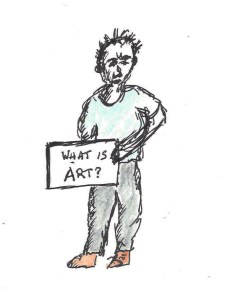
Do that something every day for 30 years.
Has that something lost its freshness?
Over on Dumb Sketch Daily—my ongoing project of learning to see—every once in a while I get caught up with trying to create art. It is almost always a mistake for me to try to create art. I am no artist and the impulse to create art results in weirdly earnest dumb sketches, sort of like a child putting on dad’s tie (do dad’s wear ties these days?) or mom’s high heels.
Still—one must experiment. And that experimentation is good because it draws the questions forward yet again.
Doing something every day, and somehow keeping it fresh, means asking the “Why am I doing this?” that drives the behavior. Yesterday I had to remember that my goal is not to create art. Making art is simply too high and too unrealistic a goal for me. It works for others, and many who comment on that blog and whom I follow are creating honest-to-goodness, bona fide, Grade A art.
Every single day.
But not me.
I’m just trying to see better. That’s a goal and purpose I can rally around. Trying to see how light shines on stuff. Trying to see what a face looks like, the creases, the asymmetry, the tractor beams that shine from eyeballs. Seeing what posture says. Seeing how shadow falls across a 100 year-old building. All of that happens as I try (and mostly fail) to capture real life on paper. The real life happening around me.
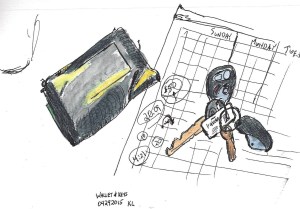
Something good and productive happens with revisiting the “Why?” question. My sense is that if I can be reengaged with the question, and with seeing how it was answered differently today, I may even be less boring. At least for a few moments.
###
Dumb sketches: Kirk Livingston
Can 78 bad sketches change your life?
Don’t stunt your growth by reaching for fame
It’s funny we gauge personal success by numbers of followers. It’s as if we’ve adopted the business transaction as a model for every area of our lives.
Business wants more eyeballs for more attention for more revenue for more profit. And that makes perfect sense for our business goals.
What’s problematic is when we confuse business with what humans need to move forward: Doing what attracts attention and gathers “Likes” is often very different from the stuff our souls need to grow.

Your business factory is not a solid model for personal growth
One thing I’m learning from the artists and photographers I’ve been interacting with at Dumb Sketch Daily (currently at bad drawing #78) is that while today’s drawing is (clearly) imperfect, there is always tomorrow’s drawing. And I know what I’ll do different in that drawing. I know I’ll try this technique, or that view, or this topic. I’ll do it again and create yet another imperfect representation of the world.
And that’s OK.
Because the pursuit is about learning to see, learning how to draw, learning how to write. Learning how to tell the truth. Learning how to interact with each other. Learning how to be human. Perhaps even learning how to interact with God.
The goal is not fame, unless you really want to turn this pursuit into a business. But learning itself—whether crowds acknowledge you or whether you plod silently and alone—learning is its own reward.
But I still argue your growth is also a benefit to the humans around you.
And while I don’t think 78 bad sketches have changed my life, I can say with certainty that I see things differently than I did 78 days ago.
###
Dumb Sketch: Kirk Livingston
Where Can I Buy a Fine-Art Mode?
The Beauty of Knowing Nothing
I don’t have a fine-tuning mode that tinkers with physical detail. I draw and it is mostly crude. I cut plywood and pine shelves and they are rough enough to make my craftsman-father scoff into his hand. I make dinner and it is mostly broad-stroke stuff that requires very little finessing. I will confess my popcorn is a work of art, combining yellow and white kernels, salted and buttered and mixed to a sensuous, savory smack of flavor. And I am learning how words interact on a page—though it is slow going.

How does someone get to the point of crafting from rough cuts to fine finished detail? It is possible that in this age of ordering clothes, pizza and romance from a button on our mobile devices, that some things still take time. Some things require beginning at the beginning. The question for each of us: do I have the courage to begin at the beginning? To know nothing for a time and do things badly?
The beauty about not having been taught drawing is that you are in a position of the acquirer: the process of figuring it out might take a while, and you will most likely continue to figure stuff out as you go, but that process is yours. There are no shortcuts and no tricks. Just the plain practice of drawing, screwing up, and drawing some more.
–France Belleville-Van Stone in Sketch! (NY: Watson-Guptill, 2014)
You cannot buy personal processes. Not really. You have to make them from scratch—those processes that help you make meaning in the world. And you have to begin at the beginning.
Mistake will be made.
You will make those mistakes.
And that’s OK.
###
Image credit: Kirk Livingston
3 Lessons I Learned Hanging With 70 Artists
See. Do. Share.
A group of artists in the Minneapolis-Saint Paul area gathers monthly to sketch. They call themselves MetroSketchers. These are talented people with facility for capturing life on a page. Yesterday I showed up to sketch alongside them at the Como Zoo in Saint Paul.

- Look To See. It’s easy to spot these sketchers in the crowds at Como. They are the ones balancing a sketchbook, and possibly watercolors or an arsenal of color pencils. They are the ones looking up and down and up and down at the very scene I dismissed with a quick glance. It’s the lingering look with an intent on capturing what they saw that was meaningful to me. Sketchers linger far longer than the causal passer-by. They must.
- Do It. Right now. That’s it—just get it on paper. Whatever you can. This is a lesson that carries over for me from writing. Do it badly, but just get one good stroke on the paper. One good mark among many bad marks. My great contribution to the day’s artistry was the Polar Bear Butt (the only animal who insisted on posing). Bad as it is, it is still a move toward representation.
- Share It. These uniformly talented people were also great encouragers. To a person they were all about what you saw and the marks you made in response. They found good stuff to say even when good stuff was pretty well hidden behind lots of not-good stuff. They also loved to talk about paper weight, the best inks to use, how small they can pack a watercolor kit and, “…here, let’s just walk through my sketchbook together.”
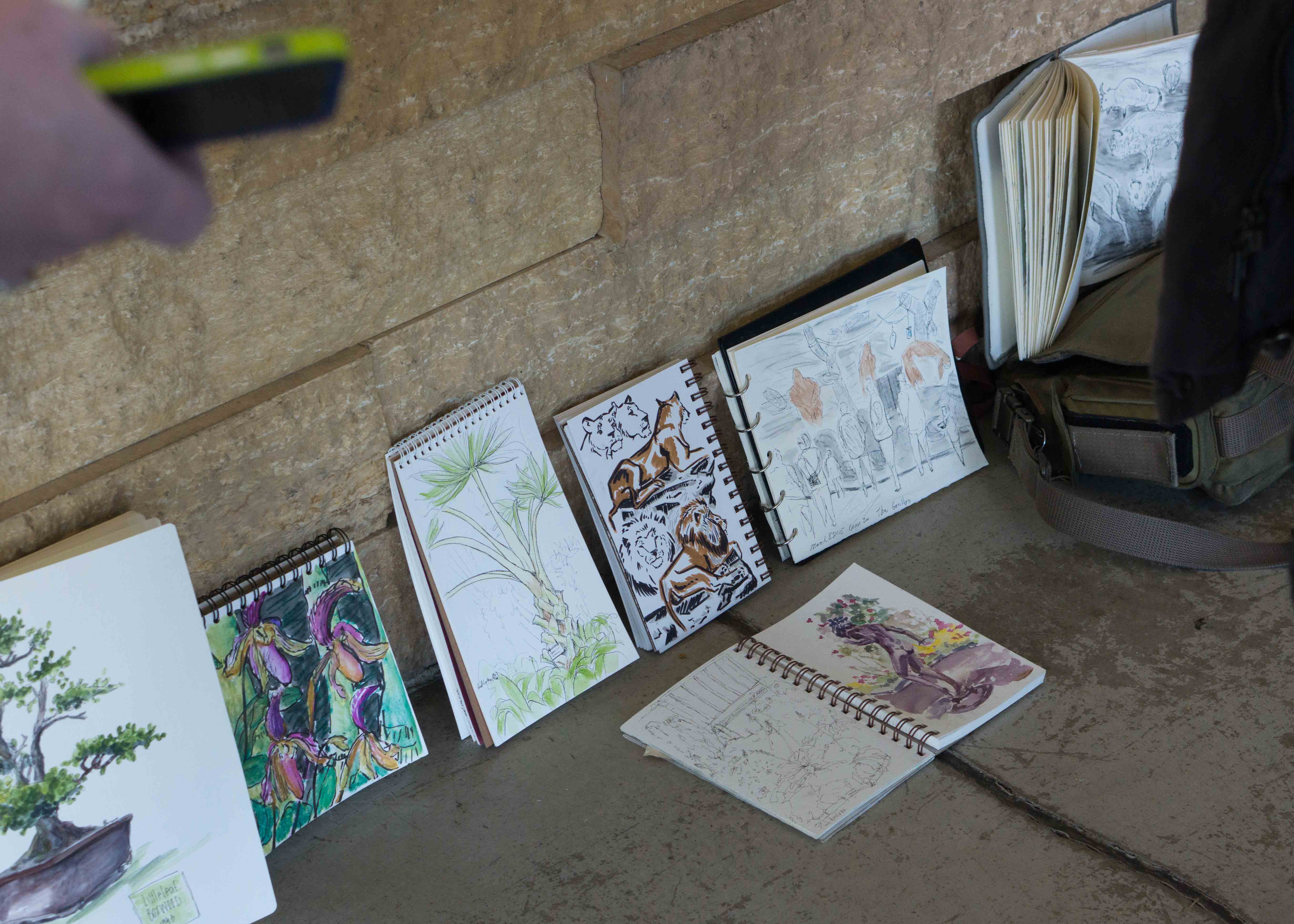
I spoke with many during the sketching and they were more than happy to show what they were doing, to describe how they were seeing and to talk about the difficulties in representation.
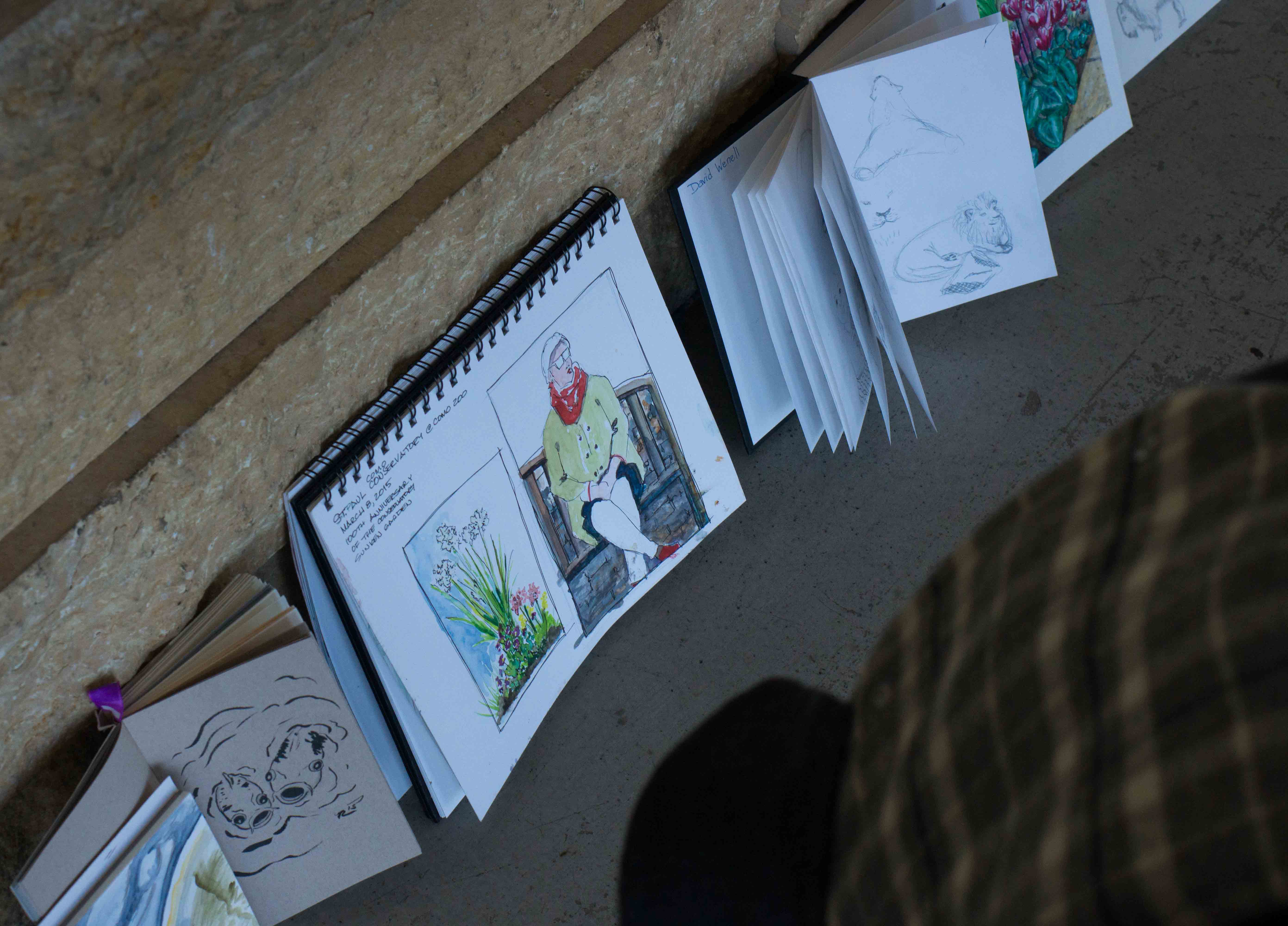
More than one sketcher expressed delight in what they were seeing—and if that is not a perfect reward for the interaction between drawing and seeing, then I don’t know what is.
###
Image credit: Kirk Livingston
The Lamp Repair Man and the Factory Owner
How do business and passion mix?
A man had a small business repairing oil lamps. He repaired wicks or refilled lamps with oil—whatever was needed. He took his cart to different neighborhoods and called out for business: “Lamp repair” and “Fix your lamp.”
When people brought their lamps to the man, they would watch him trim or replace the wick, refill the oil and polish the glass. The man had a quick rhythm to his method: he sang a song softly that guided him through his process of checking each lamp. The man was unfailingly kind and full of joy and neighborhood kids loved to watch him as he worked. He would often say providing light was what he was meant to do.
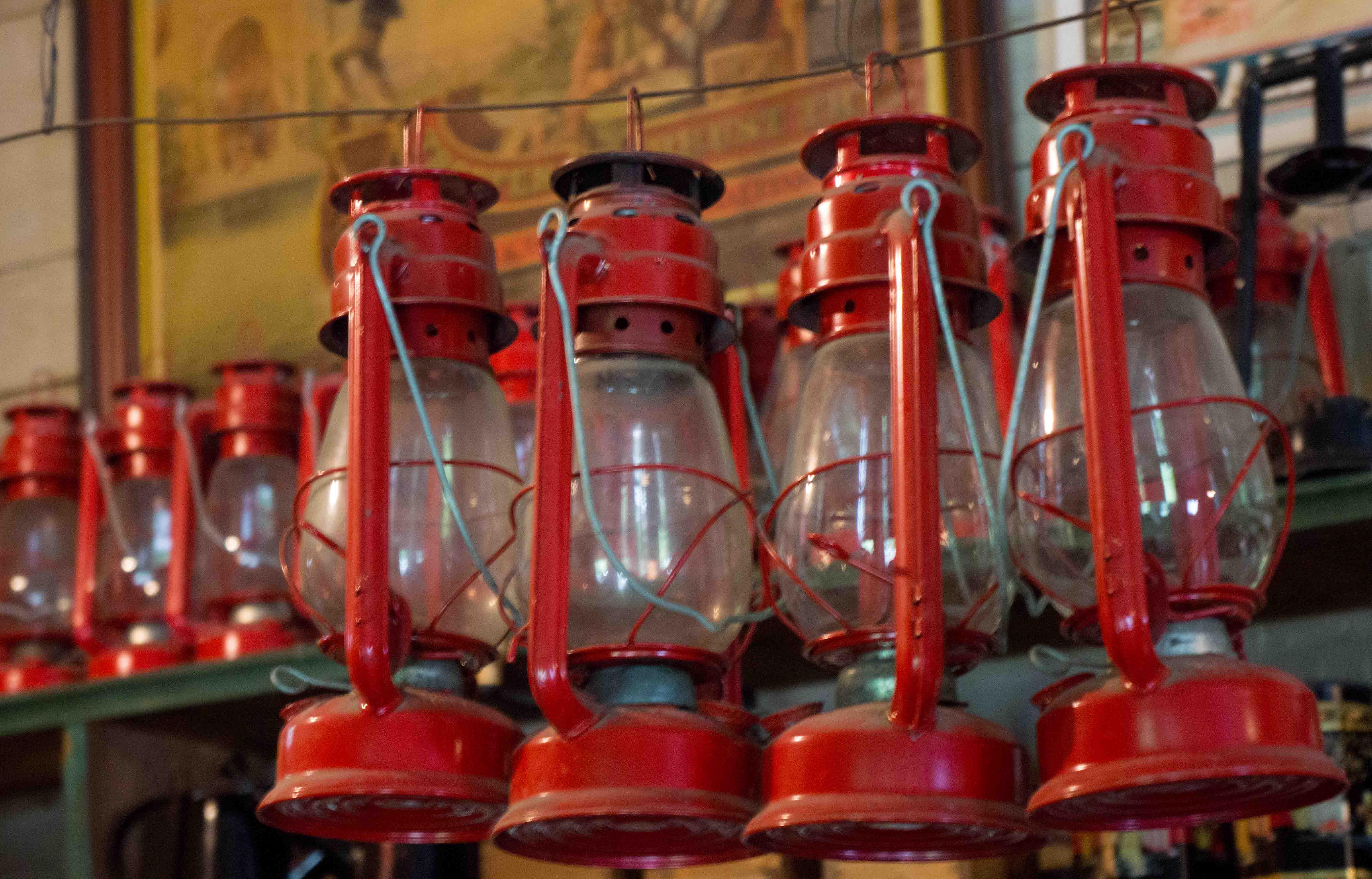
One day a factory owner was home for the morning. He was feeling a bit unwell from celebrating late into the night after successfully negotiating deep concessions with the largest union at his factory. When he heard “Lamp repair” shouted outside and remembered his children exclaiming over the charms of the lamp repair man, he stood and picked up the lamp he had been reading by and made his way outside.
The lamp repairman took the lamp and quickly sang his song to himself as he checked it over. Then he trimmed the wick, polished the glass and handed it back to the factory owner since it was nearly full of oil.
“What do I owe you, Mr. Lamp Repairman?” asked the factory owner.
“Oh, nothing,” said the man. “That took no time.”
The factory owner would not have it.
“But surely your time is worth something,” he said. “Surely you have some small fee for checking and trimming and polishing. I own a factory and I must pay for every bit of my employees’ attention.”
“Well,” said the man. “I’ve found that I am most interested in how light works and what it provides. I love a well-lit page when I read and I am eager for good lighting for others. So it actually rewards me when I can get someone’s lamp working well.”
“But can you live on good feelings?” asked the factory owner. “Do your good feelings buy potatoes or flour? Can you pay your landlord with good feelings?”
“True,” said the man. “Good feelings don’t buy much in the open market. But good intentions find their way back. I have found that helping those along my regular route helps build my business. People return when there lamp needs repair because they know I’ll be fair and they know I’ll do my best to get their cherished lamp working. You give a little, you get a little.”
“I see,” said the factory owner. “Give a bit away free and then get rewarded with loyal customers. Good strategy.”
“Yes,” said the man. “It was a good strategy for many years. But today I am actually well-provided for. I’m not rich, but my wife and children and I have enough. I actually charge only rarely because I don’t need to and because I am interested in the lives of these customers who have become friends over the years. Children and grandchildren of long-time customers bring out their lamps. I am eager that they have enough light for the many books they read and drawings they make and conversations they have.”
The factory owner took his lamp and walked back to his home, thinking back to the work he did that started his own factory.
###
Image credit: Kirk Livingston
Isn’t it time you watched a short documentary about glassblowing?
I thought so. Here you go.
This ten-minute film won the 1959 Academy Award for Documentary Short Subject.
Look at those craftsmen go! I like the guy nonchalantly puffing away at the pipe. Bert Haanstra’s soundtrack is jazzy and ridiculous, in equal measure.
###
Give Your People Presence
Is Drawing a Spiritual Discipline?
Betty Edwards, in her Drawing on the Right Side of the Brain (NY: Jeremy P. Tarcher/Putnam, 1999) calls for a different way of seeing as a beginning point for drawing. In my 60+ days of producing a dumb sketch daily I can say with certainty that my seeing has been altered. I’m open to and actively looking for much more detail in ordinary life. In particular, in the back of my mind I spend my days looking for scenes or objects or people I can reproduce (badly) on paper. And I see far more detail in buildings and structures and postures and faces than I did two months ago.
Starting to see differently feels like a small victory.
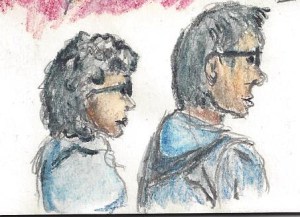
Can a dumb sketch help you be present?
Edwards has a long section on brain functionality, how the left brain works versus the right brain. I have a growing skepticism about the neatness of those two categories. I think there is some truth in the distinction. And the distinction works well for release from our typical analytical state into a more meditative zone of creativity. I’ve long depended on that zone for more creative writing assignments. But the research citations feel a bit dated and frankly I’m always a bit skeptical of forced black and white interpretations of complex physiology.
But this notion of sitting with stillness before a scene to observe, capture and (potentially) understand—it feels like a life skill that could and should translate into all sorts of different settings. Slowing to see and hear has begun to awaken all sorts of new thoughts in my brainpan. I find the practice encroaching on normal conversations, on meetings, on writing, on driving and even as I pray.
Especially as I pray.
I cannot help but wonder if learning how to observe, capture and (potentially) understand is a step toward being more present with all the beings in our lives.
###
Dumb Sketch: Kirk Livingston
English: I still believe in you.
Get in that job-machine, mister.
More dire news for university English departments: from the University of Maryland, English majors are bailing like mad. And faster and faster.
The humanities have been getting a bad rap for, oh, half a dozen decades or so, because they don’t lead directly to a slot in a job machine. And, as the thinking goes, without the job machine you fail at life. Or at least paying for life’s good things (like a huge TV and plenty of Lean Cuisine) (Or rent and clothing).
We’ve certainly seen this coming. We’ve wondered: Why go into college debt just to be a philosophy-talking barista? We’ve lamented the pitiful conditions of adjuncts. Colleges in my area cut budgets and then cut more, from fat to bone. And now wholesale amputation to accommodate the demands of producing souls for job machines.
True: English departments that focus solely on esoterics need to undergo change. I’ll argue that any academic program (or any institution, frankly) that promotes the inward-gaze as the end-all, top-function of the human condition is currently being rudely awakened.
Smart English departments are tuning in to this—just like businesses have been realizing people don’t really care about their product all that much. Even churches are starting to realize there is a world of people living and working just outside their doors—people not interested in joining the club but crazy-interested in the meaning of life. Speaking of churches, we used to call it “evangelism” when we invited others in. Business evangelists understand all too well the benefit of going where people are and adapting their product to current conditions.
But reaching out to the rest of humanity—that’s where the action is.
It’s because we’ll always need to reach out, to communicate something to someone else, that I’m optimistic about English, if not exactly English departments. Rather than an either-or approach (deep-thinking/creative expression or assembly line training), we need both-and: deep-thinking and creative expression that leads to more conscious assembly line work. And perhaps that thinking will help us move beyond assembly lines entirely.
As I prepare my next set of writing classes for college English majors, I am beefing up the entrepreneurial end. Because the way out of a soulless slot in a job machine is to invent your own job machine.
That’s something we should train writers to do. And some of those writers will be English majors.
###
Image credit: Kirk Livingston
For Some, The Past is Still Present
One Wall in North America’s Only Walled City
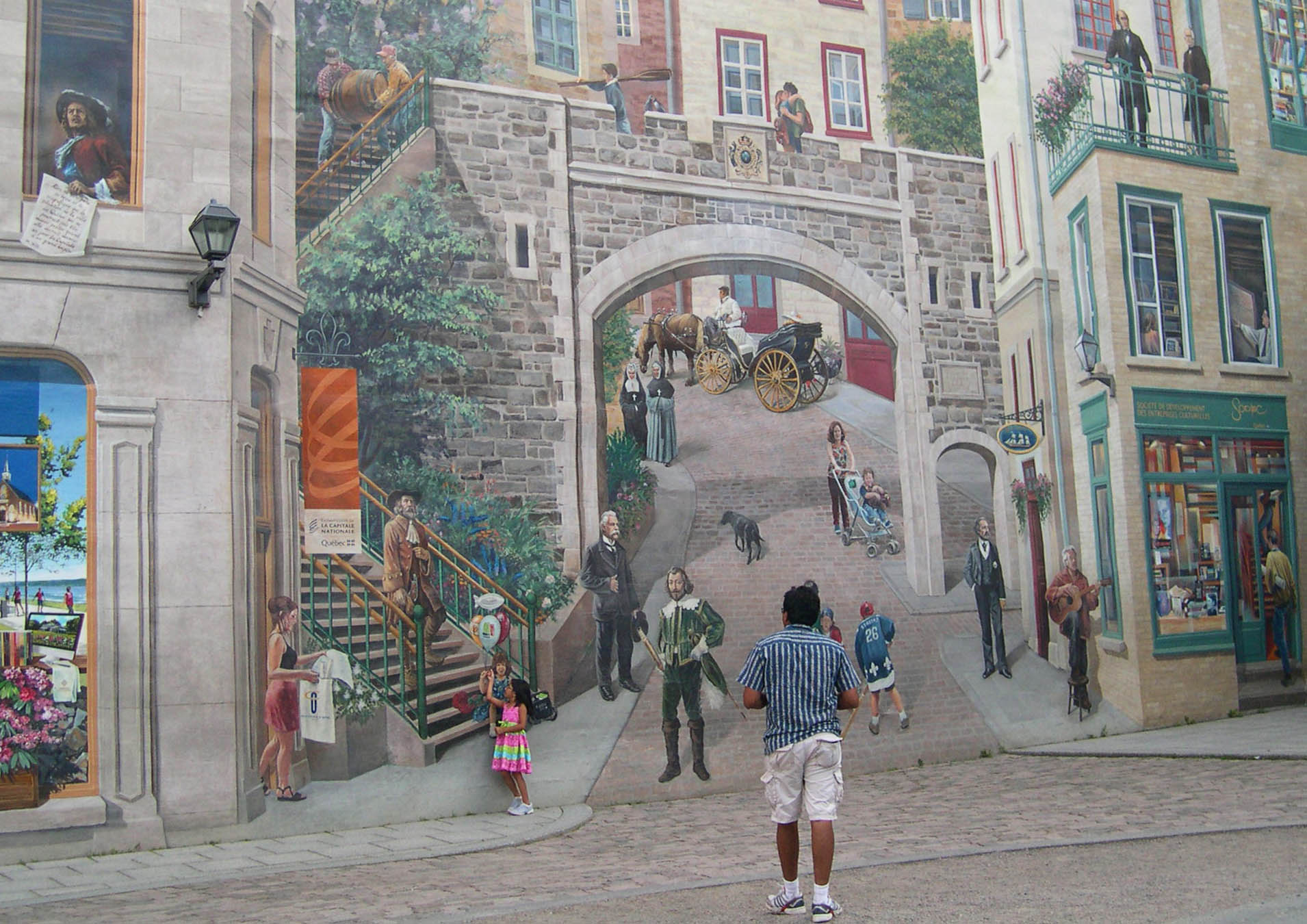
This art wall reminds me of Wendell Berry’s The Memory of Old Jack.
###
Image Credit: Kirk Livingston
Write Alone And Send To Collect. (Copywriting Tip #11)
Except for Bill Holm

Bill Holm, by Brian Peterson, Star Tribune
The late poet and writer Bill Holm spent his days teaching at Southwest Minnesota State University. In the context of daily teaching, he was too busy to write his own works. But when class finished for the semester, he wrote his poems and stories and memoirs long-hand on the back of the memos he received at school. Interestingly, he was a gregarious soul who often welcomed people into his house but continued to write at the kitchen table even as he engaged in discussions with visitors.
But for many of us, writing is a solitary activity. Oh, sure: ideas pop in conversation. Careful, committed writers take note of the idea on whatever scrap they have handy. And that scrap becomes useful when the writer is, yet again, sitting before blank screen or page.
Unless you are/were Bill Holm, it is the typical writer’s fate to sit alone.
This is not to say writers must be loners or introverts. Those are not necessary conditions, although they do often fit together.
But creating is only one part of writing. Yes, it seems like the biggest part of writing, doesn’t it? Creating and the aura around creating are certainly the most celebrated bits of writing.
But another part of writing is reading. Specifically, getting read. And that requires publishing, in one form or another. At its essence publishing is getting read by someone else. And for all the (quite true) advice about “just sitting down and writing” and “writing = butt-time-in-chair,” it seems to me there is still a missing piece: the reader at the other end of the writing. Written words need to find and land on their audience.

Here is a place where writers might learn something from copywriters. Copywriters have deadlines. They have people who expect copy at a certain time and quite often that copy is delivered verbally—often read aloud by the copywriter to the client.
Something happens when writing is read aloud to an audience. The text itself tends to shape and reshape and the writer hears it differently because of the people listening. The writer cannot help but see things differently when another person is also hearing the copy.
Many will say that some of their best writing happens during revising. I agree. Especially after having read something aloud to someone else and seen their reaction. It can be thrilling. Or depressing.
Butt-in-chair time is essential for writing. But sending your writing out—scary though it might be—is equally essential to hear how the ideas land and to revise with creativity and gusto and possibly increased motivation.
###
Image credit: Kirk Livingston, Brian Peterson/StarTribune

 conversation is an engine