Archive for the ‘art and work’ Category
Own Your Process
Ownership Sparks Creativity in Art & Work & Life
One key differentiator between working for the man (every night and day) and working for yourself is ownership. Working for yourself you own the beginning, the middle, and the outcome.
Especially the outcome.
Some of my favorite colleagues over the years—the very ones who advanced in whatever they worked at—found ways to own the process. These were the ones not content to follow orders. Instead they made the work their own, found their own way, employed their skill and imagination. I’ll argue that owning the work sparked their creativity to accomplish the task. And I’ll argue that ownership looked like responsibility for the outcome. So despite working for the man, they took ownership, made their own meaning and became, well, the man.
Over at Dumb Sketch Daily I’ve been producing a dumb sketch every day for the last 39 days. I was sorta proud of this dumb sketch:

Then a commenter suggested abstracting it, which I tried, given my limited art understanding and abilities (here):
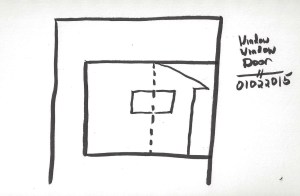
You can see the result is…simple. But it is my own (not that anyone is lining up to take credit). The commenter’s comment helped me continue my odyssey toward learning to see.
My only point is that developing new skills requires a certain elasticity. We try new stuff and get it wrong again and again and again. And we keep failing until maybe, one fine day, it turns out sorta OK.
A lot happens when we take ownership for developing our own skills. And a lot of good can come from taking responsibility for our client/boss/friend’s desired outcome.
###
Image credit: Kirk Livingston
The Talking Part of Writing
Talking Through the Valley of the Shadow of Death
When it comes to brand new, unpaged ideas (that is, not yet written), J.K. Rowling is right:
But at some point every idea needs to make contact with an audience. Writers want their idea fully-formed with beautiful plumage before they exhibit it to anyone (lest someone call my baby ugly). Copywriters know this is not possible when it comes to collaborative writing—writing that serves some mission or purpose for an organization or cause—which needs client eyeballs as a part of the process.
Because Lillian Hellman is also right:
And Nora Roberts is especially right:
There’s the writing. And then there’s the fixing. I often think of the fixing as equally creative as the original writing. Great and wonderful things happen at the fixing/revising stage.
There is a point in every copywriting project where it must be discussed. It must be read aloud. And the key is—especially with new clients—fail faster.
I recently made a category error with a new client and I’m wondering how high a price I’ll pay. Rather than insisting on an early reading and sharing first thoughts when the bar was low, I let my content slide through several holidays until the deadline is an approaching storm and the bar is high for the copy to be right on the first reading.
Which it isn’t: it’s full of questions.
Which is almost always the case with a new client. Especially if the topic has a lot of moving parts.

So lesson learned (again): insist on failing faster and earlier.
###
Image credit: Kirk Livingston
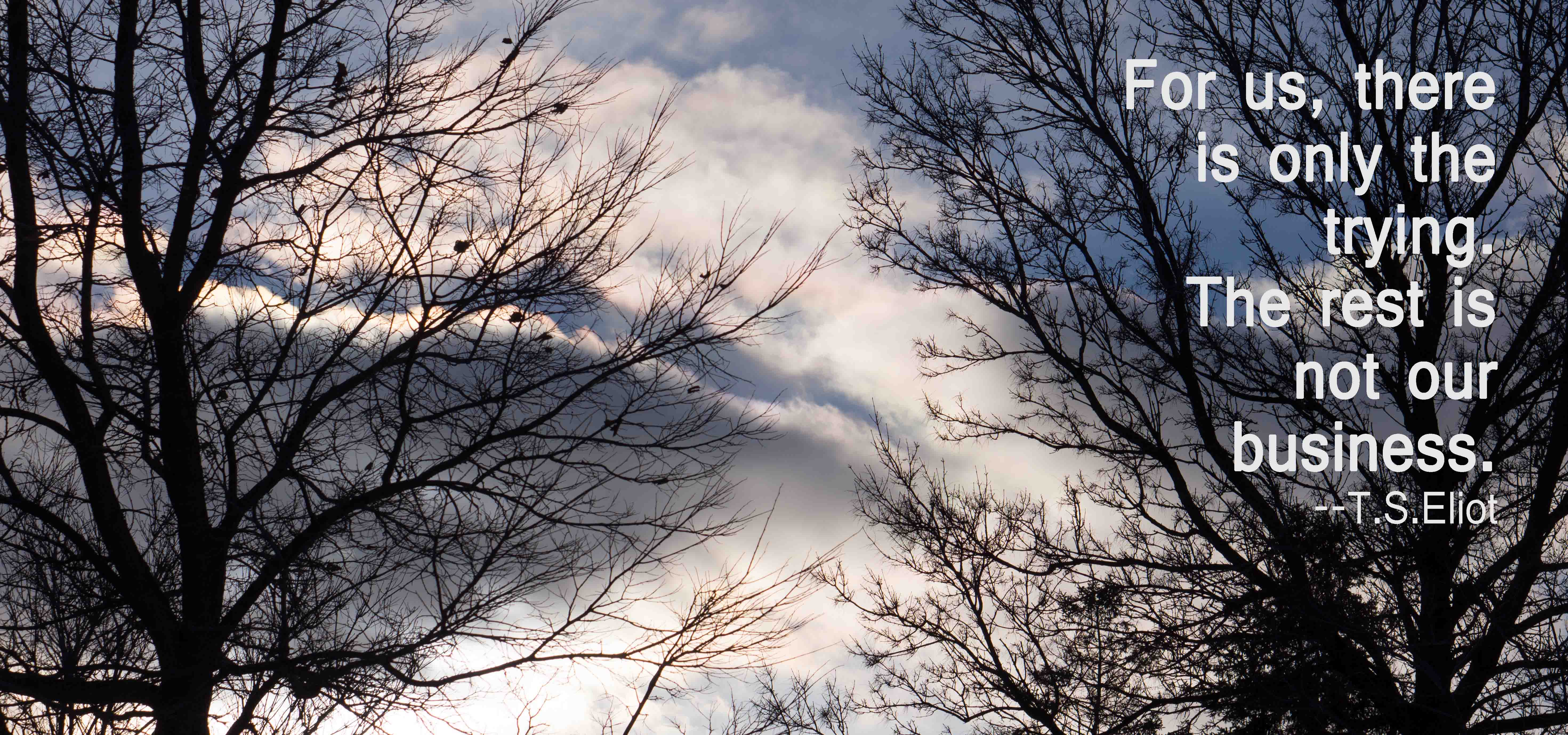
Writers at Work: “How do you imagine that will unfold?”
Seeing Need and the Power of Imagination
The leader’s peculiar gift is to help followers imagine how their work makes meaning. The leader makes personal how the organization’s work helps others, solves a human problem, makes the world better/more beautiful/safer, for starters. From that position of ownership (note that leaders may appear anywhere in an organization, position does not equal leadership) the leader imagines the next steps needed to move the organization forward. The leader acts on that vision and invites others in.

If you accept that the writer’s art is at least partly a reimagining or reordering of life, then you may be willing to consider the work of writing in business. Can writers in business look forward to how next steps unfold and then follow that thread backward to make those steps happen?
I say, “Yes.”
But not just because I do this for a living. [Full disclosure: I do this for a living]
It’s because writers in training are blind to this side of the life/work/art equation.
That’s a premise I’m toying with as I consider how entrepreneurship and professional writing fit together. I’m working through an entrepreneurial focus to the next Freelance Copywriting class at the University of Northwestern—Saint Paul, and I want to help English students see beyond self-focused essays and creative writing. A necessary starting point is inviting them to use their writerly tools to imagine life from that leadership/ownership/need perspective. I believe this can shift ownership to the writer and provide useful insight for right now.
Julian Sanchez’s tweet as the Senate report on CIA torture was released gets at this very concept:
Imagine forward and trace backward to locate solid actions. That is the leader’s gift—and possibly the writer’s.
###
Image credit: Kirk Livingston
Wait—English Majors Win in the End?
Start Writing Your Own Future
- Announce your goal to lose weight and chances are better the pounds will flee.
- Sign up for NaNoWriMo and chances are better you will actually write that novel (no matter how badly it turns out).
What we tell each other has a way of happening. What we tell each other about our preferred futures has a way of guiding next steps.
- Write a letter to your collaborative, inventor friend about a business idea and find yourself planning concrete marketing and distribution steps at Spyhouse Coffee.
- Write a business plan for your startup and suddenly remember your friend who became a venture capitalist. And then remember the friend who bootstrapped her idea.
See the pattern? Each step forward started with communication. You may say,
“No. the idea came first.”
True—maybe.

Create in real time as you go.
But consider: the communicated idea created a spark. And—given the right collaborative conditions—the spark lit a fuse. And the fuse burned, gathering other ideas until the explosive, disruptive future no one had considered.
What if English majors learned entrepreneurship and began to see their talent for orderly, persuasive, deeply-rooted writing as a way to help themselves imagine new futures and chart forward-movement for others? What if they learned to solve real-world problems with story and emotion and analytics? Their solutions would drop-kick the spreadsheet & PowerPoint crowd. What if some English majors created Lake Wobegon while others created the next Google?
What if English majors learned business lessons alongside the standard fare of reading and writing? What if they were expected to serve up the occasional business plan or marketing strategy along with the usual essay, short story and poem?
If that happened, English majors would connect earlier in life that art and work and commerce and fiction and meaning-making all fit together in the same world. And they would begin to write their own future vocation.
By the way: 16 Wildly Successful People Who Majored in English
###
Caveat #1: I was never an English major.
Caveat #2: I teach English majors. They are smart, innovative people.
Image credit: Kirk Livingston
Tom Dimock: Work & Art & Plein Air
Do [not] Disturb
Leave me alone to do my art—and leave cash on the table on your way out.
Who doesn’t imagine free hours to focus on your art or craft?
I’ve been trying to connect with a local filmmaker to chat about how she balances art and commerce. She’s already hinted once that “Commerce wins.” And though she says that, the truth is that she keeps producing her own films, which screen locally and nationally.
At the recent Art Attack at the (ginormously huge) Northrup King Building in northeast Minneapolis I ran into painter Tom Dimock. His painting of Red Wing’s Barn bluff caught my attention—so much so I had to show it to Mrs. Kirkistan as well (making it “remarkable”). In particular, Mr. Dimock had two versions of the painting: one done outside in cool Minnesota air (plein air), one done as a re-creation from a photo. Here’s the plein air version:
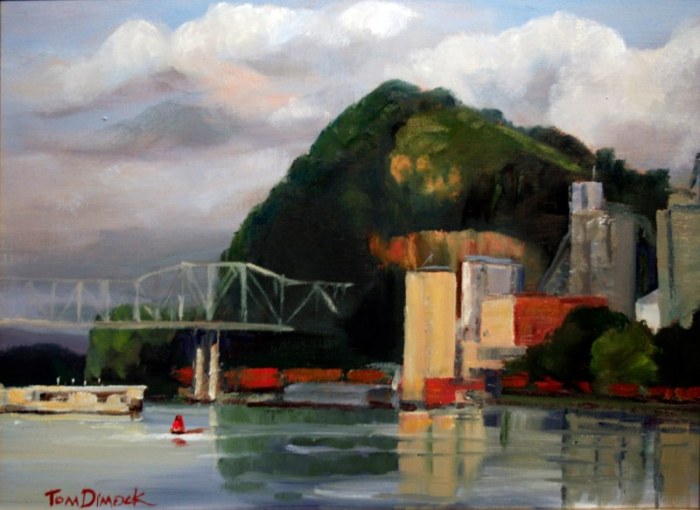
As much as we want to be free to practice our art: free of financial concerns, free of time constraints, free of any obligations, I rather think all those little tugs at our consciousness find their way into the art itself. To me, Mr. Dimock’s plein air version has a different feel than the painting produced from a photo (not pictured).
All of this to hint that waiting for enough time or enough inspiration to practice our craft or art is a fool’s wager. Instead there must be something of the plein air to our craft: doing it when we can. Practicing in whatever bits of open time we find, even out in the open. I routinely wedge bits of writing between work assignments . Big expanses of time are rare and unless I am practiced at my craft I’ll just waste time on everything but the work itself.
Plein air suggests the things we create are built more realistically in the moment, right in the context of everyday life, rather than separated and isolated. Things built in the moment, out in amidst the chaos may also yield a more true light, which is one of the keys to authenticity, whether in painting or writing or photography. It’s not hard to start applying plein air to lots of life’s bits and pieces.
Maybe plein air is the difference between what we used to call ivory tower thinking and boots on the street action (if you’ll excuse my badly mixed metaphors). Maybe that is why some of the books on my shelf go unread because they are so detached from real life while others drop me in the thick of human interaction time and again (Ian McEwen’s Atonement is doing that for me recently, as is John’s gospel).
How do you manage to practice your craft?
###
Image credit: www.dimockart.com
Brian Eno: “Everything Good Proceeds from Enthusiasm”
“Some people are more prepared to take advantage of opportunities than others.”
I’ve been a fan of Brian Eno since his Roxy Music days.
I’m not always crazy about every track from Mr. Eno, but he is always interesting. Speaking of Roxy Music here’s a first listen of Bryan Ferry’s new album “Avonmore.”

###
Via Valeria Maltoni, Conversation Agent
Image credit: NPR
Five days ago I killed someone. I had to.
Lessons Learned: 9000 Words into NaNoWriMo

- She took her own life, which shocked me. Maybe it was the best thing to generate all sorts of electricity in the people around her. For instance, I’m learning Irvina was fierce, respected and disciplined. She was a steady, planful presence. She was empathetic, maybe because of her failed first marriage and potential underworld connections. And now my characters are starting to wonder: is she really dead?
- Dialogue makes stuff happen. It also uses a lot of words, which is perfect for keeping up with the 1667 word daily goal. As Tim and Philip talk, I’m seeing the fierce loyalty they have to each other, their business, and to the woman who (potentially? maybe?) died. I was surprised to find out that Philip was an entitled SOB, but still likable. Who knew?
- The way forward is already present. Even with only 9000 words on the page, potential story arcs are presenting themselves. I’m seeing the whole thing laid out, and it remains interesting.
- Someone stuck an oracle into a fold of my story. Franklin Delano Sjogren showed up as a calm, deep presence. Where did this guy come from? I really want to sit at his feet and learn from him. I sure hope he circles back into the narrative.
Most of my usual writing is essay: persuasive, informative, educational. My work writing for clients is generally marketing copy for ad agencies, the medical device industry and other industrial clients, along with thought pieces and book chapters.
So writing a story for National Novel Writing Month is a new thing for me. So far so fun—but I hope Irvina survived.
Where can I find 1000 words before midnight?
###
Image credit: Kirk Livingston
Making It Up Daily: 1667 Words at a Time
Do You NaNoWriMo?
It’s funny that those stories we’ve lived in since childhood were written by someone. Made up, one word at a time.
Books. Movies. Plays.
All made up.
By someone.
Writing.
Game of Thrones. Lord of the Rings. The Great Gatsby. Even Burt Dow, Deep-Water Man. All made up. Maybe they carried pieces of older stories, but someone composed them. We know the names of the authors.
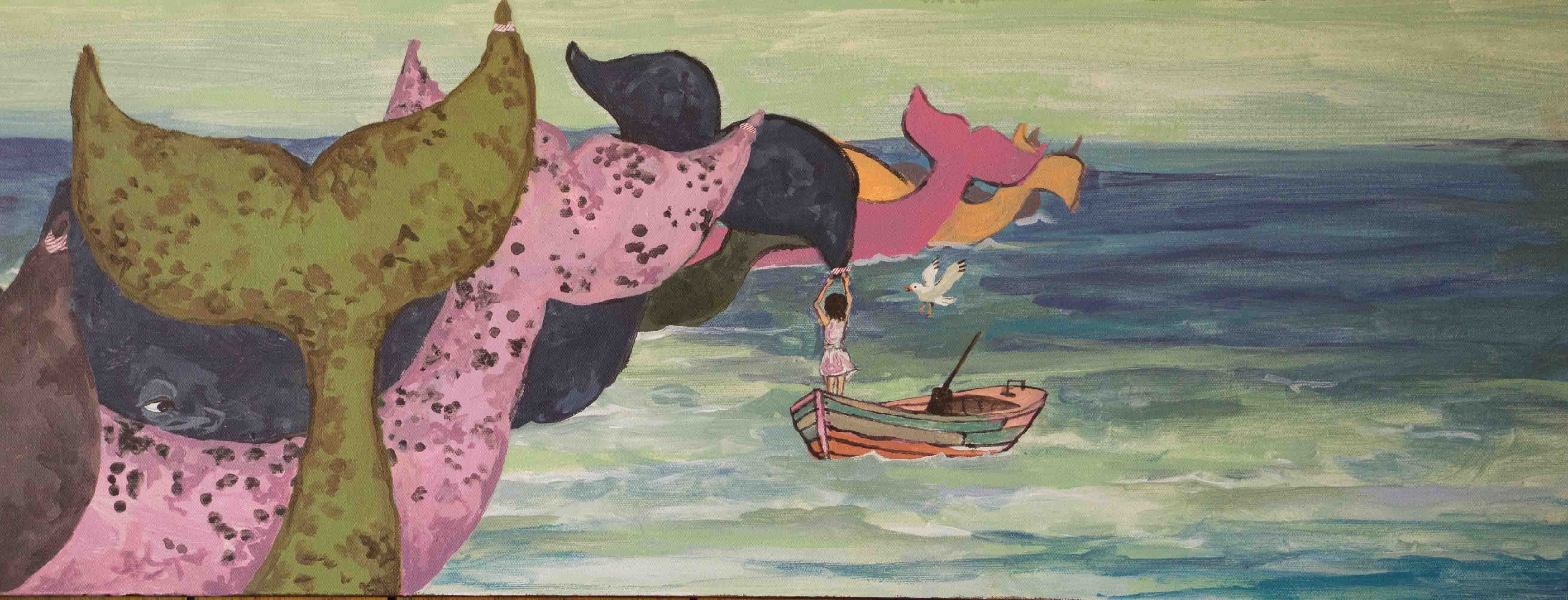
At some point in life I realized these very complete little worlds that seemed so alive were actually fiction. Funny that something made up could prove so real for so long. So concrete. But I had to pull back the curtain to realize this.
At some point—a bit later—I realized there was actually quite a lot made up: much of human interaction is made up (we call it “culture”). Oh sure, it presents as concrete reality, but behind the scenes people were literally making things up every day.
Business is a great example. Walk into a brick and mortar superstore and it seems like it’s been there forever. But we know they huge multi-million dollar inventories come and go. Same with banks. Same with restaurants—especially restaurants. Even the big institutions that are the pillars of our communities are making it up as they go. Sure, the rules of the game are there and seem to be unchanging as if handed down on stone tablets. But nothing is certain about business.
If you’ve ever been in a start-up company you’ll know that making it up as you go is expected. We need more folks willing to leap into the void of making it up. I believe making it up on paper translates to words which translates to action.
National Novel Writing Month is upon us again. And I’m joining in. It’s likely this blog will suffer inattention. But the challenge of creating a story from nothing (or more likely, from the disjointed and broken story-bits laying about in my mind and yours) is too great to resist.
National Novel Writing Month is a relatively painless way to try to produce a coherent story. Or, if not coherent, than at least something that has 50,000 words.
Where are you exercising your make-it-up muscle these days?
###
Image credit: Alli Livingston. Photo: Kirk Livingston
MIT Media Lab: Exactly When Do You Collaborate?
Tod Machover & A More Beautiful Question
There are times, especially early in the creative process, when I want to slow down and think about a challenging question by myself,” he said. (At such times, he retreats to the solitude of a barn converted into a music studio.)
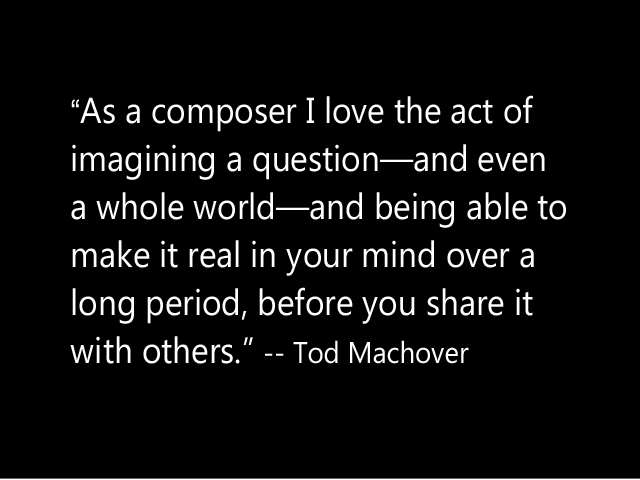
But there’s also a time, he said, when you must take your question “out of the barn” and begin to work with others. The Media Lab is designed to be an ideal collaborative environment, bringing together people from a wide range of disciplines. “Everyone is comfortable saying to others in the lab, ‘Here’s something I’m passionate about—would you help me think through this question?’”
–Quoted from Warren Berger, A More Beautiful Question (NY: Bloomsbury, 2014) 130-131.
###

 conversation is an engine