Archive for the ‘Audience’ Category
Can A Question Trump A Script?
Don’t Prepare. Just Show Up. Improv Wisdom by Patricia Ryan Madson
A confession: it’s hard for me to break free from notes when speaking.
Maybe notes are a crutch. But I think there is more to it. I spend my days writing so I have an affection and affinity for words on pages. And this: there is specificity to writing that is not quite so available for speaking. It’s a specificity that allows me to work an idea and move the parts around even as I deliver that idea to my audience.
Speaking does not allow that.
Or so I thought.
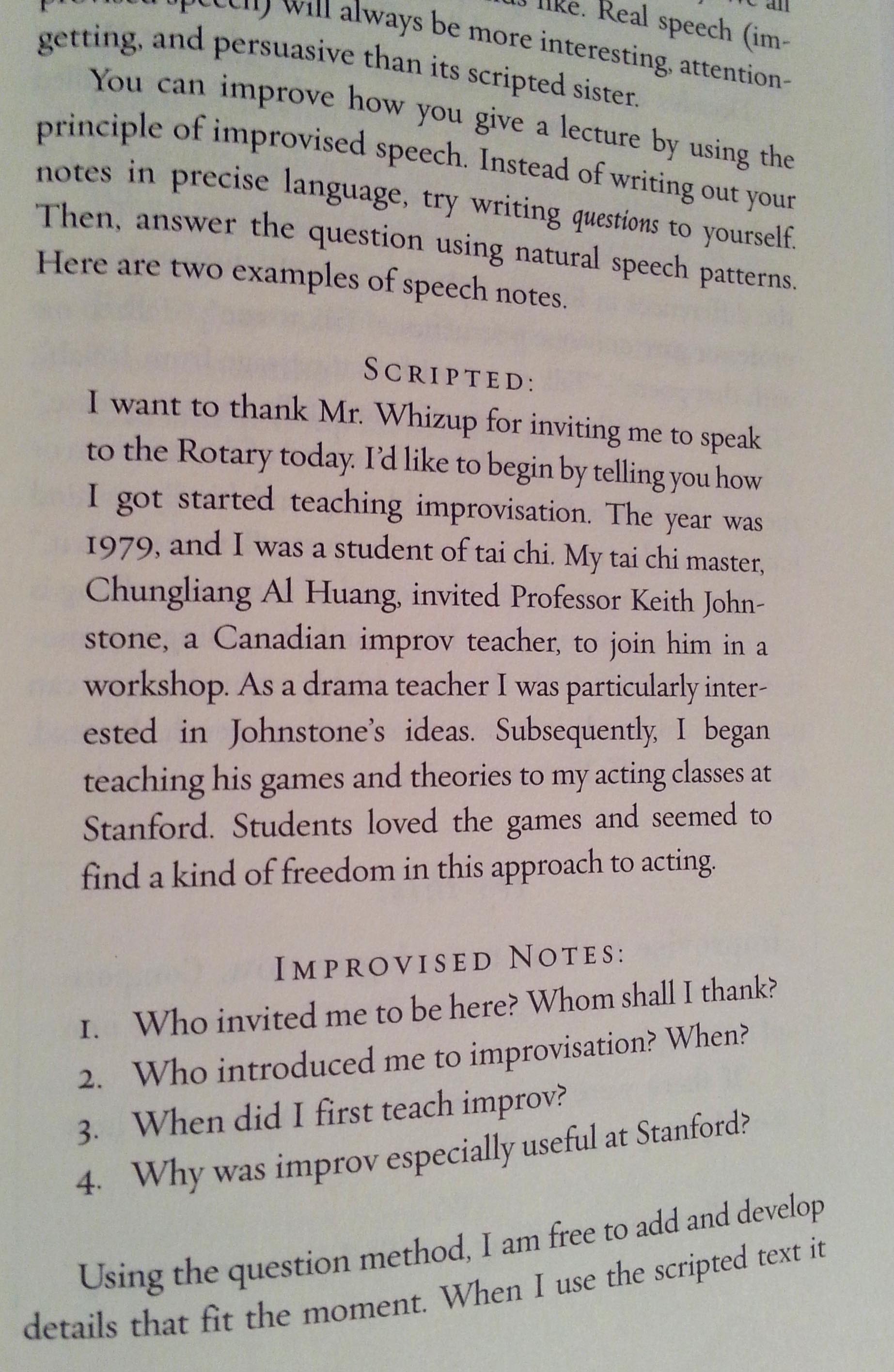
Patricia Ryan Madson’s Improv Wisdom is helping me see things differently. This well-written, easily digestible book (NY: Bell Tower, 2005) is full of all manner of notes about how to move off the page. In particular I’m struck by how Ms. Madson deftly turned scripted notes into an opportunity for spontaneity.  Check out the photo below, where she reformats scripted remarks into a series of prompts—questions—that result in something alive and conversational versus the usual bad voice-over quality that comes from reading a script.
The result of her work and approach is spot on with all we’re trying to do at Conversation is an Engine: live out loud with each other, mistakes and passions all available to each other as we show up. Day after day.
Here’s Ms. Madson speaking at Google (Authors@Google) on her notion of just showing up. I cannot help but notice that she put lots and lots of time preparing before she just showed up. Plus: I am completely taken with Ms. Madson’s willingness to make mistakes in public.
Patricia Ryan Madson may be my new aural hero.
###
Groundswell: Your Moment Has Passed.
So 2008.
I’m done with Groundswell.
Oh, I like the book. A lot. And the argument for an empowered people (via social technologies) continues to make excellent sense. Li and Bernoff did a great service by gathering facts and stories into a rational retelling of where we are today with hearing and connecting en masse.
When I first read Groundswell, emotive moments of recognition flickered constantly. Li and Bernoff led the way in helping me understand this unfolding opportunity lodged in my computer. But those moments are not just in my computer any more. They are on my phone, in my pocket and before my eyes as I walk.
It’s the ubiquity of the opportunity that makes everything look different.
Students in my class assume forums for support will be available, they turn to product and service reviews first—why wouldn’t they? Reviews from peers have always been available. These self-proclaimed 90s kids (I guess that’s a thing) interact in most of the ways that Li and Bernoff predicted. So there are few emotive flickers from them even as I shout “Yes!” (possibly to their “Huh?” and amusement). And these students demonstrate a familiarity with technology far advanced from students even two years ago.
So…wheels turn and time goes on and books fade to triviality. I’ll suppose I’ll check out Empowered next time I teach this class. The last thing anybody needs is another old guy in their life telling how things used to be.
And this: the Groundswell moment just passed has opened on a much wider vista that seems to invite collaboration like never before. To not listen to each other is starting to feel like a cardinal sin. Not because it dishonors the human condition (which it does) but because the opportunities in working together are beginning to look massive.
###
Kristina Halvorson & The Discipline of Making Stuff Up
Content Strategy and Brain Traffic
Someone asked a perfectly reasonable question:
What is content?
Our Social Media Marketing class is composed of collegiates with a passion for writing and communicating. Whether from the Journalism/Communication school or from the English department, we’ve come together around this notion of producing content in pursuit of a vision.
So we write.
While “content” seems a rude way to talk about the deep thinking that goes into a paper on, say, the merits of determinism, it’s a term that works pretty well for less lofty/more human conversation. The kinds of conversation suited to inviting in semi-interested onlookers.
Content is the stuff we use to describe our vision for…whatever. If we’re building a coalition to alleviate homelessness, the content we produce will point to the problem, tell stories about real people, show the inadequacy of current solutions and keep offering attitudes that illustrate the need and humanity of the man on the corner with the sign. If we work for a company that makes implantable deep brain stimulators, our content will highlight the current science behind Parkinson’s disease, show current (inadequate) ways of dealing with the disease, harp on the benefits of such stimulation without hiding the downsides.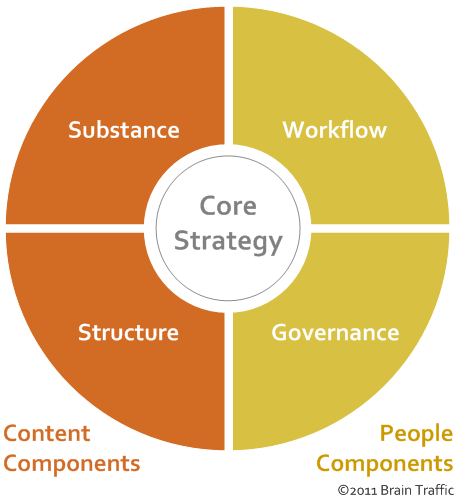
Kristina Halvorson, founder and CEO of Brain Traffic and co-author of Content Strategy for the Web will join us today (provided she can plow through 4-6 inches of new snow) to talk about the disciplines involved with making stuff up. Because that’s what content is: making stuff up. For a purpose. Making stuff up in accordance with a discipline, toward a specific end, to meet a particular business or social objective. That’s why content and writing go so well together: there’s nothing a writer likes more than stepping into a big idea and exploring the main streets, side streets and alleys and foot paths with words and images and video. Sometimes we have a map to start with. Sometimes we make up the map as we go.
Mostly we do both.
###
Image credits: Brain Traffic
Now #SOTU is a Spectator Sport
My Friend, With Whom I Disagree
Listening to Mr. Obama’s speech last night while following Twitter was a brand new thing for me—and much invigorating (so tweetful). To respond to phrases and gestures in real-time, and to see other responses, felt like I was hearing the speech in a room crowded with passionate and at times silly people.

GOP friends got all huffy and defensive and exercised:
While the other side went self-congratulatory:
What pleased me most was the rapid-fire dissenting opinions and funny stuff happening right before my eyes—in a way that actually helped me pay attention to the words. I like hearing both sides in real-time.
###
Image credit: @nick_pants via latimes
Hey: Where did that voice come from?
Don’t be stung by inauthenticity
Some in my class are English majors and don’t mind wading into the waters of how words work. So when Content Rules (Handley and Chapman) talked about voice, a close reading ensued. Handley and Chapman lobby for authenticity in voice: voice is your own way of corralling point of view and word choice and rhythm (meter?) and pressing it all into service. Voice is making language work to express your words in your way. Voice is what you sound like when you talk (and we’re aiming for conversational writing in this class, so writing and talking sort of blend).
But voice is also something that gets companies and organizations all hepped up. To give your brand a personality by adopting a particular point of view (which leads to word choices/meter and etc.) is what companies and organizations seek these days. Voice helps a brand stand out from the crowd.
And one must stand out.
But this:
How can you write with an authentic voice when you are adopting the voice of the brand?
Good question, English-major-friend. Two answers come to mind:
- Sometimes we use voice in the service of some larger purpose. So we might submit our voice to the larger brand purposes and adopt as best we can the machinations of the brand voice. Some people may naturally embody a brand voice. The rest of us have to work at it. This adding and adopting is part of serving the larger goal you believe in (at best. At worst: you adopt voice to make coin for rent). This is the collision of craft, faith and service.
- If you find yourself stinging with inauthenticity as you write for your brand—look for a different job.
I’ve maintained all along that when people add their voice to a project, new things happen. Sometimes a new voice provides new electricity and a new approach to a time-worn topic. Even old-timers can learn stuff from new voices.
Of course, people must voice up.
If you don’t say what you’re thinking, the new thing just around the corner will sit there in silence—just around the corner.
###
Image credit: red-lipstick via 2headedsnake
Do The Dumb Things I Gotta Do (They Might Be Giants)
Memo to Myself: I cannot control what others think
Tell me again: why did we think we could?
Maybe you are a fan of They Might Be Giants (TMBG). Maybe you are not. I’ve just stumbled onto a wiki that attempts to decode the (typically) obscure lyrics of the two Johns.
Songs by TMBG should never substitute as sacred texts but, “Put your hand inside the Puppet Head” has something to say to those would begin to organize a community. That’s the task we’re starting this week in our social media marketing class and I’m trying to help us understand the old command and control ways of marketing have fallen by the wayside. By the way, it’s those old command and control notions that led to the monologues that made us think whatever we said was also what people heard. That has actually never been true—people will always hear my words in the context of their lives, which means mostly hearing what they want to hear.
In short, there is no puppet head. In this social media world there are transparent people who write from passion and experience. People who build communities because they want to. People who invite others in—but never force others in (a phrase that is almost nonsense today). What we can do is to assemble a clear picture of the people we want to join our party. And we can have an image of how these people interact, where they show up on the web, how active or inactive they might be in their webby habits. And from that we can begin to sort how our social media contributions might serve them and pull them toward this community we want to build. That’s the task today: Who are these people and what do they need?
By the way, there certainly are social media puppets out there: people without transparency who bark out some corporate message or ideological pap. But the blogosphere is not kind to them, because nobody out here likes being the victim of a drive-by monologue.
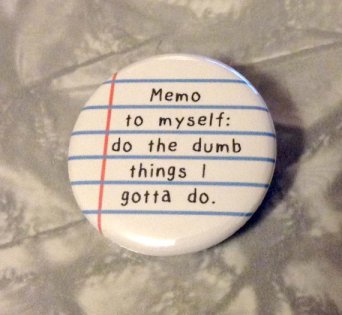 Transparency gets heard and gets a toe-hold in people’s psyches. We’re shooting for transparency and the credibility it builds.
###
Image credits: TMBG via Vimeo, Button via UnrehearsedKickline
Working Together: A Final Frontier
Talk Inc. Buries the BS Meter
Collaboration is hard for a lot of reasons. One reason is the power distance between people in a company. How can I say what I really think when I know my boss disagrees? Can I have a real conversation with an automaton who spouts corporate messaging and controls my salary?
Talk, Inc.: How Trusted Leaders Use Conversation to Power their Organizations by Boris Groysberg and Michael Slind starts with good intentions: to lay out this new challenge of interacting with employees as if they had something worthwhile to say.
But I should back up: old styles of management were about command and control: I’m boss so I’ll tell you what to do. And you’ll do it. New ways of thinking about the work of leadership and managing tout a more generous and collaborative approach to personal relationships. But these collaborative ways still have a hard time sifting down through the ranks of gatekeeping managers who intuitively see their mission as that of controlling others.
Talk, Inc. has a terrific vision, but the first section (three chapters on intimacy) is off-putting in that it quotes CEOs and VPs and various bosses at length, each talking about all they are doing to encourage collaboration.  But Groysberg and Slind may have done better to start at the other end: giving voice to employees who have been given a voice. As it stands, the first three chapters are a difficult slog because anyone who has spent time in a corporation will recognize the smarmy PR tone of the program-of-the-quarter. My corporate BS meter kept pinging into the red.
The book gets better, but all the way through I struggled with the “trusted leaders” part of the subtitle. For a book that intends to talk about the power of conversation, there is still an awful lot of command and control monologue. Whether it was the suits from Cisco or Hindustan Oil talking, it was hard to take their comments seriously.
 Talk, Inc. is, however, smartly organized into four sections (Intimacy, Interactivity, Inclusion and Intentionality). Each section has a chapter that plays out the vision, followed by a chapter that shows a company trying to carry out that particular part of the vision, followed by a “Talking Points” summary that helps the reader play it forward. The Inclusion and Intentionality sections offer more thoughtful reasoning and vision-casting for changing corporate culture so real conversation can happen. Groysberg and Slind offer solid examples of organizations that work hard at listening. But this is a story that really needs to be told from the “newly-voiced” perspective.
###
Image credit: Bill Domonkos via 2headedsnake

 conversation is an engine