Archive for the ‘Brand building’ Category
Memo To My People Updating My Facebook Page
How about a few less quotes from old dead white guys?
 Post-election, let’s have a little less constitution-driven stuff. I need to sound hip and with-it (You kids still say that?). Sprinkle a few Malcolm X quotes in there (Yes?) and maybe—I don’t know— Nietzsche (why not?). Our business partners and potential clients need to see we’re deep and edgy. But trustworthy—so, ok—maybe a few quotes from Jefferson, but way less than three a week.
Jenny: Put the business books and blogs down: Covey and Collins are sounding stale. Give me more of that pithy stuff like Seth G. puts out. In fact—give Godin’s people a call and tap into that well they are pulling from. I want to sound more like Godin. And Spike Lee.
Jerrold: Give me more comments on human interest stuff. I need to sound warm and supportive. Potential clients need to see the entire organization as approachable—so that starts with me. And do the same with Ivan in the St. Petersburg office. He needs to sound a lot less like Putin, that grandstanding old propagandist. Ivan needs to sound like New Russia—starting now.
Jamison: you gotta tune my Twitter feed. Post-election, work with Jenny on the Godin and Spike Lee stuff—get me solid tweets that pull in about a thousand more young managers. Skew young!
All of you—people tell me I should read beyond history books. Make me current! Wired. Salon. The New Yorker (within reason). Whatever.
Jenny–What’s that? Godin writes his own stuff? Which of his people said that?
###
Image credit: Sammy Slabbinck via 2headedsnake
Texts as Tools for Sorting What Matters to Your Firm
Your words make me so mad—and that’s good

words can wake us to the believable center of our purpose
I spend my days poring over texts. Reading internal notes and documents. Rereading interviews and meeting notes. Writing questions, asking those questions and writing the answers. And sometimes rereading the answers. Then I start making texts: mind-maps and cartoons and diagrams for starters. Then the short (or sometimes long) text that will go back to my client—ordered arguments and assertions. Emotive elements. Narrative. Jokes and anecdotes—whatever it takes to communicate the essence of what I take as my client’s central point.
And then I send it to them.
And they react.
Reactions vary from “you are right except for this point” to “that’s fine” (the worst possible reaction, it means my copy was so bland it stirred exactly nothing) to “you nailed what we’ve not been able to say” (my favorite reaction) to “We are deeply offended by this.” That last is my second favorite reaction—it means I got under their skin, though not in a good way.
And then we trim the right copy as a text for the target audience.
What’s remarkable is how the process of sorting through all the internal dialogue and the organization’s unexamined thought actually helps in finding the believable center of the organization’s identity. It’s got to be believable because if you can’t imagine an employee saying it with a straight face, you’ve not hit it. It’s got to believable or the promise won’t match reality—and that never gains traction with the target publics.
But the words themselves—right there on the page—can stir such a reaction from the client that they can sometimes catch a quick vision of what they aren’t. Or what they are. And that glimpse carries forward to what a team does next. And that glimpse can fold backwards into how an organization thinks about and treats itself.
That’s why copywriting is fun.
###
Image via 2headedsnake
How to Blog Your Company’s Top Voice
Your Company’s Outside Voice Must Be Personal & Remarkable
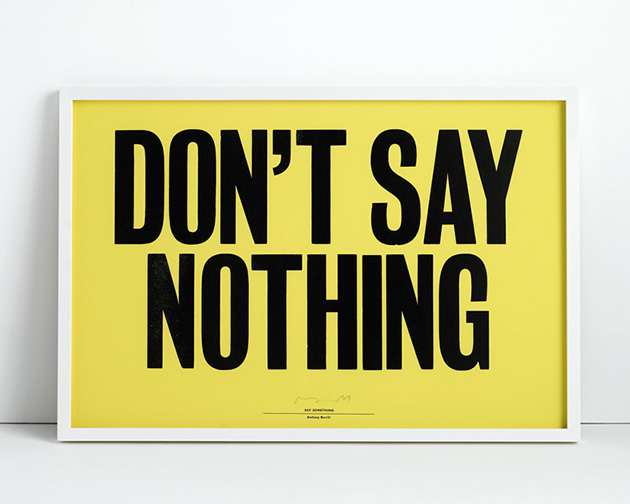 I’ve been helping a few clients think about their outside voice. Blogging has its own peculiar set of requirements that set it apart from the tone of a brochure, say. Or from a corporate press release. That recurring blog voice is related to the messaging identity your company has established. That voice is also related to the design and tone of your corporate website, true, but it is not a one-to-one correspondence.
One primary difference: your blog voice must be personal.
A blog is not a scientific, peer-reviewed journal. It must not deteriorate into a selling monologue. And it is not constantly pointing to benefits and features (which quickly gets tiresome). It’s a different animal—a personal voice. It’s got to be a conversation that takes wide and narrow routes on the way to discussing what is remarkable. The best blogs are smart and timely and pull readers in by offering this personal perspective on things of mutual interest.
Just a bit of practice using the public voice helps clients see why their outside voice must be personal and have a personality behind it (not as redundant as it sounds). It doesn’t take many sample posts to show that customers and potential customers are intrigued by an inside track into the mind of that top voice. And that top voice can pull peripheral topics to the center of discussion to show how they relate, for instance. Or to show how certain a practice will move the industry forward.
And remarkable.
Interestingly, outside voice has a way of trimming and freeing and impacting a company’s inside voice. Outside voice and inside voice are related—how could it be otherwise? What is remarkable (and thus worth blogging about) must also be remarkable on the inside of the company. The top voice blogging about what is remarkable in the industry must also pass the believability test for those inside the company. Because folks inside a company tune their BS meters to High the moment they walk in the door. Remaining personal and true is essential.
So…blogging the top voice is not an easy path. But that has always been the way of relationship-building with peers, employees, clients, customers and potential customers and even congregants. And relationship-building is worth the time and effort.
###
Image Credit: We Made This via thisisnthappiness
Can the Best Creative Solutions Ever Come from Collaboration?
Not if collaboration means consensus
If you are invited to a brainstorming meeting today, consider this.
 David Straus, in his excellent How to Make Collaboration Work lists five steps to effective collaboration:
- Involve the relevant stakeholders
- Build consensus phase by phase
- Design a process map
- Designate a process facilitator
- Harness the power of group memory
I think these steps are brilliant and especially useful as a framework for collaborations large and small. At first they seem sort of obvious—but as with so many “obvious” things, further explanation quickly gets tricky. With Straus, every step is critical and has its place. Best to plan for it.
But one thing Straus does not address is how collaboration works in developing a risky communication event that requires a singular voice. I’m thinking of something as simple as a letter, brochure, print ad or broadcast spot and beyond. Anything meant to cut through clutter and gain attention.
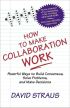 Though I’m a big believer in collaboration, there are times in a collaborative process when working alone gives the best results. I’ve always felt my best ideas come after having a chance to noodle a problem on my own and then come back with a few possible solutions to retrench with the art director or other team members.
Brainstorming meetings don’t afford this opportunity. And sometimes (if handled very badly) they lead to consensus talk. Any communication tool that is the product of consensus is likely to be so bland as to be invisible. That’s because what we usually take for consensus is finding agreement around some solution that does not offend any of the stakeholders. If someone says my headline is “Fine,” then I’ve lost the battle. As a copywriter, I crave a visceral reaction or a polarized response. Consensus often results in pabulum.
My point:
- A brainstorming meeting can be useful for getting a lot of different ideas. A brainstorming meeting is not useful for honing those ideas.
- Creative people can and do collaborate to achieve wildly wonderful stuff. But at points in the collaborative process, a singular voice must take command to champion the risky solution. And a singular vision needs to guide the piece toward a singular voice.
At some point a singular vision must step in to create a singular point of view and to champion a risky idea.
###
Image Credit: Bob Staake via 2headedsnake
“How Do I Expand My Work?”
Sustained, Focused Pursuit Is Itself Hard Work
 If you are an employee focused on the next eight hours, you might not think about “How do I expand?” It is certainly the opposite of “How can I make it through today’s work?” We all ask that second question from time to time, but when we ask the first question, we are typically in a much better emotional place. I say the two questions are related and both revolve around how you define your work.
If you are responsible for bringing in new business, “How do I expand?” is your primary question. If you are an employee and entrepreneurial, you might think about how to grow your department or to expand the charter of your department. If you are a freelancer, or part of a firm or agency (small or large) and tasked with bringing in new business, this first question can consume you.
A friend talked about the “catcher’s mitt” approach, where his ad agency is in the loop to hear about a formal or informal RFP (Requests For Proposal) from a variety of organizations, and they respond. As a freelancer, it is much the same for me—responding to requests from loyal clients and fielding requests from new clients.
But catching requests as they go by is only one piece of the pursuit. And maybe a small piece, though clearly important. A larger piece has to do with organizing yourself and your group for the work you want to do. Getting yourself and your team ready for the work you intend to do. Casting vision and organizing resources so they faithfully align with the work you are aiming at–a thing my friend is good at.
When I say organizing, I really mean trimming and pruning, because while the catcher’s mitt collects all sorts of work that is close and even very close to the anticipated, desired work, it may not be exactly on target. Organizing for the work you want means going through the difficult steps of asking what it is we are good at and what it is we want to pursue. And then moving toward that singular, or at least narrowed range of work in our outgoing conversations.
If this sounds like something that only happens in business, think again. I routinely talk with folks fresh out of college looking to set up their own business and wondering how to go about that. I often respond that they should look for opportunities to work with people and companies that interest them. And they should look for opportunities to use their communication, writing, design and thinking skills to serve (another tip from that inveterate letter writer) those people and firms they admire.
But this is not something just for new college grads. Defining our work and then trimming back and pruning it is a life-long pursuit. When we stop asking “How can I expand my work?” and start asking “How can I make it through today’s work?” we have given away a piece of our vitality.
And that looks like an end rather than a beginning.
###
Image Credit: unicornsandcuppiecakes via 2headedsnake
Nicely Done: Sharp Minds Trump Sharp Elbows.
I love the brevity and simplicity.
 The second phrase paints a clear image which points quickly to the negatives in our fighting/boasting/hard-scrabble economy. “Trump” is excellent, evocative and rather top-of-mind—and a bit ironic, given the Donald. The sign-off is full of promise for anyone considering why they would pursue education.
###
Image via Ads of the World
A New Tone to Grind from Axe?
Fear No Susan Glenn
Discharge smelly spray across your torso and watch angels fall from heaven. Or spray and wait for women’s clothing to spontaneously come undone. Why do you find that cause and effect so hard to believe?
The Axe/Lynx brands always and forever illustrate teenage male fantasies (“Chicks dig me.”). But this. This is different. Beautifully photographed and polished, this is a believable reminiscence rather than a teenage fantasy. Maybe it’s Kiefer Sutherland’s narration that sets off the nostalgic lighting. Did the older brothers of the junior copywriters at BBH find the creative brief lying around and decide to take a shot at the account? Nice job changing the tone, Peter Rosch & BBH New York.
###
How to Pitch a Medical Device Company #5: Be Amazed
 We had just hired a new advertising agency to help rejuvenate the brand of our chronic back pain therapy. I had been sitting in a meeting with several team members of the agency. After a couple hours where I and a few others described how the therapy worked and talked about the outcomes, the science behind it, the competition and the main messages and positioning, we broke for questions.
“Wow,” said the creative director. “That is cool. You guys are doing amazing stuff!” And between the lines that team communicated to me a kind of respect for the work our corporation had been doing.
Was this enthusiasm real or feigned? Yes. The agency had already been hired, so there was no need to pretend. And since advertising agencies typically run on enthusiasm, the comment was not unexpected.
But neither was it expected. Whether real or fake, their enthusiasm hit home. It was a refreshing meeting in a sea of corporate meetings ranging from dull to throat-slitting painful. Life in a medical device company—like most any company—can seem like slow-motion meetings followed by mad rushing to fulfill promises before the next slow-motion meeting. During that rush you forget your company does something exceptional.
I’ve sat on the other side too, where the product manager is telling details and showing outcomes. Even if they start subdued with facts and charts, their excitement grows as they talk through the story. A good creative team picks up on this excitement because it is contagious. New and possibly extraordinary things happen when every member of the team gets the contagion. But it cannot be an act: because feigned excitement is hard translate to the customer.
An amazed creative team can become a set of cheerleaders. This makes the internal champions of the product feel surrounded by allies—especially when the cheers are in the language their customers speak. But the amazement has to be real. The key is to find the amazing thing.
###
Image Credit: itsraininghens via 2headedsnake
Never Say This To Your Boss On A Monday
“Easy, Peterson. We’re in mixed company.”

Unless your employee figures “Why” for themselves
Certain words and phrases race from useful to cliché within an hour-long meeting. Just check out this list of 89 clichés, many of which you’ll likely hear today. Other words carry so much heavy baggage that when your VP says them, the air in the room suddenly seems carbon monoxide-heavy and people start to drift.
This word is among those problematic words.
It’s a common word. So common, in fact, that when uttered aloud it brings to mind exactly…nothing. This word is invisible.
“Strategy.”
Three of us have been talking about why it is so many clients see strategy as something hammered out by a few bosses in the back room—or simply as a complete waste of time. These organizations reward a “bias toward action,” which looks like lots of activity, lots of people staying late, lots of emails on Saturday and Sunday, without lots of results. Too often all that activity is at cross-purposes across an entire organization eager to prove their bias toward action.
The three of us would like to rehab the concept, but not the word itself. Our rehab efforts consist of breaking the concept into component parts that become as sticky as a five-year-old’s wonderment: What? Why? How? Simple stuff. But when approached directly, these words become profoundly effective tools for guiding teams and organizations and, especially brands. Incredibly useful words not just for giving instructions, but for engaging someone’s emotion and intellect. The first order of rehab is to include all three components. The second order of rehab is tell the straight story about each—without cliché, with clear endpoints. And that means end points that others can see if they get done (or not).
We’re starting to believe that managers who major on the “What” or “How” without telling “Why” are getting employees to feel OK running about on impulse drive without ever taking their work to warp speed. Of course, it is possible the manager still feels knowledge is power and to withhold the “Why” is a way to maintain that power. Impulse drive is all they’ll ever get.
Unless.
Unless their employee figures out the “Why” for themselves. Unless the employee finds a way to put meaning into their work on their own. Unless the employee learns to engage in the kind of dialogue that helps a group move forward.
I hope to write more about this. The topic includes lots of working parts: leading from anywhere in an organization, learning to help a boss ask the bigger questions without disappearing down the rabbit hole of industrial strength strategy/BS sessions, helping each other grow into people who care and do our best. And many more.
Oh—and the third, most important order of rehab: courage. The whole thing needs to be stirred up by people willing to share their dumb ideas. Because sometimes dumb ideas produce solid, cogent, meaningful results, despite the awkward moments along the way.
###
Image Credit: 4CP via thisisnthappiness
How to Pitch a Medical Device Company #3: Don’t Pretend
Language is telling.

In Quebec City not so long ago I tried my lame bits of French when ordering or to strike up a conversation. Naturally, there was no hiding that I am an American. And this: if some Francophile took pity on me and answered in French, I was immediately on a slippery slope of wordlessness. Maybe one word in French? Oui. Two words? No.
Language says a lot about what we know the moment we open our mouths. And the game played by medtech firms involves a very firm grip on the language used to explain how their therapy works and the medical problems it solves. These language skills are honed through long discussions with physicians, clinicians and researchers. One doesn’t just pick up such a vocabulary. In some ways, it’s a kind of birthright of people who’ve grown up in the industry.
But just like the Canadian French speakers, they melted (well, a little) to hear my butchering of their language. It meant I was trying. In the same way, medtech firms want to know you are ready to learn. But mostly they don’t expect you to be ready. You’ve come with something else: a track record of ideas and executions that someone imagines refreshing their brand.
So don’t pretend to know the details of their business. Better to be a learner with a solid track record.
###
Image Credit: via www.telegraph.co.uk: Frank Perry

 conversation is an engine