Archive for the ‘Brand building’ Category
How to Pitch a Medical Device Company #2: Don’t Settle for the Chain Restaurant Brand
 Med Tech spends a lot of time and interest on getting brand right. Precision graphic restrictions paired with copy that strikes a positive, knowledgeable tone are the expected norm. But sometimes the prescribed boxes and creative areas and subheads always in the same order become too familiar. And then the many pages of the branding guidelines present a calcified artery (or a narrowed alley, if you prefer) that can feel stuck.
Almost inhuman. Lifeless. Especially when most med tech firms offer much the same fare.
This is exactly why agencies are invited to pitch: someone recognized their communication had become more wooden, less engaging and sort of like yet another chain restaurant in yet another strip mall.
So the person with clout (or vision or both) says, “Hey, what if we started from a blank page.” Or perhaps you’ve been in conversation with someone and raised the question: “Surely even a med tech firm can seem almost human and engaging?”
That’s where the opportunity begins. Because it’s hard to start over when you live inside an organization. On the inside you’ve already drunk the brand Kool-Aid. And the regulatory restrictions and legal waffle-words troll through you conversations even when talking with your five-year old (“Jimmy, randomized studies correlate earlier bedtimes with general health and well-being. Many physicians would likely suggest you go to bed right now. OK?”)
The point is not to get rid of their brand. Not at all. The processes and procedure the brand encapsulates are a solid investment (that is, until they aren’t anymore). The point is to be yourself and offer a new way of thinking that floats away from the expected norm. Know there will be resistance. Brand managers will fight. But you’re just trying to bring a bit of life to the brand.
###
Image Credit: Laurent Cherere via MyModernMet
Occupy…billboards: “This Space Available”
“I feel it is wrong to be treated as a consumer every place you go.” Gwenaëlle Gobé
Abilify Commercial: Now with Extra True-ishness
The genre of pharmaceutical commercials tend to show happy-faced users with their lives coming together after having taken the chemical compound. Happy faces also take center-stage while the disclaimers and side-effects roll on the screen and in the background voice-over. What I like about this commercial is that the dark shadow never goes away—which is more true to what I understand about clinical depression.
That the shadow remains in the animation is a powerful credibility-booster in my mind. I’m guessing the product manager and agency had strenuous talks about whether to keep the shadow in and what that shadow does to the brand promise.
This is something we’ve been talking about over at Details Have a Public Face.
###
When Writing is More than Writing: The Idea Writers by Teressa lezzi (Review)
Your invitation to a new way to persuade
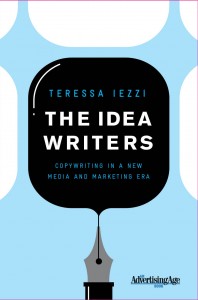 As editor for Advertising Age’s Creativity, Ms. Iezzi has a daily, close-up view of the trends in the creative world and the people behind those trends. The surprise in the book comes with the affection Ms. Iezzi has for the discipline of copywriting and the practical nature for those seeking to grow in the discipline. It is readable, informative and filled with stories about advertising heroes and insights into current campaigns. I plan on using it as text in my next class on freelance writing.
Ms. Iezzi begins by framing the story of copywriting with a look at the ground-breaking work of legends like Bernbach, Ogilvy, Reeves and others back in the 1960s. Their work was fresh in relation to what was going on around them. Indeed that decades-old work formed the basis of many of our current communication trends. Ms. Iezzi uses the legends to reinforce the importance of storytelling, which these guys got right. Storytelling is the concept that best binds together The Idea Writers, as Ms. Iezzi issues a kind of challenge to today’s batch of copywriters to push into the new ways of communicating.
Two powerful notions emerge from The Idea Writers:
- Copywriting today is much more than only writing. Maybe writing was always more pure than writing. Today’s copywriters will sketch designs, draft scripts, work out the voices of a cartoon and a blog persona. They will pitch ideas because they are closest to the energy behind the idea and because organizations run much flatter. This book helps break through the silos that are already on their way down.
- Today’s copywriters help guide brand development following new methods of persuasion. In this new age, people buying stuff have unprecedented control of brand. Today’s copywriter recognizes the stories that honor the people doing the purchasing while smartly positioning the brand as a kind of conversation partner.
Ms. Iezzi’s book is the first copywriting book I’ve read that does justice to the emerging notion of the switch from corporate monologue to personal dialogue. The only lame part of the book came when she trotted out her personal list of tiresome cliché ad ideas. Her list of six included things we all instantly know, but to say those ideas will never work again seems like a challenge. The list also invalidates the notion that we beg, borrow and steal good ideas constantly—it’s just that those ideas are more or less recognizable in a different arena.
###
Two Words Cost Me Dearly
 My Splendid Sabotage
Please know:
First: I wrote the words 40-some hours into a 51 hour project spread across a week and a half.
Second: I was desperate to capture the zeitgeist bouncing between client and agency principals.
As I wrote these two words I immediately moved to delete them. But something stopped me. Was it reckless whim? Had I given up? Why oh why did I pause over “Delete”? My self-editor should have been there, sitting beside me. He was still locked in the self-editor-dungeon where he has a cot and a Folgers can to pee in. He doesn’t get out much when I’m creating.
“Flabby Paths”
Oh, sure. They seem innocuous—even forgettable. But as a subhead for a component of this project, they were the stalled car on the track that derailed the train pulling boxcars of produce that needed to get through right now. Or: These words distracted the creative team and hurried them down a path and off a cliff.
So, my bad. Personal penalty: pulling my invoice and attacking it with scissors and fresh resolutions. It’s a matter of integrity. It’s also a matter of retaining relationships.
Floated or Finished?
It’s never just the words, of course. It’s the trust built between creatives as a project moves forward. With some team members you are free to say the really stupid stuff and let it sit for a moment between you, even as you all know some better idea is moving up an esophagus about to be uttered. But with other teams, and especially in hurry-up mode, words appearing on paper carry more weight: not of an idea floated but an idea finished. At this point in the project, my self-editor needed to be there with his “HIT DELETE” stamp poised. Because time was flying and next steps need to step up solidly.
My point? Conversations are never formulas that work in every case. And: while creating, the self-editor needs to dwell in the dungeon, but words making their way out in public need to meet his approval. Let him out sometimes.
###
Adland: A Global History of Advertising [Book Review]

The storied lives of creative talent.
The marvel of the Mark Tungate’s history is in how interconnected are so many of the storied agencies. The formula gets repeated again and again: agency hires young creative talent who eventually finds the place too stuffy and goes to start his or her own firm. I like hearing the backgrounds of many of who are now household names: Ogilvy, Burnett, Chiat, Hegarty.
Every local advertising scene has its own particular nuanced and storied development. Certainly this is true of Minneapolis (of which there is no chapter in Adland). While there are certainly national and internationally known agencies in the area, the surprise to me is how little of a creative dent local agencies have made with one of the main exports: medical devices. Certainly budgets have been smaller and consumer advertising for these firms has been nearly non-existent. But it is also true that larger medical device firms are wooed into the unexceptional pockets of agencies on either coast.
I expect a particular creative knowledge to rise from the creative milieu that is the Twin Cities—in much the same way that older established medical companies spawn one company after another. Perhaps creative applications of social media may help establish the Twin Cities communication agencies with the knowing and much-needed human voice in the dialogue between medical device firms, clinicians and consumers.
###
Building Content: Share Your Research—Even if Incomplete
A few days ago I talked with a company about their research efforts into a growing subset of a particular business process. This firm’s business is all about helping other companies make personal connections with their customers. Over the years this company has built a strong reputation for their expertise even as they continue to grow and adapt. They already know the benefits of being perceived as experts. Now they seek to add to the already strong understanding of the tools, process and attitudes needed to help companies remain connected.
One of the new opportunities before all of us is to provide leadership around a topic and invite others to talk with us about that shared passion. Seth Godin talks about it in Tribes. This company I had been speaking with has already caught the bug for growing themselves and helping others along the way. But one of the things about research is a commitment to doing something new. By definition, research means you are answering questions and finding things out fresh. Naturally we want to apply our new understanding to the problems and opportunities before us. That means we might not get it just right all the time. We may make mistakes. And don’t mistakes force a slip in our perception as experts?
I’ve been arguing all through these articles that what we gain in authenticity more than makes up for momentary slips. Social media is about real time communication, so if we read our research at some future point and realize something happened that changed everything, we’ll understand that we knew what we knew when we knew it. “Now we see things differently,” we might say to ourselves at that future point. I’m arguing for grace. I’m also arguing we’ll understand the nature of social media in this way.
 This topic has a personal application for me. I’m currently writing out a book-length project that develops a theology of communication. But I’m reluctant to chunk it out into a blog format because every part of the book changes as I move forward. What I thought was true in the first three chapters is actually changing as I write chapters four through six. I’m certain change will continue all the way to Chapter 12. Do I have the courage to make mistakes in public?
How do you approach sharing your research? I’d love to hear.
###
Please, Back Away from the Controller.

It’s about interest, not control.
It’s not like you can just adopt this new channel, buy space and you’re good to go.
It’s more like learning to be a friend again. I described the equivalent of “winning the lottery” in a dialogue-based medical device marketing context, but Seth Godin takes the next step with his Tribes: We Need You to Lead Us. Instead of focusing on the tools of social media we all find so interesting (or not), he posed the provocative question “Who is it we should be leading?” His question presupposes this inward-looking beginning point for any who care to begin dialogue: “What change am I passionate enough about to lead?”
I like that Godin helps me see that the coming dialogical world is much broader than today’s set of bloggy-twittery-searchable tools. The questions we ask when moving from monologue to dialogue have more to do with what we all care about together. Finding what we care about together is a necessary stop on the journey. And knowing what we care about together is a step beyond carefully controlling the conversation with fine-tuned messages.
What we care about together as humans has always been different from the one-dimensional messages with which we’ve surrounded our product messages. The secret to dialogue is what we learned years ago when our first friend showed up that summer day: we look for common interests. We expect give and take, and a willingness to hear and try something new. Friendship is formed when we stop claiming to know all the answers. Inviting marketers to rethink friendship is a step toward dialogue and a step away from monologue. Inviting marketers to find their place of leadership within friendship and within dialogue is a step toward freeing them to be the leaders they secretly want to be. The tribe-formers we need them to be.
###
Medtech Using Social Media #5: Winning the Lottery

Our conversations help individuals lead groups forward.
Working on a client’s factory floor yesterday, I heard a guy describe how his troubles would be over if only he won the lottery. It’s a common enough thing to say and I’m sure we all think it from time to time. I happen to think winning the lottery would be more like trading one set of problems for another. Without the life disciplines that build on any skill (including making money), without a bit of thankfulness, suddenly receiving lots of money may not change all that much about a person’s life. Maybe for the moment more expensive toys enter the picture. But without discipline, the money eventually runs out and even larger debts take their place.
In marketing communication, just like in every other area of life, we search for the perfect tool that will solve everything. The perfect strategy of engagement. The perfect ad or the perfect media buy. The perfect social media tool. But deep-down we all know that perfect tools don’t exist. Or perhaps the perfect tool for the job does exist, but it gets corrupted when interacting with us.
The vision for engagement using these new social media tools is a vision for engaged contact with a group of people who believe in what you are talking about because you are talking about what they believe in. The vision is precisely not sharpening the perfect tool for the perfect kill (that is, the perfect sale, or the perfect implantation of our message in some consumer’s brain along with the instruction to “Buy!”). And even though lots of folks are—for the moment—listening to the social media channels, with Twitter and Facebook making headline news daily, newer channels will arise and suck away attention. The enduring lesson is that we all do better when we talk things through—no matter what technology enables that talk.
The equivalent to winning the lottery for a medical device firm using social media is a group of committed friends, colleagues and fellow-travelers making a journey together. It is a group where questions are shared as freely as answers. It is a collection of conversations where your brand is given legs and flesh as the brand promise works its way out through conversation after conversation. Winning the lottery is about building a fierce loyalty along the way.
###
“Mad as Hell” Points to Need for Restored Trust. Dialogue Can Help.

Trust builds with honest talk.
Frank Luntz writing for the Los Angeles Times (reprinted in the StarTribune) points to town hall meetings as evidence that “Competing ideals are actually competing.” Though the dialogue is rowdy, it is dialogue. With leadership generally viewed as lacking integrity (for lots of reasons, from scandals to bail-outs to clear hypocrisy to “Question Authority” in modern or post-modern guise), talking together is one of the beginning points to rebuilding trust.
What if marketing and marketers led the way by engaging audiences in real talk–talk that is broader than just their product?
###

 conversation is an engine