Archive for the ‘Brand building’ Category
How You Say: Not Just “What” But “When”
A word is a fuse. Light the fuse.
I’m teaching a freelance copywriting class at the University of Northwestern—St. Paul. Yesterday was our first day and I wanted the students to begin the shift from writing papers for professors to writing words to make a difference. I maintain that excellent copywriting is the very opposite of spewing malarkey and hype. Especially today, when anybody who can read and/or listen and absorb marketing messages has their BS meter set on high all day long.
The best copy doesn’t call attention to itself. The best copy is nearly invisible and absorbed without realizing it. The best copy latches on to or illustrates a larger idea and leads the reader to the idea threshold. The best copy is emotive and rational. If it can be silly too—all the better.
We talked about the differences we perceive in writing for non-profit, mission-driven organizations and for-profit organizations. At first glance we might think one organization is all about mission and the other is all about money. But that is a mistaken notion: for-profit organizations can be all about mission and non-profits can be all about fundraising. Examples abound in each category.
One of the things I love most about teaching these particular students is the sensitivity to mission. They are cool with the notion of using your writing skills to help others. Many are considering starting work with non-profits, but that is not unusual for many studying the liberal arts. These particular students are often eager to trace their motivations for helping others back to some of the ancient texts that drive much of this school’s mission.
But one thing that is not so clear is that mission-driven work exists in both non-profits and for-profits. One’s mission comes largely from within. Our job—that thing we get paid for—is an outward-focus of the mission we bring with us. A copywriter with a sense of wanting to help others can find a home in any number of organizations, whether for-profit or not-for-profit. And using that copywriting skill to bring a reader to a life-changing realization can be a primary motivation for the whole task of writing.
I would like to see more copywriters with that motivation.
My go-to example is the quiet laugh from the writer in this four-minute film. Listen for the laugh. Think about what that laugh says about delivering the right words at the right time:
###
Lady Gaga: Onstage Vomit Sells Doritos? Of Course.
“Selling In” Not Quite Opposite “Selling Out”

One adorned in a plastic tarp need not “sell out.”
Lady Gaga made a plea for “selling in” at SXSW last week. Doritos sponsored her onstage vomit-art, which attests (she said) to her artistic success. But read the Rolling Stone article and you’ll find a more complex, nuanced notion that falls short of completely bowing to the demands of the sponsor.
When Kerry Miller (@DailyCircuit @KerriMPR) wondered aloud what people thought about “selling out,” she echoed a sentiment borne decades before when the big rock and rollers first roamed the earth and bowed to the demands of advertisers to create art to propel commerce. Ms. Miller’s comment generated responses from scholar Patrick Cox (@patrickcoxMN) and others on just what corporate sponsorship was beginning to look like.
Ms. Miller’s generation (also my generation) labeled such people “sell-outs” and tried to work up disdain for them even as we bought the cans of soda or beer or whatever they shilled. Even as we ourselves sold out to the company we worked for. And never mind that the notion of patronage has been around for as long as artists have starved.
Watch the recent Frontline “Generation Like” and you’ll get a sense of how Millenials approach the art vs. commerce question. Gen Y seems largely happy with getting free swag and brandishing logos on their social spaces/shirts/tattoos/hair cuts.
“What’s the big deal?” [They might ask.]
Ms. Kerry’s generation (my generation) is quick to point out that “You, sir, have sold out.” The Millenials I teach might return: “You, sir, have also sold out.” Which would be entirely accurate.
Maybe Gen Y has done us a favor by repackaging the connection between art and commerce: That repackaging looks more like an articulation of authenticity. It is a voice we need to hear today. I’ve been arguing that craft and service (and art and faith) do better together than separated into holy, inviolable silos.
Gen Y is articulating some of this. Not perfectly, but they are closing some gaps and opening others. The “selling out” conversation has changed.
###
Image credit: Michael Buckner/Getty Images for SXSW via Rolling Stone
Kristina Halvorson & The Discipline of Making Stuff Up
Content Strategy and Brain Traffic
Someone asked a perfectly reasonable question:
What is content?
Our Social Media Marketing class is composed of collegiates with a passion for writing and communicating. Whether from the Journalism/Communication school or from the English department, we’ve come together around this notion of producing content in pursuit of a vision.
So we write.
While “content” seems a rude way to talk about the deep thinking that goes into a paper on, say, the merits of determinism, it’s a term that works pretty well for less lofty/more human conversation. The kinds of conversation suited to inviting in semi-interested onlookers.
Content is the stuff we use to describe our vision for…whatever. If we’re building a coalition to alleviate homelessness, the content we produce will point to the problem, tell stories about real people, show the inadequacy of current solutions and keep offering attitudes that illustrate the need and humanity of the man on the corner with the sign. If we work for a company that makes implantable deep brain stimulators, our content will highlight the current science behind Parkinson’s disease, show current (inadequate) ways of dealing with the disease, harp on the benefits of such stimulation without hiding the downsides.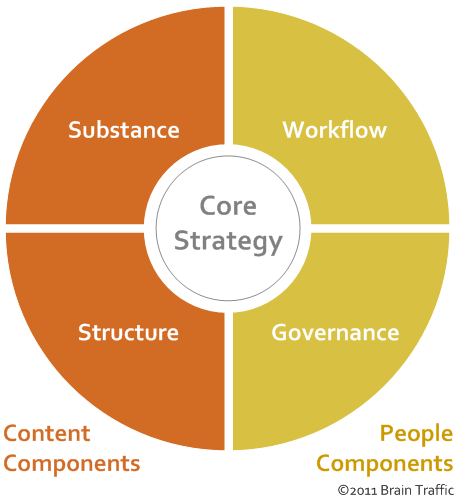
Kristina Halvorson, founder and CEO of Brain Traffic and co-author of Content Strategy for the Web will join us today (provided she can plow through 4-6 inches of new snow) to talk about the disciplines involved with making stuff up. Because that’s what content is: making stuff up. For a purpose. Making stuff up in accordance with a discipline, toward a specific end, to meet a particular business or social objective. That’s why content and writing go so well together: there’s nothing a writer likes more than stepping into a big idea and exploring the main streets, side streets and alleys and foot paths with words and images and video. Sometimes we have a map to start with. Sometimes we make up the map as we go.
Mostly we do both.
###
Image credits: Brain Traffic
Hey: Where did that voice come from?
Don’t be stung by inauthenticity
Some in my class are English majors and don’t mind wading into the waters of how words work. So when Content Rules (Handley and Chapman) talked about voice, a close reading ensued. Handley and Chapman lobby for authenticity in voice: voice is your own way of corralling point of view and word choice and rhythm (meter?) and pressing it all into service. Voice is making language work to express your words in your way. Voice is what you sound like when you talk (and we’re aiming for conversational writing in this class, so writing and talking sort of blend).
But voice is also something that gets companies and organizations all hepped up. To give your brand a personality by adopting a particular point of view (which leads to word choices/meter and etc.) is what companies and organizations seek these days. Voice helps a brand stand out from the crowd.
And one must stand out.
But this:
How can you write with an authentic voice when you are adopting the voice of the brand?
Good question, English-major-friend. Two answers come to mind:
- Sometimes we use voice in the service of some larger purpose. So we might submit our voice to the larger brand purposes and adopt as best we can the machinations of the brand voice. Some people may naturally embody a brand voice. The rest of us have to work at it. This adding and adopting is part of serving the larger goal you believe in (at best. At worst: you adopt voice to make coin for rent). This is the collision of craft, faith and service.
- If you find yourself stinging with inauthenticity as you write for your brand—look for a different job.
I’ve maintained all along that when people add their voice to a project, new things happen. Sometimes a new voice provides new electricity and a new approach to a time-worn topic. Even old-timers can learn stuff from new voices.
Of course, people must voice up.
If you don’t say what you’re thinking, the new thing just around the corner will sit there in silence—just around the corner.
###
Image credit: red-lipstick via 2headedsnake
Do The Dumb Things I Gotta Do (They Might Be Giants)
Memo to Myself: I cannot control what others think
Tell me again: why did we think we could?
Maybe you are a fan of They Might Be Giants (TMBG). Maybe you are not. I’ve just stumbled onto a wiki that attempts to decode the (typically) obscure lyrics of the two Johns.
Songs by TMBG should never substitute as sacred texts but, “Put your hand inside the Puppet Head” has something to say to those would begin to organize a community. That’s the task we’re starting this week in our social media marketing class and I’m trying to help us understand the old command and control ways of marketing have fallen by the wayside. By the way, it’s those old command and control notions that led to the monologues that made us think whatever we said was also what people heard. That has actually never been true—people will always hear my words in the context of their lives, which means mostly hearing what they want to hear.
In short, there is no puppet head. In this social media world there are transparent people who write from passion and experience. People who build communities because they want to. People who invite others in—but never force others in (a phrase that is almost nonsense today). What we can do is to assemble a clear picture of the people we want to join our party. And we can have an image of how these people interact, where they show up on the web, how active or inactive they might be in their webby habits. And from that we can begin to sort how our social media contributions might serve them and pull them toward this community we want to build. That’s the task today: Who are these people and what do they need?
By the way, there certainly are social media puppets out there: people without transparency who bark out some corporate message or ideological pap. But the blogosphere is not kind to them, because nobody out here likes being the victim of a drive-by monologue.
 Transparency gets heard and gets a toe-hold in people’s psyches. We’re shooting for transparency and the credibility it builds.
###
Image credits: TMBG via Vimeo, Button via UnrehearsedKickline
Behold the Power of 22 Words
Abraham Piper & the Second Most Shared Site in the World
Getting shared is the thing today. Maybe it’s always been the thing: interestingness traveled by word of mouth long before the share button came along. Producing (or pointing to) content that is so sticky, so memorable, that you feel like a hero passing it on—that is the point of sharing.
It turns out sharing can be measured.
And somebody, somewhere (Newswhip via The Atlantic), ran the numbers and found that Upworthy.com had the most Facebook-shares-per-article (and it is a huge number). But coming up second was Minneapolis’ own Abraham Piper with his 22 Words. Read Ned Hepburn’s story in Esquire: Second most shared website in the world. Twenty Two Words was way ahead of the likes of the Onion, Rolling Stone, Mashable, NPR and many other household names.
 My favorite quote from Mr. Piper—apart from building his empire on the tears of his children along with coffee and Coors Lite—was that his secret sauce was simply, “I can usually guess what my readers will like.” His sensibilities and his occasional wry comment makes his posts must-reads, sort of like the interesting uncle at the holiday table who says very funny stuff at just the right time.
Time after time.
Well done, Mr. Piper.
###
Groundswell Plus: Please Write a Plus-Sized Book about Today’s Social Media Opportunities
Beyond Li & Bernoff’s Groundswell
Groundswell was published by Charlene Li and Josh Bernoff in 2008 (Boston: Harvard Business School Publishing). I’ve used it a couple times to frame this new opportunity and give social media marketing students a sense of the possibilities of communication beyond liking a snarky comment, link or photo on Facebook. I’ll use the text again but I’m also prowling about for newer texts.
Groundswell is a grandfatherly text by today’s standards. Published (counting fingers: 9-10-11-12) more than five years ago and much has changed. I like the book for the authors’ optimism about building and maintaining communities. And that is precisely where it is starting to wear thin. It turns out building communities is a much more complicated endeavor that works best when flesh and blood people talk with flesh and blood people. The social media piece is a nice and useful add-on, but students need to see a larger picture.
I’ve got other texts that give details about best practices and content strategy. We’ll certainly discuss the disciplines of editorial calendars and fine-tuning their understanding of their audience and tightly defining what their audiences need/want. And, as always, we’ll write and share and write and share and learn what works for ourselves.
Groundswell is firmly focused on taking full advantage of business opportunities. That’s why I first started reading it and it may be why I end up with something else next time. My students tend to be a devoted bunch: they attend this Christian college and their writing (most are English students with a professional writing focus, plus a few journalism and business majors) bubbles up from deep theological streams. Many will say they have no interest in business right up to the point where they realize they actually have to pay off their school loans. That realization attenuates their post-college work vision. One my teaching goals is to help students start to see just how much those deep theological streams can pour through the world of work with all sorts of happy results (an income comes to mind, but also making a difference in real life).
What I’d really like is a Groundswell Plus. I’d like a version of Groundswell that paints a larger picture of the community-building opportunities. Perhaps Groundswell Plus tells stories from the Arab Spring (for instance) or Ai Weiwei and points readers toward organizing for social change. Maybe this plus-sized version of Groundswell could point readers toward unearthing social problems (along with business opportunities) that might respond to collaborative energies.
Because in the end, students want to give themselves to things that matter.
Just like the rest of us.
###
What Matters? Whatever She Says.
Ideology tells me all I need to know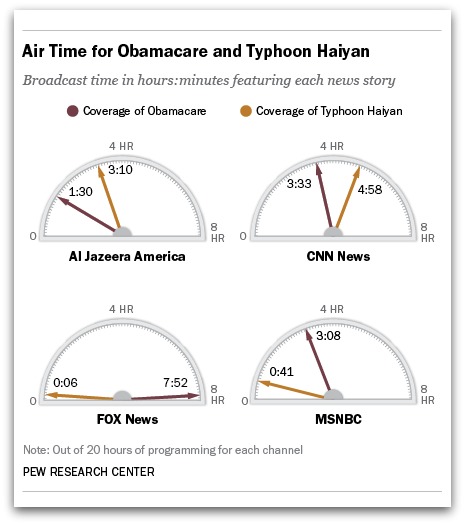
One curious thing about today’s entertainment mix is that we pick and choose where to get our news. And by “news” I mean the stuff happening in the world we want to know about.
Once upon a time the woman on TV with the engaging smile told me what was important at 10pm every night. Back in those old days the headline on the front page of the StarTribune also pointed at the critical big stuff of the day. And the people standing around the coffee machine at work confirmed what was important by talking about it.
Today we make our own choices—and unless we’re careful, we end up with a skewed version of the world. The Pew Research Center released a study of 80 hours of programming from four channels from Nov. 11-15:
The two channels with strong ideological identities in prime-time—liberal MSNBC and conservative Fox News—spent far more time on the politically-charged health insurance story than the overseas disaster. And the two organizations that built a brand on global reporting—CNN and Al Jazeera America, an offshoot of the Qatar-based Al Jazeera media network—spent considerably more time on the tragedy in the Philippines.
The panic machine called Fox News demonstrated that the Affordable Care Act rollout was much more important than the typhoon that claimed lives and property in the Philippines. MSNBC followed suit but with a bit more discipline. Al Jazeera America took a more fair & balanced approach to the two topics. You might argue that each organization was simply building their brand and giving their audiences what they sought. I agree. And I also think each organization continues to train their audience in what to want and what is important.
Humans are subjective beings so opinion and ideology always enter and inform our thinking and conclusions. Maybe the best we can do is to doggedly seek out alternate source of news, which is to say, purposefully hear from others (especially those different from us) about what is important. And given today’s multiplicity of channels, it would be a shame to think one organization can give a truly full perspective.
###
Image credit: Pew Research Center via The Future Journalism Project

 conversation is an engine