Archive for the ‘church is not an industry’ Category
I Wish More Churches Observed This Convenient Fiction: Outsiders Are Among Us
Outsiders seeking truth won’t settle for bland spirituality
 Our church is at its best when we say to ourselves there are people here kicking the tires of Christianity. I think it can be true, but in the church I attend, I rarely meet anyone who has not already bought the car. Still—don’t we all keep kicking the tires?
Saying there are outsiders lets us drop the clichés and insider language. It lets us jettison the assumptions about being good or put together. It makes us all a bit less stodgy and a bit more honest. Even the most deeply devoted person keeps thinking through the issues of her or his life where they are still kicking the tires: can I trust God in an economy that keeps swirling in the toilet? Or to guide my grown-up kid to make good choices? Can I still trust God when (perhaps) more years lie behind me than before me? Life constantly changes, of course. There is always more living than there is faith to meet the next challenge. But then we watch together for how God intervenes even with faith to move forward.
I like boiling down clichés and disposing of the club mentality that insider language inevitably fosters. But this is not the same as the traditional understanding of seeker-sensitive, where actual content is tossed aside in favor of a bland spirituality. No, Christianity has some barbs that are difficult to understand and hard to come to peace with. The key is to present the barbs honestly and admit we struggle with them too. All while hearing regularly from the ancient texts that have always informed the church. That is a text that speaks to any outsider willing to listen–and is the time-honored antidote to bland spirituality.
###
Image Credit: Max Streicher via 2headedsnake
Church Scattered Looks Different From Church Gathered
But it is still the Church

what of the church scattered?
I’m starting to wonder about the church gathered and the church scattered. When gathered, the church is governed by the authoritative voices elected/appointed that would seem to speak to/for the entire body. Pastors, associate pastors, sub pastors. Women pastors purposefully not called pastors (in the great Evangelical tradition of shell game authority).
But the church scattered…what of that? Are the pastors/elders still in control? Not hardly—the church has reconvened out in their work places where the docile congregation morphs to serfs, middle-managers and captains of industry. With varying levels of ability, authority, autonomy and knowledge. The church is dispersed like clockwork every Monday and there is no stopping that. What is the goal of the church when not gathered? The same: to display the manifold wisdom of God, as the Apostle Paul said. And perhaps the social chirps from the pocket (the Tweets received, the prayers sent by text, the blogged thoughts and updated Facebook statuses that indicated relationship) enhance the scattered church’s connections and saltiness out in the world.
The mission when gathered is to whoop it up over the God of the universe and the truth about Him letting us know Him. And to help each other grow in knowing God. The mission when scattered? Like oil in gears, or salt on food, or light scattering cockroaches on a dark floor: individuals act out the presence of God in direct contact with the corrupted and corrupting stuff of everyday life (which is to say, the human condition).
The church industry spends a lot of time working on and directing the gathered piece. But the scattered piece gets less attention, though there is a kind of osmosis assumed to be at work, where the context of church gathered gets translated to church scattered. But it’s always been up to individuals to sort that translation out.
What do you think? How is the church scattered different from the church gathered?
###
Image credit: Michael Jantzen via 2headesnake
Big Church
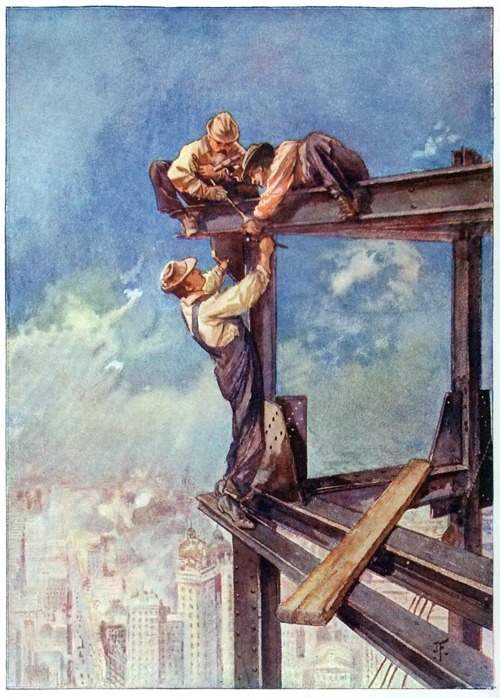
big church extends deep into the work week
There are big churches—but this post is not about large buildings and lots of people. There is the political big tent, which tries to draw together all sorts of people with diverse viewpoints. There is the Big Ten and the big top and the big bang theory and the Big Gulp—from which Mayor Bloomberg wants to save New Yorkers. This post is about none of those, though perhaps Big Bang is closest.
This post is about Big Church.
It’s not about size so much as messaging. Not about authority so much as a disbursing of gifts, talents, passions and mission. Not about one person’s vision and that person’s ability to pull others with him or her so much as it is about a silent listening of many to One, and each responding in kind.
Sometimes we need to state what something isn’t to figure out what it is (a kind of apophatic attempt, you might say).
I’m stuck on a quote from an old dead guy who wrote letters trying to help his readers recognize the big church already at work among them. I wrote about a couple of this guy’s quotes here, and I’ve started with all the “this is not’s” because I’m convinced we mostly don’t see what this old dead guy was saying. That is, we don’t see it, though it is there and vibrant and alive in ways that are still largely invisible to us.
Big church is an entity that communicates persistent care through all its parts. We may think the pastor is the voice of the church, but that’s not so. The pastor is one voice. But the voice of the church looks like words and action. It looks like words and action that extend deep into the work week, far beyond Sunday morning. Big church lives out a redemptive message while embedded in culture and work and relationship. And big church is constantly inviting. But not inviting to a place or a political party. Or to put on a narrow (or wide) filter. Big church invites people into relationship. And it invites people already in relationship to go deeper.
All this because the individuals who comprise the big church routinely step out of self-created subcultures—we’ve done so for centuries—as seasoning for the broader culture. Stepping out carrying God’s passion for other individuals, in all the many ways God has in mind. Big church seamlessly folds in “together” and “apart.” That’s why church is big. And certainly much bigger than a place you go for an hour on Sunday.
###
Image Credit: OBI Scrapbook Blog
Going to Church? Hear All the Voices

did you feel that?
Any pastor who cared would say the same thing: no solitary voice can ever speak for an entity as all-encompassing as the church. And except for the rare despot-in-training or the health/wealth preacher coercing you with anti-Bible blather to line his or her pockets, most leaders will say they want something like laminar flow, not just robotic followers.
Laminar Flow? Back when I wrote about mechanical heart valves we talked about the flow across leaflets and disks and how that flow of blood could have a cleaning effect or a stagnating effect.  Cleaning was good: it kept the mechanism moving. Stagnating—not so good: clots could form, which could impinge on the movement. The key was to design valves where flow was largely in the same direction. And that sounds like a bunch of conversations sprouting from individuals but moving in the same direction.
All-Encompassing? This notion the Apostle Paul talked about in some of his letters (like here and especially here) is far too large to leave in the hands of pastors and professionals and volunteer leaders. And it wasn’t just Paul: Old Testament dudes were saying the same things in different language and with different emphases. It takes an entire people—across ethnicities and nations and generations—to even begin to grasp the full story. An entire people writing the story with words and deeds and conversations.
This thing is big. Really big.
###
Image credit thisisnthappiness, RC Modelers of Laredo
What does a “social” church look like?
What Does a Social Anything Look Like?

hey-let's unlock our solipsism
We talk a lot about “social” but often marketers and corporate communicators practice the same old monologue and one-way messaging characteristic of the last century—they just shrink and divide their messages into packets of 140 characters and broadcast them through the channels people happen to be listening to at the moment.
For most of us “social” means only broadcasting through relatively new channels. We mostly don’t get the listening part of dialogue. This deafness comes from a deep place: this human tendency to see ourselves and our thoughts—our messages—as the axis for all that happens in the world. How could it be otherwise, given that we experience every part of life through our senses: the world comes to us as images, sounds, tastes, feeling and odors?
Certainly that is the case with profit-seeking entities like corporations. We monologue because we want people to buy our stuff. Same with churches: leaders broadcast what they want followers to hear and act on. Same with any organization.
3 Lessons and a Revolution
I’ve just finished my third run at teaching Social Media Marketing at Northwestern College and yesterday was my favorite day: when the students present what they learned from their social media excursions and community building activities. They learned:
- That the most tautly-orchestrated rhetorical strategy falls apart pretty quickly in the face of the opinions and interests of their audience. Students become completely captivated by hearing others respond to their words and ideas. These responses are especially enticing after years of writing papers only for the professor’s eyes.
- Try-Fail-Adapt was a motto we took from our texts and nearly universally adopted. This is the way forward with building communities using social media.
- That vague “interesting” titles and headlines don’t pull readers nearly as well as solid simple titles and headlines. And that putting a number in a headline produces a bit of magic. Something women’s magazines have practiced for decades.
One notion that threaded its way through the presentations was this subversive, revolutionary aspect of working with social media. When you look beyond today’s tools as just more broadcast channels and see that people are given a voice, the world starts to tilt differently. People with a voice. A voice that agrees with leaders. Or not. Voices that speak back to power. We’ve already seen those voices collecting around the Arab Spring, Putin’s Russia and our own Occupy movements. What will that look like as people slip into ownership of the church? Because it is sure to happen there as well. Will leaders learn to lead collaboratively and by pulling people toward them? Or will leaders rely on pulpits and authority structures for their power? And how long will that tactic last?
###
Image credit: Neatorama
Extreme Listening in a Congregation: Framing a Question and Listening for the Reply

and yet, sometimes it does work
Once upon a time a church had outgrown their facility and the leaders wanted to raise money to build. So they thought of a campaign and called it “Hearing from God.” In the campaign they asked members to pray about how they should give and then pledge toward the amount they heard. After several months of praying, along with weekly stories from the pulpit of people who prayed, heard and decided to give generously, the final day came when all the pledges were in. But the pledges did not cover the costs of the new building—not even close.
Did the “Hearing from God” campaign succeed as a marketing tool? Yes. The campaign focused congregational interest by tying growth plans with the expectation that this was God’s vision and God’s work. This tactic is nothing new to the human condition, whether we’re talking about starting a war, running for office, providing jet fuel for the pastor’s personal jet or gassing-up any other part of the church growth business The campaign worked exactly as planned: it helped elicit pledges from the congregation, pledges over and above typical giving.
Did the “Hearing from God” campaign succeed as a moment of corporate listening? No. And massively so. The congregation was asking “Should we?” while the leaders were asking “How much?” The end of the campaign revealed how different the two questions were, as leaders refused to revisit the what they actually heard from God. Instead they pushed the project forward, despite the seemingly obvious conclusions.
The multi-million dollar project moved ahead, but the twist on hearing and resultant lack of listening initiated a corrosive set of questions about leadership. Subsequent decisions about firing and hiring supported the growing congregational awareness that the entire church entity had been hijacked by a set of leaders pursuing private dreams. “Hearing from God” became a shorthand joke among the congregation for whatever current project leadership was pursuing. Over the course of the next two years, thirty-three to fifty percent of the long-term members leaked out the back door.
What does it cost to avoid hearing?
###
Image credit: x-planes

 conversation is an engine