Archive for the ‘Collaborate’ Category
Social Media: Not Hard. Not Easy.
Write What You Will
I’m struck by the opportunity social media presents to writers.
One of the stories I tell in my Social Media Marketing class is about the demise of The Morning Show on Minnesota Public Radio. For years I listened to Dale Connelly and Jim Ed Poole spin out their eclectic music selections and oddball humor. So did a lot of people.
Jim Ed Poole retired (and then, sadly, passed away) and then The Morning Show went away as well. Dale Connelly began a new show in a similar vein—Radio Heartland—with a blog as co-host. The blog served as that necessary conversation partner—certainly never replacing Jim Ed Poole—but keeping Dale engaged with listeners. Then, as is the way of progress and regress and corporate decisions, Dale Connelly was out of the job. Radio Heartland continued with the same eclectic music but without the oddball humor. I continue to enjoy the music of Radio Heartland.
And, no surprise, the faithful audience for The Morning Show followed Dale Connelly to his Trail Baboon blog. No music, just oddball humor. Now Dale is the news director at KFAI Community Radio in Minneapolis even as he continues to write for his still-growing audience.
I tell this story because it illustrates an opportunity about starting as a writer today. Since there are no gatekeepers on the Internet, a writer can write what a writer wants to write. A writer can take pages and pages to sort through whatever it is she or he has to say.
True: no one may show up to read it. The writing may feel like shouting into the wind, but the point is to keep going in an effort to sort what it is you have to say as a writer. Audiences form. Eventually—at least that is the hope.
But for writers just starting, social media presents an opportunity to hone a message and then tinker with the best way to present it. This process of sorting and honing and tinkering develops a set of valuable skills that are absolutely transferable to the world of commerce (and far beyond, into our creative lives). I will argue that this sorting and honing and tinkering with our messages is the lifeblood of any writer.
My students already understand this. They’ve all begun this process without any prodding from me. But we’ll push a bit on the sorting and honing and tinkering in the next few weeks.
Especially the tinkering.
###
Image credit: respectezcesingeot via 2headedsnake
Ahh: Back To Work
ListenTalk: The Promise. The Mission. The Chapters.
Dear Reader: A word, please.
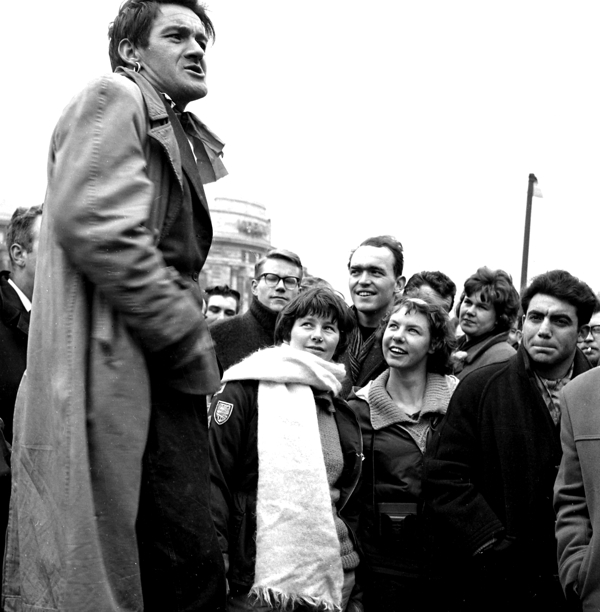
Speakers’ Corner, London, mid-1960s
Over the next few months I’ll be writing in response to a couple classes I’m teaching at the University of Northwestern—St. Paul. That means I’ll be dealing with questions and ideas that pop up in class. The classes tend to be quite collaborative and the students have interesting contributions that I may work out in this forum.
I’m also trying to work out how the notion of ListenTalk applies to the different audiences I work with as a copywriter. ListenTalk: Conversation is an Engine is built on a theological basis and is first a meditation on a new (or—I maintain—a very old) way of looking at how we spend time with each other. Over the course of the year I hope to enlarge the argument to help workers talk with bosses (for instance) and vice versa. I’d like to enlarge the argument so conservatives and liberals can put down their label (and libel) machines to engage in productive talk. I hope to work out the notion of commercial conversation so companies can begin to talk with customers in a way that treats people as rational collaborators versus emotive flesh-encased ATMs.
But first, and to bring a bit more focus on this initial argument, I present the promise and mission of ListenTalk, as well as the chapter synopses:
ListenTalk Promise:
Read ListenTalk and you will be stimulated to reconsider how even your smallest, most ordinary conversations are part of a much larger story.
ListenTalk Mission:
ListenTalk was designed to help individuals in faith communities see how God works through the most ordinary and common conversations—and to see how those conversations transform everything from personal calendars to cultural mandates.
ListenTalk Chapter Synopses:
- The Preacher, Farmer and Everybody Else. What do you expect from a conversation? Preachers preach and hope for the best. But farmers work the soil in a studied way that collaborates for growth. Meet five thinkers who have studied the ways and means and opportunities hidden under the surface of ordinary conversations. These five show that ordinary conversation is full of collaborative potential and regularly turns into some of the most important, creative and lasting work we can do together.
- Intent Changes How We Act Together. If we enter a conversation itching for a fight, that’s just what we’ll find. But we can change our intent. And one thinker shows a better way to engage in persuasion, while the apostle Paul shows God’s intent to pull us toward Him without a fight.
- How To Be with a God Bent on Reunion. The first thing to know is that conversation with God is not limited to a lifetime. Second: talking with God over a lifetime tends to change a person. Third: what does it look like to befriend, follow and serve a God whose full energy is spent on connecting with people?
- Your Church as a Conversation Factory. Peter found a way to incorporate God’s old words into a very new situation. Conversations among believers do the same, person to person, with world-changing results. How conversations emerging from within a church change everything outside the church.
- Extreme Listening. Extreme listening opens us to live in a larger story: Just ask Hannah. Five misconceptions about listening. Become an extreme listener by adopting three attitudes, four motivations and three strategies.
- A Guide to Honest Talk. How to walk your talk in three steps: 1. Show up. 2. Know this about people. 3. Join in and move out.
- Prayer Changes Our Listening and Talking. What really happens when we engage in conversation with God? Conversation with God as our model for talking with each other.
- Go ListenTalk. We are most alive when helping others see the true thing inside us. Marching orders and opportunities.
###
Image credit: Moyra Peralta via Spitalfields Life
The “Aha” Outta Nowhere
ListenTalk: Conversation is an Engine [One Page Summary of the Book]
Every once in a while you have a conversation that makes you say “Aha!”
I have those conversations too.

These are the conversations you did not see coming: The offhand comment from the guy in the next cubicle stuck in your brain. You turned it over and over and an hour later the phrase surprised you by unlocking some long-term vexation. The funny thing about these conversations is how they pop up at the most unexpected times—even from clear strangers—and how they can go on to solve pretty big problems. Even funnier: The person we are talking with can be entirely unaware of the importance of the thing they just said.
ListenTalk: Conversation is an Engine is all about where those “Aha” conversations come from and how to have more of them. In ListenTalk we grab conversation and hold it to the light and look at it from a few different angles. We look at what happens when we try to persuade each other of something (which we do constantly) and what happens when we listen deeply. In fact, three smart thinkers offer a refreshing take on what it means to really listen. These three show how the practice of listening gives back far more than it consumes. ListenTalk asks about what happens when our words get launched into a conversation. The answer is another surprise, because words tumble out more often as invitations than commands (even commands are really invitations because of how words bump against human agency). Words have the power to make permanent solid bonds in our physical world. They also have great destructive power.
ListenTalk spins a few ancient stories about how words worked when God talked with people and people talked with God. These old stories begin to make clear just how much is at stake in our ordinary conversations, not just for us but for generations to come. These old stories also hint at deep thick ways of forming insoluble communities that can withstand lots of pressure and still remain collaborative while becoming ever more hopeful. ListenTalk finally links ordinary conversation with the satisfying sorts of conversations humans were meant to have with God—and offers those conversations as a path forward.
[This is a draft summary of my book, which I’ll be shopping around to a few publishers shortly. Comments? Questions? Issues? Angry retorts?]
###
Image credit: imgur
28 Years Ago Today My Wife Got Married
I was there too. It was cool.
Cold, actually. And snowy and sunny and windswept–just like today.
Did I mention the cold?
 A lot happens in 28 years: life (three, to be exact, off seeking their fortune in the wide world) and death, sickness (some) and in health (mostly). For richer (considering the entire globe—yes!) or poorer (not much of this).
Besides being gorgeous and lively and devoted and way smarter than me, one of the many things I appreciate about Kris (Mrs. Kirkistan’s name outside this bit of the blogosphere) is this long, long conversation we’ve had—28+ years’ worth. About everything under the sun: from travel to faith to work to philosophy to money to house repair (and lack thereof) to all manner of family issues to, well, you name it. The concept of Conversation is an Engine likely started 28 years ago today. I just didn’t start writing until 2009. The skinny guy with the (now) hipster glasses had only the barest inkling of the possibilities.
Hey—here’s to marriage (raises coffee cup jauntily)! I’ll just step away from this keyboard now and tell Kris how much I appreciate her. In real time.
###
Image credit: Kirk Livingston
Better Listening in 2014
Wonder + Bigger + Spark

Robert Kennedy Funeral train, Harmans, MD, 1968
Three attitudes that can help us listen better in 2014:
1. Regain a sense of wonder. It’s easy to pose as world-weary: our culture rewards the cynic and pessimist as more experienced. But let’s remember the fun of being with people who have a sense of wonder. It’s why we take young kids to see Santa or fireworks or midnight mass or sunrise service: they have the capacity to take it in without the baggage and doubts that come from years of living. It’s a capacity to believe and it need not be lost forever. I still cannot quite believe our Toyota—or any car—runs at negative 13 degrees (Fahrenheit). Slow down to savor the cold, or the taste of Mrs. Kirkistan’s stew or fresh bread, or the smart thing your spouse or colleague just said—all these inch us back toward wonder. And that is where we belong: amazed at the life around us, listening to eagerly take it all in.
2. This thing is bigger than me. In a week or so I’ll start teaching a professional writing class at a local Christian college. One supporting thought I return to again and again is a theological notion that giving ourselves away pays far more dividends than hoarding and habitual self-focus. It’s a thought that pivots around the old notion of kenosis or self-emptying. There are some great ancient texts that work this out and it never fails to open a set of productive thoughts for me, especially when it comes to the task and opportunity of writing. Two take-aways:
- It’s quite possible, and even likely, that I learn more about myself by serving others and focusing on others’ needs than I do constantly obsessing over my own needs and wants.
- Listening becomes like a tasty meal when I start to wake to the needs and opportunities around me.
This is a message I need to hear all the time. I constantly forget this.
3. See the spark in another person. No one likes the notion that we may have responsibility for a complete stranger, but there is an undeniable pang when you see the homeless person on the corner with the sign. That pang means you are still human (Congratulations!). This notion also has theological roots in the old idea of hospitality to a stranger. That pang moves us to do something—or perhaps we hide from it. Either way, the pang is there. Those moments of recognition occur all day long and they are a call to honor and, yes, listen to, the humans around us. It starts by acknowledging the names of the people in our meeting and moves out from there.
If we grew in listening this year, interesting and possibly amazing things would happen.
###
Image credit: Paul Fusco via MPD
A better way to set goals
1000 words: from goal to discipline

Revisit and add detail as you go forward
Mrs. Kirkistan and I talked up goal-setting with our good friends over New Year’s Eve. Goals get a bad rap these days and I know why.
Looking back at my 2013 goals, I see they were too ambitious and without proper milestones. Even so, they served as directionals that propelled me forward as I revisited them over the course of the year. Mrs. Kirkistan and I will take an hour or so and talk through and pray through our goals before the weekend. Then I’ll post them on the back of the door into Suite 102 of the Livingston Communication Tower (high over Saint Paul).
As I labor to expand and then trim back my personal, business and spiritual goals, I realize more than ever this is not a static process. Much like the sketch above, I’m sort of blocking out broader desires and expectations while adding in definite dates and details for only a select few. But some of these goals fit better as disciplines than goals with timelines attached. For instance, the discipline of writing 1000 words a day has served me well over the past few years (thank goodness I never stipulated they had to “good” words—that kind of pressure would gum the works). That goal has turned to a discipline, which is great—the day feels wasted if I’ve not written 1000.
I have a goal of publishing ListenTalk: Conversation is an Engine early this year (that’s right, Juxtapose: How to Build a Church that Counters Culture is back to the original title, for those who follow such things), and I have a few milestones with dates attached to help make that happen. Last year’s goal helped me finish the book and get it to and back from an editor, though I severely underestimated how much time it would all take.
But some things just work better as disciplines, like ongoing exercise and the daily ground-breaking conversations with colleagues and potential collaborators.
How does goal-setting work for you? Rather than give up on goals because they are too hard, is there some useful piece you can take and make work for you?
By The Way: Check out this meditation on goals from The Pietist Schoolman: I like his challenge to focus out, rather than just in, on personal goals.
###
Image credit: changethethought.com via 2headedsnake
Chief Conversation Officer: So 2009
Still…what if we armed someone with authority and charged them with getting us talking?
Not just some C-level social media manager—I mean someone really interested in starting conversations throughout an organization and (especially) outside the organization. A sort of gadfly armed with an attitude and a purpose. That purpose would not be selling (it seems natural to put a garrulous salesperson in that position, doesn’t it?). The purpose would be collaboration. And the attitude? Open.
This chief conversation officer would not deploy monologue with all her contacts. Instead, she would be skilled in the art of the open-ended question. She would be relational and vulnerable.
Yikes!
But those are the building blocks of conversation.
Anyone intent on climbing through an organization will read those words and be repelled—“relational” and “vulnerable” represent the opposite of the power trip and pulling rank. Just think on the best, most productive conversations you’ve had and you’ll see you were free to say anything, you were pulled in by the enthusiasm of your conversation partner and by the crazy fun of participation. You were not worried about how you were coming across—which is the collateral damage of most boss-focused rhetoric.
The Chief Conversation Officer (CCO) will be a fearless talker and an optimist. He’ll be a mindful connector. He doesn’t know where the next terrific idea will come from. But he fearlessly pursues conversation with janitors and CEOs and middle managers and walks along with line workers to hear their concerns and ideas. The CCO is boundary-crosser and synthesizer: processing information from everywhere and spinning it into, well, gold.
Launching people left and right.
Sounds like a fun job.
And this: the Chief Conversation Officer could work effectively from nearly any actual position.
What if 2014 were the year of the Chief Conversation Officer?
###
Image credit: Ho-yeol Ryu via MPD
Listen Your Way Into a Larger Story
Start to stop. Stop to hear.
There’s an old story of a woman who could not get pregnant. Her rival got pregnant with unrelenting, vexing regularity. Read the story here—it’s from an ancient text many of us privilege as telling true stuff about the world.
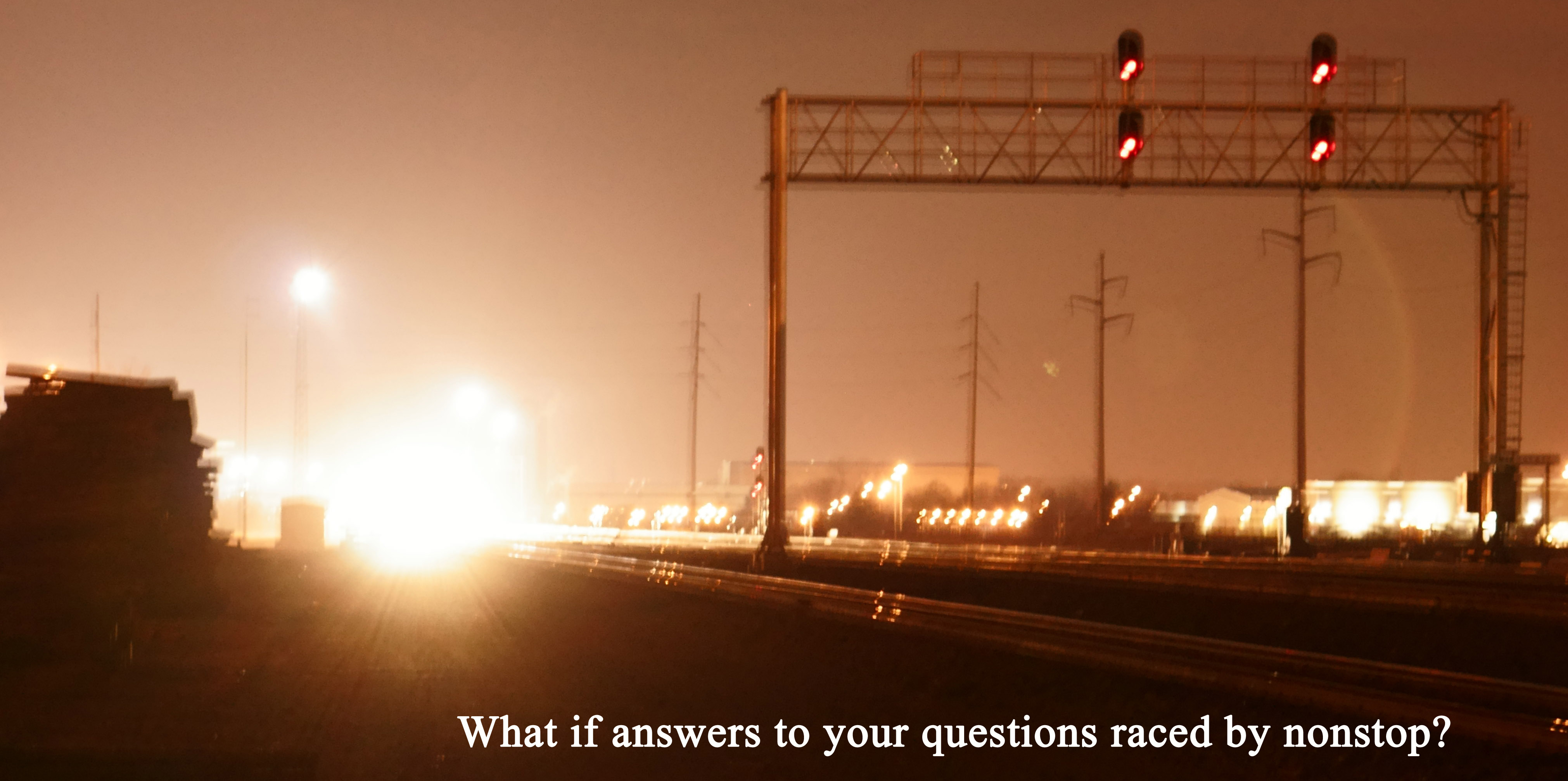
I keep returning to this story because of what it says about how desperation drives our listening habits. The truth is we don’t listen well. Often we don’t listen until we have to: maybe we need some information and it kills us to slow long enough for the clerk/cashier/spouse to spit it out. But we need that information to get where we need to go.
But what if we made a habit of listening? Intent listening. Close listening, rather than listening only when backed into a corner. What if we eagerly sought out answers in the conversations right around us?
What if the clue to the way forward after our recent lay-off was in the conversation we’ll have at 2:30pm with an old work colleague? What if insight for a growing doubt we’ve had about our faith was just inside the threshold of a chance conversation with an old friend? What if answers to our questions were spinning around us constantly?
That sounds like magical thinking, right?
The woman in the story prayed in her vexation and angst. She prayed so hard the feeble old guy watching her thought she was drunk. The old guy was no prophet and not all that well respected, still, his words formed an answer to the woman’s long-standing question. The story goes on to tell how the answer to her question was part of a much, much larger story with questions an entire nation was asking.
Questions and conversations can be a potent mix.
###
Image Credit: Kirk Livingston
Lou Gelfand: No More Complaints
How do you love an impossible task?
In darker moments I wonder what good lies in all the words produced, day after day—especially my own words. But if words serve only to remind or tell again the story of a bright spot someone saw, then maybe that is enough. Because bright spots shine a bit of hope.
Lou Gelfand was a bright spot for me.
I am a casual newspaper reader. I read the StarTribune and various news sources on-line. But the StarTribune has been my go-to, privileged (and sometimes angering) source for many years. Lou Gelfand was the long-suffering ombudsman/readers’ representative. For nearly 23 years he listened to complaints and reader’s rants and charges of bias (a countless number, surely). And then he calmly worked it out with words on paper.
Mr. Gelfand’s “If You Ran the Newspaper” columns were a must-read for me because he seemed fearless in taking colleagues and readers and the process itself to task. He aimed for resolution and made everyone mad as he did it. But there was something satisfying in his assessments. His words produced a sort of end-game where conflict and anger were addressed, if not always resolved.
Here’s Mike Meyers, former Strib reporter and friend of Gelfand, on the mood created by Mr. Gelfand’s assessments:
“He was a guy who often ate alone in the cafeteria because reporters were so damned thin-skinned,” Meyers said.
Mr. Gelfand was a kind of pivot point between audience and the communication machinery that was the daily newspaper. It was a no-win position from the beginning—an impossible assignment—which Mr. Gelfand moved forward with aplomb, sympathy and spirit.
His son called him “relentlessly fair” and Gelfand surveyed his own columns and found he split about evenly between backing the paper and the complaining readers.
Read Mr. Gelfand’s obituary here.
###
Image Credit: via Frank T Zumbachs Mysterious World
Photography and “built-in objectivity”
Hyper-collage from Jim Kazanjian
Lenscratch features photographer Jim Kazanjian, who makes images without ever picking up a camera. Instead, he pieces together found images to form mad hallucinations that are just a bit off—in the way a nightmare is all the more horrifying because it is so close to normal.

I like Kazanjian’s twist on objectivity (which is also a statement on what we privilege):
I’ve chosen photography as a medium because of the cultural misunderstanding that it has a sort of built-in objectivity.
Kaznajian’s aim is to “render the sublime.” His method is, well…
My method of construction has an improvisational and random quality to it, since it is largely driven by the source material I have available. I wade through my archive constantly and search for interesting combinations and relationships. Each new piece I bring to the composition informs the image’s potential direction. It is an iterative and organic process where the end result is many times removed from its origin. I think of the work as a type of mutation which can haphazardly spawn in numerous and unpredictable directions.
Kaznajian’s method is also a sophisticated comment on the creative process. Have a look at the full article: http://lenscratch.com/2013/12/jim-kazanjian/
###
Image credit: Jim Kazanjian via Lenscratch

 conversation is an engine