Archive for the ‘Communication is about relationship’ Category
Kristina Halvorson & The Discipline of Making Stuff Up
Content Strategy and Brain Traffic
Someone asked a perfectly reasonable question:
What is content?
Our Social Media Marketing class is composed of collegiates with a passion for writing and communicating. Whether from the Journalism/Communication school or from the English department, we’ve come together around this notion of producing content in pursuit of a vision.
So we write.
While “content” seems a rude way to talk about the deep thinking that goes into a paper on, say, the merits of determinism, it’s a term that works pretty well for less lofty/more human conversation. The kinds of conversation suited to inviting in semi-interested onlookers.
Content is the stuff we use to describe our vision for…whatever. If we’re building a coalition to alleviate homelessness, the content we produce will point to the problem, tell stories about real people, show the inadequacy of current solutions and keep offering attitudes that illustrate the need and humanity of the man on the corner with the sign. If we work for a company that makes implantable deep brain stimulators, our content will highlight the current science behind Parkinson’s disease, show current (inadequate) ways of dealing with the disease, harp on the benefits of such stimulation without hiding the downsides.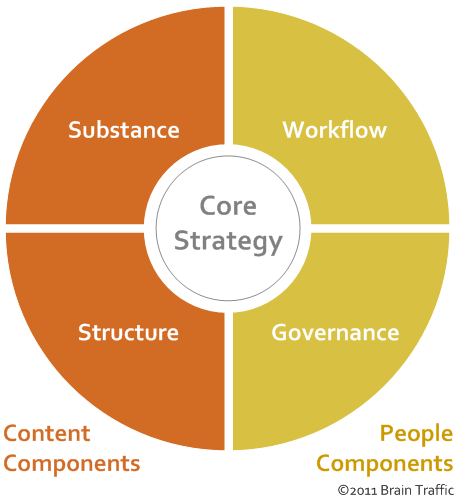
Kristina Halvorson, founder and CEO of Brain Traffic and co-author of Content Strategy for the Web will join us today (provided she can plow through 4-6 inches of new snow) to talk about the disciplines involved with making stuff up. Because that’s what content is: making stuff up. For a purpose. Making stuff up in accordance with a discipline, toward a specific end, to meet a particular business or social objective. That’s why content and writing go so well together: there’s nothing a writer likes more than stepping into a big idea and exploring the main streets, side streets and alleys and foot paths with words and images and video. Sometimes we have a map to start with. Sometimes we make up the map as we go.
Mostly we do both.
###
Image credits: Brain Traffic
Now #SOTU is a Spectator Sport
My Friend, With Whom I Disagree
Listening to Mr. Obama’s speech last night while following Twitter was a brand new thing for me—and much invigorating (so tweetful). To respond to phrases and gestures in real-time, and to see other responses, felt like I was hearing the speech in a room crowded with passionate and at times silly people.

GOP friends got all huffy and defensive and exercised:
While the other side went self-congratulatory:
What pleased me most was the rapid-fire dissenting opinions and funny stuff happening right before my eyes—in a way that actually helped me pay attention to the words. I like hearing both sides in real-time.
###
Image credit: @nick_pants via latimes
Hey: Where did that voice come from?
Don’t be stung by inauthenticity
Some in my class are English majors and don’t mind wading into the waters of how words work. So when Content Rules (Handley and Chapman) talked about voice, a close reading ensued. Handley and Chapman lobby for authenticity in voice: voice is your own way of corralling point of view and word choice and rhythm (meter?) and pressing it all into service. Voice is making language work to express your words in your way. Voice is what you sound like when you talk (and we’re aiming for conversational writing in this class, so writing and talking sort of blend).
But voice is also something that gets companies and organizations all hepped up. To give your brand a personality by adopting a particular point of view (which leads to word choices/meter and etc.) is what companies and organizations seek these days. Voice helps a brand stand out from the crowd.
And one must stand out.
But this:
How can you write with an authentic voice when you are adopting the voice of the brand?
Good question, English-major-friend. Two answers come to mind:
- Sometimes we use voice in the service of some larger purpose. So we might submit our voice to the larger brand purposes and adopt as best we can the machinations of the brand voice. Some people may naturally embody a brand voice. The rest of us have to work at it. This adding and adopting is part of serving the larger goal you believe in (at best. At worst: you adopt voice to make coin for rent). This is the collision of craft, faith and service.
- If you find yourself stinging with inauthenticity as you write for your brand—look for a different job.
I’ve maintained all along that when people add their voice to a project, new things happen. Sometimes a new voice provides new electricity and a new approach to a time-worn topic. Even old-timers can learn stuff from new voices.
Of course, people must voice up.
If you don’t say what you’re thinking, the new thing just around the corner will sit there in silence—just around the corner.
###
Image credit: red-lipstick via 2headedsnake
Do The Dumb Things I Gotta Do (They Might Be Giants)
Memo to Myself: I cannot control what others think
Tell me again: why did we think we could?
Maybe you are a fan of They Might Be Giants (TMBG). Maybe you are not. I’ve just stumbled onto a wiki that attempts to decode the (typically) obscure lyrics of the two Johns.
Songs by TMBG should never substitute as sacred texts but, “Put your hand inside the Puppet Head” has something to say to those would begin to organize a community. That’s the task we’re starting this week in our social media marketing class and I’m trying to help us understand the old command and control ways of marketing have fallen by the wayside. By the way, it’s those old command and control notions that led to the monologues that made us think whatever we said was also what people heard. That has actually never been true—people will always hear my words in the context of their lives, which means mostly hearing what they want to hear.
In short, there is no puppet head. In this social media world there are transparent people who write from passion and experience. People who build communities because they want to. People who invite others in—but never force others in (a phrase that is almost nonsense today). What we can do is to assemble a clear picture of the people we want to join our party. And we can have an image of how these people interact, where they show up on the web, how active or inactive they might be in their webby habits. And from that we can begin to sort how our social media contributions might serve them and pull them toward this community we want to build. That’s the task today: Who are these people and what do they need?
By the way, there certainly are social media puppets out there: people without transparency who bark out some corporate message or ideological pap. But the blogosphere is not kind to them, because nobody out here likes being the victim of a drive-by monologue.
 Transparency gets heard and gets a toe-hold in people’s psyches. We’re shooting for transparency and the credibility it builds.
###
Image credits: TMBG via Vimeo, Button via UnrehearsedKickline
Working Together: A Final Frontier
Talk Inc. Buries the BS Meter
Collaboration is hard for a lot of reasons. One reason is the power distance between people in a company. How can I say what I really think when I know my boss disagrees? Can I have a real conversation with an automaton who spouts corporate messaging and controls my salary?
Talk, Inc.: How Trusted Leaders Use Conversation to Power their Organizations by Boris Groysberg and Michael Slind starts with good intentions: to lay out this new challenge of interacting with employees as if they had something worthwhile to say.
But I should back up: old styles of management were about command and control: I’m boss so I’ll tell you what to do. And you’ll do it. New ways of thinking about the work of leadership and managing tout a more generous and collaborative approach to personal relationships. But these collaborative ways still have a hard time sifting down through the ranks of gatekeeping managers who intuitively see their mission as that of controlling others.
Talk, Inc. has a terrific vision, but the first section (three chapters on intimacy) is off-putting in that it quotes CEOs and VPs and various bosses at length, each talking about all they are doing to encourage collaboration.  But Groysberg and Slind may have done better to start at the other end: giving voice to employees who have been given a voice. As it stands, the first three chapters are a difficult slog because anyone who has spent time in a corporation will recognize the smarmy PR tone of the program-of-the-quarter. My corporate BS meter kept pinging into the red.
The book gets better, but all the way through I struggled with the “trusted leaders” part of the subtitle. For a book that intends to talk about the power of conversation, there is still an awful lot of command and control monologue. Whether it was the suits from Cisco or Hindustan Oil talking, it was hard to take their comments seriously.
 Talk, Inc. is, however, smartly organized into four sections (Intimacy, Interactivity, Inclusion and Intentionality). Each section has a chapter that plays out the vision, followed by a chapter that shows a company trying to carry out that particular part of the vision, followed by a “Talking Points” summary that helps the reader play it forward. The Inclusion and Intentionality sections offer more thoughtful reasoning and vision-casting for changing corporate culture so real conversation can happen. Groysberg and Slind offer solid examples of organizations that work hard at listening. But this is a story that really needs to be told from the “newly-voiced” perspective.
###
Image credit: Bill Domonkos via 2headedsnake
Ahh: Back To Work
ListenTalk: The Promise. The Mission. The Chapters.
Dear Reader: A word, please.
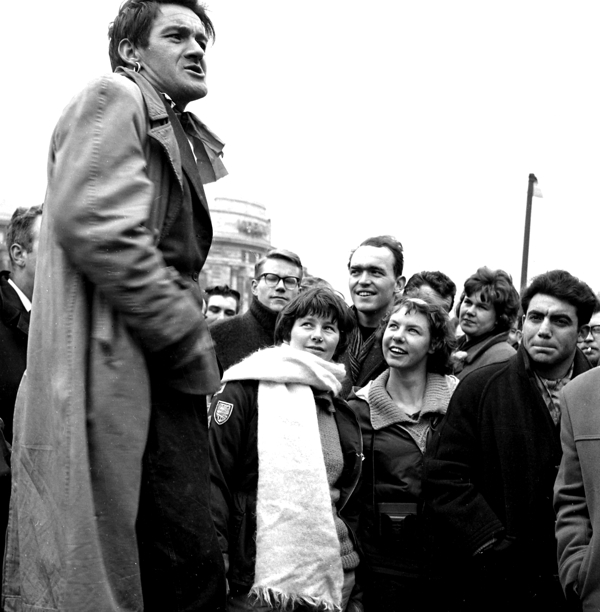
Speakers’ Corner, London, mid-1960s
Over the next few months I’ll be writing in response to a couple classes I’m teaching at the University of Northwestern—St. Paul. That means I’ll be dealing with questions and ideas that pop up in class. The classes tend to be quite collaborative and the students have interesting contributions that I may work out in this forum.
I’m also trying to work out how the notion of ListenTalk applies to the different audiences I work with as a copywriter. ListenTalk: Conversation is an Engine is built on a theological basis and is first a meditation on a new (or—I maintain—a very old) way of looking at how we spend time with each other. Over the course of the year I hope to enlarge the argument to help workers talk with bosses (for instance) and vice versa. I’d like to enlarge the argument so conservatives and liberals can put down their label (and libel) machines to engage in productive talk. I hope to work out the notion of commercial conversation so companies can begin to talk with customers in a way that treats people as rational collaborators versus emotive flesh-encased ATMs.
But first, and to bring a bit more focus on this initial argument, I present the promise and mission of ListenTalk, as well as the chapter synopses:
ListenTalk Promise:
Read ListenTalk and you will be stimulated to reconsider how even your smallest, most ordinary conversations are part of a much larger story.
ListenTalk Mission:
ListenTalk was designed to help individuals in faith communities see how God works through the most ordinary and common conversations—and to see how those conversations transform everything from personal calendars to cultural mandates.
ListenTalk Chapter Synopses:
- The Preacher, Farmer and Everybody Else. What do you expect from a conversation? Preachers preach and hope for the best. But farmers work the soil in a studied way that collaborates for growth. Meet five thinkers who have studied the ways and means and opportunities hidden under the surface of ordinary conversations. These five show that ordinary conversation is full of collaborative potential and regularly turns into some of the most important, creative and lasting work we can do together.
- Intent Changes How We Act Together. If we enter a conversation itching for a fight, that’s just what we’ll find. But we can change our intent. And one thinker shows a better way to engage in persuasion, while the apostle Paul shows God’s intent to pull us toward Him without a fight.
- How To Be with a God Bent on Reunion. The first thing to know is that conversation with God is not limited to a lifetime. Second: talking with God over a lifetime tends to change a person. Third: what does it look like to befriend, follow and serve a God whose full energy is spent on connecting with people?
- Your Church as a Conversation Factory. Peter found a way to incorporate God’s old words into a very new situation. Conversations among believers do the same, person to person, with world-changing results. How conversations emerging from within a church change everything outside the church.
- Extreme Listening. Extreme listening opens us to live in a larger story: Just ask Hannah. Five misconceptions about listening. Become an extreme listener by adopting three attitudes, four motivations and three strategies.
- A Guide to Honest Talk. How to walk your talk in three steps: 1. Show up. 2. Know this about people. 3. Join in and move out.
- Prayer Changes Our Listening and Talking. What really happens when we engage in conversation with God? Conversation with God as our model for talking with each other.
- Go ListenTalk. We are most alive when helping others see the true thing inside us. Marching orders and opportunities.
###
Image credit: Moyra Peralta via Spitalfields Life
The “Aha” Outta Nowhere
ListenTalk: Conversation is an Engine [One Page Summary of the Book]
Every once in a while you have a conversation that makes you say “Aha!”
I have those conversations too.

These are the conversations you did not see coming: The offhand comment from the guy in the next cubicle stuck in your brain. You turned it over and over and an hour later the phrase surprised you by unlocking some long-term vexation. The funny thing about these conversations is how they pop up at the most unexpected times—even from clear strangers—and how they can go on to solve pretty big problems. Even funnier: The person we are talking with can be entirely unaware of the importance of the thing they just said.
ListenTalk: Conversation is an Engine is all about where those “Aha” conversations come from and how to have more of them. In ListenTalk we grab conversation and hold it to the light and look at it from a few different angles. We look at what happens when we try to persuade each other of something (which we do constantly) and what happens when we listen deeply. In fact, three smart thinkers offer a refreshing take on what it means to really listen. These three show how the practice of listening gives back far more than it consumes. ListenTalk asks about what happens when our words get launched into a conversation. The answer is another surprise, because words tumble out more often as invitations than commands (even commands are really invitations because of how words bump against human agency). Words have the power to make permanent solid bonds in our physical world. They also have great destructive power.
ListenTalk spins a few ancient stories about how words worked when God talked with people and people talked with God. These old stories begin to make clear just how much is at stake in our ordinary conversations, not just for us but for generations to come. These old stories also hint at deep thick ways of forming insoluble communities that can withstand lots of pressure and still remain collaborative while becoming ever more hopeful. ListenTalk finally links ordinary conversation with the satisfying sorts of conversations humans were meant to have with God—and offers those conversations as a path forward.
[This is a draft summary of my book, which I’ll be shopping around to a few publishers shortly. Comments? Questions? Issues? Angry retorts?]
###
Image credit: imgur
Mike Spitz: Medicated for your Protection – Portraits of Mental Illness
Looking for traces of normalcy
Sometimes an image can help us have a difficult conversation. Mental illness is one of those topic areas we continue to have difficulty talking about.
Mike Spitz is a clinical therapist and photographer who set out to document the faces of people with mental illness. Here’s his process:
Despite their mental and physical deterioration, abandonment by friends and family, and their pathology, my aim was to capture the subjects’ humanity, dignity and any traces of normalcy. I was not trying to present them as “crazy.” I shot in a straight forward manner without unusual angles, blurring, or other tricks to create a madness “effect.”
Mr. Spitz shot photos on weekends and nothing was pre-arranged and the photos depended on the willingness and mental condition of the people being photographed:
Most of them were friendly, helpful, eager to participate, and lacking in the usual self-consciousness and inhibition of models and other “normal” or “sane” subjects.
Check out the full post at Lenscratch, which remains a daily must-read for me.
###
Image credit: Mike Spitz via Lenscratch
28 Years Ago Today My Wife Got Married
I was there too. It was cool.
Cold, actually. And snowy and sunny and windswept–just like today.
Did I mention the cold?
 A lot happens in 28 years: life (three, to be exact, off seeking their fortune in the wide world) and death, sickness (some) and in health (mostly). For richer (considering the entire globe—yes!) or poorer (not much of this).
Besides being gorgeous and lively and devoted and way smarter than me, one of the many things I appreciate about Kris (Mrs. Kirkistan’s name outside this bit of the blogosphere) is this long, long conversation we’ve had—28+ years’ worth. About everything under the sun: from travel to faith to work to philosophy to money to house repair (and lack thereof) to all manner of family issues to, well, you name it. The concept of Conversation is an Engine likely started 28 years ago today. I just didn’t start writing until 2009. The skinny guy with the (now) hipster glasses had only the barest inkling of the possibilities.
Hey—here’s to marriage (raises coffee cup jauntily)! I’ll just step away from this keyboard now and tell Kris how much I appreciate her. In real time.
###
Image credit: Kirk Livingston

 conversation is an engine