Archive for the ‘Communication is about relationship’ Category
Quiet Leadership by David Rock. How to Help Someone Have an “Aha!” (Review)
Talk your friend into the answer she already knows
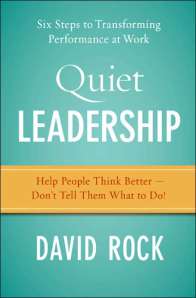 How do you help people connect the dots in their work lives…and in the rest of their lives? Turns out there is a lot we can do. And our primary tool is conversation. In Quiet Leadership, David Rock gives an overview of (relatively) recent neurological findings to show how our brains remain plastic, that is, moldable and changeable, long after childhood. It was once thought that at some point in late childhood our brains stopped—well, it’s not that they stopped growing, but seemed to create new neural pathways with less frequency. That thinking was all wrong. The truth is our brains are capable of growing new neural pathways all the time—new mental “wiring.” And by calling it “wiring,” Rock hints at the mechanics of how we help each other connect previously unconnected thoughts and motivations. He works at changing our mental wiring using questions about our thinking. Helping people find their own answers is light years more effective than telling someone what to do.
Like most books written for the business market, Rock presents a tidy set of steps to follow. Quiet Leadership has six steps. Each step has a chapter or section attached, so there is a lot of very practical, very interesting information for each. I outline these steps below because after reading the book and getting a sense of the potential, I’m curious to remember and try them:
- Think about thinking (focusing on how your conversation partner is thinking about the issue troubling them)
- Listen for potential (listening with a belief your conversation partner already has the tools for success)
- Speak with intent (Be succinct. Be specific. Be generous.)
- Dance toward insight (Conversation really is a kind of dance)
- Permission
- Placement
- Questioning
- Clarifying
- CREATE new thinking by exploring:
- Current Reality
- Explore Alternatives
- Tap Energy
- Follow up (Renewing and restoring the motivational connections by checking in later)
You may be skeptical of tidy steps. You may think “dance toward insight” is too over-the-top. I agree. And yet there is something in what Rock says that speaks to the reality of any conversation. Conversations routinely take off in crazy directions. Conversations often start with a need and we immediately feel helpless to meet the need: we don’t know all the details. Even if we did, we don’t know how our conversation partner is really thinking about the issue.
Rock provides a way to probe thinking (I like how he asks permission to probe) to not only help a person find solutions, but also to help a person be motivated to act on the solution.
I’ll use this book as I teach, with clients, and in general conversation. I highly recommend it.
###
Dummy’s Guide to Conversation #9: Say it Out Loud To Get It
 A pastor friend once wondered why the congregation didn’t know this certain fact he had mentioned in a sermon. My friend was under the notion that people listen closely to every word of a sermon. I am convinced people do listen—just not to every word.
I know this because I have taught college students and mistakenly thought that the wide-open eyes and direct eye contact meant they were listening. It took me until my first test to realize how mistaken I was. Direct eye contact is as much an act as appearing to type notes while facebooking friends. Students and all of us easily adopt the outward behaviors that allow us to escape miles away to play on the beach while the person in front persists in boring monologue.
But a conversation is a different environment than a lecture or sermon. Don’t let your conversation partner bore you with abstractions. Challenge them. Question. Ask. This is the very nature of conversation and it fits with how we understand anything: we need to try an idea on for size to sort out whether it fits us or the situation.
Trying an idea on for size looks like talking.
We must turn something over verbally to begin to understand it. It’s just how the will is connected to the brain—through the voicebox. Not exclusively, sometimes we get it without saying it or asking. And sometimes writing a note helps in understanding (that’s often how it works for me). But make peace that people need to respond in one way or another to truly begin to understand something.
This is part of the reason lectures can be so ineffective.
###
Image Credit: BLU (street artist from Bologna Italy) via 2headedsnake
18 HBR Finalists on Redistributing Power
It Is Written: The M-Prize and You
 For some time I’ve wondered what leadership will look like when the power of monologue is finally revealed as the empty shell it always was.
I’m not alone with that question.
It seems the folks running the Harvard Business Review have teamed with McKinsey to incent people to rethink “the work of leadership, redistributing power, and unleashing 21st century leadership skills.” The result is a series of case studies that should prove interesting—and not just to folks in the leadership industry.
I’ve not read any of these 18 articles but I plan on reading them all. I’m interested because the more we learn about how to build conversations that free our best thinking, the more likely we are to innovate. And the more likely we are to find ourselves living out our vocation. And the more that happens, the more better everything gets.
Yesterday I stumbled on an ancient text that presented an insight on the very kind of leader the M-Prize hopes to unearth. The text talked about a very unusual leadership skill set: This leader is equally at home encouraging the worker in pain as he is furthering the cause of justice. This leader can fan the dying embers of a person’s passion even as she moves earth’s largest causes forward. No trampling on others in an upward climb for this leader.
If you stop by Conversation is an Engine with any regularity, you know that a theology of conversation exerts a powerful gravity around here. We have this hunch that people were made to be in conversation and that we become fully human as we engage in conversation. And more: conversation may be a part of any knowledge we lay claim to.
Naturally, there’s a lot more to say about this.
But the leader who understands the power of conversation and works at interactive collaboration rather than straight-line order delivery is the leader poised to succeed.
It is written.
So—Kudos to the HBR/McKinsey folks for their vision.
###
Image credit: actegratuit via 2headedsnake
Church: Neither Benign Social Club nor Political Hack
One Approach to Juxtapose
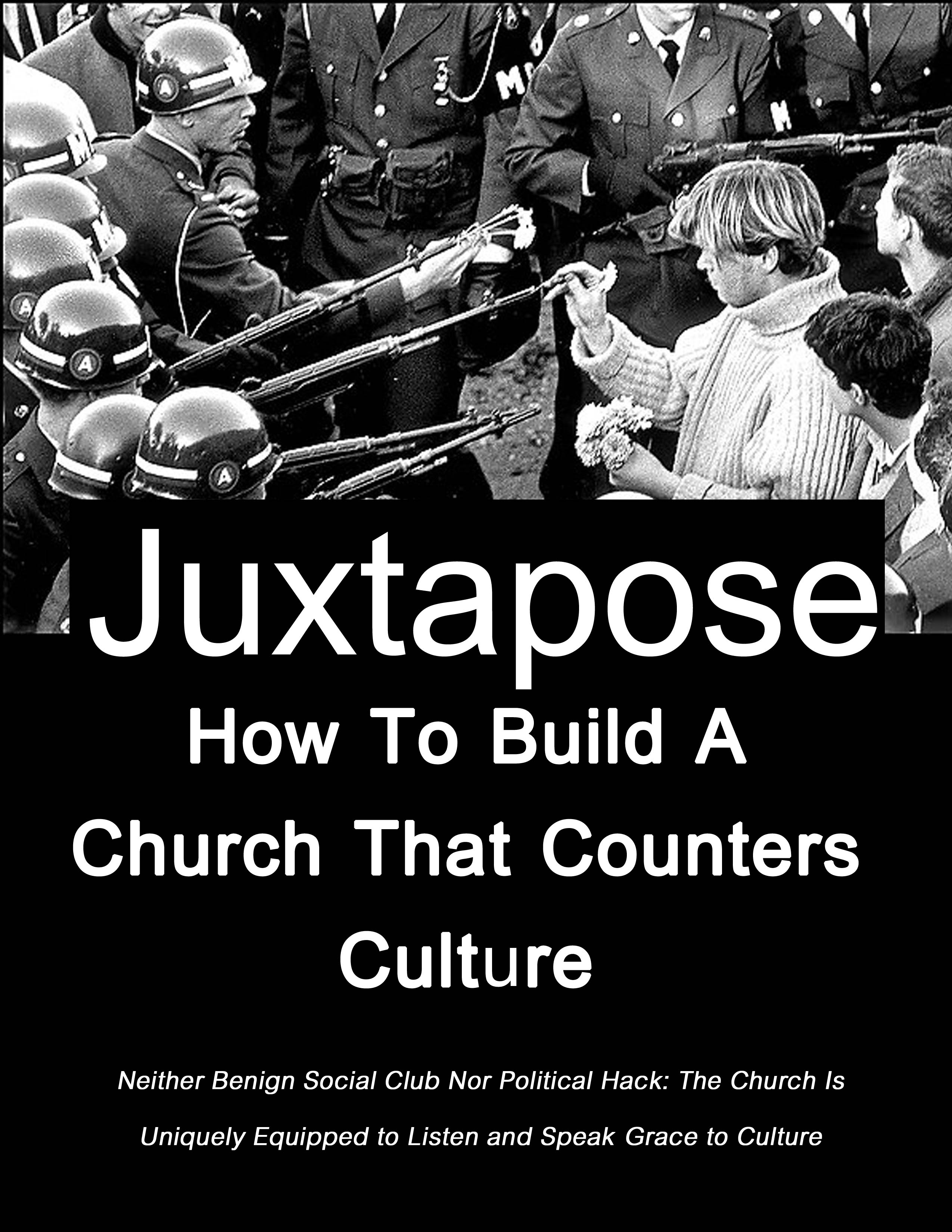
This is one concept as I work out the marketing messages for Juxtapose: How to Build a Church That Counters Culture.
If browsing in Barnes and Noble, would you stop and handle a book that looked like that?
###
Image Credit: Unknown. Do you know?
John: In the Can or Canned?
Termination Tuesday Is A Loser for Everyone

Or leaping off the can?
Monday’s StarTribune story by Thomas Lee on Termination Tuesdays at Best Buy contained this jewel of a quote by a survivor:
“Whenever someone leaves their desk, we think that person just got laid off, when he or she might just be going to the bathroom,” said one surviving employee who requested anonymity because the individual was not authorized to speak to the news media.
I worked like at a place like that for a time. With astonishing regularity we would be in a meeting, the door would open and the director of sales would pop his head in long enough to say,
“John Smith is no longer with the company.”
Any question (“Where is John Smith?” / “Where did John Smith go?” / “What happened?”) was met with the same phrase repeated:
“John Smith is no longer with the company.”
And sure enough, post-meeting, John Smith’s desk was cleared and his car was gone from the parking lot. In my year and a half with the company, this happened at least a dozen times.
It was unnerving.
I understand the confidentiality issues, but some sort of communication would have been helpful. Of course, among the survivors, there was all sorts of whispered communication, rumors, speculation and “Who’s next?” The regularity of employee disposal caused everyone to freshen their Plans B, C and D. With no explanation, loyalty to the firm was tenuous at best. When I finally left the firm, I asked the director of HR what it was like to fire so many people. She rolled her eyes and said it was the worst thing she ever had to do. There was a whimsy to the job destruction that had nothing to do with industry consolidation.
I’ve seen consolidating industries as well. It’s just as unnerving, though the communication is dour though more straightforward. I started with Honeywell just before the axe started swinging and many thousands lost their jobs—but at least we all saw the axe swinging closer and closer.
Whether job destruction happens through managerial whimsy or industry consolidation, employees walk on thin ice for so long that work, relationships, craft and loyalty all submerge.
Unfortunately, that is the guiding business ethos of the day: employees are another capital expense. And when things get tight, well….
My only plea would be for as much open communication and dialogue in a company as possible. And it doesn’t hurt for employees to continually sharpen their craft as they ask, “What next?”
###
Image credit: dotroom via 2headedsnake
Everybody Attends the School of Hard Knocks
Grandad’s knowing was not so different from my own
What knowledge works best?
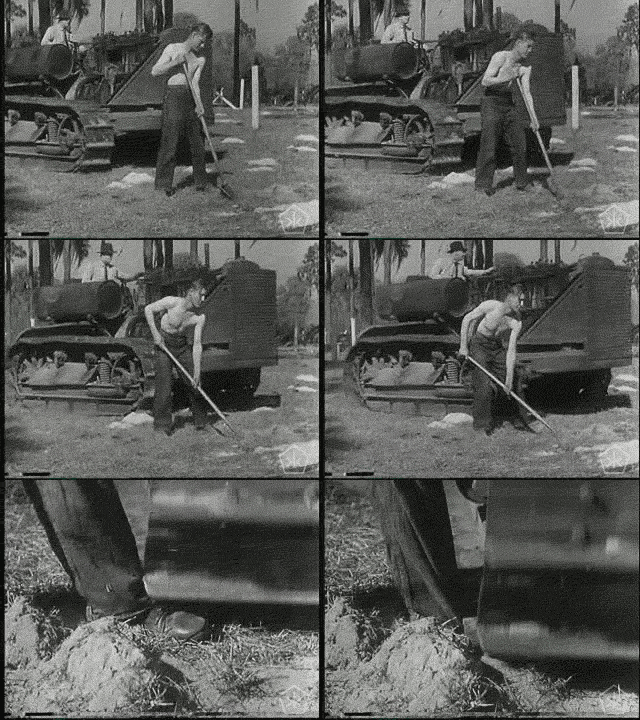
My grandfather, when faced with the schools and degrees and academic pursuits of his grandchildren, would typically say he went to the school of hard knocks. He grew up in the great depression and was on speaking terms with want. In the Navy he literally experienced hard knocks—one of which resulted in a metal plate in his skull. Later in life he was something of a salesman and generally learned by doing. His was a kind of knowledge easily passed on because it relied on behavior and action and movement. You could see what he did and you could do it too, or at least try to.
Same with my father: what I know about fixing stuff I learned from watching Dad. It takes me longer, or course. And I fail several times before I finally succeed (if indeed, I ever succeed). And, yes, the occasional plumber’s word gets uttered during the fixing.
Walter Ong wrote about the transition from oral to literate cultures. He noted that knowledge passed verbally was quite different from locating knowledge on a page. One fatality of the movement from oral to literate culture was that learning became a more isolated thing rather than a thing we did together:
In an oral culture, knowledge, once acquired, had to be constantly repeated or it would be lost: fixed, formulaic thought patterns [that is, clichés] were essential for wisdom and effective administration. (Ong, Walter J. Orality and Literacy: the Technologizing of the Word. NY: Routledge, 1993. 24)
Today our schools consist of lots of reading (which is good, which I applaud) and some hands-on. But in generations past there was not so much opportunity for spending a few years in college, let alone graduate school. People learned from each other any way they could. Apprenticeships helped, and helping Dad build a wall or a house—all these were the stuff of learning.
It seems to me still that experience is the best teacher. Not that books aren’t great. I’m a committed reader. But the best, most useful knowledge, the kind you can pass on to someone else, comes from information plus experience. Some mysterious forging takes place in the cauldron of reading + doing + telling + interacting with others. The result is a very strong knowledge that is also highly communicable.
More than once I’ve heard business owners and recruiters say they favor those who have experience in their field compared with those who go directly from bachelors to masters to doctorate.
Once the information we’ve read becomes something we do with our hands or something we can communicate to someone else, it becomes very useful indeed.
###
Image credit: Okkultmotionpictures (American Red Cross, “Why Not Live”) via 2headedsnake
Are You a Philosopher or a Popularizer?
Must I choose?
 In recent conversation with a local philosopher and food writer, we got to talking about the work of a philosopher in the world today. There’s teaching, which employs academic rigor to help students understand where philosophy has been and what it has been up to. There’s research, typically a subset of teaching, that sorts truth from fiction and sometimes swaps the two. And then there’s, well…that’s it. That’s what a philosopher does in our culture.
Teaches.
Teaches rarified stuff only a few understand and even fewer care about.
Which is not to say philosophy is not happening all over the place.
I’ve begun to argue we’re all philosophizing all the time. We’re not all at the highly abstracted levels represented by academic philosophy. But we’re all in the business of making meaning. Most of us don’t much think about it: once we’ve figured out the basics of family and job and faith and community, the business of meaning-making largely runs on auto-pilot. Until we get cancer. Or age. Or lose a spouse.
Or see a sunrise.
The more questions we ask in everyday life—the less we take as a given—the more life we experience. This is the wonder of being amazed at the small connections that occupy those making meaning every day. Which should be all of us.
My recent conversation turned to the author Alain de Botton, who I described as a philosopher but then back pedaled. We allowed he was certainly a popularizer. I’m a fan of de Botton. I like the places his books send me and the meaning-making tasks he introduces. I also like to read Damon Young, the Australian who is a bona fide philosopher and card-carrying popularizer (meaning only that he regularly publishes philosophy columns in Australian newspapers).
I’m not sure so a philosopher cannot also be a popularizer.
I’ll argue my friend’s food writing displays a philosophical bent even as he courageously walks into the smallest, diviest joints in the metro. I’ll also argue that the ordinary conversations we have with each other, the ones where we try to sort out the details of life together, are themselves often instances of practicing a sort of popular philosophy.
Ordinary conversation is the very stuff of thinking together.
I hope it becomes more popular.
###
Image credit: Via 2headedsnake
Ownership Begets Engagement
Is it busy-work when you steer your car?
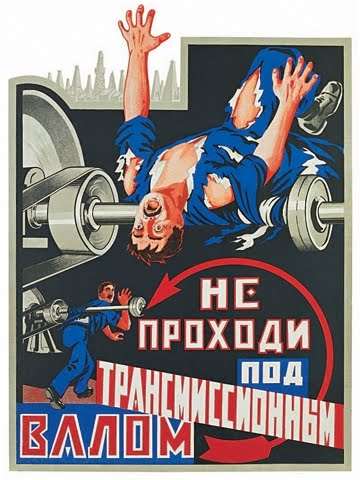
Still hard to beat the old Soviet work posters for sheer motivational energy
My client needs to keep operators engaged over an entire eight-hour shift. Steve explained how training goes: the first part of the shift passes with new operators entirely engaged. All the moving parts are fascinating and mesmerizing. But after the first three hours, or the first five hours, when the process seems trouble-free, boredom sets in. Nothing unusual happens. Operators start to look away.
It’s when the boredom sets in that danger starts to rise.
Despite redundant built-in safeguards and automated alarms, the process could easily suck in a digit (for instance) and then an arm and then well, it can quickly become a nasty business. Or more likely, a small knot escalates very swiftly to ruined product.
So: vigilance. But how to help employees stay engaged?
It turns out there are all sorts of small tasks required to run the machine. Routine checks performed on schedule, walking up and down the football-pitch sized machine can help ward off those nasty moments. Those nasty moments are not inevitable.
Keeping people engaged is a challenge because it is a much broader topic than just for operators at a manufacturing plant. We all deal with it.
When I teach I try to change things every 15 minutes. From discussion to exercise to small groups to video. “Let’s move our desks together for this next section,” I might say. And just getting up and moving is sufficient to bring to get a college student’s mind back from the Bahamas (if only for a moment).
There are certainly tricks that can seem to encourage engagement. But longer-term, I would argue that ownership is the best secret-sauce for building engagement. When the operator feels she owns the process, that it is hers, she watches very carefully. Same with any employee: let them own their process from inception to outcome, and they become very engaged. Take away their ownership with micro-managed short orders, and you lose the engagement. My most engaged students are those who understand how the assignments and class discussions mirror the real process outside of class. Their understanding and perspective on the small tasks helps them own the process.
###
Image credit: via Copyranter
Please Write This Book: How To Be Properly Peripheral
A word for the 99%
Not everyone can be at the center. Not everyone is the leader, the big cheese, the boss. Some dwell on the fringe. Work, neighborhoods, any given party, hey—even families have members who are more comfortable sidling toward the exit.
In these posts I’ve written that the church is better off not being in the center of things: we do better speaking in from the periphery. Give the church power and it behaves like anyone with power: making the rules and silencing the voices that disagree.
But purposefully peripheral? That’s a hard case to make in our culture, where fame is everything. Especially since most of us struggle with a mild solipsism: do you or your pet poodle or your Prius remain when I walk out of the frame? I’m not so sure. I only know what I know because I am at the center of everything.
Consider: the leadership industry devises all sorts of ways to help people pull themselves up by their own bootstraps so they become the center point, the pulpiteer for their organization. The respected voice, influencing others, perhaps (sinister hope) controlling others. That’s the favored spot—am I right?
But purposefully peripheral? There’s a pretty compelling theological argument for looking for ways to serve rather than control. Please write the book about how that argument unfolds for the 99% of us who are workers rather than rock stars. Please write about how our small daily actions have an impact. Please give me a vision for how the quiet, mostly unnoticed work is really the glue that holds society together and is also—quite possibly—the neurotransmitters of divine action. Tell me again why listening trumps talking most of the time.
I’d read that book.
I’d buy that book.
###
Image credit: Ed Fairburn via 2headedsnake
On Being: One Shining Moment for Talk
Krista Tippet, David Gushee and Frances Kissling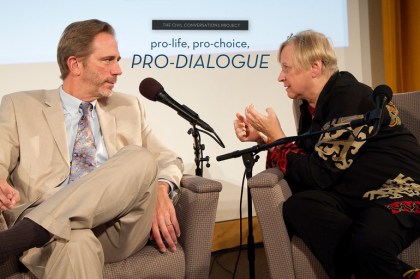
On Being recently broadcast a 51 minute conversation entitled Pro-Life, Pro-Choice, Pro-Dialogue. The recording includes a bunch of great moments and thoughts about communication and conversation as David Gushee and Francis Kissling each have their say and then tell what they’ve gained from the other side of this deeply divided topic.
I need to listen to the entire conversation again.
But toward the end of there was a moment where Ms. Tippet asked about the paradox of passionately clinging to what you know is true even as you reach out to understand what your opponent/conversation partner says/thinks/feels. There is a growth that happens, a change. It is not a giving away of passion or the rightness of the cause, but a deep concern that emerges. Here’s Mr. Gushee:
…after the Princeton conference in 2010 I felt clearer [about the] the position I had going…. But also I was more clear about the intelligence and the love that motivated the people on the other side too. And I respected that…. (~43:30 to 44:01)
There is a mistaken fear about dialogue that says if I engage with another person who does not believe like I believe, I run the risk of losing what I believe. But most people find the opposite to be true: passion grows deeper and something else is added: an understanding care about the other person. The passionate divide may remain, but surrounding that divide is care for another. And that begins to change everything.
This seems to me a shining moment.
A moment many of us could pursue.
###

 conversation is an engine