Archive for the ‘Communication is about relationship’ Category
Success Looks Like What You Measure Every Day
Success also looks like what you say in ordinary conversation
What are your gauges of success?
 Does success look like sitting behind the big desk in the corner office? Perhaps it looks like podium in front of a collection of esteemed colleagues. Or maybe success looks like owning your own company or cabin or cabin cruiser or cabinet full of liquor.
We all hold these success images in our brains, even if we’ve never actually explained them to ourselves, let alone anyone else. And yet those images shape where we go.
It’s worthwhile asking where those images lead. Where does your picture of success lead your work or writing or relationships? Keep that question abstract, at a level that cannot be measured and which shows no progress, forward or back, and the image still has power to direct, but more like a mirage.
But when we assign numbers to our image of success, and when we look at those numbers daily, things start to change. Especially when we have taken our big dreams and broken them into day-sized goals. Then our progress (or lack) is obvious. Now we see clearly because the numbers on the scale don’t lie. I’m a numbers person—I measure all sorts of stuff, from writing goals to minutes of exercise (I wish I could write “hours”) to weight (Oy!). Those numbers remain as a cold slap in the ego.
Today I found myself explaining to a new friend one goal for this blog and for the work I do: I’d like to connect work and faith in a way that I’ve not seen before. I’d like to recognize work as much, much more than a platform for verbal persuasion. The old models of integrating work and faith seem more about dropping preachers into the hostile, alien territory of commerce so they can set up a church service. As a boss, I would not welcome such integration (we’re here to work, after all).
Instead, I’d like to convince all of us that the work itself is chock full of rich meaning and is actually part of why we were put on earth. I’d like to connect our work to how we were made to our service to others (in agreement with the inveterate letter writer), which all connects back to the One who put us here.
I’ve just told you my (still abstract) image of what success looks like. I maintain that telling our image of success is another kind of measuring stick. Even if the person we tell never holds us accountable, we have said it aloud and now we know for sure one more dimension of that far off land called success.
###
Image credit: 2headedsnake
Dialogue is a Scenic Bypass: Dummy’s Guide to Conversation #12
Conversations Are Peaks You See From
 Monty Python funnyman Michael Palin has a series of travelogues that have entertained the Kirkistan household recently. Palin’s trip through the lands that were once Yugoslavia brought back memories of that brutal war even as the screen showed a land seemingly resurrected from all-out destruction.
Get the series from Netflix.
Palin does more than just comment on what he sees. Around Sarajevo, he traveled with a team going over the land inch by inch (literally, almost using a toothbrush) to clear mines that remain. Palin also traveled with a team of puppeteers doing shows at local schools to warn kids not to walk in the woods. A walk in the woods brought a high likelihood of getting blown up by a mine. No one walks in the woods around Sarajevo.
The videos are from 2007 and I hope it is safer today in Sarajevo.
Not long ago I wrote about dialogue as a place. A conversation yesterday reminded me of how quickly I can find myself in a different land, suddenly seeing things from an altered perspective—a sort of mountain top view. A view I had not anticipated, but that revitalized me deeply. I was talking with an author about her experience of writing for an academic audience versus writing for a more popular audience. She mentioned her faith that an audience will show up. To me that statement is a mark of true faith.
Our conversations are not unlike the people Palin meets. Even if we are talking with those we think we know, we can be surprised by the different perspective that suddenly dawns on us. Perspectives that can change everything. But, like Palin, we need to be on the lookout for the new thing. Can we cultivate an openness to seeing things differently? And can we honor how the person before us sees things differently?
###
Image Credit: tonsofland via 2headedsnake
DIY Drama Queen: a Cop, 2 Boots and a Homeless Guy
Tell Your Old Story in Today’s Conversation
 Not so many days ago a New York cop bought some boots for a homeless, shoe-less guy. The photo went viral because it was remarkable—stuff like that doesn’t usually happen. The telling of the story warms the heart and we want to share it.
Communication-types talk endlessly about stories and narrative and narrative arc. All this literary-criticism lingo has made its way from academia through the land of communication and advertising and out into mainstream speech of the news anchor, for instance. Behind all this talk is the simple notion that people respond to stories.
Because people respond to stories, we give assignments to our outward facing employees to snag potential customers and engage clients with precisely those stories that feature our product or service in a key role. Maybe the product saves the situation. Maybe the service is a vehicle of freedom. Certainly the product enriches the identity of the people using it.
But what about inside the company? Where are those engaging narratives in our ordinary, daily conversations? Does story have a place in our workdays? Should it?
One medical device company I worked for held a company-wide meeting around this time of year where patients came on stage and told stunning stories of how they could now walk (or stand or eat or breathe) again. They talked about how their lives were changed by the very products we all worked on.
And we all got weepy.
But ordinary, daily conversations produce no such tears—how could they? We’re all about work and getting stuff done, after all. We’re not here to tell stories. But some smart bosses are telling larger stories. Some meeting leaders are starting with the narrative arc that includes patients being healed and lives restored. Some team members are embedding in their discussion how their product makes it easier to turn solar energy to electricity—and why that has meaning for today’s work. Bringing those stories to the mundane conversations can seem like a cynical, manipulative ploy—but only to those intent on cynicism and manipulation.
It’s time to bring those stories back into our conversations. Not as ploys. Not as manipulative levers. But because of our universal need to make meaning. Especially to make meaning of our daily work.
We’re moving into a season where we tell lots of old stories: When I was a kid Christmas looked like this. When we were first married, we did this for the holiday. Way back when a virgin had a baby. In a stable. And everything changed.
Be the drama queen in your part of your company or organization. Take center stage and demand attention. And tell the remarkable story you heard.
Stories help us make meaning and are worth passing on.
###
Image Credit: Politix
What Thinking Together Looks Like
Hint: Don’t picture a straightjacket for your brain or tongue
 A few days back I quoted William Paul Young who said he wrote “to create and open space, not to reduce it.” Today Seth Godin posted practical, context-building questions that help move clients away from the “I’ll know it when I see it” notion that is anathema to any creative person.
I was reminded of a long, involved eleven-step process that lurked in a space between marketing and communication in a big medical device firm I worked for some time ago. The process was the Communication Director’s darling and had a lot going for it in the sense that it was orderly and helped set priorities. But the order and priority-setting locked all participants (of which where dozens) into endless recurring meetings and production of PowerPoint decks to present to each other. Again and again. The process helped us move forward at the beginning but eventually the process itself took over and became an end in itself. I observed that smart, competent and innovative people started clamming up in these process meetings because the process itself dictated what we could say and when we could say it.
Both Young and Godin rely on something like intuition as they give priority to human relationships to help create environs the invite us to think together. I believe this process of opening-up—all while keeping your eye on your goal—is what gives us space to do our best work.
And there is no formula for that.
###
Image Credit: via 2headedsnake
Rob Bell and Our Costly Questions
Conversations to engage a generation of questioners
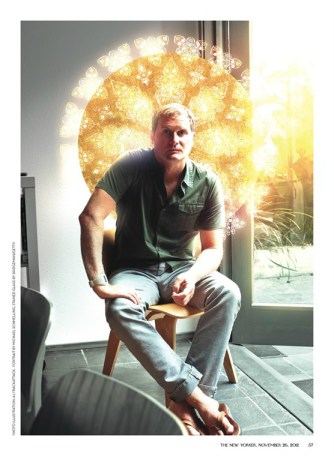 There’s a telling line in the recent story of Rob Bell in The New Yorker (“The Hell-Raiser”), where the author Kelefa Sanneh conjectured that in writing “Love Wins,” Bell was “dreaming of a world a world without arguments—as if the right book, written the right way, would persuade Christians to stop firing Bible verses at each other and start working to build Heaven on earth.” (60) Conjecture about what others are dreaming is often problematic. But Sanneh, like the rest of us, take our cues from what others say and write, which is standard operating procedure for human communication events. Conjecture is always fair game for conversation.
There’s a lot the author gets right in the article and there are a few places with loaded language and mashed-up history. For instance, the notion that the “church matured” (60) out of the notion of Hell as a physical place is too loose a summary to really work. Debates about interpretation rage today, from all quarters.
Sanneh’s focus on how a preacher became a questioner among a people who do not respond generously to larger questions makes for interesting reading. These are my people and I confess that I too have responded without generosity too many times. And yet these larger questions are exactly the conversational fuel that can help move forward this often awkward project called the church. Especially because the generations behind me are increasingly wed to questions rather than dogmatic answers.
Much of what Bell wrote resonates with me. In particular, I’m smitten by this notion that people can talk—even about very deeply held things—without demonizing or judging each other. The notion reminds me of those noble people who early in the history of the church were in conversation with the inveterate letter writer. They eagerly heard what he had to say then examined it on their own to decide whether it was true or not. I imagine them discussing with authoritative texts and possibly disagreeing, but maintaining their relationships.
Bell has done us a great service by voicing these questions, even though the penalties for him have been high.
###
Image Credit: The New Yorker
Your Cubicle Neighbor’s Bold Reveal May Be Your Salvation
One Lesson from Office Space
In Office Space, as Peter Gibbons descended down the dark tunnel searching out meaning in his work, he maintained friendships with other like-minded/cynical employees, Michael Bolton (no, not that Michael Bolton) and Samir N. And then there was Lawrence who heard everything about Peter’s life through the thin walls of the apartment next door. Together these friends reveal more and more to each other as the film progresses.
I’ve been blessed with great work friendships over the years. I believe the shared experience of dealing with the despot in the corner office and the silly conundrums she or he introduces can have a binding influence on co-laborers. Plus, the work of finding or making meaning in work often happens at the collegial level: the expertise, instincts and humor with which we approach our work has a way of rubbing off on those around us and vice versa. These friendships can and have lasted for years through changed jobs and kids and sickness and all manner of life change.
Not long ago I wondered aloud what would happen if God showed up at work. To that list I might add the people around us with whom we connect. These people in our shared work experience are way more than companions in misery—they may be part of your job’s salvation. Part of that has to do with what we reveal of ourselves to each other. And maybe the hope is that we share the stuff that matters with these people with whom we spend our days.
###
Image Credit: IMDB
Shop Talk Creates Remarkable Moments
Does God show up in shop talk?
 I wondered aloud what it would look like if God showed up at work. I thought it would not look like church but instead might resemble acts of excellent service, possibly offered anonymously. I argued such service might flow from a deeper dedication than winning points with the boss. I also speculated that if God showed up, He might bring with him a sense of the larger purpose to our work.
One medical device company I worked for the CEO would routinely travel with sales reps to visit physicians. When the CEO showed up, the tenor of the conversation changed. Suddenly it was not about just product benefits and features, but it was about the surgeon’s particular need with the kinds of patients she was seeing. Or what the cardiologist was noticing about how this technology helped his patients and where there could be improvements. The conversations broadened out beyond technology, and then broadened out beyond that particular physician to all surgeons or all cardiologists or all patients with this particular pathology.
Shop talk—the conversations we have with colleagues—can be a rich source of practical help. It can also be utterly engaging. It’s the details we notice and sharing the things that work (and noting those that don’t) and the funny stories of different personalities and their ways of approaching work. Shop talk is all about what we find remarkable, what we find stimulating or workable. Or amazing. Or meaningful. But shop talk can never be created by a computer—it is always about a human response to a shared situation.
It’s Monday, that day of the week when our work can feel particularly mundane or stale. Hearing our colleague explain why our shared work helps people can be refreshing. It can help reframe today’s tasks. Sometimes it takes great courage to explain to our jaded, cynical colleagues why we continue to move forward and why this work has meaning. My favorite leaders have shop-talked their way into answering the meaning question—and today I’m grateful for their acts of revelatory courage.
###
Image credit: surrealmagicalism via 2headedsnake
Rudy’s Crisis of Character
Does your crisis need introspection or extrospection?
 Rudy (not his real name) (his real name was Samuel) was pastor of a small church in rural Wisconsin. A lot of people looked up to Rudy. It’s easy to imagine the pressure to be an example in such a community. Some/much of that pressure was self-inflicted.
Rudy’s son had a drug problem. When the problem came to light—in a very public way—Rudy blamed himself. He took a break from his pastoring job and pulled his trailer out into the woods where he was going to pray and read the Bible and think about where he had gone wrong and generally plead with God. He was in good company on this—lots of people in the Bible pursued these pleading communication events when crises hit. A few days alone, or alone with God, may answer the “What next?” and “Where did I go wrong” questions.
I’ve thought about Rudy’s instinct over the years. I grew up in a tradition where sorting things out on your own was expected. “Whatever you need to do to straighten up and fly right, well, get on with it” was the general sense of how things ought to progress. That was Rudy’s primary methodology.
Yesterday I had a delightful chat with a local philosopher. We got on the subject of what happens when we encounter the Other. What is our responsibility for the people with whom we come in contact and when does that responsibility kick-in? How can we be mutually for the people in our lives—and maybe for the people on the fringes of our lives? It turns out that one way is through our conversation. Even the casual conversations—just in passing—can have a deeply cathartic effect at times when people say what is really going on. I cannot help but wonder if Rudy’s instinct might have benefitted from time alone followed by a long walk with two or three childhood friends to help him sort the flotsam from the jetsam. Followed by weeks of conversation with his wife, Carol (not her real name) (her real name was Gertie). Followed by lots and lots more honest talk—especially with his son.
Because when we speak with each other—sometimes we say (and hear) the things God would say to us.
Speaking of Rudy (not his real name) (his real name was Ebenezer). Everything turned out ok: Rudy eventually left his pastor job and he became an exemplary truck driver and was chock full of wisdom for the people on his route. And the son’s drug problem grew until it stopped abruptly when teen angst gave way to career and age and the need to pay attention to life.
###
Image credit: Roland Topor via 2headedsnake
The Lost Art of Getting Back
Returning phone calls is so 2008
 A recent post from Big Picture Leadership reminded me how mystified I am that so few people actually return calls or emails. Twice in the past two weeks I’ve had conversations about this phenomenon. And these conversations were with people in positions of power, which makes the phenomenon all the more difficult to figure.
I get that everyone is busy. I get that we often we think we know why the person called or emailed, and that their issue is not our issue. Or perhaps the answer is “No” but we don’t want to say it aloud. But I think not-getting-back is deeper than just busy. I think it actually says something troublesome about people, perceptions and power relationships. I am guilty too—on all three counts.
These days the medical device industry regularly purges employees for one reason or another—just like every other industry with human capital. What once was a stable position in a stable company is now neither. A person in a stable position in a stable company has a certain perception of power that tracks with their budget and mandate. That perception of power vanishes the instant the person is called into the corner office to be downsized. I know this because I see these people working LinkedIn like crazy.
I have some older people in my life these days and I’ve been listening to what they say about the sense of being marginalized and invisible. George Tannenbaum’s recent reflection on Work. And death is apropos and could also have included what happens as people slowly fade into their age, which is to say, into the woodwork.
Over the last few months I’ve also had opportunity to email three philosopher/authors who works I love reading (Drs. Sean Hand, Robert Sokolowski and Michael Purcell). I had obscure obscure questions or comments about something they had written, and would they comment further? I was amazed—indeed, it was remarkable—that all three gave very generous responses and even provided extra source material.
These philosopher’s responses remind me that I want to be the kind of person who doesn’t take power distance, assumptions about what my friend will say or mere busyness as a reason to not acknowledge someone’s humanity.
###
Image credit: terra99 via 2headedsnake
“Work is my salvation.”
Theologically—entirely false. Literally—sorta true.
I heard myself say that headline the other day. My buddy and I were talking about what it means to pursue a craft. For me, the work of pursuing a craft is about the ability to focus. And the ability to get back to focus post-distraction.
 Focus and getting back to focus are inherent parts of learning and practicing a craft. I believe that focus on craft builds sanity and humanity. Getting back to focus on my craft of copywriting has pulled me out of many mentally ambiguous places and difficult decisions. Focus on craft—especially as I aim toward usefulness and practical service—allows me to background difficult decisions and gives time for my subconscious to work at them. And after I’ve focused I am able to do productive work on those decisions.
I also think growing in our craft is a way to serve God and people. Bethel Seminary—my alma mater—recently received a $190K grant to pursue a “Work with Purpose” program (Bethel Magazine, Fall 2012, p.8). I’m eager to see how this unfolds because the standard churchy answers for a productive and full life mostly involve using work as verbal platform to persuade others. But the work itself—that’s where I see growth, usefulness and, frankly, the hand of God. This is an old notion from the Reformation that need resurrecting pronto.
Last weekend Mrs. Kirkistan and I watched a documentary called Buck, about a guy from a rough, abused background who had an uncanny way with horses. I’m not a horse guy, and I’m not a fan of cowboy flicks, but this film was mesmerizing from beginning to end. What Buck could tell people about themselves as he watched the way they treated their horse was painfully close to home. The movie is full of notions about collaboration, respecting others and how to work with others without breaking them. One take-away quote from the film was that “horses just need to do something useful. They want work to do.” Maybe Buck was anthropomorphizing horses—maybe not. I do know that the craft we learn and the work we do often places us productively among other people.
And that is a good place to be.
###
Image credit: gibsart via 2headedsnake

 conversation is an engine