Archive for the ‘Communication is about relationship’ Category
Being Present is Hard Work
Just Don’t be Boring
 I know this from teaching college students. Some students are right there with you (I love these people!). I see others fade into and out of our discussion while some simply park their carcass in a chair as their mind plays on a sandy beach in South America. I don’t blame them. Helping any audience be present is a challenge for every communicator. It’s a challenge I try to take seriously in teaching, writing and face-to-face conversation. A creative director I worked with would always say, “just don’t be boring.” He was right. No speaker or conversation partner has a right to squander someone else’s attention.
I know being present is hard from my own experience as well. Paying attention to someone requires a lot of energy. Maybe introversion/extroversion has something to do with it. Maybe not: extroverts have an especially hard time listening because they really, really want to interrupt and say their spiel.
Over the weekend I talked with a physician who works really hard at being present with each patient. Her day is spent in 15-30 minutes intervals of intense listening followed by repeating what she heard, followed by diagnosis mixed with more listening and more response. It’s easy to see why it takes all her energy.
Rereading Robert Sokolwski’s Introduction to Phenomenology, I ran across this quote:
All experience involves a blend of presence and absence, and in some cases drawing our attention to this mix can be philosophically illuminating. (18)
The physician worked hard at being present with her patients precisely because the words uttered by patient after patient were only one piece of the puzzle. She was also analyzing what wasn’t being said, what the patient was trying not to say, as well as analyzing physical appearance and the way the patient holds him or herself. Same stuff we all pay attention to, but the physician needs to draw concrete conclusions or at least educated guesses that could lead to a course of action.
Being present is a gift we give to each other.
###
Image credit: Paul C. Burns via thisisn’thappiness
Pleasant Propaganda: The Museum of Russian Art

Vlad, let’s hang out at the people’s dam today.
Plan on seeing the exhibit of Soviet Paintings (From Thaw to Meltdown: Soviet Paintings of the 1950s-1980s) at The Museum of Russian Art in South Minneapolis before it closes shop later this month.
The paintings on the top two floors start with unbridled propaganda, depicting solid workers grinning about their jobs in the steel mills, factories and collectivist farms. The strong women and robust men in their industrial settings are both beautiful and horrifying at the same time, when you realize some of the workers were more likely emaciated prisoners from the nearby prison (“Beautifying Saransk” by Alexander A. Mukhin). But the exhibit takes you beyond the grand hyperbole to show how the artists worked within the political boundaries even as they let bits of reality in. By the time you get to the back of the top floor, you are seeing more realistic depictions, including the unsettling working conditions in steel mills.
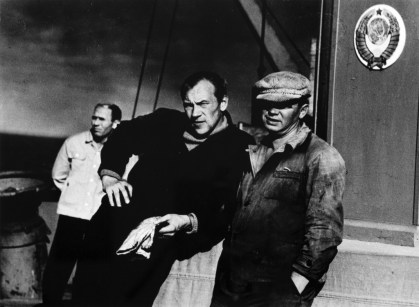
Comrade…you want soy milk in your latte?
It’s worth walking downstairs to see photos of actual workers, families and daily life in the Soviet Union: gritty and sober images in black and white. If you grew up during the Cold War, these are the images you remember.
And then it’s worth considering how images shape our lives. The propaganda paintings are easily recognized and dismissed—though many seem stunning today. The photos in the lower gallery seem more real—but they are just as much showing one viewpoint—another kind of persuasive effort that contrasts well with the upper galleries. A guy can’t help but wonder what sorts of images our political candidates can paint when $1 million fundraisers are the standard fare. A lotta loot buys a lotta propaganda.
Go soon—the exhibit closes shop in August.
###
Image credit: Vladimir Petrovich Tomilovski via The Museum of Russian Art
Related: Hard-hitting Russian safety posters that need no translation
Relevance is Dead. Long Live Relevance.
Future church isn’t like present church: connect four dots

here comes what’s next
We’re relating differently these days. I’m not talking just about Facebook and Twitter and/or any other rising social media. We’re relating differently because our expectations are changing—partly due to our experience of being heard (which does relate to social media). This post is aimed at the church, but much of it could apply to any organization. Some parts are unique to the church.
Here are four points to consider as you think about how organizations may connect in the future. Apply yourself to three bits of reading and one bit of listening. It’s all interesting/amusing/amazing. Then tell me: how do you see the church changing?
Dot 1: Jeff Jarvis & the Death of Content
Jeff Jarvis was invited to speak to a group of professional speakers. He spoke about how content is dead and how the speakers should really be hearing from the audience and piecing together brand new things.
I suggested — and demonstrated — that speakers would do well to have conversations with the people in the room and not just lecture them. I said I’ve learned as a speaker that there is an opportunity to become both a catalyst and a platform for sharing.
His talk did not go over well with the professional speakers and there was plenty of harrumphing. Read his article here. But the take-away was the opportunity for speakers (and leaders) to be both “catalyst and platform for sharing” versus pouring content from a podium.
Dot 2: Jonathan Martin & the Decline of the Church Industry
Over at Big Picture Leadership there is a lengthy quote from Jonathan Martin who has suddenly seen that he is not at the center of things. He laments that the Spirit has passed him and Piper and Driscoll and CT and all the other usual suspects in favor of the rush of new Jesus-followers in developing nations. Read the excerpt here. Read the whole thing here.
I like this guy’s approach. I think he nailed it. But I disagree that the Spirit has moved on to other countries and peoples. I think the Spirit is alive and well and deeply embedded in God’s people—wherever they are—just where the Spirit will always be as long as people profess faith in Jesus the Christ. But what Mr. Martin observed is simply the decline of church as an industry in the U.S.
To that I would add: and not a moment too soon.
It was never sustainable, anyway: all the inward-focused authority generated by books and CDs and conferences and leadership gurus and models and formulas. Why did we think that God worked through all that? Oh. That’s right. Because the authors and conference leaders told us so. Here’s my favorite take-away from Mr. Martin:
We enjoyed our time in the mainstream well enough to forget that the move of God always comes from the margins . . .
But what if Mr. Martin is even more accurate than he knew or believed? What if the locus of authority is shifting from controlling authorities to the people in the pew who refuse to spectate? What if people really started taking seriously the notion that they should bring their gifts and voices directly into the ritual gatherings and far beyond—sort of like that inveterate scribbler Paul wrote?
Dot 3: Apophenia and Participatory Culture
At Apophenia they are asking questions (fitting!) in preparation for a book on participatory culture. What is participatory culture? I’m new to the phrase too, but danah boyd cites several characteristics of such a culture:
- With relatively low barriers to artistic expression and civic engagement
- With strong support for creating and sharing one’s creations with others
- With some type of informal mentorship whereby what is known by the most experienced is passed along to novices
- Where members believe that their contributions matter
- Where members feel some degree of social connection with one another (at the least they care what other people think about what they have created)
I very much like this notion and phrase because that is the culture I most want to belong to. I spend my days thinking about communication in industry. I think the church holds the key to the most invigorating participatory culture possible. I believe the future of the church will be a participatory culture speaking directly to all culture rather than focusing inward to build a religion industry.
Dot 4: Reggie Watts: Sing the Milieu
Watch this guy produce his own content (sounds)—even as he grabs content (sounds and ideas) from the environment—to make something new. It reminds of Jeff Jarvis’ note that content is not king, and how he challenged a group of professional speakers to listen to their audience. It also hints at a jazz-like participation with the audience and the larger environment.
Perhaps one way to connect the dots is to say that the top-down approach to relevance is dead or dying. The top-down approach has long been a battle cry of the church-industry: let’s give the people what they ask for, but we’ll mix in the stuff we think they need, like giving a pill to a dog by mixing it in her food. Maybe what we’re seeing now is a new mix: content relevant from the bottom up because people are listening in a new way. More precisely, they are listening for the good stuff planted there by the Spirit of God.
And please hear: this is not either-or. It is both-and.
The church can lead the way in this. Not the church as an industry, but the church made of people. But will leaders have courage to listen to individuals? Or will leaders circle the wagons?
How do you connect the dots?
###
Image credit: Howard Penton via OBI Scrapbook Blog
The Moving Horizon of Engagement: The New Yorker’s Nathan Heller on TED
How to Boil Down Levinas?

help find a way
A recent issue of The New Yorker includes an excellent article on TED talks. On his way to explaining why the talks are so popular, Nathan Heller stumbles onto the differences between our rituals of learning in college and how college is set up to support those rituals, and compares that with the kind of learning people need outside of college—the kind that keeps expanding rather than narrowing. Along the way he mentions in an offhand way how Levinas does not lend himself to a quick recap. One must do much preliminary work to begin to understand Levinas. Philosophy, especially phenomenology and theology are useful backgrounds to begin to understand Levinas. But only as a beginning.
The author of Conversation is an Engine is well familiar with this. As he tries to explain Levinas from time to time, blank stares and hasty retreats to other subjects are typical reactions. The French philosopher and apologist for The Other is famously obscure. And fascinating. But obscure.
Heller’s offhand remark reminds me that the bigger challenges ahead of us as communicators have to do with how we let people in on the details that engage us. Over at Big Picture Leadership there was a discussion recently about what it means to witness. That discussion reminded me of an ongoing conversation a few of us have had about what makes something remarkable, as in, making me remark out loud to another person because it was that important to me. In both cases there has to be an intensely personal connection for it to bubble up through our conscious mind and cross our lips.
If we are intent on rhetoric that draws others in (and I believe it is a most excellent thing to be a passionate booster for what we love and understand), than we are constantly providing low-hanging fruit for newcomers to grab and taste so they too will become enamored by the taste and want more. This is the horizon of engagement. That horizon is growing shorter and getting closer with every Google Search.
More sophisticated discussions will always have their place among practitioners and experts. But we’re quickly moving to the point where we each need to have a ready answer about our work, or firm, and what we believe.
###
Image Credit: Martin Morazzo via thisisnthappiness
I don’t always wear clothing, but when I do…
How a Leaderless Team Ruled Project Runway
 OK: bait and switch. I typically wear clothing. And if you know me, I doubt fashion comes to mind. But my costume-designing wife and the fashionistas in our house started watching this show. And I’ve started to like it because it parallels my work of producing copy that must be new and unique while fitting tight space, tone, accuracy and brand requirements.
Season 8 episode [whatever] featured a group exercise. This was poignant for me because when I teach professional writing at Northwestern College, I often include a group exercise. The group exercise is universally hated. For all the reasons you might expect: it’s hard to define what the group is doing together. There’s always someone who fits the slacker role. No one wants to take charge and if the work isn’t up to par, it feels like someone else’s fault.
Next time I introduce a group project, I’ll use Project Runway Season 8 Disc 2 [yes. I am a Netflixer] to set up the team task. That episode shows an outstanding example of what can happens when a leaderless team backs away from personal project management and allows each member to find their own way. Some bit of magic happened in the show that allowed each designer to do their own thing while still producing garments that seemed to belong together. It’s as if they were listening to each other at a level beyond the words used. Leaderless teams don’t always work that way. But that it worked that way once gives me hope.
In contrast, the team with the heavy-handed project manager forced every member to work down at a level beneath their abilities. The judges held that team’s feet to the fire with blistering reviews.
I am intrigued by what can happen when creative people work together. Perhaps the best leader helps their team hear and understand each other so each creator’s personal best is produced rather than some spiritless guess about what the bully micro-manager wanted.
###
Image credit: 4CP via thisisnthappiness
A Road Trip May Just Unspool Your Secrets and Hopes and Fears
What Sidetracks These Conversations?

Is there a shortcut to those conversations that happen toward the middle of a five day canoe trip in the Boundary Waters? Is there a quicker way to those moments of insight that happen after camping together for two weeks? Is it possible that the drive itself, from Wisconsin to New York City, actually played a starring role in the kind of conversations we had all along the way—plus all that happened after?
No. And Yes.
No, there is no shortcut and Yes there are other ways and Yes those conversations play pivotal roles in our lives.
I was reminded of this during a weekend drive to that hotspot of the Midwest— Decatur, Illinois. Eight + hours in the car has a way of unspooling topics as the miles pass. Topics you were never even thinking of—until you realized you actually had something to say about them.
This is one reason Mrs. ConversationIsAnEngine and I like those long drives. Enormous strips of time laid out lengthwise where you talk about anything and everything as landscapes pass. Are you with me? You’ve had these conversations. Maybe you’ve had with your then future spouse. Or college buddies. Or people you didn’t know from Eve before the trip.
But in daily life? Forget it. I’m too busy social-media-ing and texting and Netflixing to let those topics unspool. Plus—I’m not ready. You’ll judge me. Amazingly, simply spending a lot of time (and I mean a lot of time) with someone breaks down these questions and fears. It happens on a car trip. And it happens as you run the craft room at the summer camp. Or when you show up yet again to stand side-by-side gutting a 100 year old house. And amazingly, it can also happen when working cubicle-by-cubicle with work colleagues—but the key is the small open windows of insight we give each other over time. Those small windows can add up to real insight and relationship building.
So—a Monday resolution: resolve to not waste this week complaining and gossiping again about the director or your boss or the arses in accounting. That talk just slams windows shut and puts nails through the sill. There’s nothing expansive or unspooling about it.
###
Image Credit: Stiknord
How to Sap Energy & Steal Creativity: “Just Execute”

Don’t think. Just do.
A talented strategic friend chatted with the vp of marketing at a medtech startup. What was the company looking for in their posted marketing hire? They just wanted someone to execute. Just execute? My friend was floored. You want to hire someone and not use their entire brain? You want to disengage the emotion that arises from thinking through a problem? You have such knowledge of the market, you’ve considered every angle, you know all there is about your target audience, you are so confident you don’t need anyone else thinking this through? Or—was the pressure so great to show results that they could not waste time on strategy. Either way, the entire conversation pointed out this was a company to avoid.
“Just execute” is corporate bully language for “Do it because I said so.” Nearly every human benefits from knowing the “what” and “why” behind an order. And even God entertained modifications to His plan while Moses verbally worked through the mission as they chatted around the burning bush.
Don’t misunderstand: there is absolutely a place for “just execute.” Stuff gotta get done. Yes. But long term, stuff gets done much more effectively when we enlist whole people to work with us. And that means bringing people along with us as we process our mission. Just say “No” to the smoky backroom where highly paid C-suiters work out the details and then send a courier with decrees out to the rank and file.
This authoritarian tendency looks even worse in a volunteer organization like a church. Because money is not a factor there—it’s all about feeding motivation. Avoiding rich conversations about “why” short circuits the process and makes whole people flee.
Whatever your position, do yourself and your organization a favor by helping people see the big picture. Helping them form and reform and personalize the big picture. Whether you are a manager, a volunteer coordinator, a pastor or lead worker on an assembly line. This is what leaders do.
And know this: Those who won’t share or budge on the big picture will not attract or retain talent. But they will find themselves starting from scratch again and again.
###
Image Credit: C-front
Start Anywhere Not Over
Starting over, would you do it different?
Today’s project? This job? That relationship? This marriage?
Looking back, we all see some things that would benefit from a shift in approach.

I was recently talking with a new college grad in a job with significant responsibility. He wants to do great work, but the immense pile of work before him and the fast pace environment seem to conspire against ever feeling caught up, letting alone doing the exceptional stuff he did in college. I recognize lots of friends and clients in this same spot. Most of us have been there or perhaps that is our permanent home.
But if you started over, you’d do things differently.
Really?
Some things. Perhaps. But those old patterns are woven deep into the fabric of our approach to any given day. Starting over may not have the cleansing effect we hope for. There are no easy answers to managing your time to do great work. Saying “No” to some work and “Yes” to other work is part of the solution. Learning to focus and keep distractions at bay is another piece. Lots of people have lots of advice for how to deal with this and much of it is quite good. Seth Godin distributes advice like this every day. Free. His “The Dip” is all about when to quit and when not to.
Training Day
Maybe the pressures we face today or this year have everything to do with the direction we need to grow. Maybe the pressures we face are part of how we are to be shaped right now. I’m fond of an old dead poet/king/dancing machine. In this particular ancient text of his, he offered that the troubles we find ourselves in have a disruptive quality designed to help us look again for balance. And balance is found in a deepening alignment with, well, God. Whether in today’s project, this job, that relationship and especially this marriage. This poet had strategies for his pursuit. Those strategies make sense any time we’re wondering whether we should just start over. And his strategies make even more sense if we’re trying to figure out how to pick up just one piece right now. Right in the middle of the pressure—which piece can I start that will unravel this tangled mess?
Before you start over, start anywhere.
###
Image Credit: via thisisnthappiness
Never Say This To Your Boss On A Monday
“Easy, Peterson. We’re in mixed company.”

Unless your employee figures “Why” for themselves
Certain words and phrases race from useful to cliché within an hour-long meeting. Just check out this list of 89 clichés, many of which you’ll likely hear today. Other words carry so much heavy baggage that when your VP says them, the air in the room suddenly seems carbon monoxide-heavy and people start to drift.
This word is among those problematic words.
It’s a common word. So common, in fact, that when uttered aloud it brings to mind exactly…nothing. This word is invisible.
“Strategy.”
Three of us have been talking about why it is so many clients see strategy as something hammered out by a few bosses in the back room—or simply as a complete waste of time. These organizations reward a “bias toward action,” which looks like lots of activity, lots of people staying late, lots of emails on Saturday and Sunday, without lots of results. Too often all that activity is at cross-purposes across an entire organization eager to prove their bias toward action.
The three of us would like to rehab the concept, but not the word itself. Our rehab efforts consist of breaking the concept into component parts that become as sticky as a five-year-old’s wonderment: What? Why? How? Simple stuff. But when approached directly, these words become profoundly effective tools for guiding teams and organizations and, especially brands. Incredibly useful words not just for giving instructions, but for engaging someone’s emotion and intellect. The first order of rehab is to include all three components. The second order of rehab is tell the straight story about each—without cliché, with clear endpoints. And that means end points that others can see if they get done (or not).
We’re starting to believe that managers who major on the “What” or “How” without telling “Why” are getting employees to feel OK running about on impulse drive without ever taking their work to warp speed. Of course, it is possible the manager still feels knowledge is power and to withhold the “Why” is a way to maintain that power. Impulse drive is all they’ll ever get.
Unless.
Unless their employee figures out the “Why” for themselves. Unless the employee finds a way to put meaning into their work on their own. Unless the employee learns to engage in the kind of dialogue that helps a group move forward.
I hope to write more about this. The topic includes lots of working parts: leading from anywhere in an organization, learning to help a boss ask the bigger questions without disappearing down the rabbit hole of industrial strength strategy/BS sessions, helping each other grow into people who care and do our best. And many more.
Oh—and the third, most important order of rehab: courage. The whole thing needs to be stirred up by people willing to share their dumb ideas. Because sometimes dumb ideas produce solid, cogent, meaningful results, despite the awkward moments along the way.
###
Image Credit: 4CP via thisisnthappiness

 conversation is an engine