Archive for the ‘Communication is about relationship’ Category
Occupy Everything: Every Group Forms Around a Promise
Anarchists organize for anarchy while pacifists plot their war on war. A church may promise a club-like space where everyone knows your name or it may work out the day-to-day look of those ancient texts that call for justice, mercy and rightness with the Creator.
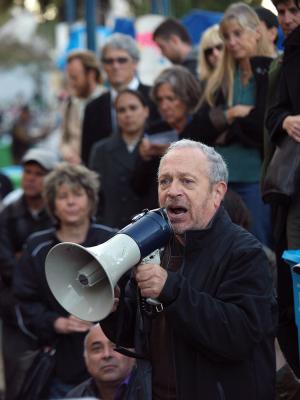
Optimist/Activist Professor Reich
At the moment, Occupy Wall Street is a BYOP (Bring Your Own Promise) event. But commentators and talking heads are showing up to frame up their version of the promise. Also showing up: opportunists, would-be pornographers, and anybody with a beef. Robert Reich took to the bullhorn Wednesday at Occupy San Francisco with his version of the promise: “I really do believe we are on the cusp of a fundamental change,” Reich said.
Maybe so.
Maybe Occupy [whatever] is this generation’s 1968 moment. Maybe the greedy will be shamed into… what? Backing away from the system that hands out checks for the way they risk other people’s money? Maybe we are simply shining light on the scurrying rats of a corrupt and corrupting financial system. We also shine the light on our own culpability in a corrupt and corrupting system
The single, binding promise has yet to emerge. But certainly our conversation is different today. And that feels like progress.
###
Image Credit: SF Examiner
Words Work as Stepping-Stones
“…Words work as stepping-stones through confusion to resolution.” — Marilyn Chandler McEntyre in Caring for Words in a Culture of Lies
 This happens in ordinary conversation: I start my explanation with one set of words and end up in quite another place. Often the conversation takes me from confusion to resolution. But more often I come to the end of what I’d never planned on saying with a new insight or a new question that needs answering (if only in my own mind).
But Marilyn Chandler McEntyre was actually talking about the way prayer works in the above quote. She had been quoting a poem by Gerald Manly Hopkins. Here’s how she finished the quote:
“What begins as argument ends in an act of vulnerability and self-yielding. The words we encounter along the way [from GHM’s poem]—just, contend, plead, disappoint, friend—offer stopping points for reflection upon our paradoxical situation before God: familiar and strange, bound by law and freed by grace, fulfilling and frustrating, longing satisfied.”
I had not been familiar with Hopkins’ poem. But the words I encounter in the Psalms offer movement from argument to self-yielding with stopping points for reflection—and the entire Psalter functions like a bolus of spot-on conversation.
###
Image via 2headedsnake: Cem Ulucan
Conversation: Transaction or Gift?
 Ours is a transactional economy: we pay cash-money (well, plastic money) for a product or service. We don’t need a relationship with the product or service provider. Our cash-money relieves us from relationship and moves us to ownership. In a gift economy (See Lewis Hyde’s The Gift) we receive a gift and are obligated to a relationship. We give the gift back, though not to the one who gave it to us. We give the gift on to someone else. The gift finds its way back.
Is conversation a gift or a transaction? The answer is yes. But where does conversation live as a spontaneous wild-child?
###
Image via 2headedsnake
Mega-Church or Micro-Brew?
What’ll it be?

Are beer wars an apt analogy for churches? Maybe so. Walk with me:
My friend and I are cooking up a book proposal for how the church can use social media. But a major disagreement stands between us: Do churches really want to go where social media leads? Groundswell (Li and Bernoff), which I use as a text in my Social Media Marketing class, makes a compelling case that the end-game of social media is people participating in product development, in customer support, in sales and—generally—in decision-making. Businesses using social media only to broadcast messages (the old marketing monologue model) will be left out of the real conversation as it continues around rather than with them. Many corporate overlords resist this new communication freedom and stay out of the conversation—until forced into it.
What about churches? My friend thinks the future lies with mega-churches that typically retain control of as many outward and linking messages as they can—for the sake of efficiency. I believe nearly the opposite: that we’ll see more churches that require less control of messages so as to actually invite people to bring their voices and contribute. I see as problematic the requirement of multiple overlords, presidents, governors, lieutenants, elders, council-people—you name it—just to keep the big ship moving. Multiple overlords tend to squash multi-directional voices.
Back to beer: There will always be Budweiser and Miller. But last time I checked, that’s not where the market growth was. The growth was in the micro-brews. My explanation for that growth: people realize they want beer that tastes like beer rather than water. Same with churches, there will always be a few mega-churches around, but the real growth will take place in smaller congregations where a definite personality develops because many voices are being heard and are actually participating in directing the community. Or perhaps growth will take place in those mega-churches that make a way for spectators to become contributors with voices.
And now back to social media. I contend that social media naturally leads to a democratization of leadership and a multiplicity of voices—two genetic traits not found in the DNA of most hierarchical mega-churches. But they could be in the DNA of smaller congregations (but, clearly, authoritarian leaders exist in any size organization).
At least two glaring problems to all this:
- I’ve oversimplified my argument by casting big as bad. That is simply not true. Very big churches can be very relational and very flavorful (to push the beer analogy). And there is clearly an attraction for churches that hold firmly and broadcast the Bible’s message of the God bent on reconciliation. Maybe big churches can also admit a multiplicity of voices. I just haven’t seen it.

- Even Groundswell recognizes that only a small percentage of any online population serves as creators. A slightly larger population functions as critics. But the great majority of folks online are spectators. Test your own population here. Maybe that’s the same population that fills up the back rows of any church or college class—those who prefer watching. So while I’ve noted that social media provides the opportunity to amplify one’s voice, few actually take advantage of it. Maybe that will change. Maybe it won’t. The truth is most of us are pretty happy to not lead.
What do you think? Does social media lead to a place churches really want to go?
Postscript: I believe the opportunity social media presents has a theological component that moves us closer to the creator’s intent for communication. More on that later.
###
David Bohm: When is Empty Talk Full?

Someone may be home.
Some time ago there was an anthropologist who lived for a long while with a North American tribe. It was a small group of about fifty people. The hunter-gatherers have typically lived in groups of twenty to forty. Agricultural group units are much larger . Now, from time to time that tribe met like this in a circle. They just talked and talked and talked, apparently to no purpose. They made no decisions. There was no leader. And everybody could participate. There may have been wise men or wise women who were listened to a bit more–the older ones–but everybody could talk. The meeting went on, until it finally seemed to stop for no reason at all and the group dispersed. Yet after that, everybody seemed to know what to do, because they understood each other so well. Then they could get together in smaller groups and do something or decide things.”
—Bohm, On Dialogue (p. 19)
###
Image Credit: 2headedsnake, jeremie decalf
Jeff Nunokawa & People-Centric Scholarship
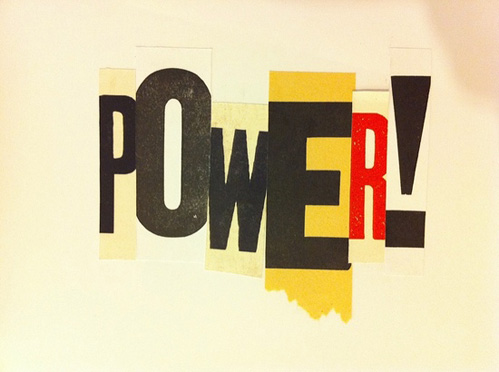 A recent New Yorker Talk of the Town feature showed Jeff Nunokawa practicing his scholarship on Facebook. Rebecca Mead’s article “Earnest” compared Dr. Nunokawa writing his first book in a windowless basement with the way he connects today with his Princeton students. His “meditations” get read because they are brief, accessible and located exactly where his audience spends their time—Facebook.
“…I like the social-media element—I want it to be sociable. It’s not that I don’t want to be a scholar, but this is how I want to be a scholar.” (The New Yorker, July 4, 2011, 19)
Something good is happening here. And the good thing is not that scholarship is dumbed-down or going away. Tightly controlled, peer-reviewed articles using insider-only language will continue as a means of advancing scholarship. But this good thing is a fresh emphasis on accessibility: making the connections so more people can get pulled into the excitement of understanding. You may call it low-hanging fruit. But this copywriter sees it as a ministry to the human race.
At the moment, the academy doesn’t reward this: popular retelling of scholarship is often not tenure-track stuff. But the institutional gatekeepers will not have the last say, as more people join these ongoing conversations.
Something good is happening. Something new. I welcome it.
###
Image credit: Scott Dadich
Person of the Book or People of the Book? Love Wins by Rob Bell (Partial review)

It’s too easy to fool ourselves.
Just how blind am I?
Recently I sat with some well-respected relatives who had devoted their lives to pursuing God. Our conversation turned to quick jibes at Rob Bell’s Love Wins. I had only vaguely heard of the book and the controversy surrounding his reading of the Bible. But knowing very little didn’t stop me from defending Mr. Bell purely based on my growing admiration for people trying to reframe stale old arguments.
My uncle said “You have to know the Book to know the Author of the book.”
I found myself in agreement and then in violent disagreement. I thought of my childhood and young adulthood growing up with the Book—that is, the Bible. We spent time in it every day. We memorized it, acted it out and generally knew it pretty well. But it wasn’t until solid conversations with others, both dead (that is, authors who left their books behind) and alive, helped me start to see the shortcuts I had taken in my own single-minded reading. That is, I started to see the blinders I wore that I didn’t even know about. I need conversation with others to help me see my blinders. I can now reassert my love for the Biblical texts, their authority in my life and the God behind those texts and Jesus the Christ who lived, died and lived—but I do so knowing faithful, admirable people can and do disagree over how some/many of those texts are read.
Can you be a person of the book without admitting others into your thought circle? There is a blindness that settles on us even more securely when we think we are just looking at the text and pulling out truth. The problem is not with the text. The problem is with our blindness, which is just another feature of the limitations of our humanness. This is not about more education. Nor is it about liberal vs. conservative. It is about seeking help to locate our blind spots. Of course, we don’t go looking for our blind spots. We go out looking for someone to tell something interesting too, and we end up finding out there is something pretty important we missed.
Also there is another piece: that of holding scripture in faith while allowing questions to sharpen and make visible some critical pieces we need to know to move forward. There is no letting go of faith here, but there is a willingness to help move closer to that truth.
I’m partway through Mr. Bell’s book and enjoy his fresh take very much. I find myself agreeing with his point that heaven is both in the future and partially present. Same with Hell. So far I don’t see anything anti-Biblical. And people from my particular tradition need only refer back to Dr. Ladd’s famous The Gospel of the Kingdom to be reminded of the now/not yet nature of Jesus’ talk about life on this planet. However, my reading of Mr. Bell’s third chapter makes me restless, because I believe there are consequences to what we say and do. I want to hear his full argument before commenting further.
My point: to be a person of the Book is to be a person of conversation.
My wife and I have been blessed by a group who will think together verbally about the Book. This group counters and challenges the inward-looking tendencies arising from my pietistic background. Certainly there is great benefit to carefully watching over our personal devotion. But real truth demands the relationships that talk.
Take-away: don’t rush to judgment in conversation.
###
Image Credit: Achille Beltrame
Meaning Shows Up Between Us
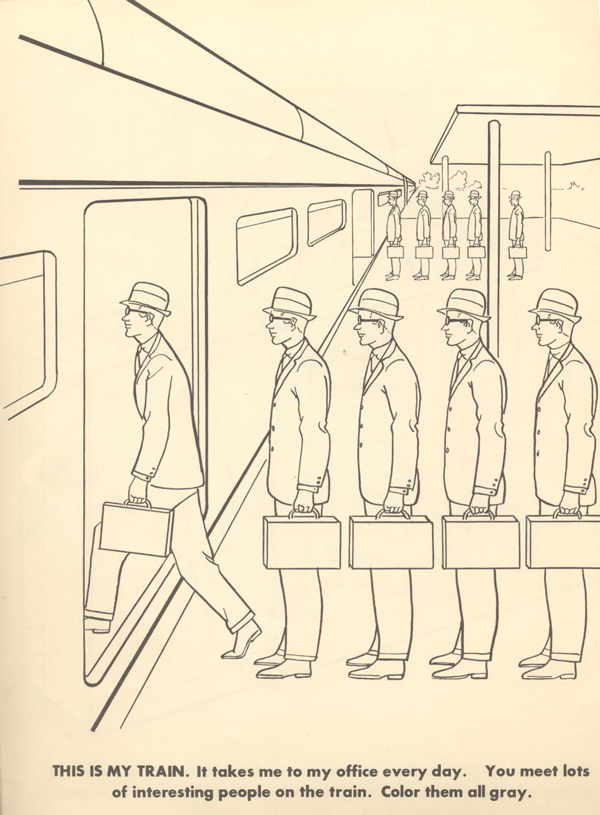
We are each products of the conversations we’ve had, whether with people, books or situations.
That’s why we keep changing.
###
Image credit: A Hole in the Head
Dialogue is a place
 Dialogue is a place. It’s a playground where humans come to teeter and totter, to swing and slide. It’s a geography—a verbal top-of-the-Foshay—where we suddenly see for miles though still sitting in a coffee shop talking with an old friend. Our best conversations become spots on the map we revisit for the rest of our lives.
###
Photo credit: Minnemom

 conversation is an engine