Archive for the ‘Communication is about relationship’ Category
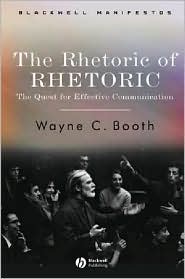
The Rhetoric of Rhetoric: The Quest for Effective Communication by Wayne C. Booth
Readable.
Wayne C. Booth’s The Rhetoric of Rhetoric: The Quest for Effective Communication (Malden, MA: Blackwell Publishing, 2004) was published in a series called “Blackwell Manifestos.” Booth’s passion is equal to the series’ task, whether he is preaching the gospel of “listening-rhetoric” (really getting at underlying truths in conversation versus “bargain-rhetoric” where your goal is to mediate a truce or “win-rhetoric” where your goal is to engage in monologue and so browbeat the conversation partner into submission) or ranting about the rhetorical missteps of the George W. Bush government, there is no lack of passion.
But perhaps the clearest message and the one I take with me is the notion that every piece of communication carries (furthers?) some rhetorical purpose. Every communication has a purpose. And to sit passively receiving without considering what the author/rhetor hopes to accomplish is to allow myself to be taken advantage of. Whether I’m watching a commercial on TV (even a good one), listening to a sonata, hearing a preacher or even reading the prophet Amos or some other ancient text, I’m at my best when I consider—and possibly reject or even accept—the message coded into the communication.
A text wants a response.
###
We Need Your (Creative) Briefs

Unsettle the brain and spirit to move forward.
Don’t just paste in your purpose from the last creative brief. Don’t fill your creative brief with numbers and trivia that aren’t sharpened to make your point. Especially don’t dump in the jargon your client prattled on about. Make your brief work first as a communication tool and then as a community-building tool, because (you know this already) you’ll get the best work from your creative team by engaging them with more than facts. You’ll want them excited. Not excited about a tactic, but excited about what this communication (and what this product) will accomplish out in the world.
Don’t let your creative brief be just another check mark on your ever-expanding list of things to do to get a project started (and thus off your desk). Make your creative brief a thing of beauty and curiosity, like Cicero made his speeches: put in an exordium to get the team riled up about the opportunity. Put in some narrative that explains the full scope of the issue at hand, but sharpen it so your copywriter feels the pain the audience feels (and also feels the opportunity revving up your client). Confirm the why of your point: what are the salient details your copywriter can use? Then refute your point: what reasons will your detractors trot out to show how wrong you are? Then send the team off with a stirring conclusion (peroratio) that sums things up and blends pathos (emotion), ethos (your own sterling character) and logos (reason) in the most unsettling way. I always write my best copy when something isn’t sitting right in my soul.
Some of these ancient guys (like Aristotle and Cicero) have a few things to tell communicators today. How to rouse a team to action is one of those things. We need that.
###
Great Moments in Rhetoric: Climate Change and the IPCC Mission

Good communicators are transparent about their purpose.
The Wall Street Journal reported yesterday on the Intergovernmental Panel on Climate Change (IPCC) mission to take “sophisticated and sometimes inconclusive science, and boil it down to usable advice for lawmakers.” The article speculates (via scientists working with the IPCC) that institutional bias toward oversimplification is what lies behind the erroneous projection that Himalayan glaciers could melt by 2035.
If there is anyone out there who still believes in truly objective science—or truly objective anything—I’d like to meet them. It should surprise no one that we constantly arrange facts to meet our pet goals. And we infuse those facts with the urgency that fits our purpose rather than an urgency arising from the facts themselves. This is a human trait and we should expect it in every communication. Facts are facts, yes. But facts are also small pieces of a rhetorical puzzle that can (and will) be built together in a number of different ways. Is there ever a time when we experience facts in isolation—without some rhetorical flourish—that is, without some political aim that wishes to move us toward a favored action?
No.
But persuasion is not wrong. It is a necessary piece of human life on this planet. All our actions, all our thinking, all our communication, all our learning, all of most everything is organized by political pulls. That’s not overstatement: even the best among us are always motivated by partisan or self-serving objectives. Rather than resist this fact of human life, it makes more sense to look closely at the objectives that drive us. Of course, there are two sides to every story, including this large story on climate change. Sure the WSJ is written from a conservative perspective and this article was meant to shine light on hypocritical methods of their opponents, which always makes for good reading and sells newspapers.
It’s just important that we keep in mind what stake our communication partners have in moving us one way or another. And perhaps as communicators, we do best when we state our goals early. In fact, I think our audiences are put in a positive state of listening when they hear our disclosures up front.
###
Write news based only on Facebook and Twitter?
In our “Writing for Community” class yesterday we discussed the difference between blogging and journalism. It’s getting harder draw a firm line between who is doing what, but the code of ethics about fact-finding and fact-checking remain key differentiators.
Stan Schroeder at Mashable offers the story of five French journalists who lock themselves in a farmhouse in France for five days and “write news based only on what they read in Twitter and Facebook.”
The success of their news gathering and sifting for facts will require great ingenuity. But I’m reminded of Thomas Merton, the Trappist Monk whose influential writings about current events were based largely on letters he received rather than rapt attention to media.
###
Passion is the Preferred Communication Tool

"Haircut, please." "Meet me in your lot in 15."
Clay Shirky, writing in “Here Comes Everybody,” argues effectively that with the lower transaction costs for forming groups (caused by social media), there are more possibilities than ever to pull a group together for most any reason. Dan Pink wrote yesterday of a social media-driven mobile hair-cuttery he saw at Google headquarters. Whether your focus is major profits, minor prophets or mingling in Provence, there are all sorts of new opportunities for banding together around a passion. All it takes is strategic use of the tools freely available, plus the willingness to reach out.
I’m asking my Writing for Community class to brainstorm the contours of the opportunity before them as they seek to build communities. With a passionate leader encouraging group sharing, what sorts of things are possible? We’re already seeing examples every day, from the high-schooler who tried to get released from being grounded by amassing thousands of fans on her Facebook page (her parents remained unimpressed) to the seemingly spontaneous “I’m with Coco” protests.
Depth of passion may well be the limiting factor. Just what am I willing to do to make my point? How far out will I reach?
###
Entering an Ancient Text
Our small group is reading an ancient text together. It’s reproduced in a contemporary volume and to my eye looks like the same English words and punctuation I might find in today’s StarTribune. But the prophet Amos is writing from a very different time and place. He was a shepherd back in the B.C.’s when kings ruled the peoples. And though he was (again) just a shepherd, he spoke a message that came from the God whose roar could wither a mountaintop and drop a pasture into mourning.

The text works on the reader
John Walton, in his introduction to “The Lost World of Genesis One” (Downers Grove: IVP Academic, 2009) writes that understanding an ancient text is not a matter of translating the culture but entering that ancient culture—as much as possible. I picked up Walton’s book because I am fascinated by the huge task taken on by the writer of Genesis 1 and mirrored in John’s Gospel (John 1). Who doesn’t wonder how everything began? And this: what do those deep roots say about life today?
Entering into Amos’ ancient culture will be our task. We’ll do it as a group. We’ll bring supporting sources and texts that point us toward that ancient culture as we walk through those nine chapters. We’ll look at how the author uses his words, what he repeats, what he emphasizes. How he frames his argument. We’ll take a bunch of conversational stabs at understanding the text and I expect to be deeply challenged about the ephemerals I fixate on.
And…I’m expecting God to show up. I’m listening for that roar.
###
How do information and opinion feed community growth?
That is one of the primary questions asked by Laura Gurak in her 1997 book “Persuasion and Privacy in Cyberspace” (Yale University Press), which I came across recently searching for a text applying rhetorical theory to community and social media. In the 13 years since this book came out, the cyber world she described is now a full-fledged daily part of most American lives. In fact, ”cyber” starts to feels anachronistic, because it is accepted fact that people of all ages use the web for news, information and entertainment. So much change in 13 years.
Gurak examined how the ethos of those early Usenet exchanges developed into a force that kept the Lotus MarketPlace product off the shelves and stimulated protest of the Clipper Chip. A combination of flaming discourse, hyperbole, overstatement and one-sided discussions helped fan flames that both drew the community together and (mostly) served the rhetorical purposes the ad-hoc groups that formed around the communication itself.
And that’s the piece worth noting: community formed around the communication. The identification of a problem coalesced a group around an issue. People chose to become engaged through a mostly techie communication tool (as it was back in the early 1990s). Many set to work on identifying and going deeper into the issue, even as they shared what they knew publicly.
I had a conversation recently with a small business owner which helped me see that he (and possibly others) is not understanding the much larger context within which his business sits. Many of us still think of the interweb as a (very) big Yellow Pages. It certainly is that, but less so as time goes on. But our “Yellow Pages” vision restricts our thoughts about web presence to getting our banner ad to some location where people can see it. And maybe we can manipulate the web so that our banner gets seen more clearly, or at least more frequently, than our competitors. But the budding promise is that like-minded people are finding each other as they make information, and themselves, more accessible. And more: people are finding others to be like-minded—even before they knew their own mind on a particular topic. That‘s the way conversation has always worked. I’m suggesting that the conversations on the web are creating community members and, possibly, customers. But for small companies, in an age where meaning is more and more important, are customers really the bottom line?
Yes. And no.
I write as a small business owner myself. I cease to exist as a business without customers. And yet, I’m constantly searching for something more than customers. I’m searching for partners who want to develop a compelling vision together and well, change the world.
Gurak traces the movement of several pieces of standard rhetorical theory as she walks through the history of these arguments surrounding Lotus Marketplace and the Clipper Chip. The tools of communication that helped make an audience back in 1990 are in process today much more accessible to many. The question is: can we keep from duplicating the ethos of hyperbole and one-sided argumentation?
Just what kind of communities are we trying to form, anyway?
###
Google’s Nexus One and Voice Commands

My relationship with stuff is changing.
I look forward to the promise of voice commands on every field in my smart phone, which is noteworthy in the Nexus One. I’ve just discovered that my AT&T Tilt responds to voice commands. Sorta. It’s true there is a feature that allows me to talk at the phone. I can get it to recognize most of my family’s names, though my son’s name always starts a Latin Jazz tune from the Columbian band Sidestepper (preloaded on my phone). Annoying. Does my phone purposefully misunderstand me? Even when I use my best clipped public speaker voice, my “Call Mike Flannigan” never results in anything but contact information for Mark Whalen. I may say “New Appointment” and, well, nothing happens. I can lower my voice. I can slow my voice. I can speak closer to the microphone. But…do I need to work on persuading my telephone to do my bidding?
Most of our rhetorical situations involve people. Usually a speaker and an audience. As a copywriter, I’m most often thinking about persuading some target audience with a written medium—but you see the point: people persuading people. Aristotle wrote about the elements of persuasion and talked about using pathos (emotion), ethos (character) and logos (logic) to get attention (and buy-in). All of these are available when we interact with fellow humans. But which of these is needed for telling my telephone what to do? My phone can’t judge my character (or…can it?). I know it relies on logic, especially when I tell my Tilt to do things it was never programmed to do. But pathos…. Do I need to speak kindly to my telephone? What kind of relationship am I about to have with my telephone?
My wife travelled with a friend not too long ago. The friend called her son using a voice command. Though weaving through traffic at highway speeds, she spoke his name in a low, calm, soothing way. She spoke slowly and got through with her practiced recitation. She knew exactly what her phone would respond to. And that’s what she gave it. Once connected, she went back to her higher, quick-moving manner (which her son knew all too well) and persuaded him of something in short order.
We’ll adjust to new technology. We’ll learn to use voice commands to accomplish stuff. But I am starting to notice the relationships I have with non-human stuff: my phone. My computer. The lamp in my office. Is there a limit to the number of relationships I can have? Do my relationships with stuff crowd out my relationships with people?
###
Transcripts tell a story. That story needs framing.

Every story needs context.
Recently I applied for entry in an academic program. I had the opportunity to read my college transcripts from a couple decades ago. My shadowy recollection of college was that I started in electrical engineering, didn’t care about the classes (hated them, in fact) but soldiered on because that was the clear path toward economic security—or so I thought. Eventually, the engineering department and I sat down together and had a frank talk. Both of us felt there just might be a better place for me elsewhere at the UW-Madison. That’s when I made the switch to study philosophy and immediately felt like I had come home. Twenty years later, the cold hard facts on the transcript were much worse than I remembered. Yikes!
Subsequent experience and studies helped me understand there are some paths I am meant to walk down, and some I am not. Engineering was not one of those paths. Writing was and has been since. In applying to this particular academic program, I made the case that some of us learn what we’re about later in life. I tried hard not to say “slow learner.”
Whatever part of life we’re in, there’s a story that needs to be told. A story waiting for us to tell it. Where the story starts is not where it ends (I’m thankful for that). And even our retelling of the story makes it stronger, validates it, and causes growth in all sorts of ways in us and in our listeners. The guys who hung around Jesus the Christ told stories of what he did and who he was, especially after he died and came to life again. New Testament writers called them “apostles,” which means “ones sent to act on the authority of another.” (Donald K McKim, Dictionary of Theological Terms) Part of what these apostles did was tell stories. These stories gained traction as time went on and became cultural foundations (as well as personally life-altering for me).
Our communication is and always has been marked by the stories that help us understand our experience of life. Sharing our stories helps us grow.
###

 conversation is an engine