Archive for the ‘consulting’ Category
Don’t Bother Me, I’m Busy Talking to Myself
Just because you have a budget doesn’t mean you know what you’re talking about
 I just finished with a client who refused to take direction.
What’s that? You think a consultant should not give direction to a client? You could not be more wrong. That’s exactly what a good consultant does. It’s just that a consultant’s direction doesn’t look like orders or demands. A consultant’s direction looks like alternatives to the usual and invisible way of doing things.
Sometimes we need help seeing what is right before us. We are soaked in teams that are steeped in detail that is loaded with the talk that just circulates between people in the know. This adds up to a set of increasingly narrow word choices that are interesting only to the team. Those words sound like gibberish to anyone on the outside.
My client continued to talk in the insider terms only they understood. And they would not be dissuaded. In the end, they approved copy that ensured no one outside their little circle would understand.
Which feels like failure to me.
This doesn’t happen often, but it’s a bummer when it does. And it makes me think again about how complicated communication is, and why it is so important to start talking earlier rather than later. And why it is critically important that we pull our head out of the huddle from time to time.
###
Image credit: killythirsk via 2headedsnake
“How Do I Expand My Work?”
Sustained, Focused Pursuit Is Itself Hard Work
 If you are an employee focused on the next eight hours, you might not think about “How do I expand?” It is certainly the opposite of “How can I make it through today’s work?” We all ask that second question from time to time, but when we ask the first question, we are typically in a much better emotional place. I say the two questions are related and both revolve around how you define your work.
If you are responsible for bringing in new business, “How do I expand?” is your primary question. If you are an employee and entrepreneurial, you might think about how to grow your department or to expand the charter of your department. If you are a freelancer, or part of a firm or agency (small or large) and tasked with bringing in new business, this first question can consume you.
A friend talked about the “catcher’s mitt” approach, where his ad agency is in the loop to hear about a formal or informal RFP (Requests For Proposal) from a variety of organizations, and they respond. As a freelancer, it is much the same for me—responding to requests from loyal clients and fielding requests from new clients.
But catching requests as they go by is only one piece of the pursuit. And maybe a small piece, though clearly important. A larger piece has to do with organizing yourself and your group for the work you want to do. Getting yourself and your team ready for the work you intend to do. Casting vision and organizing resources so they faithfully align with the work you are aiming at–a thing my friend is good at.
When I say organizing, I really mean trimming and pruning, because while the catcher’s mitt collects all sorts of work that is close and even very close to the anticipated, desired work, it may not be exactly on target. Organizing for the work you want means going through the difficult steps of asking what it is we are good at and what it is we want to pursue. And then moving toward that singular, or at least narrowed range of work in our outgoing conversations.
If this sounds like something that only happens in business, think again. I routinely talk with folks fresh out of college looking to set up their own business and wondering how to go about that. I often respond that they should look for opportunities to work with people and companies that interest them. And they should look for opportunities to use their communication, writing, design and thinking skills to serve (another tip from that inveterate letter writer) those people and firms they admire.
But this is not something just for new college grads. Defining our work and then trimming back and pruning it is a life-long pursuit. When we stop asking “How can I expand my work?” and start asking “How can I make it through today’s work?” we have given away a piece of our vitality.
And that looks like an end rather than a beginning.
###
Image Credit: unicornsandcuppiecakes via 2headedsnake
I don’t always wear clothing, but when I do…
How a Leaderless Team Ruled Project Runway
 OK: bait and switch. I typically wear clothing. And if you know me, I doubt fashion comes to mind. But my costume-designing wife and the fashionistas in our house started watching this show. And I’ve started to like it because it parallels my work of producing copy that must be new and unique while fitting tight space, tone, accuracy and brand requirements.
Season 8 episode [whatever] featured a group exercise. This was poignant for me because when I teach professional writing at Northwestern College, I often include a group exercise. The group exercise is universally hated. For all the reasons you might expect: it’s hard to define what the group is doing together. There’s always someone who fits the slacker role. No one wants to take charge and if the work isn’t up to par, it feels like someone else’s fault.
Next time I introduce a group project, I’ll use Project Runway Season 8 Disc 2 [yes. I am a Netflixer] to set up the team task. That episode shows an outstanding example of what can happens when a leaderless team backs away from personal project management and allows each member to find their own way. Some bit of magic happened in the show that allowed each designer to do their own thing while still producing garments that seemed to belong together. It’s as if they were listening to each other at a level beyond the words used. Leaderless teams don’t always work that way. But that it worked that way once gives me hope.
In contrast, the team with the heavy-handed project manager forced every member to work down at a level beneath their abilities. The judges held that team’s feet to the fire with blistering reviews.
I am intrigued by what can happen when creative people work together. Perhaps the best leader helps their team hear and understand each other so each creator’s personal best is produced rather than some spiritless guess about what the bully micro-manager wanted.
###
Image credit: 4CP via thisisnthappiness
How to Pitch a Medical Device Company #1: Know MedTech Context

help us feel human again
I spent the early years of my working life being formed by the medical device industry. I was energized by the mission of seeing people restored and hearing joyful patient stories. I enjoyed the banter with physicians and learning about the junction of technology and living systems. And I was charmed by the folks I worked with: some of the smartest people around, with a bent toward helping others. Not everybody, mind you, but enough lively, mission-fed people that the workday was full of surprise.
Things change. Corporations mature—for better and worse. Lately it seems the balance sheet and the quarterly earnings call too easily drown out mission. Smart people who enjoy a challenge still work there, and it is an industry with more and more specific boundaries. So if your agency is pitching medical device work, please be aware of these three influences that shape the perspective of the people you will be talking to:
- Legal pinioning
- Regulatory straight jacket
- Branding dead ends
These perspective-shapers sounds like a bummer, but smart agencies with a knack for operating in tight quarters can help make a difference. The first two perspective-shapers are fairly obvious. Naturally, the best medical device companies hold the patients who receive their therapies in the highest regard. And you would not want to work with a company that didn’t. But in our litigious age, there’s lots of money to be made from suing manufactures for all sorts of things. Naturally, medical device companies ramp up their risk-averting processes. Lawyers review nearly every outward facing piece of communication and regulatory reviewers—the picky cousins of lawyers—delight in ferreting out each word of potential deviation from the FDA-approved copy. And the work of lawyers and regulators is invaluable.
Branding dead ends are not so obvious and few will admit to them out loud. These take a bit more explanation, so I’ll reserve it for another post.
But in your initial approach to conversations with med tech employees, know that most of their conversations are like walking a tightrope: marketing is always a balance between what you’d like to say and what you can say given the published studies. Agencies with more consumer experience can find this deadening. But resisting the pinioning and the straight-jacket—in your own way—is one of the ways your team can add value. It’s just got to be believable. And it becomes more believable when you ask for and expect the list of approved claims before starting work on your pitch. Since every claim must have a valid reference, basing your creative on the right foundation can make the difference between making the final cut and being dismissed as not up to snuff.
Image Credit: Engadget
Copywriting Tip #4: Speak Truth to Profits (Dan’s Story)

ancient copywriters rocked
I’m fond of a particular collection of ancient texts. One tells the story of a copywriter named Dan. Dan’s client was all-powerful and routinely dismantled (sometimes literally) those who did not do exactly as he asked. This client never hesitated making impossible requests and had no problem forcing his teams to guess his mind.
Dan was an employee who had been groomed and mentored and specially-trained for leadership. And yet Dan retained a commitment to the recognition that even his abusive, ill-tempered, seemingly all-powerful employer had to answer for his actions and did not have as much control as he liked to believe. This perspective had been shaped early in Dan’s life by his large, extended family.
Dan’s understanding of life held sway over his work. And while he was dedicated employee, he had committed himself to write truth, no matter the cost. This put him in a bind when it came to this client, because this client’s wealth and power routinely corrupted those around him, so most everybody told the despot exactly what he wanted to hear.
The story goes that one gruesome assignment forced the entire team to guess what the employer dreamed and interpret that dream. Or be dismantled. Of course no one could do it, and so they said. The employer force the point and the team prepared to be dismantled. Dan heard of the impending mass dismantling and he and his buddies thought they better act on their understanding that even the king answered to God. So they prayed. That’s right, this is a story of a copywriter who conversed with God so he could do his work better. Dan would often point to these conversations with God when people praised his insights.
And he did get insight. From God. It was not an insight that put the employer in a good light, but Dan told it anyway. And everyone lived another day.
The Moral
Truth matters more than appeasing the abusive despot before you.
And This
The copywriter’s work has always been about providing insight into the soul of a client and the heart of a client’s audience. Get help with that.
###
Image credit: Douglas Smith via 2headedsnake:
Dummy’s Guide to Conversation #7: Flog Your Gnostic

Let Your Newbies Speak Prior to Corporate Brainwashing
Step into a marketing meeting in any medical device firm in the Minneapolis-St. Paul area and be assaulted by a barrage of acronyms. Those uttering the abbreviations assume everyone present knows what they mean—or not. Some climbing their ladder speak precisely to show they know way more than others sitting around the room. For those, language is less about communication and more about one-upsmanship. Certain words signal a superior knowledge, a sort of Gnostic approach to the workplace that demands allegiance and, frankly, a bit of awe for all listening. When the exceptional words are spoken, a hush falls. And not just because most people don’t have a clue what was just said. But also because the words hint at some brave new insight (often just as obscure). Much of which is counter-productive to getting work done as others scramble to decode the awesome insider lingo.
Then again, what is “work”? Is work the climb up through the corporate-playground jungle bars to reach the top where the cool kids hang? Or is work about serving some need or group not immediately at hand? For most of us, work is a mix of the two. Usually we hire on because of the mission only to get embroiled in the politics. Part and parcel.
Good work begins by flogging the Gnostic. Flogging the Gnostic means slowing the flow of incomprehension with questions that penetrate to the sinew of a larger idea (or at least a benefit). Exposing the Gnostic is all about cutting to the bone of language that your true, final audience will understand. All the better if you can dissect to a simple, sticky, credible, believable idea anyone could understand.
For better or worse, flogging the Gnostic usually begins with your own inner Gnostic. Certainly you’ve felt the magnetic pull to parrot the word your boss/client just said, that magic word-of-the-moment that instantly captured attention. Better to aim right at the final audience, right through the BS, right through the acronym salad, straight to the folks you are trying to serve.
As a consultant my role is often to shun the insider language and play dumb (an easy task for me). This is the only way to build toward an actionable, sticky idea that communicates, no matter what it looks like to those playing the insider game.
Resolved: this week I will flog the Gnostic.
###
Photo Credit: August Sander via thisisnthappiness
House Hearing on FDA and Medical Devices: Even God Doesn’t Guarantee Safety
A sluggish FDA is partly a response to our demand that they arbitrate safety

Great Power. Still Human.
[Full disclosure: I consult for the medical device industry.]
Tomorrow’s hearing with the House Oversight and Government Reform Subcommittee on Health Care is all about looking for a better way to get medical devices approved. MassDevice reports Minnesota Rep. Erik Paulsen will be there to push for an “ ‘innovation pathway’ for pioneering medical devices.” Paulsen is also there to try to block a proposed $20 billion tax on the medical device industry.
Lives ride on the safety of medical devices. The companies I work for take this very seriously and institute redundant processes to check, double- and triple-check that all the right things were done. They take a great deal of pride in their record and FDA oversight is likely a boon to Minnesota’s culture of medical device safety.
That the FDA is slow to approve medical devices and is often seen as a bottleneck for innovation does not surprise me. How could it be otherwise, given that Americans want iron-clad guarantees that everything with the FDA seal is perfectly safe? We want and expect the FDA to play a God-like role in assuring us nothing harmful every escapes their jurisdiction. And sharp-toothed lawyers constantly circle and swim in at the first hint of blood, so it is also a big-money game.
Do we expect too much from the FDA? Is anything ever truly safe and entirely understood? Though the FDA would likely argue that they are simply applying “reasonable standards for safety,” the public doesn’t see it that way. FDA “approval” means something far more to most of us: that nothing should ever go wrong. That’s too big a role for a person or an agency. Even God doesn’t issue a decree like that: He only says that it all works out in the end for those in relationship with Him. By the way: my experience is that the FDA never “approves” anything. They just clear it for market release. Subtle difference, right?
We all need to be reminded again of what constitutes a reasonable standard for safety.
###
Image credit: Kay-too
Quiet Leadership by David Rock. How to Help Someone Have an “Aha!” (Review)
Talk your friend into the answer she already knows
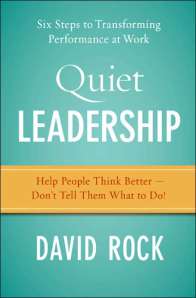 How do you help people connect the dots in their work lives…and in the rest of their lives? Turns out there is a lot we can do. And our primary tool is conversation. In Quiet Leadership, David Rock gives an overview of (relatively) recent neurological findings to show how our brains remain plastic, that is, moldable and changeable, long after childhood. It was once thought that at some point in late childhood our brains stopped—well, it’s not that they stopped growing, but seemed to create new neural pathways with less frequency. That thinking was all wrong. The truth is our brains are capable of growing new neural pathways all the time—new mental “wiring.” And by calling it “wiring,” Rock hints at the mechanics of how we help each other connect previously unconnected thoughts and motivations. He works at changing our mental wiring using questions about our thinking. Helping people find their own answers is light years more effective than telling someone what to do.
Like most books written for the business market, Rock presents a tidy set of steps to follow. Quiet Leadership has six steps. Each step has a chapter or section attached, so there is a lot of very practical, very interesting information for each. I outline these steps below because after reading the book and getting a sense of the potential, I’m curious to remember and try them:
- Think about thinking (focusing on how your conversation partner is thinking about the issue troubling them)
- Listen for potential (listening with a belief your conversation partner already has the tools for success)
- Speak with intent (Be succinct. Be specific. Be generous.)
- Dance toward insight (Conversation really is a kind of dance)
- Permission
- Placement
- Questioning
- Clarifying
- CREATE new thinking by exploring:
- Current Reality
- Explore Alternatives
- Tap Energy
- Follow up (Renewing and restoring the motivational connections by checking in later)
You may be skeptical of tidy steps. You may think “dance toward insight” is too over-the-top. I agree. And yet there is something in what Rock says that speaks to the reality of any conversation. Conversations routinely take off in crazy directions. Conversations often start with a need and we immediately feel helpless to meet the need: we don’t know all the details. Even if we did, we don’t know how our conversation partner is really thinking about the issue.
Rock provides a way to probe thinking (I like how he asks permission to probe) to not only help a person find solutions, but also to help a person be motivated to act on the solution.
I’ll use this book as I teach, with clients, and in general conversation. I highly recommend it.
###
Do a Dumb Sketch Today
Magnetize Eyeballs with Your Dumb Sketch
 As a copywriter, I’ve always prefaced my art or design-related comments with, “I’m no designer, but….” I read a number of design blogs because the discipline fascinates me and I hope for a happy marriage between my words and their graphical setting as they set off into the world.
But artists and designers don’t own art. And I’m starting to wonder why I accede such authority to experts. Mind you, I’m no expert, but just like in the best, most engaged conversations, something sorta magical happens in a dumb sketch. Sometimes words shivering alone on a white page just don’t cut it. Especially when they gang up in dozens and scores and crowd onto a PowerPoint slide in an attempt to muscle their way into a client’s or colleague’s consciousness. Sometimes my words lack immediacy. Sometimes they don’t punch people in the gut like I want them to.
A dumb sketch can do what words cannot.
I’ve come to enjoy sketching lately. Not because I’m a good artist (I’m not). Not because I have a knack for capturing things on paper. I don’t. I like sketching for two reasons:
- Drawing a sketch uses an entirely different part of my brain. Or so it seems. The blank page with a pencil and an idea of a drawing is very different from a blank page and an idea soon to be fitted with a set of words. Sketching seems inherently more fun than writing (remember, I write for a living, so I’m completely in love with words, too). Sketching feels like playing. That sense of play has a way of working itself out—even for as bad an artist as I am. It’s that sense of play that brings along the second reason to sketch.
- Sketches are unparalleled communication tools. It’s true. Talking about a picture with someone is far more interesting than sitting and watching someone read a sentence. Which is boring. Even a very bad sketch, presented to a table of colleagues or clients, can make people laugh and so serve to lighten the mood. Even the worst sketches carry an emotional tinge. People love to see sketches. Even obstinate, ornery colleagues are drawn into the intent of the sketch, so much so that their minds begin filling in the blanks (without them realizing!) and so are drawn into what was supposed to happen with the drawing. The mind cannot help but fill in the blanks.
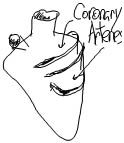
The best part of a dumb sketch is what happens when it is shown to a group. In a recent client meeting I pulled out my dumb sketches to make a particular point about how this product should be positioned in the market. I could not quite hear it, but I had the sense of a collective sigh around the conference table as they saw pictures rather than yet another wordy PowerPoint slide. In fact, contrary to the forced attention a wordy PowerPoint slide demands, my sketch pulled people in with a magnetism. Even though ugly, it still pulled. Amazing.
###
Two Words Cost Me Dearly
 My Splendid Sabotage
Please know:
First: I wrote the words 40-some hours into a 51 hour project spread across a week and a half.
Second: I was desperate to capture the zeitgeist bouncing between client and agency principals.
As I wrote these two words I immediately moved to delete them. But something stopped me. Was it reckless whim? Had I given up? Why oh why did I pause over “Delete”? My self-editor should have been there, sitting beside me. He was still locked in the self-editor-dungeon where he has a cot and a Folgers can to pee in. He doesn’t get out much when I’m creating.
“Flabby Paths”
Oh, sure. They seem innocuous—even forgettable. But as a subhead for a component of this project, they were the stalled car on the track that derailed the train pulling boxcars of produce that needed to get through right now. Or: These words distracted the creative team and hurried them down a path and off a cliff.
So, my bad. Personal penalty: pulling my invoice and attacking it with scissors and fresh resolutions. It’s a matter of integrity. It’s also a matter of retaining relationships.
Floated or Finished?
It’s never just the words, of course. It’s the trust built between creatives as a project moves forward. With some team members you are free to say the really stupid stuff and let it sit for a moment between you, even as you all know some better idea is moving up an esophagus about to be uttered. But with other teams, and especially in hurry-up mode, words appearing on paper carry more weight: not of an idea floated but an idea finished. At this point in the project, my self-editor needed to be there with his “HIT DELETE” stamp poised. Because time was flying and next steps need to step up solidly.
My point? Conversations are never formulas that work in every case. And: while creating, the self-editor needs to dwell in the dungeon, but words making their way out in public need to meet his approval. Let him out sometimes.
###

 conversation is an engine