Archive for the ‘copywriting’ Category
Tip #9: Launch Your Idea. Don’t Detail It.
We all repackage our stories for the best effect
Writing copy can be disorienting—especially for English majors. Rather than grading on how they develop an argument and how well they follow particular usage rules, they are graded on how well their copy meets a marketing need. They are graded on how well their creativity pulls in the target audience—and how quickly. Each exercise and assignment becomes more about the big idea and the execution of the idea rather telling all the detail in an orderly fashion.
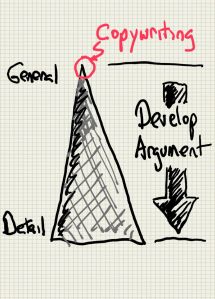 It can be disorienting because we might have mistakenly thought copy was just emotional marketing hype, the (nearly invisible) stuff that abides in much of our current messaging (“clutter,” you might say). Copywriters just toss any word in an ad, like “new” or “organic” or “protein” to get people to buy in, right?
But copywriting is more like a lab where you boil down the raw material to get an essence. Then you adjust the pheromones in that essence to get the behavior you want in the audience you seek.
Wait—that sounds manipulative.
If it is, it is a common trait and practice shared by all humans. We’re all packaging and repackaging our stories in real time. We constantly change-up our experience and knowledge and opinions as we deliver them to friends and family, prospective mates, acquaintances and strangers. It’s not a purposeful misleading, it’s just that the human condition is constantly changing and we see things differently at any given point. And we all want to be heard, so we change how we say things.
Mind you—orderly telling is still critical for copywriting. But audiences don’t make time for essays (sadly). And developing an argument is still critically important—it’s all just very, very fast.
The key is getting—and holding—attention.
Eight other copywriting tips for English majors here.
###
Image credit: Dumb sketch by Kirk Livingston
Let’s have a prune party
In what odd corner of the universe could “prune” and “party” ever fit together?

C’mon copywriter: not everything your product marketer says is true.
###
Via Vintage Ads
Why Name a Problem?
“They won’t recognize a great solution until they see how big the problem was.”
Along the way to becoming a copywriter one must learn to name problems. This is an essential skill for anyone trying use their creativity out in the world of real people and real issues. Because when you present your bit of inspired copy to a prospective client (as one does when planning for serendipity), they will not see how inspired it is until you tell the problem the copy solved. Once they understand the problem, they can begin to appreciate the genius of the solution you created.

Naming a problem is best done in story form: there was this nasty condition and people worked around the nasty business in this way, which was inconvenient and bad. But we saw that this could be done, and so I created this. Which seemed to work and everyone was happy. Problem solved.
But naming a problem can sometimes be uncomfortable. Not usually after the fact, when everyone can easily see that it was a problem. But before: if you are the first one to notice a problem it takes a bit of courage to say it out loud to others. What if you got it wrong? What if you just don’t understand? If you name the problem, will you be responsible to fix it?
Here’s where a lesson from work fits back into real life as a human: naming a problem is the first step toward fixing it. That is true with my clients and it is true with students and it is true in all sorts of relationships and life situations. To name something is to register that a problem exists. It puts the problem on the radar and communicates to others that there may be an issue.
Until you name a problem you have very little opportunity to address it.
Naming is a bridge to fixing.
###
Image credit: Kirk Livingston
Tag:
Thai Life Insurance: Get All Good-n-Weepy
Pass the Tissues
Look: I know it’s selling me something. But I kinda want to buy. Not so much the life insurance as “witnessing happiness.”
###
Via Adfreak/ Rebecca Cullers
Copywriting is a Full-Contact Sport
James Young: a Technique for Producing Ideas
Today we discuss Mr. Young’s book on how to have ideas. It’s an old book and disregarded by some of my copywriter/art director friends. But I come back to it again and again. I like how Mr. Young serves up the notion of a way to go deeper than our immediate surface reaction. I like the book because he provides signposts and mile-markers along the road of getting to the heart of a notion.

Now that’s good copy.
To me, copywriting is a full-contact sport. Here’s what I mean: ideas do not come from sitting in a dark room and thinking deep thoughts. That is called a “nap.” Ideas come from a mind-body connection. Copywriting starts with gathering materials (Young’s Step #1) and then writing out the connections between those materials and the target audience’s problem or perceived need (Young’s Step #2—Masticate). This mastication or digestion step involves pages of false starts and headlines and mind-maps. It involves shuffling index cards and drawing with crayons on the walls/arms/shoes and many dumb sketches. It involves telling others your nascent point and watching their reaction (“What the…. Huh? Get away from me.”)
I particularly love Young’s Step #3—Walk Away. It’s when I go for a bike ride or a jog or a walk. Or lunch. Anything other than the problem at hand. And then—Behold—the solution pops into being. Fully-formed. Sorta. Sometimes it’s an ugly baby and needs, shall we say, a trim. But out of this process come useful ideas that get to the heart of the matter and may—just possibly—cut through clutter rather than add to it.
Check out Maria Popova’s take on Young’s technique here.
###
Image via Copyranter
Turn Your Message Away.
What might happen if you spun your story outward?

###
Image Credit: Kirk Livingston
Boss: With this ping, I have now pled
Think Globally. Act Tactically.
Sometimes we just do our job.
Sometimes we think bigger thoughts and help our boss sort out what next—long before being asked.
I maintain our best work comes from that place where we think strategically and act tactically. Our best work comes from big thinking harnessed to this moment’s need.
Today in our copywriting class we talk about relationships with clients. My line on this is to cherish, honor and protect your client—which starts to sound like a marriage—not quite the right analogy.
Then again, maybe it isn’t far off.
Clients are people who trust us to handle their message. They’ve hired us to do something they cannot do. This is a privilege. Our favorite clients know the best work comes from well-articulated need and parameters followed by the freedom to go and do. And sometimes our clients depend on us to help articulate those needs and define those parameters—simply because we get very close to the need.
This is where the copywriter’s outside perspective helps immensely. It’s also where we deploy our skill of listening into the deep waters of what our client eats/sleeps/breathes/knows. Because sometimes what seemed like only tactical work can turn into an opportunity even the client didn’t realize was before them. And we need to say so.
Such is the opportunity with collaborative teamwork and trusting work relationships. And that’s why it is important copywriters always think Grande or even Venti rather than Short.
Here’s to clients! (Jaunty raising of the ice water glass)
Long may they…, well. Hire.
###
How You Say: Not Just “What” But “When”
A word is a fuse. Light the fuse.
I’m teaching a freelance copywriting class at the University of Northwestern—St. Paul. Yesterday was our first day and I wanted the students to begin the shift from writing papers for professors to writing words to make a difference. I maintain that excellent copywriting is the very opposite of spewing malarkey and hype. Especially today, when anybody who can read and/or listen and absorb marketing messages has their BS meter set on high all day long.
The best copy doesn’t call attention to itself. The best copy is nearly invisible and absorbed without realizing it. The best copy latches on to or illustrates a larger idea and leads the reader to the idea threshold. The best copy is emotive and rational. If it can be silly too—all the better.
We talked about the differences we perceive in writing for non-profit, mission-driven organizations and for-profit organizations. At first glance we might think one organization is all about mission and the other is all about money. But that is a mistaken notion: for-profit organizations can be all about mission and non-profits can be all about fundraising. Examples abound in each category.
One of the things I love most about teaching these particular students is the sensitivity to mission. They are cool with the notion of using your writing skills to help others. Many are considering starting work with non-profits, but that is not unusual for many studying the liberal arts. These particular students are often eager to trace their motivations for helping others back to some of the ancient texts that drive much of this school’s mission.
But one thing that is not so clear is that mission-driven work exists in both non-profits and for-profits. One’s mission comes largely from within. Our job—that thing we get paid for—is an outward-focus of the mission we bring with us. A copywriter with a sense of wanting to help others can find a home in any number of organizations, whether for-profit or not-for-profit. And using that copywriting skill to bring a reader to a life-changing realization can be a primary motivation for the whole task of writing.
I would like to see more copywriters with that motivation.
My go-to example is the quiet laugh from the writer in this four-minute film. Listen for the laugh. Think about what that laugh says about delivering the right words at the right time:
###
Kristina Halvorson & The Discipline of Making Stuff Up
Content Strategy and Brain Traffic
Someone asked a perfectly reasonable question:
What is content?
Our Social Media Marketing class is composed of collegiates with a passion for writing and communicating. Whether from the Journalism/Communication school or from the English department, we’ve come together around this notion of producing content in pursuit of a vision.
So we write.
While “content” seems a rude way to talk about the deep thinking that goes into a paper on, say, the merits of determinism, it’s a term that works pretty well for less lofty/more human conversation. The kinds of conversation suited to inviting in semi-interested onlookers.
Content is the stuff we use to describe our vision for…whatever. If we’re building a coalition to alleviate homelessness, the content we produce will point to the problem, tell stories about real people, show the inadequacy of current solutions and keep offering attitudes that illustrate the need and humanity of the man on the corner with the sign. If we work for a company that makes implantable deep brain stimulators, our content will highlight the current science behind Parkinson’s disease, show current (inadequate) ways of dealing with the disease, harp on the benefits of such stimulation without hiding the downsides.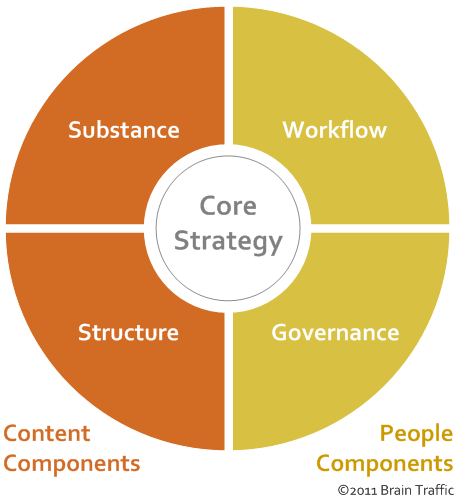
Kristina Halvorson, founder and CEO of Brain Traffic and co-author of Content Strategy for the Web will join us today (provided she can plow through 4-6 inches of new snow) to talk about the disciplines involved with making stuff up. Because that’s what content is: making stuff up. For a purpose. Making stuff up in accordance with a discipline, toward a specific end, to meet a particular business or social objective. That’s why content and writing go so well together: there’s nothing a writer likes more than stepping into a big idea and exploring the main streets, side streets and alleys and foot paths with words and images and video. Sometimes we have a map to start with. Sometimes we make up the map as we go.
Mostly we do both.
###
Image credits: Brain Traffic

 conversation is an engine