Archive for the ‘curiosities’ Category
Just a train ride today
Don’t fall asleep–like you always do on the train
Wait. Was that Margaret Thatcher around 3:54?
###
via Sell! Sell! Blog
You Don’t Have to be a Professor to be a Professor
Rock Your Otium With Purpose
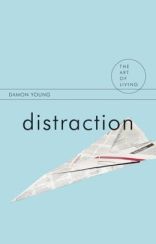
Australian philosopher Damon Young’s Distraction cites the fascinating example of Dutch philosopher Benedict de Spinoza. An able, talented and academic-class thinker, he did much of his work outside the academy. But in 1673 Spinoza was offered a position at Heidelberg University where he would teach while earning the salary of a full professor—opening for him a “life worthy of a philosopher.”
Spinoza refused.
He preferred to continue to practice his craft: grinding optical lenses for short-sighted friends. Spinoza wanted to earn his own income and use his free time (his otium) to uncover the mysteries of the universe and sort out how people should treat each other. Teaching would be a distraction from his primary work of writing and thinking. He refused the distraction, though the job seems a much easier route for what he was already doing.
Young wondered if there was something of the work of the mind in the crafting of the lenses that helped Spinoza move his thinking forward. That connection between thinking and craft is something Matthew Crawford (Shop Class as Soulcraft) would likely agree with. Spinoza’s lenses were renowned and admired—he did good glass work. But his philosophical writings are why we remember him.
We still read Spinoza today. Young points out that while Spinoza’s prose makes for boring reading, it is among those unusual texts that have passed the test of time.
 The truth is there are only so many hours in a day. If you’re an adjunct professor, you are basically volunteering your time, which might have gone toward research. If you are a full-time professor, you must diligently make clean breaks from distraction to do the research you studied for.
I relish Spinoza’s example for the intrinsic motivation that led to his colossal works. I am also intrigued by the relationship between his daily lens grinding and the sight he brought to his writing. I very much enjoyed Damon Young’s book.
###
Image credit: Philippe Ramette via Frank T. Zumbachs Mysterious World
Going to Church Today? Consider This.

expect a conversation that will help sort things
Probably someone will speak to the group—that’s typically what happens. And there will be singing. Prayers will be offered. You’ll shake a few hands. Maybe you’ll learn something new. Maybe you heart will be lightened. Your load lifted.
If heart-lightening or load-lifting happens, stop and think why. Was it because of magic words spoken from the pulpit? Not likely, as there are no magic words. But there are words that find a home in a person’s conscious thought and get absorbed there to do some work. One of the tests the old church fathers used to determine if a letter or text should be included in the Canon (our Bible today) was whether it had the power to change people—did the text speak with authority into a people’s lives? Did something happen because of hearing the text? When those old words get uttered from the pulpit today—they are not magic—but their truthiness has sticking power.
Just as likely: you meet someone who says something that affects you. Makes you think. Makes you reconsider an impending decision. And perhaps that same heart-lightening or load-lifting occurs. Sometimes we meet people who speak truth and it has the same effect.
And consider this: perhaps you go into that time expecting to hear something. What I mean is, sometimes we move into a situation actually expecting to hear something that could have the power to change how we think or act. You might call this listening. Or attentive listening. Or attenuated listening. Or listening on steroids. But whatever you call it, this is the most productive penultimate approach: listening with expectation. Then you pick up the tasty truthiness from any source.
###
Image credit: Douglas Smith via 2headedsnake
What’s a Rolodex and why would I want one?
When will the cloud break your heart?

“I don’t care if Google has my information,” said the sales woman.
Digital natives may be a lot of things, but one thing is certain: they aren’t too worried about technology. For them tech is a fact of life, like air and electricity and coffee—always there. Always ready. All slick and wireless and greased to go. That’s why Facebook is mostly just a free $13 18 20 billion Rolodex and Google is a verb. Thus has it always been. And so it shall always be.
Except when it isn’t.
Digital natives have abandoned themselves to the cloud assuming it will always be there. Mostly they don’t have a plan B when stuff goes away. Plan B is to call friends for numbers and addresses and recreate what they had before—but that’ll never happen because Facebook will be there, right?
I don’t put myself in the digital native category, which means I remember a bunch of dumb old stuff like phones with cords and 5 ½ inch floppy disks and, well, I won’t bore you with a kiln-load of nostalgia. But I retain crisp memories of this: important stuff vanishing with a bad piece of media. And an old computer simply destroying things I’d spent lots of time on. More than once. And that lesson stuck. That’s why my contacts and files reside in multiple places, including the cloud. That’s also why I do not assume Internet access in my travels. Instead I have this dumb game of searching for Wi-Fi wherever I go: just last week I ran across a signal called “Chuck Norris” in South Minneapolis. My many experiences losing important information have made me happy to seek redundancy.
The sales woman at the AT&T store has no problem storing contacts, messages and files with Google. Same with millions of us. Who cares if Google scans our communication and sends the right advertisers our way? Who cares if Facebook is about to have one of the largest IPOs in history, based on the dumb comments we type and the hours we spend on the site? Nobody cares—we get what we want out of the deal. We chat with people and divert ourselves with dumb games. Half of Americans think Facebook is a passing fad—and GM thinks their advertising with Facebook is a waste of money. Even if both of those are true, something more enticing and powerful will surely rise next.
I’m guessing down the road we’ll realize the much larger issue was not about losing stuff. And the larger issue maybe isn’t even that we’ve given away the keys to our connections between friends, family and acquaintances. We have yet to understand the full impact of this progressive-thought harvesting, but I’ll admit Nick Carr’s post on digital sharecropping has set me to thinking about where I spend my digits. It also makes me reluctant to entrust everything to the cloud and the enterprising folks who manage it.
###
Image credit: Chris Buzelli via thisisnthappiness
Is it Time You Wrote Your Autobiography?
I’m not writing one. Then again, who isn’t adding to their autobiographical material daily, whether with words or deeds?
but surely I am king of something
I’ve been reading the autobiography of R.G Collingwood, an Oxford philosophy professor of the last century. He set out to trace the outline of how he came to think—a kind of personal intellectual history. Early on in his life (at 8 years old) he found himself sitting with a philosophy text (Kant’s Theory of Ethics). And while he did not understand it, he felt an intense excitement as he read it. “I felt that things of the highest importance were being said about matters of the utmost urgency: things which at all costs I must understand.” (3) That reading set one course for his life.
One thing that makes this book worth reading is his notion of how questions and answers frame our production of knowledge. Collingwood said he “revolted against the current logical theories.” (30) He rebelled against the tyranny of propositions, judgments and statements as basic units of knowledge. He thought that you cannot come to understand what another person means by simply studying his or her spoken or written words. Instead, you need to know what question that person was asking. Because what that person speaks or writes will be directly related to the question she or he has in mind. This is incredibly useful when studying ancient texts—like a letter from the Apostle Paul, for instance. It’s also incredibly useful when listening to one’s wife (ahem), or a student or to anyone we come in contact with.
Another thing that recommends this book is hearing him tell about his main hobby: archaeology. Collingwood was the opposite of a couch potato. He spent a lot of times in digs around the UK, unearthing old Roman structures and then writing about them. Here too, he explained that while some archaeologists just set out to dig, he only set out to dig when he had formed a precise question to answer. His digging (tools, methods, approach) were all shaped by this question. By starting with a question, he came to very specific answers and, of course, other brand new questions.
Questions begat answers. And more questions.
What question is your life answering?
###
Image credit: J-J. Grandville via OBI Scrapbook Blog
Talking Philosophy with a 10-Year Old
Why not talk about something more interesting like dragons or flying?
 I like reading Emmanuel Levinas. He’s mostly opaque, but every once in a while his writing opens on a breathtaking view and is just what I needed. If I had the opportunity to explain why Levinas matters to an interested ten-year old, I would say that we have a problem with other people. And the problem is that we mostly don’t want to hear from them. I could use an example from their life: you don’t want your mom to interrupt your fun: when she calls you in for dinner, you go in only reluctantly. One problem with the will of the other is that we don’t welcome distraction from our preoccupations. But it is not just that, it is that we really don’t want to even interact with some other who might have authority over us.
10-Year-Old: “Oh. You just don’t want to do what other people say. Does Levinas tell you how to avoid doing what others tell you to do?”
Kirkistan: “Not exactly.”
10-Year-Old: “Does he tell you don’t have to do what they say?”
Kirkistan: “No. It’s more like you suddenly want to do what the other person wanted because you really, really loved them.”
10-Year-Old: “Like maybe if my grandparents were in town and asked me for something and I wanted to do it for them because they are so nice?”
Kirkistan: “Yeah. Maybe like that. And maybe you found yourself really interested in the experiences they had, partly because they are such good storytellers and they make everything sound so exciting. You like their stories and can almost imagine being there.”
10-Year-Old: “So my grandparents are cool and I want to get to know them because they are nice and tell interesting stories. So what you are really talking about is why it is important to hear from other people and why we should care.”
Kirkistan: “That’s right.”
10-Year-Old: “So why did you start be talking about stopping what I thought was fun to do something I had to do?”
Kirkistan: “Well, I might have been a bit confused. But also because sometimes I close my ears to people who are trying to give me a gift. Something I really need. Say you are at the grocery store with your parents. It’s Saturday. And there are sample ladies on every aisle. There is lady offering free ice cream in the frozen aisle. And another man making pizzas in that aisle. And another with little chicken nuggets and another handing out crackers and cheese.
Kirkistan: “But say you really didn’t want to go to the grocer. You really wanted to watch cartoons. So you went to the grocer reluctantly, but you took your iPod and listened to music the whole time. You walked behind you parents, music turned up. So you didn’t hear the sample ladies calling out to you. You kept your eyes on the floor so you didn’t see them either.”
10-Year-Old: “That would be bad. I like ice cream and chicken nuggets and pizza. It’s like I had missed all the really good stuff while everybody else got something. I’d have gotten my way but I’d have missed out on the very best stuff.”
Kirkistan: “That’s why Levinas is important. He helps us start to see and understand why it is we should care about the people around us: what they know. What they bring to our conversations. What they have to say about this and that. Even people who don’t seem to have anything to say—even those people can surprise us with lots of interesting things.”
10-Year-Old: “OK. Well, why don’t you just listen to people? I listen to people and learn things all the time. That isn’t hard to do. It is super easy to listen to people. It’s not like you have to do anything. You just listen.”
Kirkistan: “Well, that is great advice and I want to follow it. My answer to you would be that as you get older, you start to think you know a few things. We get to thinking we know the patterns of how things work and we figure we know pretty much how anyone will respond in any given situation. Anyway, all I’m saying is that it gets pretty easy to think you know what most people will do or say in any given situation. The surprise—if you can call it that—is that quite often people live up to our expectations. They do what we think they’ll do. Not always. But often. Then the question becomes, “Did that guy say that because I expected him to say it?” “Did I have a hand in turning this conversation this way?”
10-Year-Old: “You’re pretty boring aren’t you?”
Kirkistan: “You might be right.”
10-Year-Old: “Why don’t you write about something interesting like dragons or warships? Why don’t you write a book about how to fly?”
Kirkistan: “Great suggestions. I really want to write a book about how to fly. I think that this is the book I am writing.”
###
Image Credit: Mid-Century via thisisnthappiness
Writing with Sheet Metal (ShopTalk #2)
The Pull of the Factory Floor
 As a copywriter I spend my days in front of a pair of computer screens. Writing. Yes, I have meetings with clients and colleagues, brainstorming sessions and updates and phone calls. But mostly I remain planted before my computer, sorting through masses of information, ordering data that came with competing priorities and generally figuring out new ways to present the right facts to the right people in a way that causes a reaction.
Then there are days I visit a particular client’s factory. It’s a factory with a whistle that blows, union members who take 15-minute breaks, safety glasses and focused workers at benches doing macro and micro tasks. It’s a factory that stamps and welds metal, where electricians wire metal carcasses as long and tall as a semi-trailer. This factory is lit so everything is visible and produces a hum of activity across the concrete floor, which is the size of several football fields.
Why give so much detail? Because many who read this—myself included—spend our days in offices. But a factory floor is a different sort of place—a different world, with a different set of priorities and where production is king but craft sits near the throne.
I like this factory floor because it is different from an operating room, different from a cath lab, different from a conference room during an endless PowerPoint presentation, different from a row of cubicles and different from the Livingston Communication Tower (high over St. Paul). There is an irresistible, energizing activity on this factory floor that flows out of the scores of workers. But maybe that energy also comes from my past, because I grew up watching my dad craft furniture from oak and walnut. Maybe that’s where I absorbed the notion that producing a solid piece someone might actually use is a great way to spend your time and a fulfilling thing to do.
In this ongoing discussion of what makes for fulfilling work, I want to trace fulfillment down a different thread. This thread places the writer in a team with a goal of productivity. The writer and the team are focused on this goal of shipping something real and substantial. At the same time this team is also sort of doing life together—because in the middle of work there are the discussions about the rest of life. For a writer, this team-ness is a different way of spending the day and not to be missed.
Don’t take this as a romantic view of factory work. Instead, see it as the reality of the life situations where your craft takes you to meet a need.
###
Image credit: Yael Frankel via 2headedsnake
College Majors to Avoid + Rebuttal
And back to the work itself
 Good design often has this effect on me: it makes me want to find and do the work I am meant to find and do. Moving quickly through the many architecture or art or photography blogs out there also reminds me of what vision looks like when carried out. Vision alters our perceptions of the physical world and sometimes alters the physical world itself. And that is no small thing.
Yesterday I found myself in disagreement with the Burnt-Out Adjunct (whose too-infrequent posts I eagerly await and enjoy) who wrote that liberal arts studies should be more corollary than central to a college degree. Pisspoorprof was reflecting on another of these “ten worst” articles that pop up from time to time. This time it was Yahoo! Education touting the Four Foolish Majors to Avoid if you are trying to reboot your career.
Liberal arts degrees were the #1 opportunity killer with philosophy a close #2 opportunity killer. By the way, I cannot help but note that the entire article is an advertisement for the continuing services of Yahoo! Education.
As a holder of an undergrad degree in philosophy I both agree and disagree.
- Yes: no one hires a college grad to resolve deep-seated teleology questions (one does that on one’s own time). But to his credit, the VP at Honeywell who gave the OK to hire me (lo these many years ago) did question my stance on freedom vs. determinism.
- No: How about granting a bit of perspective? We need people who can think outside the present job parameters. And we desperately need people to challenge those parameters. Educating people to acquiesce by default is not what we need (though it is a short-term path to cash). Liberal Arts (and especially philosophy, let me say) can help this happen. Yes that sounds like the standard line from any college admissions staff says. Yes it is what professors say as they pass each other in the hallowed halls. No you don’t need a college degree to challenge the system, make a million bucks, make a difference or be homeless.
But studying things that don’t make money has a way of making us more conscious of all that is going on around us. Will it eventually make money? Maybe. Maybe not. But we need people with larger vision who can paint or write or photograph or build a different way of looking at things—however that happens.
What do you think?
###
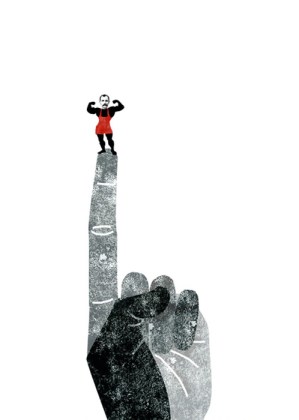
Image credit: Studio Lindfors via 2headedsnake

 conversation is an engine