Archive for the ‘curiosities’ Category

Dear NSA: About my recent web searches for HCN and NaCN
 It’s not about bomb-making. Or Drugs. Honest.
Mr. Snowden’s revelations to the Guardian have brought me back to earth about how much of any private web work is actually public knowledge (ahem, everything).
So, to the NSA handlers following my recent searches: my interest in sodium cyanide has nothing to do with bomb-making. Can bombs be made of sodium cyanide? I’d google it but my NSA handler would only put me higher on the list of midwestern ne’er-do-wells.
And my interest in how to handle white powder—well, I can certainly see how that could be misinterpreted. Both hydrogen cyanide and sodium cyanide are byproducts of my client’s process. I’m just learning how others deal with them.
That’s all.
Nothing to see here.
Move along, please.
###
Image Credit: Frank Shepard Fairey
Table 7: The typist’s quiet laugh is every writer’s dream
Four minute film from Marko Slavnic
###

How To Speak Stupidier
To Know Deep, Speak Freely
My early college days taught me this valuable lesson: “Shut up.”
When I didn’t have a clue what was going on in class, when the professor appeared to speak English but I couldn’t make sense of his words, I remained quiet and took notes. Maybe the notes would make it clear. Eventually.
Later in college and then in graduate school I learned an even more valuable lesson: “Speak my ignorance.” I learned there are worse things than appearing foolish. Not knowing is worse than looking foolish. Bypassing an opportunity to learn is way worse than looking foolish. Looking foolish, it turns out, is not an inhospitable place to hang out. Today I’m settling into general foolishness quite comfortably, thank you. If I want to know how stuff works (how a millstone works, why Ulysses S. Grant didn’t buy a home in the swank section of Galena, Illinois, why flour explodes), I’ll need to risk looking foolish. I’ll need to ask.
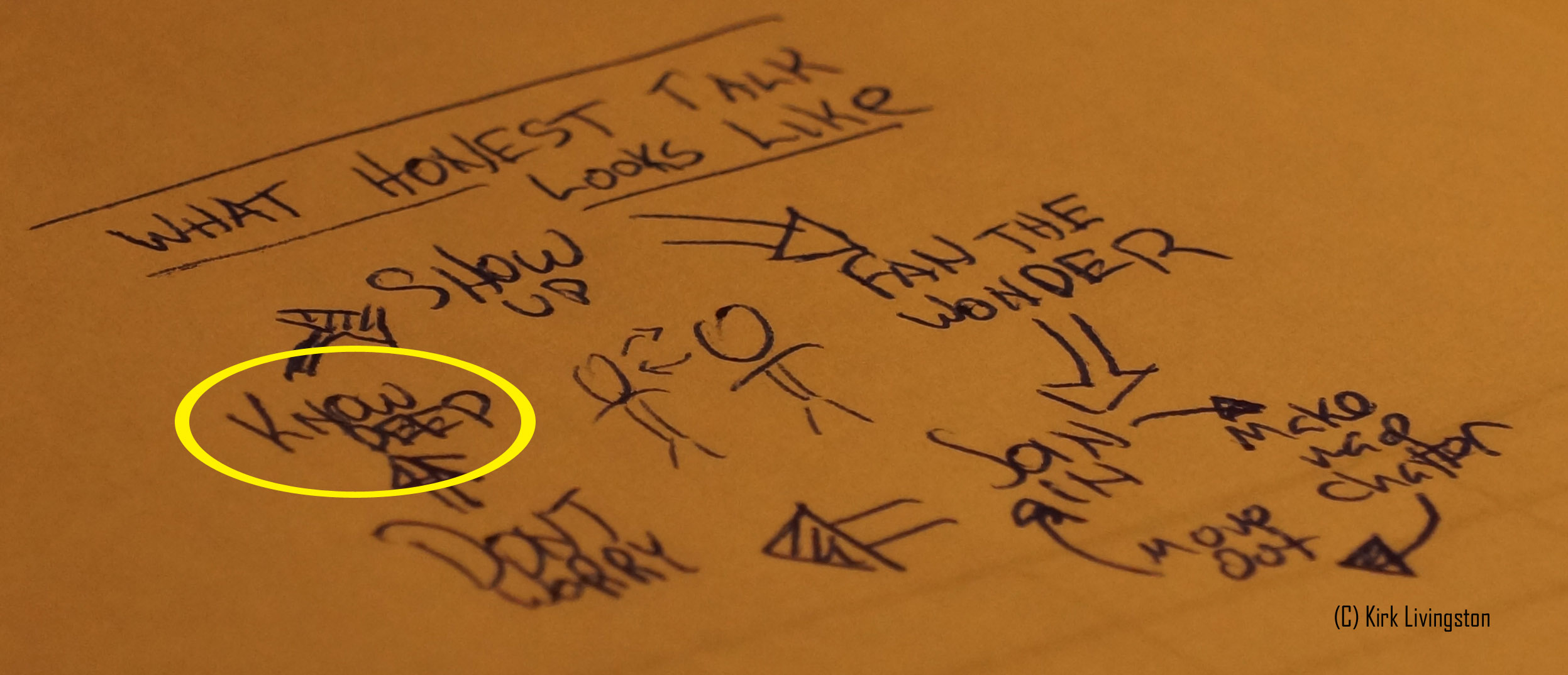 In this cycle of events that occur when we connect with each other, the “Know Deep” part is standing out to me today. What I know depends on what I’m willing to ask, which means I’ll need to reveal I don’t know something. Such revealing can be hard. But if I don’t tell someone what I don’t know, I risk never knowing. In the end, I must name the things I know so I can begin to realize what I don’t know. This may be a lifelong process.
Not knowing and being willing to look foolish can make for stimulating conversation: people like to help us know. And a child’s “why” and “how” questions can be refreshing, no matter what aged person they come from.
###
Song for the Land-Locked
Hounds of Finn: “Putting one foot in front of another”
I’ve recently discovered the Hounds of Finn. They make groovy music. I can’t stop listening to their “Ocean.” Yes: I need to go buy the music. This entire Radio Heartland interview is great but “Ocean” starts about 7:06”
###
Theology of Place: Minnesota
WWFD: What Would Fred Do?
Ever since I read of Fred Sanders’ work developing a theology of place in California, I cannot stop thinking what such a set of thoughts and conversations would look like for Minnesota. Mr. Sanders developed the notion after teaching a summer undergraduate class at Biola University focused on California authors and essayists.

Here’s Sanders describing his project from the EPS blog:
I wanted to apply that great books approach to California literature, about which I knew very little. I just had an instinct that the perennialist approach, in which we read the proven classics, “the best which has been thought or said” in the history of the western world, would benefit from a little dose of localism, where we investigate a regional heritage and get to know our own surroundings.
A Minnesota-based project would have a lot of moving parts.
There are the obvious Lutheran influences, of course. From Germany and Sweden. Catholic influences are also strong and vocal and from everywhere. The two cities where the majority of Minnesota’s population lives, Minneapolis and St. Paul (plus surrounding suburbs), are themselves launching grounds for waves of immigrant communities. Irish folks, Northern Europeans of every stripe. More lately Hmong and Somali folks have entered the area. There are communities of people from India and Ghana and Thailand. The Native American community should be an anchoring presence. Just walking the neighborhoods reveals much about what is important to the different groups.
Then there are the literature pieces: from F. Scott’s newly rejuvenated Great Gatsby to the benign(ish) Lake Wobegon characterization of Minnesota to Augsburg Fortress publishing insightful theological tomes to the nationally recognized Milkweed Editions. I’m missing lots and this is just for starters.
There’s all the science and medicine and vast amounts of research taking place at various colleges and universities. Medical devices and industry headquarters. The advertising and design and communication communities are clever and vocal. How would one start to get a handle on a theology of place: what are the priorities of the people of these communities? How does faith mix into the public and private lives of the people who live here? And what have the results been and what can we say about what is likely to develop in this vast mix?
Maybe the beginning point is to follow the lead of Minnesotan Andy Sturdevant who’s MinnPost column The Stroll is a weekly chronicle of pedestrian interestingness in the Twin Cities. Stuff we typically we don’t see because we rarely leave our cars.
Maybe we need our theologians and philosophers and artists to take group hikes through the cities, followed by a beverage and a discussion about what they saw and understood and what it all meant.
I’d sign up for that walk.
###
Image credit: Alli Livingston
Can you tell the truth if your form is a liar?
Herzog & Morris & Searching for Sugar Man
The politburo of Kirkistan recently made its way through two documentaries. One paved the way to fully appreciate the other.

In Capturing Reality: The Art of Documentary, Director Pepita Ferrari set documentarians Errol Morris, Werner Herzog and others in front of the camera to show and tell how their work is entirely biased toward telling their story.
Why would anyone expect otherwise?
Except there is something about the documentary form that shouts “objective”—which turns out to be a profound misdirect. Some documentarians are not above setting up and staging shots in their passion for telling their story. This should surprise no one. And it is neither wrong nor a misrepresentation—depending on how the documentary is billed. As always: caveat emptor. And this: sometimes the story is true though not all the parts actually happened. Fiction writers lead with this all the time (the preface to Tim O’Brien’s The Things They Carried comes to mind).
Ferrari’s film was a perfect set-up for Searching for Sugar Man. This is an unbelievable tale of a washed out 70’s era Motor City singer/songwriter who helped foment revolution in South Africa—but who never knew it. This film exhibits breathtaking storytelling, with the paradox gripping you from the first scenes. It’s also a history lesson in how apartheid fell. I won’t give away the end except to say it is one of the sweetest stories I’ve heard in a long time.
How about taking in a documentary this weekend?
###

 conversation is an engine