Archive for the ‘curiosities’ Category
Year in Chesed—Day 11: What if we cultivated radical availability?
 One thing that happens in a conversation is that we become available to each other. It’s a function of simply talking. But what if our talk was all bound up with the baggage of our intent? We want to be seen as a certain person. Wise. Funny. Clever. So we use pre-fab phrases and clichés and stories heard elsewhere. Nothing wrong with that, but at some point we need to drop the modular phrases and really tell who we are. This is part of being present.
I’m a fan of the writer/theologian/activist/martyr Dietrich Bonhoeffer. His clear writing never fails to pull me in. And I love how he raises my eyes to see what a people could look like who love God together. In Life Together he wrote that brotherhood (or “fellowship” a word desperately in need of rehab) is not some ideal we strive toward or some pot of gold at the end of a rainbow, if only we could get our ducks in a row, shape up, and all that “I’ve got to do better” stuff. Instead brotherhood is a “…reality created by God in Christ in which we may participate.” (Life Together, 30) Bonhoeffer suggested that in this reality, it is not the man or woman “furnished with exceptional powers, experience, and magical, suggestive capacities” (32) who has the ability to bind others to her or himself. Instead, the real power is what God says. The Wikipedia entry on Life Together is thought-provoking:
Bonhoeffer felt strongly that there is an empirical experience that results from meeting with others to become intimate before Christ. He suggests that Christians should confess their sins to one another. He states, “The church community, not some philosophical or theological system of thought, is God’s final revelation of the divine self as Christ existing in community”. In other words, Christians should not wait for a revelation from God before they do something, but because they are continuously and prayerfully considering what is right, it is possible that God has already revealed His will to them and they need to summon up the courage to take the appropriate actions.
Yesterday’s postcard from chesed talked about the ways of the Eternal One with the wicked and the righteous. For the wicked: separation. For the righteous: presence. Except that’s not the image painted on the card. The image had two parts: one was like a desert with scorching winds, smelling of sulfur and raining coals. One part was a face. God’s face.
I cannot claim any righteousness, except in agreement with Bonhoeffer about what the Christ did. I mostly live my life on the other end of the spectrum. And yet the picture of radical availability gives me a bit more courage to hide less and pursue being available.
###
Image Credit: Bad Postcards
The Interwebs Have Gone Too Far: Fun at the Expense of the Stoughton Norwegian Dancers
Is nothing sacred?
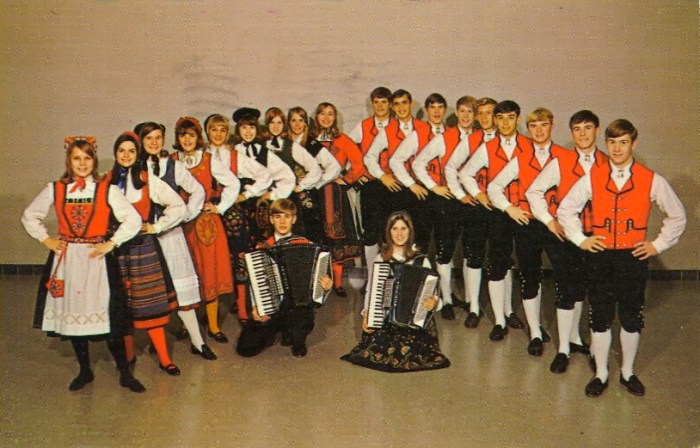
Wait--where's the flask of Schnapps? I know it's there somewhere.
These were the coolest kids in Stoughton High School! And now look at them: Exhibit I on the list of bad postcards.
Oy. My brain hurts from the cognitive dissonance.
###
Via Bad Postcards
Occupy…billboards: “This Space Available”
“I feel it is wrong to be treated as a consumer every place you go.” Gwenaëlle Gobé
How Can I Accelerate Adoption of New Ideas? PBS Arts Off Book
Aesthetics or style isn’t what drives me. What drives me is the core idea, and then I apply a design sense to that core idea. (2:08)
###
Via: The Casual Optimist
Best Star Trek Mattress Commercial You’ll See Today
“Live Long and Sleep.”
With this goofy, shameless ripoff, Dodd’s might actually lock on shoppers with their tractor beam.
Via Copyranter
Please Write This Book: A Year in Chesed
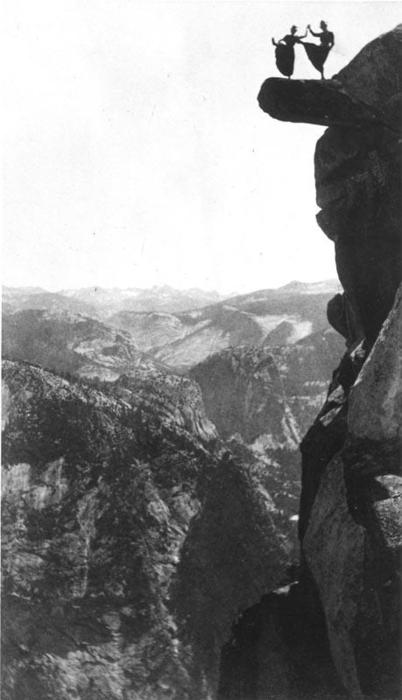
of course there is dancing
In A Year in Provence, British copywriter Peter Mayle, moved to France and wrote about this place of exceptional food, wine and beauty. Mayle provided his reader with nearly first-hand experiences of cooking, shopping and conversation. Along the way we saw hints of a different way of living.
I want to read a book that takes a similar journey, but rather than air travel to a glorious foreign country, I want the author to settle into a land devoid of anxiety and full of bonhomie toward men and women. I want the author to get there by following the thread of meaning from a very particular foreign word: “Chesed”
Google chesed and you’ll find a central Jewish value that means (for starters) “lovingkindness,” but points to much, much more. This old Hebrew word appears 247 times in the Torah and 127 times alone in the Psalms. “Chesed” has shades of meaning in the Torah, variously translated to English as: loving-kindness, mercy, favor, pity.
I imagine living in chesed is something like life in a foreign country. My glimpses of this country come mostly through the Psalmists who use the word again and again as they respond to or acknowledge God’s care. It is a word that describes a way of life that is the polar opposite of my country’s “Black Friday,” and all that consumerist orgy represents.
As you write this book, please take long, generous expeditions into this land of living in gratefulness and thanksgiving. Explore how the inhabitants of this land depend on materials and attitudes already in their possession. Please show me what contentedness looks like. Show me how they brush off the slights and insults and lack of fame because they are grounded with a deeply-rooted faith-joy in the creator. I imagine this land as anti-Kim Kardashian: Sopping with contentment. Joy. Stability. Not glamorous. Not narcissistic. Not attention-seeking. So that means your book won’t get on the news every evening. But I’ll buy a copy.
Spend a full year there. Show me what happens when the crops are not bountiful and enemies encroach. Show me chesed when taxes are due and when plans go terribly wrong.
Please write this book soon because my land is teaming with insects whose bite results in a longing for more shiny stuff and much daily fame. In the meantime, I’ll keep looking through the postcards the psalmists sent.
###
Image Credit: Via 2headedsnake
Tattoo U: Reading Those Who Take Required Courses
 Painted along her spine and
Shouted from the pitch of her neck:
“What’s the least I can do?”
Eyes closed her gentle snoring:
“This is boring.”
Doodled maze focusing attention down
And in and away from the other:
“Why bother?”
Just another required class
My parents are funding
Or deepening my debt.
Whatever.
This posture a tattoo
A rhetoric of being
A one person drama
An act that snaps to real
Not easily shrugged off
After the definition-jail of school sets sail
Where topics contain in rigid compartments
While practices secretly wash from stem to stern
Habits inked
Minute by hour by week
Quarter by semester
Cleansed only after years of toil
Digging from the depths of whatever
Where no one pays your fee
Or your debt.
###
Image credit: via Falcons on the Floor
Comcast the Free Router and the Monthly Fee: a Story of Thanks
Have I been helped or did I run up against a new marketing ploy? You tell me.
 In conversation with Comcast after my router stopped working, they said,
“Hey, we’ll give you a free router. It’s part of our service to you!”
Cheery words! But wait—what’s the catch?
“No catch,” said the Comcast representative. “Look, I’ve already put in an order for you.”
Cool! Of course I want a free router! It would take five days via UPS—is it possible I could pick up an old router from the local Comcast store while I’m waiting? Just to keep the signal moving through my home?
“Certainly.”
So I did and the old router worked mostly well, though it drops the signal for about 30 seconds every hour or so. But I could live with that while waiting for this new Netgear router. The new Netgear router came: easy instructions, which I followed. No signal. Called Comcast:
“Sorry for your troubles. You’ll need to order our Xfinity service plan. It’s only XX per month. But what I can do is walk you through turning your router on and off.”
OK. Hmm. No service plan for me, thanks. Yeah—sometimes turning everything off and on helps. I’ve done it half a dozen times, but maybe I got the order wrong. I’ll try that. Didn’t work. Called Netgear. After an hour with a kindly gentleman from India, he concluded my router had been loaded with special Comcast software that would not bend to the will of his computer screen directions and superior knowledge.
Called Comcast. My router doesn’t work. Can you send me a working router?
“Sure. I’ll order one right away. And thanks for being a Comcast customer!”
I reinstalled the older Comcast router and it worked, though with the peculiar dropping of signals once an hour. And I anticipated the new Netgear router making it’s way across the land on a brown UPS truck. New Netgear router #2 came: same easy instructions. Same result. No signal. Called Comcast:
“Sorry for your troubles. You’ll need to order our Xfinity service plan. It’s only XX per month. But what I can do is walk you through turning your router on and off.”
No Xfinity plan, thanks. And actually, I’m now pretty good at turning it on and off, but thanks. Called my Netgear friends from India:
“I don’t understand why Comcast tells you to call us when they install special software on the routers. You’ll have to call Comcast. Here’s the special Comcast Router help numbers.”
What’s that? Special numbers for router support? That smells suspiciously like real help! I call both numbers—excited to encounter experienced talkers. How’s that? One number is out of service? What? The other number connects me to an Xfinity service plan automatic ordering line and I can be connected right now. No thanks. Back to installing the old router that drops signals. Still, it works. And for that I am grateful. I could just go buy a router and probably will. They get cheaper every week.
So—was I helped or was this just an elaborate ploy to get me to start another monthly fee to support the free Comcast hardware? I’m still not sure. But I’m thankful for the free old router that drops the signal with military precision once per hour.
Happy Thanksgiving to all and especially to Comcast and my Netgear friends in India!
###
Image credit: Via We Love Typography, Good Deeds by jon contino
Dummy’s Guide to Conversation #5: Sit With It

Go trolling with your decision.
Despite the passive image, it’s an active decision-making strategy powered by talk. And it has everything to do with the people you mix with every day.
Here’s how it works: You are vexed by some perplexing question. Some potential fork in the road. Let’s say the stakes are high so the choice is even harder. This question takes up residence in your mind. You don’t know what to do or which direction to take. With no decision forthcoming, you watch pieces of your life go on hold, each waiting for the choice.
So you force a choice. You make your best guess, but you leave time—if possible—to rethink your choice. You shoulder the mantle of owning the decision and taking it with you out into your work and your relationships and even into the casual acquaintances that pop up. And you just watch and see how it feels. This is how you sit with a decision.
Sit with it and watch. You are making a choice and trying it on for size. This is not done in isolation. It happens in conversation. With our words we explain what we’ve chosen to do. Amazingly, it is as we form words and explain what we’ve chosen that we come to grips with the full dimensions of this choice. People respond: “Yes. That’s perfect for you.” Or “Hmmm. That doesn’t seem like you.” Casual acquaintances hear the slimmest snippet of the choice in story form and ask a question that reinforces the decision. Or not.
It’s as if we need to listen to our own words to see how we feel about something. Sitting with a decision means hearing yourself form and reform the story in ways unique to each audience you encounter.
This strategy works for all sorts of things—not just decisions. Relationships. New ways of looking at things. Learning. Sitting with a notion is a way of collecting wisdom from others as you make life choices.
###
Image Credit: leonid tishkov via 2headedsnake
The Best of Us are Still only Serial-Doers
It’s about running. But it’s also about what she is not doing. And It’s kind of about doing more than one thing at once. We are all are simply serial do-ers: We always do one thing at a time. We may think we’re multi-tasking, but we focus only on one thing and then another. The best of us fool ourselves by switching gears faster.
###

 conversation is an engine