Archive for the ‘Dialogue Marketing’ Category
Abercrombie and Fitch: the Brand to Avoid
News today that Abercrombie and Fitch must pay a Minnesota family $115,264 for discriminating against a disabled person when the store refused to accommodate a daughter with disabilities. The autistic youth needed help in the dressing room from her sister, which A&F clerks would not allow. After repeated attempts, the girl said she “felt like a misfit” at Abercrombie and Fitch. It took a lawsuit to even get the matter noticed by the company. The result was a fine, though certainly “hefty” by the standards of a $3.5 billion business (in sales last year).
Two interesting features of the story reported in the StarTribune: one is that disabilities are not always outward in appearance. You cannot always see a person’s disability. Though Abercrombie and Fitch had a policy for accommodation, stores clerks understood that to mean visible disabilities and would not accept that there are other types. And that points to a lack of training at Abercrombie and Fitch, though in fact they say they have an “innovative and provocative approach to [diversity] education that we call reality-based learning.” Perhaps someone needs to mention to Abercrombie and Fitch that just calling something “reality-based” does not make it so.
I cannot help but wonder if the very goals of Abercrombie and Fitch are as much to blame as the lackluster clerk training. I’ll admit I know next to nothing about the organization. But from a brand perspective, I have gained all the information I need. The truth is still the same: brand impressions are the extent of our interactions with most organizations. After raising teenagers and hearing their impressions of the merchant, and just by simply passing the store myself, the brand message is clear enough: become a beautiful person by buying Abercrombie and Fitch stuff. The store’s narrow understanding of beauty and constant attention to sensuality trivializes the human condition and sends a load of false messages to everyone who comes in contact with it. I know that the Minnesota girl is not alone in feeling like a misfit—I saw my kids and their friends rejecting the company’s narrow view, along with the products they peddled.
There’s no question that beauty and sex sell—they always have—but Abercrombie and Fitch’s surface perspective seems to have affected their approach to everything. And my evolving impression of the Abercrombie and Fitch brand is that they use beauty and sensuality to sell false versions of reality to kids. And now I know their surface way of looking at things discriminates against people with disabilities.
It’s time to shop elsewhere.
###
Medical Device Firms using Social Media, Step #1: Have You Defined Yourself Out of Conversation Success?

Who are you talking with?
Launch plans have always been about sharpening one-way messages and sending them out through as many channels as may get noticed (and as many as you can afford). But what if your next product launch changed up the usual one-way messaging mix of brochures, ads, comparison sheets, case studies and article reprints with a few simple tools that help you get traction where it counts—in engaged discussion?
In the next few blogs I’ll offer suggestions about how regulated industries can begin to build communities using social media. One thought to start: Who are you talking with?
As a medical copywriter and communication consultant, I’ve spent years working with marketing colleagues to stay focused on target audiences. You see, we had these sharp and polished messages we wanted to shoot—and we needed to know who to shoot them at. Getting these messages ready for communication battle was tough work because each message had to zip through all the natural barriers every human erects around their will. It surprises me now that some messages actually did get through.
But there’s this new thing going on: technology plus market proactivity plus searchability are turning the tables so that the person with the moneybag to spend on communication no longer owns the medium. Of course, it was mere mirage that such a person actually did own it—since the brand conversation has always been in the hands of customers.
One first penetrating question as you develop launch plans: Who are we talking with? It is right and proper to continue to develop and hone benefit messages for new products. New devices must be born with clear benefit statements and positioning otherwise they never even get seen in the market. But the exercise of teams crafting marketing messages usually results in one-way messages toward target audiences.
“Who am I talking with?” is a different question than “Who are you aiming at?” Aim is one-way focused, so the message gets there. Or not. Talking is a two-way conversation. But conversation is not a delivery vehicle for one-way messages. Talking to a person who delivers only one-way messages is like listening to a monologue: at best it is only mildly interesting. Usually we do our best to politely hang on. But conversation is a give and take where both parties remain interested, both parties have a stake in continuing, both parties get something from the conversation.
Going beyond the question of aim to the question of conversation brings another level of discussion to your marketing meetings. Questions like, what would a genuine conversation look like? And who would we be talking with? Physician? Clinicians? Patients. Possibly yes to all three. And what could a conversation accomplish? Just to ask this question is to begin to see things differently. And it is also to begin to prepare for a future where one-way messages have an even more limited power and where conversation is a vital element of any launch.
So: are you conversing with interested partners or are you delivering a monologue alone in the middle of the room?
Next-up: Building Community among Frenemies
###
Busking and the Urge to Hone Your Craft
Meet Rob Firenix. He’s a British showman, part juggler, part fire dancer, part street actor and stand-up comic who has traveled and worked in 55 countries. I met him last weekend in Windsor, Ontario at the International Busker Festival.
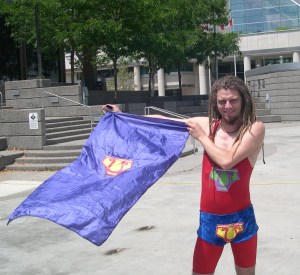
Rob Firenix is Captain Underpants
While Windsor city workers remained on strike (14 weeks plus), garbage piled high around garbage cans with parks and museums going to seed, Mr. Firenix and other buskers honed their craft for free (at least until they passed the hat), depending on delighting the crowd to earn their keep. It’s worked for the last eight years for Mr. Firenix.
With a background in corporate theater and experience choreographing large shows, he found he loved the freedom of performing live before audiences on the street. Pulling from another earlier job of working with people with disabilities, Mr. Firenix wants to make things accessible for everyone. It’s this attention to making the show easy to understand that also brings in the levity.
“I love it when people can have a laugh.”
One of the best parts of busking is “speaking directly to his audience” said Mr. Firenix. He is constantly tweaking his show to see what laughs he can get and how he can go further in delighting his audience. His current show is a character-based performance (“Captain Underpants”) that often features a pair of audience members in the ridiculous tights as well.
Was his craft comedy? Or was it the juggling or firedancing?
“The show is the craft,” he said. “Getting people to stay and enjoy the show is the craft.” He explained that a crowd may watch a person juggle for three or four minutes, but there has to be something more.
“It’s all about presentation.”

Willing Audience Members. In Tights.
As a communicator, I found myself in awe of Firenix and other buskers who worked on their craft out in the open, depending on impulse generosity for their bread. It’s a gutsy way to go about work—especially poignant in a city on strike because of limited post-retirement benefits. It says he is serious about the craft, that honing the craft is not a luxury but a necessity. It also points to the presentation as something of primary importance: people need to be engaged and stay engaged or they walk away.
Buskers also show there can be more to work than money.
###
The Power of “Search”

We search for what we know is important.
This one simple function has changed the way I personally create and access information. With a few keystrokes I can locate any particular word on my computer. This is great because often I can remember only one word of something I’ve read or written, and I certainly cannot remember which document it was in. Contrast the power of search with the old ways of keeping information in tight categories so that if I needed something, I followed a trail of folders which would (eventually) lead to the right document. I gave up on tracking actual physical pieces of paper long ago. “Search” not only saves time, it ends up being more precise.
Clay Shirky, In Here Comes Everybody: The Power of Organizing Without Organizations makes the case that the power of search is changing the way we organize and access information and the way we organize and access each other. We can come together now as we search out common problems and interests. Shirky contrasts these new ways of organizing by showing how complicated organizations have become: the larger the organization the more complicated the structure required to track work, direct workers’ movements and facilitate clear communication. Shirky offers a fascinating discussion of where org charts came from (they helped railroads establish clear communication so west-bound and east-bound trains could share the same track). There will always be org charts, but will they tell the whole truth? With this new “freedom to find,” large companies are beginning to see lines of authority blur. We will (also) always have bosses, but bosses will not always have the power of superior knowledge. I wonder how those relationships will change over time? One of Shirky’s points is that nimble new organizations are already taking advantage of this non-organizational way of organizing. He points to Flickr (versus Corbis) as an example of an organization that depends on user-generated organization as a successful model for the future. The contrast between Flickr and Corbis is not completely fair because of the differing goals of the two organizations.
Of course, we hear endlessly about how Facebook, LinkedIn, Twitter, and the other various social media are changing the way we connect. And we know from personal experience how Google has become our first source for answers to questions. The future of communication—where who we listen to will have less to do with lines of authority or the budget to develop clever messaging and purchase media—and more to do with how we access information. As we search on interests, hobbies, problems, solutions, vocation, avocation and whimsy, we’ll bypass gatekeepers, generate more word of mouth (physical and/or computer-mediated), and quite possibly, more truth.
###
Read about “Building a Generous Brand”
Check out John King’s article about Building a Generous Brand in Ad Age. This is a positive step, when an agency as forward-thinking as Fallon starts considering how brands can “give back.” This is also an excellent way of thinking about the dialogue that consumers really want to have—versus the dialogue marketers wish consumers wanted to have. Is this more evidence that the days of one-way messaging are going away? The danger is that the generous brand becomes just another manipulative gimmick. But in this new dialogical age, such chicanery will be found out, posted and soundly dressed down.
###
What MPR can tell Marketers about Talking with a Target Audience
It’s hard to wrap our minds around new ways of doing things—especially when the new ways require clear thinking along unexplored routes. Yesterday in conversation with a marketer we discussed the difficulty in getting his niche business known. There is no “road map,” he said, no established market for the custom work his firm does. Clients eventually come to them from all over the world. And for these clients, my friend’s firm is a group of miracle-working artisans who combine art and science to solve manufacturing problems.
The problem is getting word of the miracle-working artisans to just the right people. At just the right time. Exactly when they are having the manufacturing problem that requires a miracle.
Which reminds me of an experiment going on over at Minnesota Public Radio. It’s called Radio Heartland and host Dale Connelly uses his Trial Balloon blog to hear and respond to exactly what his audience is looking for—which happens to be something more than the eclectic range of music that plays 24 hours a day through the new station.
Dale Connelly’s show, and the continuous-running station that derives from it, are actually a remix of The Morning Show that Connelly and “Jim Ed Poole” ran for 25 years. A show that built a wide following despite being on the verge of removal from the radio dial a number of times—at least that’s how the lore goes. The remix includes a highly interactive element.
First, the Music
The genius of Radio Heartland is two-fold. First, there’s the music, which Connelly alternately describes as “Americana” or “roots,” but neither of which title allows for a playlist that runs from Tom Waits to Sammy Davis Jr. to the Drive-By Truckers to the Kinks to the Café Accordion Orchestra. Any summary of the music is woefully incomplete. Like the previous Morning Show, Radio Heartland also gives play time and promotes local music. Connelly changes up the music as he hears from his audience.
Second, the Conversation
I asked about the role of the conversation in running Radio Heartland. “I think of the blog contributors as my co-hosts,” said Connelly. “And I try to work their ideas and music suggestions into the fabric of the show every day.” Reading through the blog it quickly becomes clear that much more than music is on topic. Goats, goat cheese, a virtual Radio Heartland Community band (“The Goatles”?) and lots of conversation that is only tangentially related to goats.
But music is really the focus. In particular, how the music works through the ups and downs of a day. What the music reminds of and how it works in the lives of listeners. Listeners freely respond with comments, praise, poems and prose. Much of the comments are in direct response to Connelly’s lively and funny writing and regular blog updates. It is clear the listeners feel heard.
Then the Loyalty
“Word of mouth is our major promotional tool for new listeners right now,” says Connelly. But the blog helps, especially when people “tune in” to hear/see how their comments and suggestions work out. One of the hallmarks of the Morning Show was great listener loyalty—which Connelly felt would be threatened—which ultimately led him and produce Mike Pengra to set up the HD and Web-Only station.
What can Marketers learn from Radio Heartland?
- That engaging in dialogue as a precursor to conversation can actually help potential customers find you. Is this just another version of “If you build it, they will come?” Possibly. But given the low cost of entry into dialogue and the potential for building word-of-mouth interest, when is the time to launch? Putting specifics out for discussion invites response. And when those interested see their suggestions incorporated—all the better. Sporadic readers move to loyal readers.
- Loyalty builds one conversation at a time. So does community, for that matter.
- Loyalty may start with “Search.” We’ll always ask our questions to people in the know. We’ll rarely turn to a drawer full of brochures for answers. Just make sure your interest pops up in the search.
- There may be a conversational space your firm can own. It may have nothing to do with goats (one can hope). But it will take the shape that flows from a dialogue that seeks and responds to dialogue partners. But dialogue possibilities will not always be as wide-open as they are now.
###
To Fear What You Might Hear
Lars Bastholm, recently co-chief creative officer at ad agency AKQA moved to oversee digital creative for Ogilvy North America. In a Q&A posted on AdAge, he talked about wanting a larger platform for messaging:
“You’ve heard me pontificate about what I call social storytelling, where you have a much more open-ended dialogue with consumers. It’s not about pushing a message but inviting people in and it requires you monitor the conversation more thoroughly and to be more responsive.”
There will always be one-way message development. Assembling these messages remains valuable to an organization and serves to hone communication. The mistake is to think tomorrow’s audiences will simply absorb those one-way messages. Tomorrow’s effective message-makers will include points of contact that invite the target audience into conversation.
After sending out messages through a growing number of channels, “monitoring the conversation more thoroughly and being more responsive” is the next movement of corporate conversations. But monitoring and responding are movements many of us are not prepared for, or at least inadequately prepared for. Those activities require a kind of deep listening followed by creative synthesis to piece together anecdotes into a sensible patchwork that accurately portrays our brand’s successes and flaws. It’s a whole-brain activity.
It’s much easier to deliver a monologue than it is to remain engaged in conversation—it’s also far less satisfying for all participants. Maybe we hang back from dialogue because we fear what we might hear.
###
A Telephone Is Not A Commitment To Communicate
The other day a friend painted a picture of marketing and sales at his company: it looks like a telephone. His firm had not spent on outward-facing communications for a couple years. Instead, they picked up the phone and called people. This company targets a very tight niche of companies needing specialized fabrication services.
We talked about the state of their communication, and how brochures and the usual assortment of tools seemed like a waste of money—given that his industry has very few players and most are well-known to each other. I wondered aloud whether he could position his employees as expert problem solvers—which exactly is what they are—as walking, talking brochures. Is it possible that the very thing they do on the telephone could have a broader reach and work for them all the time? This is the promise of entering into dialogue.
But before moving that direction, set aside tactics for a moment. Before freeing employees to be public experts, any company—and especially my friend’s company—must make an extraordinary commitment. They must commit to communicate. If my friend’s company uses today’s conversational tools like he previously used advertising or brochures—tossing one-way benefit messages out in the marketplace every once in a while—he will fail. Instead, he and his company need to cultivate an attitude of sharing what they know in a way that draws out interest and conversation. And that is an on-going commitment. That’s how experts become experts.
Interestingly, putting experts into conversation is also a route to increased employee satisfaction. Good employees love to use their expertise to help real people solve real problems.
###
Our Strange World: Bankers Give Money Back
Yesterday’s StarTribune included an article about TCF returning TARP funding (“TCF rejects rescue money,” 3/3/2009, p. D1). Chris Serres quoted TCF chief executive Bill Cooper as saying it was a no-win situation. If they don’t accept TARP money, people would think they couldn’t get it and they were in trouble. If they did receive TARP money, Cooper said, “you’re stigmatized as evil people stealing from taxpayers.” An article in today’s StarTribune reports on two more banks receiving TARP funding.
Turns out TCF didn’t need it and would write a check for the $361.2 million.
Is it possible we’ve turned some corner in this country where the big money-makers are starting to worry about their appearance to the working folks? TCF has always seemed like a bank for anybody—perhaps the PR department thought they could win points with their target audience by returning money they didn’t need. Did they feel just stigmatized—or maybe even a bit guilty? Or did they just tire of the public peeking into their expensive meetings. Whatever the motive, giving money back seems like a positive sign. Kudos to TCF and Bill Cooper.
It’s a tribute to the power of opinion that $360 million (and change) is being returned by a bank that didn’t need it in the first place. This act seems to elevate the actions that could result from public knowledge: people might bank elsewhere. And dialogue among the working folk could begin an exodus from a stigmatized TCF.
It could happen.
###
Let’s Start with “Manipulation-Free Zones”
My friend is a corporate philosopher who lives out his work life in a tall glass tower thinking about, among other things, how to adapt his corporate culture to create more honest dialogue. My primary concern with dialogue in this blog has been how to engage customers honestly. But yesterday’s conversation with this friend I realized that honest dialogue (and if not honest, is it really dialogue?) requires truth-telling. And truth-telling starts inside corporations, even inside individuals. As Mrs. Kirkistan put it, “It seems sort of obvious, doesn’t it, that people should tell the truth?”
Indeed.
But what is obvious to us on a personal level gets twisted in a corporate setting, and processed and stuffed into an animal bladder and offered as a truth-sausage at the other end. Such manipulations are standard procedure for any organization to present their product or service in the best light. That’s where the one-way messages have always come from, the ones that fall flat with potential clients because they stink of the processing plant and are exactly similar to all the other one-way message that land on their mental doorstep hundreds of times each day. My friend suggested I read the Cluetrain Manifesto, which I’ve ordered. The cluetrain website offers to dig much deeper into the notion of conversation between companies and customers, and also promises that customers will—and are already—finding the relevant information they need to make a decision. And they are finding it independently of (and likely contrary to) the one-way messages thrown at them. The website is dated at 1999, so these are not new thoughts, but seem to be gathering force in 2009.
Which brings me to another conversation with an FDA-regulated firm wanting to engage in dialogue but knowing the limits of what their regulators and lawyers would allow to be said in the corporate space. As we kicked around the idea of blogging and just how much truth-telling (in the raw, personal form the blogosphere rewards) could really happen, we stumbled on the peer-review model and wondered if more truth-telling must necessarily happen outside the corporate site, where dialogue could be engaged with experts offering unfiltered opinions. Naturally, such a web site must offer hearty benefits to any dialoguer. I hereby declare these site “Manipulation-Free Zones,” though I recognize that manipulation is part of the human condition. It is the rare human who does not present himself/herself and his/her interests in the best light. But can we aim high?
###

 conversation is an engine