Archive for the ‘Dumb Sketch’ Category
What does fresh hope sound like for cynical colleagues? (How to Talk #3)
A credible word spoken boldly
Constant cynicism is a downward spiral that saps energy, like the dome light on all night—little by little wasting energy for no reason. Eventually the car will not start. Have a conversation with a cynic and the world looks a shade or two darker.
Offering fresh hope to a cynical colleague is not about squatting at the other end of the emotional spectrum, babbling like a Pollyanna. That is quickly seen as fanciful.

No.
Fresh hope is a word of the moment that is credible and believable. A word about where we are going or what we are doing that becomes meaningful. If not meaningful right now, meaningful later. Fresh hope has a way of stopping the cynic, if only momentarily. But even the cynic finds herself meditating on a word spoken yesterday or the day before. The cynic happily shoots down the platitude, but his trigger-finger falters at a contextual insight from a conscious person processing a shared experience.
Fresh hope requires a bit of courage. Cynicism and general world-weariness is always in style.
But hope? Not so much.
But what’s the point of conversation if not to speak up boldly about what is important?
###
Dumb sketch: Kirk Livingston
Plot with a View
Humans: Industrious. Resilient. Fragile.
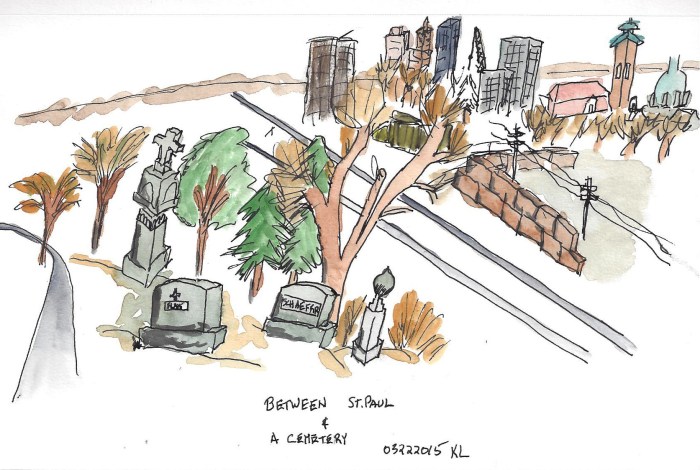
Every once in a while I am reminded.
###
Dumb Sketch: Kirk Livingston
Seeing may be the trickiest part of drawing
Instinct and childhood definitions make poor interpreters of everyday life
Take this dumb sketch (Exhibit A). I made it while sitting in the lobby at the Children’s Theatre Company in Minneapolis. Those green trees? Utter fiction. Apart from a few pine trees, there is very little green in Minnesota right now. Green won’t even think about appearing for weeks.
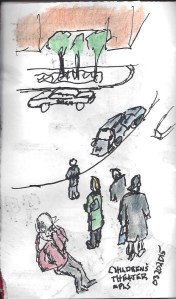
Exhibit A
Yet here we have green trees. I threw a dash of green there because trees are green. Except they weren’t green. They were brown. And scratchy and barren-looking. I commented to a drawing friend that my instinct said “green” from long use of my childhood definition of “tree.” And that slap of green was on before I even thought about it.
The gap between seeing and responding is the troublesome bit. If instinct drives my seeing, I miss pylons and electrical wires and gasoline tank farms and wireless telephone towers. All that industrial accretion I’ve seen one million times—all of it invisible. Even though it is really odd-looking stuff, jutting up into the sky at bizarre angles, like nothing in nature.
I don’t see people too: the clerk behind the counter. The janitor with the broom there, off to the side. I try to become practiced at not seeing the homeless man with his cardboard blessing at the end of the ramp. But that never works.
Mrs. Kirkistan and I volunteer at the Children’s Theater Company. It is simple duty: handing out programs. I was surprised this time by how invisible I became to children. Despite being squarely in their way so they must actively move around me to get into the theater. And when I verbally offer them a program, they twitch, suddenly surprised to see a human directly in front of them.
It’s not that I’m diminutive (I’m not). It’s because the entrance to the theater is awesome, like nothing a kid sees anywhere else. Walking through those double-doors into the dark red cavern with hundreds of seats stretching down and up into space and very strange objects akimbo on the stage—it’s hard for anyone to look away. All of that is purposeful on the part of the theater and adds to the experience.
It’s odd being invisible. And that makes me wonder how many people I miss in the course of ordinary life, simply because I have acted on instinct rather than actually believing the data from my eyes.
Instinct and childhood definitions are poor interpreters of everyday life.
###
Dumb Sketch: Kirk Livingston
Can 78 bad sketches change your life?
Don’t stunt your growth by reaching for fame
It’s funny we gauge personal success by numbers of followers. It’s as if we’ve adopted the business transaction as a model for every area of our lives.
Business wants more eyeballs for more attention for more revenue for more profit. And that makes perfect sense for our business goals.
What’s problematic is when we confuse business with what humans need to move forward: Doing what attracts attention and gathers “Likes” is often very different from the stuff our souls need to grow.

Your business factory is not a solid model for personal growth
One thing I’m learning from the artists and photographers I’ve been interacting with at Dumb Sketch Daily (currently at bad drawing #78) is that while today’s drawing is (clearly) imperfect, there is always tomorrow’s drawing. And I know what I’ll do different in that drawing. I know I’ll try this technique, or that view, or this topic. I’ll do it again and create yet another imperfect representation of the world.
And that’s OK.
Because the pursuit is about learning to see, learning how to draw, learning how to write. Learning how to tell the truth. Learning how to interact with each other. Learning how to be human. Perhaps even learning how to interact with God.
The goal is not fame, unless you really want to turn this pursuit into a business. But learning itself—whether crowds acknowledge you or whether you plod silently and alone—learning is its own reward.
But I still argue your growth is also a benefit to the humans around you.
And while I don’t think 78 bad sketches have changed my life, I can say with certainty that I see things differently than I did 78 days ago.
###
Dumb Sketch: Kirk Livingston
When Buildings Dream
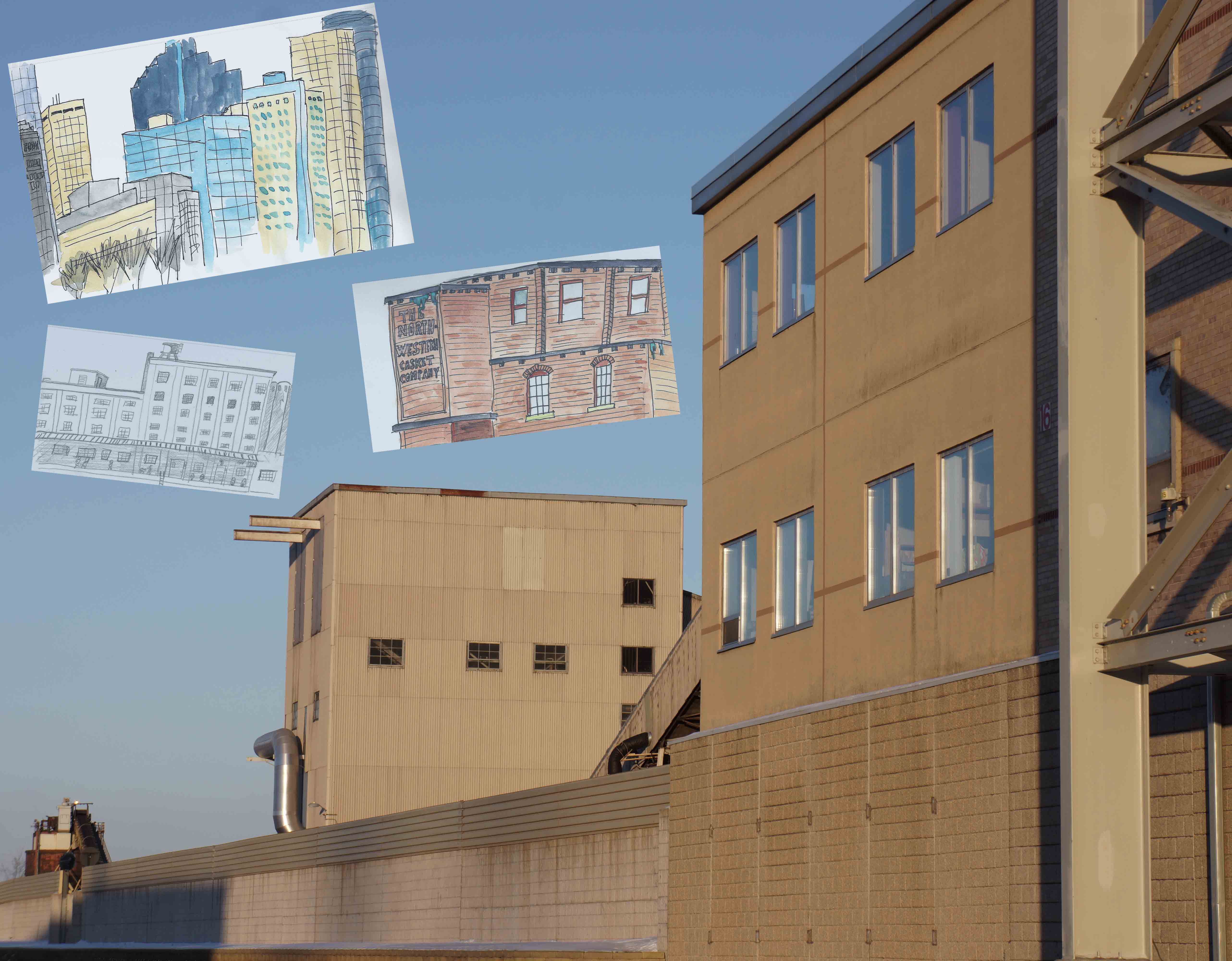
###
Image Credit: Kirk Livingston. Dumb Sketch Credit: Kirk Livingston
Where Can I Buy a Fine-Art Mode?
The Beauty of Knowing Nothing
I don’t have a fine-tuning mode that tinkers with physical detail. I draw and it is mostly crude. I cut plywood and pine shelves and they are rough enough to make my craftsman-father scoff into his hand. I make dinner and it is mostly broad-stroke stuff that requires very little finessing. I will confess my popcorn is a work of art, combining yellow and white kernels, salted and buttered and mixed to a sensuous, savory smack of flavor. And I am learning how words interact on a page—though it is slow going.

How does someone get to the point of crafting from rough cuts to fine finished detail? It is possible that in this age of ordering clothes, pizza and romance from a button on our mobile devices, that some things still take time. Some things require beginning at the beginning. The question for each of us: do I have the courage to begin at the beginning? To know nothing for a time and do things badly?
The beauty about not having been taught drawing is that you are in a position of the acquirer: the process of figuring it out might take a while, and you will most likely continue to figure stuff out as you go, but that process is yours. There are no shortcuts and no tricks. Just the plain practice of drawing, screwing up, and drawing some more.
–France Belleville-Van Stone in Sketch! (NY: Watson-Guptill, 2014)
You cannot buy personal processes. Not really. You have to make them from scratch—those processes that help you make meaning in the world. And you have to begin at the beginning.
Mistake will be made.
You will make those mistakes.
And that’s OK.
###
Image credit: Kirk Livingston
Pick a Door: Blessed are the Poor
How do you read this?
Jesus went up the mountain with his followers, as the great teachers do. His first words:
Blessed are the poor in spirit, for theirs is the kingdom of heaven.
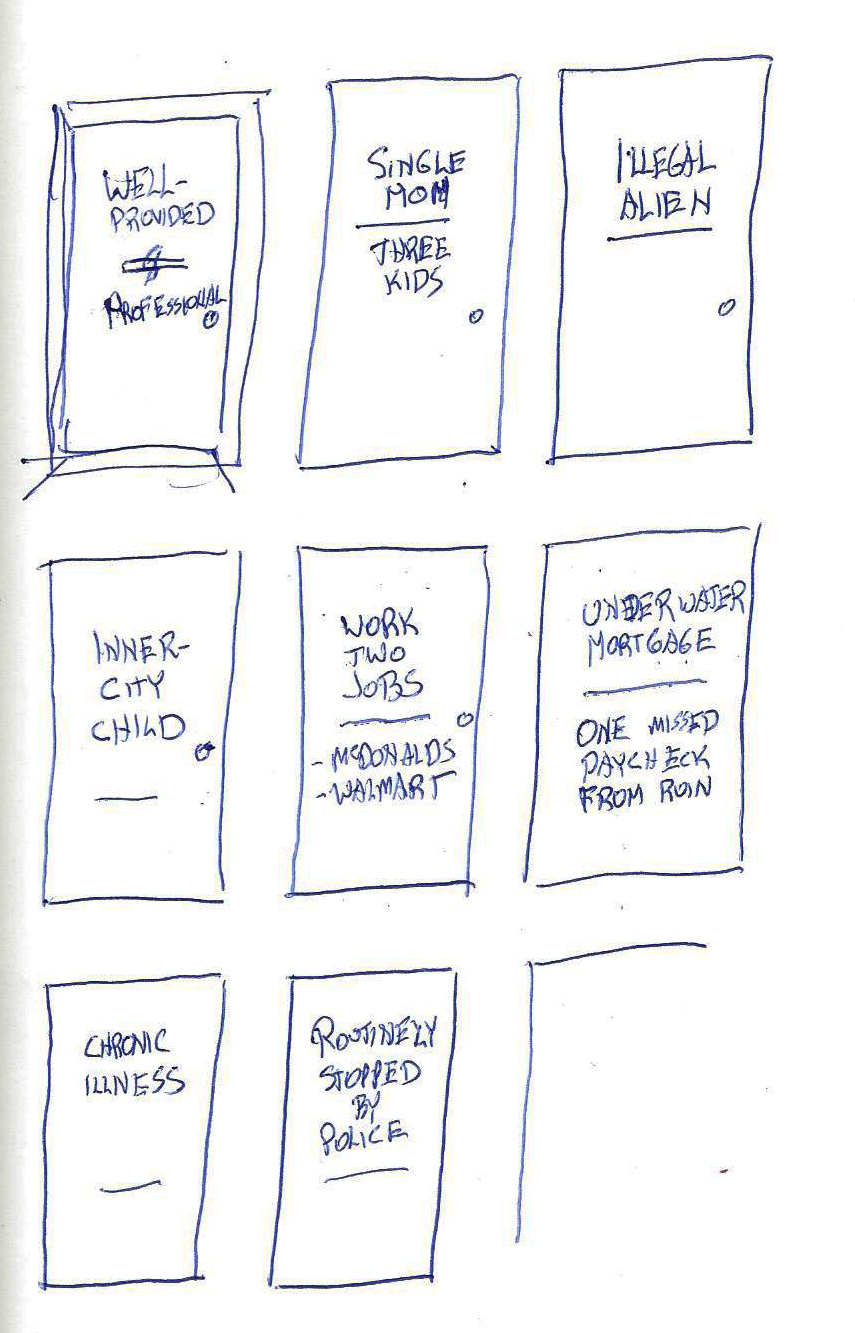
How you hear those words depends on where you come from. The images that come to mind, the connections you make, the hope or lack of hope—much is prefigured and preloaded by the conditions you bring.
What did the original hearers hear? That is the question.
But we make a start toward answering that question by asking what door we just stepped through.
###
Dumb sketch: Kirk Livingston
Seeing Past Childish Symbols
Step 1: See the Template You’re Working from
I’ve been trying to learn to draw and Betty Edwards’s Drawing on the Right Side of the Brain has been particularly helpful. Edwards looked at why it is so many adults say they can’t draw, which is especially odd since nearly every child loves to draw. How did we move from love to incompetence? Edwards answers that by tracing our development as artists, and here is one milestone:
By around age five or six, children have developed a set of symbols to create a landscape. Again, by a process of trial and error, children usually settle on a single version of a symbolic landscape, which is endlessly repeated. (73)
As we age we become dissatisfied with those symbols but we have not worked out new ways to put on paper what we see. And so we give up, and our drawing gets stuck in that old symbolic system. Edwards provides a much richer discussion, but at least one result is that we must set aside our childish system of symbols to begin to see.
Which is not so simple.
I still start with a circle.
Not so simple because of the confusion that sets in as we try to translate real world scenes into a two-dimensional representations. To set aside the sun as a happy face in the upper right corner means I must look at how the sun reflects off, well, everything. To look at a face and see that—no, there is no outline—is off-putting. How to draw a face without starting with an oval?
This is why Edwards starts with learning to see as a precursor to learning to draw. In my 70+ days of drawing daily, learning to set aside my childish symbolic language has proved difficult. But the answer to seeing better and especially to seeing past the old symbols is to do things badly. And maybe do them badly for a long time. To do things so bad they are cringe-worthy. But that is the price one pays to learn.
I cannot help but think this life lesson and applies across the board. Learning to see and hear, and learning to form your own opinion and make your own representation applies universally. Growth from child to adult means you find new ways to interact with parents, so you set aside some (not all) the old relational cues. The ways we interact with colleagues and bosses must change as we take ownership for our work. Even the childhood symbols that directed our understanding of life purpose and how one knows God must be rejiggered. There is a template for romance we would do well to look at again. Nearly every part of life is helped by reexamination.

“Cutie Pie” + “Let’s Read” seems like a good place to land.
But make a deal with yourself : be patient and give yourself time to move beyond the immediate confusion.
###
Image credits, including dumb sketch: Kirk Livingston
Hit Send & Live With The Results
Because Isolation Won’t Cut It
There is a special frightening moment in many of my writing projects lately. I’ve had a few longish-form assignments, each with lots of moving parts. In each I’ve needed to collect first-hand information from people with diverse backgrounds and expertise, and then combine that with research from journal articles. Each interview—each assignment—was a mini-seminar where I was schooled (very quickly) on the intimate details of the situation.

Ship it, already.
Not so long ago I noted the benefits of sending work out to others and embracing deadlines. More recently I made the case for the aspirational lie, noting how one works toward telling the whole truth, mostly getting it wrong before getting it right. Both the sending out and the aspirational lie are at work in this visceral fear. There is this moment, after I’ve written my email with explanations about what my client will see, after I’ve written my caveats, after I’ve attached my rough draft, this moment where I pause.
Do I really want to send this?
Because, honestly, I could do more. It’s a visceral moment: I feel in my gut the holes in the draft. Do I really want my new client to see my argument in this shape? But budgets and timing dictate this project move forward. And the only way forward is through a reaction from someone else.
Just as I’ve noted how my dumb sketches are talking to the writing part of my life, now I see how the entrepreneurial “Just Ship It” mantra is playing into my creative side. Because there is much to be gained by getting a reaction.
###
Image credit: Kirk Livingston
Give Your People Presence
Is Drawing a Spiritual Discipline?
Betty Edwards, in her Drawing on the Right Side of the Brain (NY: Jeremy P. Tarcher/Putnam, 1999) calls for a different way of seeing as a beginning point for drawing. In my 60+ days of producing a dumb sketch daily I can say with certainty that my seeing has been altered. I’m open to and actively looking for much more detail in ordinary life. In particular, in the back of my mind I spend my days looking for scenes or objects or people I can reproduce (badly) on paper. And I see far more detail in buildings and structures and postures and faces than I did two months ago.
Starting to see differently feels like a small victory.
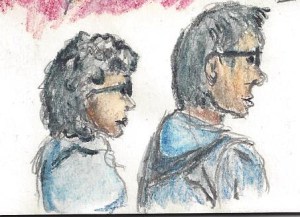
Can a dumb sketch help you be present?
Edwards has a long section on brain functionality, how the left brain works versus the right brain. I have a growing skepticism about the neatness of those two categories. I think there is some truth in the distinction. And the distinction works well for release from our typical analytical state into a more meditative zone of creativity. I’ve long depended on that zone for more creative writing assignments. But the research citations feel a bit dated and frankly I’m always a bit skeptical of forced black and white interpretations of complex physiology.
But this notion of sitting with stillness before a scene to observe, capture and (potentially) understand—it feels like a life skill that could and should translate into all sorts of different settings. Slowing to see and hear has begun to awaken all sorts of new thoughts in my brainpan. I find the practice encroaching on normal conversations, on meetings, on writing, on driving and even as I pray.
Especially as I pray.
I cannot help but wonder if learning how to observe, capture and (potentially) understand is a step toward being more present with all the beings in our lives.
###
Dumb Sketch: Kirk Livingston

 conversation is an engine