Archive for the ‘Dummy’s Guide to Conversation’ Category
Verbatim: “Pursue truth behind our differences,” Wayne C. Booth
Who will you argue with today?
 The late Wayne C. Booth was Professor of Rhetoric at the University of Chicago. Among the many books he wrote was The Rhetoric of Rhetoric, which I reviewed here. In that book he talked about three kinds of conversations: win-rhetoric where the point of the conversation is to bash your conversation partner into submission. Bargain-rhetoric is where we dialogue toward the goal of finally getting to common ground that benefits both of us. In the business world we called this “win-win” because everybody benefits, though deep concessions were often made. But Booth favored this final type: listening-rhetoric, which had the goal of “pursuing the truth behind our differences” by listening with the intent of understanding what the other is saying. There are many benefits to that way of holding a conversation.
Listening-rhetoric sounds pretty obvious as the way forward, right? I agree. Yet when I check my intent in the middle of a conversation (hard to do), I find I am more often trying to listen strategically to counter whatever obstacle my conversation partner places between us. Or I am not even listening. Instead I’m thinking some far away thought (but maybe that’s just me—I’ve always had a problem staying anchored in the present).
I propose a fourth kind of conversation: reconciliation-rhetoric. I see it as Listening-Rhetoric Plus. Pursuing the truth behind our differences can often lead to a very fertile place—a place as uncomfortable as it is fecund. But leaving the conversation as just touching the two of us does not reveal the whole truth. In reconciliation-rhetoric, me and my conversation partner invite God into our discussion. This isn’t churchy stuff. It isn’t religious stuff. It is a human connection that recognizes the bigger stuff going on around us. It is actively asking and talking about how (if?) God’s plans enter our discussion. Maybe it looks like a silent prayer. Maybe it looks like an out-loud prayer. Maybe it is the recognition that larger plans may be in motion, subsuming our own. I’m taking my cue from a pivotal ancient text written by Paul the apostle in his second letter to the church in Corinth (Chapter 5).
Just who is involved in our discussion, anyway?
###
Photo credit: Niklaus Ruegg
Do a Dumb Sketch Today
Magnetize Eyeballs with Your Dumb Sketch
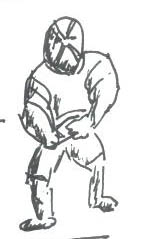 As a copywriter, I’ve always prefaced my art or design-related comments with, “I’m no designer, but….” I read a number of design blogs because the discipline fascinates me and I hope for a happy marriage between my words and their graphical setting as they set off into the world.
But artists and designers don’t own art. And I’m starting to wonder why I accede such authority to experts. Mind you, I’m no expert, but just like in the best, most engaged conversations, something sorta magical happens in a dumb sketch. Sometimes words shivering alone on a white page just don’t cut it. Especially when they gang up in dozens and scores and crowd onto a PowerPoint slide in an attempt to muscle their way into a client’s or colleague’s consciousness. Sometimes my words lack immediacy. Sometimes they don’t punch people in the gut like I want them to.
A dumb sketch can do what words cannot.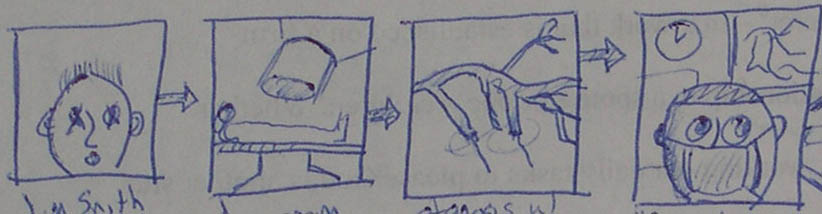
I’ve come to enjoy sketching lately. Not because I’m a good artist (I’m not). Not because I have a knack for capturing things on paper. I don’t. I like sketching for two reasons:
- Drawing a sketch uses an entirely different part of my brain. Or so it seems. The blank page with a pencil and an idea of a drawing is very different from a blank page and an idea soon to be fitted with a set of words. Sketching seems inherently more fun than writing (remember, I write for a living, so I’m completely in love with words, too). Sketching feels like playing. That sense of play has a way of working itself out—even for as bad an artist as I am. It’s that sense of play that brings along the second reason to sketch.
- Sketches are unparalleled communication tools. It’s true. Talking about a picture with someone is far more interesting than sitting and watching someone read a sentence. Which is boring. Even a very bad sketch, presented to a table of colleagues or clients, can make people laugh and so serve to lighten the mood. Even the worst sketches carry an emotional tinge. People love to see sketches. Even obstinate, ornery colleagues are drawn into the intent of the sketch, so much so that their minds begin filling in the blanks (without them realizing!) and so are drawn into what was supposed to happen with the drawing. The mind cannot help but fill in the blanks.
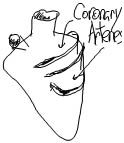
The best part of a dumb sketch is what happens when it is shown to a group. In a recent client meeting I pulled out my dumb sketches to make a particular point about how this product should be positioned in the market. I could not quite hear it, but I had the sense of a collective sigh around the conference table as they saw pictures rather than yet another wordy PowerPoint slide. In fact, contrary to the forced attention a wordy PowerPoint slide demands, my sketch pulled people in with a magnetism. Even though ugly, it still pulled. Amazing.
###
Listen Up: #2 in the Dummy’s Guide to Conversation
The problem with listening is the other people who keep talking
 You’ve opened your pie hole and made like a human: shaping experience into words that can be understood by the humans around you (though it’s still a bit fuzzy how anyone understands anything). You anticipate being stopped dead in your tracks with realization or wonder, right in the middle of a conversation.
But there’s a step to bridge the two: you’ve got to listen.
The traditional problem with listening is other people: they keep talking. When they are talking, you are not at the center and they keep uttering words that don’t refer to you. For instance: they rarely mention your name, which you keenly listen for. They keep talking about their own experience. Why, oh why, don’t they stop talking and ask me about me?
Let me introduce you to three friends who knew something about listening: Mortimer Adler, Alain de Botton and Jesus the Christ. I met Mortimer Adler when I read his book, “How to Read a Book.” Why read a book on how to read a book? Because of the author’s crazy fascination with understanding. He didn’t just read, he annotated, he outlined and he synthesized. He labored over passages in long conversations with the authors. Plus, he made it sound like fun (which it is!). Of course, there is not enough time to do that with every book, so Adler picked what he called the “Great Books.” His Great Books program has gone in and out of style over years, depending on your politics and your conclusions about who qualifies as worth reading.
Alain de Botton writes readable books that satisfy his curiosity and pull his readers into the vortex of questions he counts as friends. If you’ve ever wondered how electricity gets to your house or what is the process behind producing biscuits (that is, cookies) or why Proust is worth reading or why Nietzsche was not a happy-go-lucky guy, de Botton is the author you want.
Jesus the Christ knew something about listening, despite being both God and man. His human condition opened a limiting opportunity which in turn caused him to steal away for hours to converse with the God of the universe. I go into depth on this in Listentalk. But the point is that prayer, which is ultimately more about listening than talking, was a preoccupation of the man who was God.
Listening opens us to hearing—which sounds like “duh” except for when you examine your own listening practices and realize how often you are thinking of something else entirely when your spouse/child/boss/friend/neighbor appears to be talking. But to really hear, to be crazy to understand, to be curious and to be committed to connection opens us to the place where we can be stopped dead in our tracks.
###
Stop Dead in Your Tracks: #3 in Dummy’s Guide to Conversation
Could Paying Attention be the New Black?
 This has happened to you: Going along. Minding your business. Dashing off small replies to the usual small talk. Maybe you hint at the plus-sized existential questions colliding and storming through your subconscious; the doubts and uncertainties that threaten to spill through your cranium as a conscious thought you even might utter. Maybe you stay silent.
But the internal roiling doesn’t let up.
“What does it all mean,” you mutter under your breath on the elevator to the 23rd floor, remembering your wife’s comment about needing more attention and your boss using pretty much the same words and your doctor stating you need to focus on exercise otherwise diabetes is around the corner. That’s when the person next to you looks up from her phone and says,
“I don’t know, but the CDC says attention deficit disorder is on the rise.”
She smiles half a smile and goes back to her screen.
It hits you: Maybe there is a national attention deficit disorder and your life reflects it. Maybe our screens and multitasking so distract us that full-on attention is rare and becoming rarer. Since we carry the multi-tasking addiction with us into every conversation (like a drunk secretly playing out the context of the next drink), we simply have no bandwidth to attend the need, the threat, or the story (it is National Day of Listening, after all) playing out before us. And suddenly you long for an hour of blissful focus.
Black Friday may be a worthy day to consider that paying attention is the new black: the fashion statement that can only be given, not bought. And paying attention to what we say to each other—really listening—may be a gift that looks more like an investment in the future of a relationship.
If The Word Fits
If the first step in the Dummy’s Guide to Conversation is to open your pie-hole, proving you are both human and alive, then the second step is to listen. And the third step is to be stopped—or at least to be prepared to be stopped. So much of life seems set to automatic pilot. The same bowl of Raisin Bran every morning. The same drive to work. The same greeting to the guard, same conversations with the same coworkers. Same words sent. Same words received.
When we have the Aha moment on the elevator to the 23rd floor next to the woman immersed in her screen, we should take note. Write down the insight. Listen to it. But don’t stop there; consider making a habit of watching for the moments of supreme attention that stop you dead in your tracks with wonder. These are the very pivot points we shoot past without even taking in the scene. And that’s too bad, because we miss an opportunity to learn something about ourselves, our culture and our future.
###

 conversation is an engine