Archive for the ‘Hard Conversations’ Category
Words Build Stuff Between Us
Words destroy stuff we’ve built
We all know this, don’t we? It’s perfectly obvious.
If words were money (words are definitely not money), we would be aware of our spending to inform or persuade or entertain. And just like people who make a hobby of “going shopping,” spending our word budget every day would be just another normal piece of everyday life for a U.S. citizen (or “consumer,” as business has renamed humans).
And that is actually how words work: We spend them.
With words we buy influence. We give some bit of knowledge or direction to someone else and win something in return. Some bit of psychic collateral. With words we buy context: we proclaim this or that in response to a situation at home or at work. Sometimes those around us agree with our context-setting assessment. Sometimes they don’t. Hint: if you want more people to agree with you, become the boss. Authority has a way of bringing believability with it, whether or not it is earned.
How we spend our words is worth thinking about. For many of us conversation seems instinctual. We say this in response to that. We inform, persuade, entertain with a joke. We do most of this without making conscious choices about our wordly-intentions.
But what if we did think of how we spend our words? What if we invested our words to accomplish some end? What if we invested our words with meaning—which is to say, what if we said things that were pulled from the well of what is important to us? That would make us vulnerable, of course. It would also be a platform for growth. Because when we say what is important, we learn something about ourselves and often a meaningful conversation can follow. The kind of conversation that has a chance of touching us deeply.

If you’ve not read Mistakes Were Made (But Not by Me), now is a good time. Tavris and Aronson have been referred to frequently as the Rolling Stone article on rape at the University of Virginia and news reader Brian Williams were found to have amped up their stories beyond anything resembling truth. Tavris and Aronson talk about cognitive dissonance and how we have such a hard time living with ourselves when our inconsistencies and personal malpractices appear—so we just change the story to coddle our precious psyches. The authors also demonstrate how memory gets built and rebuilt as we change stories:
Memories create our stories, but our stories also create our memories. Once we have a narrative, we shape our memories to fit into it.
–Carol Tavris and Elliot Aronson, Mistakes Were Made (But Not by Me), (Orlando: Harcourt, Inc, 2007) 77
I am advocating for conscious use of words, and for filling those words with stuff that is important to us—scary as that is. I see this as the opposite of small talk. I do, however, acknowledge that small talk is the precursor to big talk.
In my dream world, we use words to constantly build stuff between us rather than destroying relationships by purposely misunderstanding and showing we are better/righter/fitter/stronger/groovier.
###
Image credit: Kirk Livingston
God-Talk and Other BS
Do Communication and Spirituality Connect?
I say “Yes.”
And I say it manifests in the ordinary conversations of everyday life.
Let me prove it: deep down in your brain-pan, where you instantly recoil from people who snap at you; back down there where your inner child says snarky, politically incorrect, frankly obscene, stuff that your adult, outer-self edits and translates to “Hmm. I see….”
Deep down there in the hidden recesses—that’s part of the connection.
Your immediate responses to the stuff of everyday life can tip you off that things are not right—deep down in the soul. Yes—I’m talking about weird stuff. But you have an inner life, right? A place where no one visits but you.

If that inner place is full of doubt, while your outer self—the adult self in tie and loafers, who edits and translates the inner child’s voice so the rest of the world remains unaware what a low-life that kid is—if that outer self proclaims stable faith in God and corporation and the upright institutions (ha ha) that surround us—that’s where the cognitive dissonance starts. That’s the precise locus of hypocrisy.
Mind you: I’m big on doubt. Questions are good. Questioning institutions and the quick answers to life’s hard questions—I’m all for that. Talking unbelief to God makes perfect sense to me (Just read Job, my patron saint of doubt honestly-processed).
It’s the saying one thing while believing another I’m not for. It is that very place where God-talk becomes BS. And I believe most of us have sixth-sense/BS detector that goes off when outer words don’t match inner life—even if we cannot put our finger on exactly why. I am most certainly talking to myself here as well.
We need to process our bouts of cognitive dissonance together to keep our God-talk from becoming BS—rudderless words without the ballast of belief and action a life-lived.
If you don’t have a friend to be honest with, find one.
This is important.
Today is Good Friday—a day when the Christian Church celebrates (is that even the right word?) Jesus’ death. Three days later we celebrate that this dead guy is dead no longer.
I appreciate this time of year for processing doubts together with others. Quite often we come away rejoicing. And somehow more whole.
###
Image credit: Kirk Livingston
By the way: I’ve written ListenTalk: Is Conversation an Act of God? to explore this connection. Pre-order here.
Let’s Talk: Will You Fly This Plane into a Mountain?
Listening-Rhetoric and Public Conversations Gone Private
To the casual news-reader, it’s looking more like the German copilot purposely flew into the side of a mountain. Given that, it’s not hard to imagine last week’s conversations between airline human resource vice-presidents and corporate lawyers:
- How do we screen for lethal depression?
- Let’s get serious about that two-people-in-the-cockpit rule.
- Is there an intention-detector we can employ before anyone—pilots included—steps into an airplane?
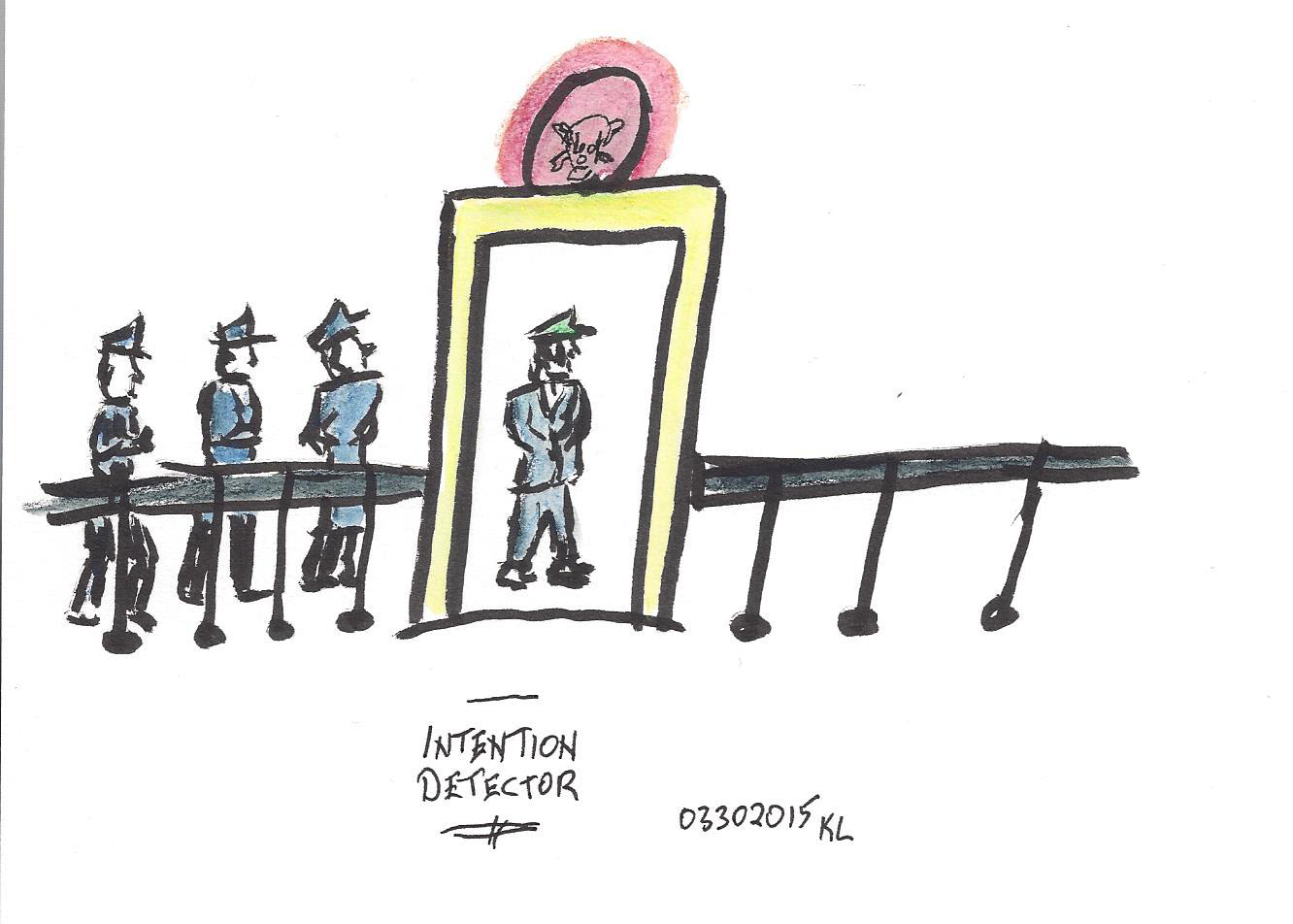
Intentions frame how we talk and how we listen. Wayne Booth posited that sometimes we come into a conversation with the intent to win—to bash our conversation partner into submission with whatever way we can. Sometimes we come with the intent to bargain, and so we are ready with a list of conciliations. Sometimes we come to listen and learn. Booth called that “listening-rhetoric” and recommended it as an antidote for stupidity, partisanship and as a way to “pursue truth behind our differences.”
People will speculate for a long time on the pilot’s intentions and actions—which we will never fully know. But as lawyers and HR talk I hope they will also examine the role of relationship-building conversation as an antidote to isolated suffering. Suffering that may become lethal.
###
Dumb Sketch: Kirk Livingston
Dubious Conversation Skills: Skepticism and Fault-Finding
Pivot Your Conversation on Some Fresh Hope
One dubious skill I learned early in corporate life was that skeptics and fault-finders earn respect at a conference table. If you are not presenting the idea (and thus less invested in making it work), you’ll win experience-points with others by blowing holes in whatever the group is discussing. Finding fault won’t cost you much and could win you a more exalted place in the world of that organization. Plus: you need know next-to-nothing about the idea or context to find some loose thread to pull and hope for collapse.

Please walk this way
Yesterday I sat around a conference table with a group of skilled, opinionated, driven people who had a brand new idea. All around the table were invested because they had been working different parts of the idea for some time. The hero directing the conversation skillfully wove a bit of verbal fabric above us by hinting at how these disparate work groups were—quite possibly—creating some brand new category. I’ll not be more specific because of non-disclosure agreements, but what was remarkable to me was the intent of the verbal dreaming and the way it resonated with a group that could have been contentious.
Yesterday’s meeting reminded me that fresh hope is a disarming thing to bring to a group of seasoned people.
By the way, my book ListenTalk: Is Conversation an Act of God? is moving through the publisher’s proofreading department toward an actual physical presence. Chapter 2, “Intent Changes How We Act Together” highlights the work of the late University of Chicago rhetorician, Wayne Booth, who showed three different ways our intentions derail conversations. He ended up developing a way of talking that could unite conversation partners—much like the hero in my story above. You can put your name on a list [here] to be notified when the book is available.
Randomized, double-blind studies indicate that people who put their name on that list live happier, more thoughtful lives. I just made that up. But you can–and probably should–put your name on that list.
###
Image credit: Kirk Livingston
Pick a Door: Blessed are the Poor
How do you read this?
Jesus went up the mountain with his followers, as the great teachers do. His first words:
Blessed are the poor in spirit, for theirs is the kingdom of heaven.
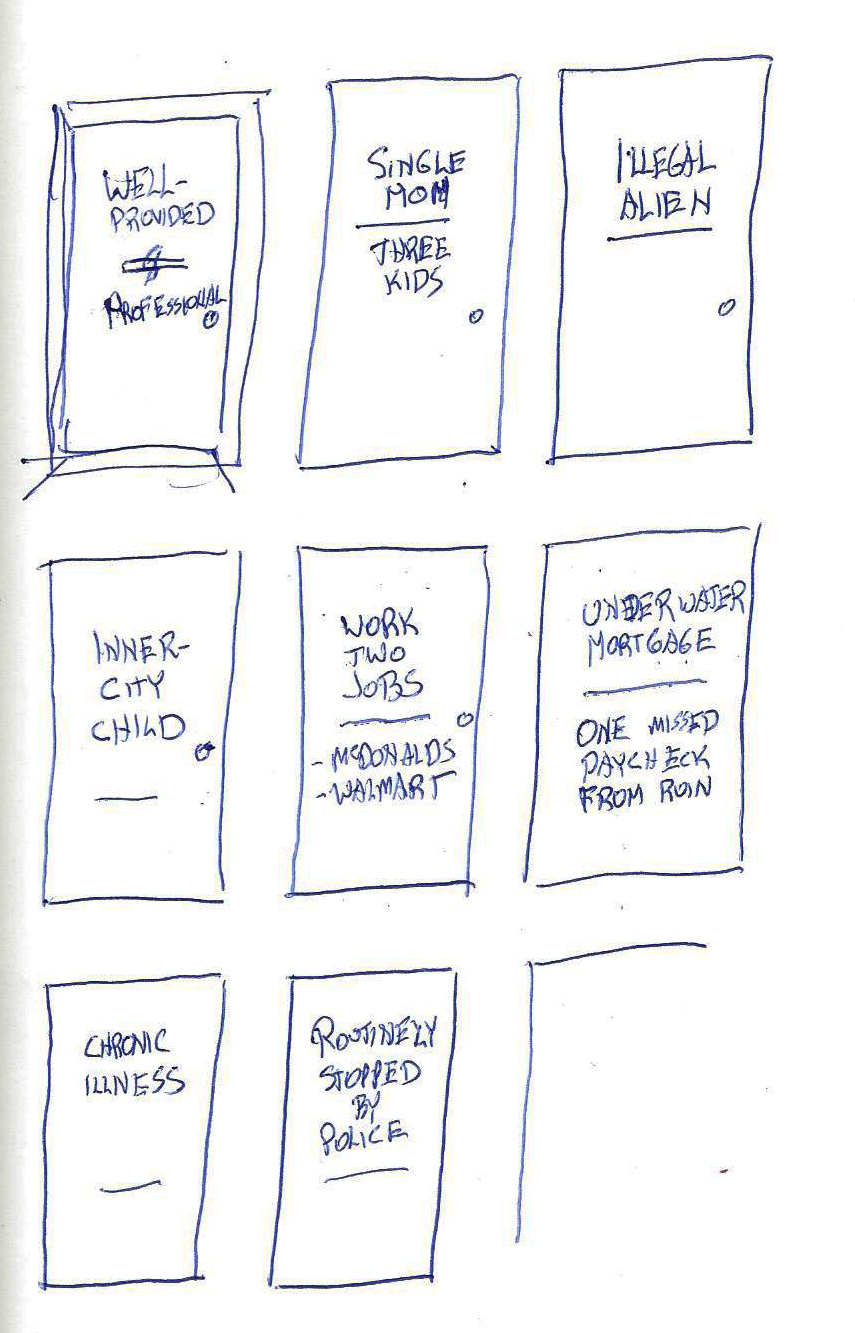
How you hear those words depends on where you come from. The images that come to mind, the connections you make, the hope or lack of hope—much is prefigured and preloaded by the conditions you bring.
What did the original hearers hear? That is the question.
But we make a start toward answering that question by asking what door we just stepped through.
###
Dumb sketch: Kirk Livingston
How to Anticipate a Thaw
Sometimes life mirrors fiction
My client needs a strategy for their online presence.
They know their presence appears text-heavy and pedantic, making them less attractive to the new audience they seek. My client’s online presence must quickly inform the querying audience why they should care, but this message needs to be packaged with a color palette and intuitive organization that say “Come in!” long before the audience gets to the headlines, let alone body copy.

All sorts of off-the-shelf tools can make that happen these days. WordPress has a number of themes that can invigorate tired old websites.
But what I’m interested in is the engagement-promises my client can make that are deeply true. The organization itself is on the cusp of change and their online presence is a first new thing to present a refreshed vision. As such, their presence needs to be aspirational (“Here’s who we want to be”) but also rooted in long-held values. Their new presence needs to reflect the hard-won, chiseled facets they have come to love—facets that may just present new ways forward.
When I get stuck writing a piece of fiction, I go back and see what my characters have already been saying and doing. And then I retrace their steps along a new trajectory. And that is exactly what my client needs.
This is a team effort situated in real life. And this team effort will retrace and map and begin to outline a new trajectory. This team hopes to generate a conversation that precipitates a thaw after a long winter. We hope this conversation will pull in those who have long been hibernating.
###
Image credit: Kirk Livingston
Stop On The Way
Ask: “What do you see from there?”
Mostly we hurry from this to that.
In this season we move from party to party. At work we move from meeting to meeting, hardly stopping to breathe, let alone reflect or appreciate the unique spot we’re in.
We do this because we are crazy-busy (always the right response in our culture). And sometimes reflection is uncomfortable, especially between things. No one really wants to dwell in the space between. But the space between has things to say as well. Things you would never hear otherwise.

Always “crazy-busy.”
We all know someone stepping between things. Maybe our friend has left a job or school or some relationship. Maybe we ourselves own some piece of life that has less than secure footing. All of us caught in between want the solid ground of the other side.
But we gain perspective by asking what we see from this liminal space. What does life look like from this uncomfortable, slippery place? What is important here—and should that thing be important when our footing is more secure?
Perhaps we do our friend a favor by asking what they see from that uncomfortable place—could it even be bit of mercy to ask that question?
###
Image credit: Kirk Livingston
Who We Are Who We Aren’t.
A lot rides on identity
- We aren’t torturers, that’s for sure. Except for…wait, it looks like we are (read the report here).
- We believe in the rule of law, unless we’ve been violated. Then we stand above the law.
- We believe in the level playing field, where everyone has the same opportunity. Except bankers and corporate boards and Wall Street and race are exposed nearly every week as rigging the game and handing big money and privilege to the rule makers.
- We’re not a police state, except for when we are. And it looks like we are building in that direction.

The personal and local and national conversations we need to have are getting harder and much less comfortable. Maybe that’s because we’ve put them off so long and been in denial for so long. Maybe it is because we remain afraid of talking with people unlike us.
But we need these conversations. These are the conversations that help us figure out who we are. These are the conversations that help us move forward.
###
Image credit: Kirk Livingston

 conversation is an engine