Archive for the ‘making mistakes’ Category
Rudy’s Crisis of Character
Does your crisis need introspection or extrospection?
 Rudy (not his real name) (his real name was Samuel) was pastor of a small church in rural Wisconsin. A lot of people looked up to Rudy. It’s easy to imagine the pressure to be an example in such a community. Some/much of that pressure was self-inflicted.
Rudy’s son had a drug problem. When the problem came to light—in a very public way—Rudy blamed himself. He took a break from his pastoring job and pulled his trailer out into the woods where he was going to pray and read the Bible and think about where he had gone wrong and generally plead with God. He was in good company on this—lots of people in the Bible pursued these pleading communication events when crises hit. A few days alone, or alone with God, may answer the “What next?” and “Where did I go wrong” questions.
I’ve thought about Rudy’s instinct over the years. I grew up in a tradition where sorting things out on your own was expected. “Whatever you need to do to straighten up and fly right, well, get on with it” was the general sense of how things ought to progress. That was Rudy’s primary methodology.
Yesterday I had a delightful chat with a local philosopher. We got on the subject of what happens when we encounter the Other. What is our responsibility for the people with whom we come in contact and when does that responsibility kick-in? How can we be mutually for the people in our lives—and maybe for the people on the fringes of our lives? It turns out that one way is through our conversation. Even the casual conversations—just in passing—can have a deeply cathartic effect at times when people say what is really going on. I cannot help but wonder if Rudy’s instinct might have benefitted from time alone followed by a long walk with two or three childhood friends to help him sort the flotsam from the jetsam. Followed by weeks of conversation with his wife, Carol (not her real name) (her real name was Gertie). Followed by lots and lots more honest talk—especially with his son.
Because when we speak with each other—sometimes we say (and hear) the things God would say to us.
Speaking of Rudy (not his real name) (his real name was Ebenezer). Everything turned out ok: Rudy eventually left his pastor job and he became an exemplary truck driver and was chock full of wisdom for the people on his route. And the son’s drug problem grew until it stopped abruptly when teen angst gave way to career and age and the need to pay attention to life.
###
Image credit: Roland Topor via 2headedsnake
How to Blog Your Company’s Top Voice
Your Company’s Outside Voice Must Be Personal & Remarkable
 I’ve been helping a few clients think about their outside voice. Blogging has its own peculiar set of requirements that set it apart from the tone of a brochure, say. Or from a corporate press release. That recurring blog voice is related to the messaging identity your company has established. That voice is also related to the design and tone of your corporate website, true, but it is not a one-to-one correspondence.
One primary difference: your blog voice must be personal.
A blog is not a scientific, peer-reviewed journal. It must not deteriorate into a selling monologue. And it is not constantly pointing to benefits and features (which quickly gets tiresome). It’s a different animal—a personal voice. It’s got to be a conversation that takes wide and narrow routes on the way to discussing what is remarkable. The best blogs are smart and timely and pull readers in by offering this personal perspective on things of mutual interest.
Just a bit of practice using the public voice helps clients see why their outside voice must be personal and have a personality behind it (not as redundant as it sounds). It doesn’t take many sample posts to show that customers and potential customers are intrigued by an inside track into the mind of that top voice. And that top voice can pull peripheral topics to the center of discussion to show how they relate, for instance. Or to show how certain a practice will move the industry forward.
And remarkable.
Interestingly, outside voice has a way of trimming and freeing and impacting a company’s inside voice. Outside voice and inside voice are related—how could it be otherwise? What is remarkable (and thus worth blogging about) must also be remarkable on the inside of the company. The top voice blogging about what is remarkable in the industry must also pass the believability test for those inside the company. Because folks inside a company tune their BS meters to High the moment they walk in the door. Remaining personal and true is essential.
So…blogging the top voice is not an easy path. But that has always been the way of relationship-building with peers, employees, clients, customers and potential customers and even congregants. And relationship-building is worth the time and effort.
###
Image Credit: We Made This via thisisnthappiness
Endo Brochure Silent on Vital Bits—2 Skills for Tonight’s Debate
Read the White Space. Hear the Silence.
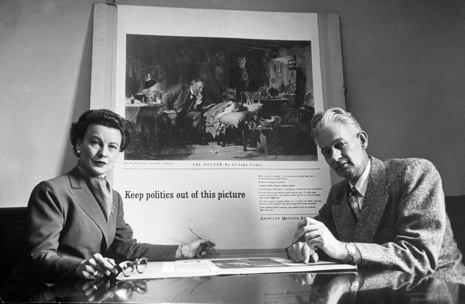
Campaigns, Inc.: My Antiheroes.
MedCity News reports on an Endo Pharmaceuticals brochure under scrutiny by the FDA. The problem was a lack of transparency about the dark side of the therapy—a therapy designed to slow the growth of prostate cancer cells, namely:
- paralysis that may result from the risk of spinal cord compression
- the increased risk of diabetes/heart attack/sudden cardiac death/stroke
In a lively debate in comments section of the Pharmalot blog, the consensus seems to be that the FDA made a good call. Commenters began by speculating this was likely more than just a slight oversight as the Endo communicator skipped regulatory/legal review in a rush to meet a deadline. Then commenters started tracing the language to the Vantas Implant website and began speculating on the rest of their messaging and promotional literature.
The debate amuses me because it is the rare product brochure that is read outside of a sales presentation. And it is even rarer for a brochure to withstand extended exegesis. That the FDA does this regularly earns my respect/awe/fear. Love them or hate them, the FDA’s dogged attention helps medical copywriters and marketers hew to the high road.
The debate also serves as a reminder of the skills needed for watching tonight’s presidential debate. It’s the white space and silence that may be most eloquent. The skill of reading the white space and hearing the silence means the audience must be equipped with the fuller argument. The FDA certainly was. But to read Jill Lepore’s recent New Yorker essay (“The Lie Factory: How politics became a business,” Sept. 24, 2012) is to come away with all the history and reasons as to why the American populace remains a happily uninformed audience. Whitaker and Baxter of Campaigns, Inc. helped set the stage for the current state of our spectatorship:
In tonight’s debate, I’m trying to break free of my usual indolence to hear between the lines (as it were).
###
Image credit: The New Yorker
It Turns Out Time Is Not So Flexible
My Wife Demonstrates Use of a “Clock”
 I’ve always joked that I live in a time warp. Time actually moves backwards as I drive to my next meeting (which is not a confession of speeding, please understand).
I am of the tribe who refuses to leave what I’m doing to get to the next thing. In my mind—as I remain at my keyboard—myriad mental time and distance calculations convince me that of course I have plenty of time to get to that meeting. My watch is set ten minutes ahead so I am only five minutes late to things. (That’s a reasonable margin, right?) Of course there will be green lights. Certainly there will be no traffic—I count on it. Naturally I can shower/shave in five minutes and be ready. Absolutely.
As it turns out, my wife is able to use a clock. And she timed my five-minute shower. And then she asked me if I could take a shower and eat breakfast in five minutes.
“Yes,” I said. “Of course.”
“Twenty minutes,” she said.
“What’s that?”
“Yes.”
So, here’s my new deal with the universe: I’ll give myself thirty minutes to shower and eat breakfast. And not just because my wife has had something to say about this for 27+ years. Perhaps peace with Mrs. Kirkistan—in this area—would be useful.
Yes.
I’ll get started right away.
Just let me finish this thought.
###
Image Credit: Ryan Todd via thisisnthappiness
Encounters with Silence
Where does insight come from?
Only knowledge gained through experience, the fruit of living and suffering, fills the heart with the wisdom of love, instead of crushing it with the disappointment of boredom and final oblivion. It is not the results of our own speculation, but the golden harvest of what we have lived through and suffered through, that has power to enrich the heart and nourish the spirit.
–Karl Rahner, Encounters with Silence (Westminster, Maryland: Newman Press, 1965. 30)
###
Image Credit: Via 2headedsnake
Americans: Large Mass. Small Memory.
Hey Media: That’s not the Bill Clinton I remember
 Is this we’ll how we’ll be remembered? The people who enjoyed the fat of the land but couldn’t remember what happened from year to year? If anyone reads through our newspapers in 100 years, surely that will be their conclusion.
Even before Bill Clinton’s celebrated speech last night (I have yet to listen to it, but I will—Bill Clinton is a great speaker), we learned from various media outlets that he was a popular president and how both Democrats and Republicans remember fondly his tenure.
Really?
I remember him as the president known for oral sex with an intern. Who then lied about it on camera. I remember him as the president who allowed me to explain oral sex to our kids innocently listening to the radio news. He is the man who was impeached and a national disgrace. The man who was a running joke for late night comedians for several years.
I’m all for grace and fresh starts. And I’ve got my problems—I’m not judging, only remembering.
Bill Clinton a popular president? Yes, for the media and comedians. Maybe today if you look only at the economy during his time in office. But for me: my memory is decidedly mixed. At best.
###
Image Credit: Keith1437 via 2headedsnake
“How Do I Expand My Work?”
Sustained, Focused Pursuit Is Itself Hard Work
 If you are an employee focused on the next eight hours, you might not think about “How do I expand?” It is certainly the opposite of “How can I make it through today’s work?” We all ask that second question from time to time, but when we ask the first question, we are typically in a much better emotional place. I say the two questions are related and both revolve around how you define your work.
If you are responsible for bringing in new business, “How do I expand?” is your primary question. If you are an employee and entrepreneurial, you might think about how to grow your department or to expand the charter of your department. If you are a freelancer, or part of a firm or agency (small or large) and tasked with bringing in new business, this first question can consume you.
A friend talked about the “catcher’s mitt” approach, where his ad agency is in the loop to hear about a formal or informal RFP (Requests For Proposal) from a variety of organizations, and they respond. As a freelancer, it is much the same for me—responding to requests from loyal clients and fielding requests from new clients.
But catching requests as they go by is only one piece of the pursuit. And maybe a small piece, though clearly important. A larger piece has to do with organizing yourself and your group for the work you want to do. Getting yourself and your team ready for the work you intend to do. Casting vision and organizing resources so they faithfully align with the work you are aiming at–a thing my friend is good at.
When I say organizing, I really mean trimming and pruning, because while the catcher’s mitt collects all sorts of work that is close and even very close to the anticipated, desired work, it may not be exactly on target. Organizing for the work you want means going through the difficult steps of asking what it is we are good at and what it is we want to pursue. And then moving toward that singular, or at least narrowed range of work in our outgoing conversations.
If this sounds like something that only happens in business, think again. I routinely talk with folks fresh out of college looking to set up their own business and wondering how to go about that. I often respond that they should look for opportunities to work with people and companies that interest them. And they should look for opportunities to use their communication, writing, design and thinking skills to serve (another tip from that inveterate letter writer) those people and firms they admire.
But this is not something just for new college grads. Defining our work and then trimming back and pruning it is a life-long pursuit. When we stop asking “How can I expand my work?” and start asking “How can I make it through today’s work?” we have given away a piece of our vitality.
And that looks like an end rather than a beginning.
###
Image Credit: unicornsandcuppiecakes via 2headedsnake
Say What You Will: Dummy’s Guide to Conversation #10
How to Not Feel Bad About Voicing Your Opinion
 I grew up wanting to not disrupt people. Sadly, I remain a people-pleaser.
I’m working on it. (so back off.) (darnit.)
But I’m learning lately that every voice really does matter—no matter what condescending tone your client or boss or the VP takes in today’s conversation. Even when she sighs and says “We’ve been over this,” know that if it bugs you, you need to bring it up. And the know-it-all in Purchasing doesn’t really know it all—he just sounds that way. So raise your point. If what you hear doesn’t sit well, say so and tell why. Reject verbal manipulation and say what you will. Be civil. But say it.
That inveterate letter-writer said to speak truth in love, and he was right (again). Each of us hears only what we want to hear most of the time. And it only gets worse over the years as our blinders sit more firmly over our eyes and ears. We don’t see or hear what we don’t know. We’re not even looking for it. But we need to hear it, and sometimes we desperately need to hear the big obvious thing everyone is trying hard to not say. Our words are most effective when they carry with them true care for another person. “True care” as opposed to the catty smites that characterize so many of our public forums.
Say it because your conversation partner will get over it. Or not. It is true that sometimes our words can end friendships—but that is less likely when our words also communicate care.
And beyond our need to hear from outside ourselves, a lot of critical human work gets done within the moving parts of a conversation: affirmation, understanding, self-understanding, mutual-understanding, reframing a situation, brand new ways of looking at things. That list is long.
But none of that happens if we don’t say what we are thinking. So stop worrying about disrupting the day of the self-important windbag. Much bigger things are at stake.
###
Image Credit: Eric Breitenbach via Lenscratch
Boss No Like Social Media
Mashable reports that employers are not all hep on giving more social media freedom to employees.

tweet that
It seems the spread of negative information is their persistent nightmare fear. There are all sorts of main courses and sides to this tasty debate, but one thing a boss might consider is taking a longer-term look at the issue. Yes, we all know how easy it is to waste hours on Facebook. And many of us are starting to assume Facebook will give way to something else, George Tannenbaum thinks it will happen by 2017. I expect a rising Facebook backlash. But whether a backlash happens broadly, something will rise in its place. That’s because once people realize they have a voice, there is no going back.
But a longer look at giving many people a voice recognizes at least two facts:
- The era of sovereign control over you employee’s voices is over. Despite what Vladimir Putin thinks and does, what you allow or forbid workers to say at the workplace matters less and less when you don’t control the technology residing in a pocket. And conversations about your work are already in progress, whether you know it or not.
- Reasons and a few simple parameters beat “No” every time. All anyone wants is an explanation. It’s a grown-up thing to explain the reasons behind a choice that affects others. An explanation moves a team in the right direction. Even an explanation like my friend offered a two-year old visitor at his party. The toddler wanted to pick up a little poodle who had no intention of being picked up by the toddler: “You know what, Jenny? This is a Wiggly Dog. And no one can pick up a Wiggly Dog.”
Even if you have to make up a new category of canine, it’s worth an explanation. Of course, an explanation invites questions. Simply put: bosses need to get used to hearing voices. May as well start planning for it.
###
Image Credit: via Retronaut
The Trap of Telling All You Know
The Benefits of Version 1.0

My Ignite experience reminds me that the goal of speaking is engagement, even above conveying information. Looking back, I tried too hard to say too much.
I have a much deeper appreciation for people who can pull off a compelling talk. And I realize these people work hard to be compelling. Preparation is much more about editing then writing. Then again, conveying excitement to an audience–could it be something of a gift? Maybe a gift that grows through practice.
But as Greg Flanagan said in his wonderful talk “Make Mistakes,” I’ll call this version 1.0.
###
Image Credit: via 2headedsnake

 conversation is an engine