Archive for the ‘Opportunity’ Category

No, Really: What does a Philosopher do?
When Adjuncts Escape
Helen De Cruz has done a fascinating and very readable series of blog posts (Part 1, Part 2, Part 3) tracking the migration of philosophical thinking from academia into the rest of life. As low-paid, temporary workers (that is, “contingent faculty” or “adjuncts”) take over more and more university teaching duties (50% of all faculty hold part-time appointments); smart, degreed people are also starting to find their way out of this system that rewards increasingly narrowed focus with low pay and a kick in the butt at the end of the semester.
Ms. De Cruz has a number of excellent interactions with her sample of former academics (at least one of whom left a tenured position!). I love that Ms. De Cruz named transferable skills. What would a philosophy Ph.D. bring to a start-up? Or a tech position? The answers she arrives at may surprise you.

Why the Nichols Station Apartments look different.
I’ve always felt we carry our interests and passions and skills with us, from this class to that job to this project to that collaboration. And thus we form a life of work. Possibly we produce a body of work. We once called this a “career,” but that word has overtones of climbing some institutional ladder. I think we’re starting to see more willingness to make your own way—much like Seth Godin described his 30 years of projects.
The notion of “career” is very much in flux.
And that is a good thing.
Of particular interest to me was the discussion Ms. De Cruz had with Eric Kaplan. Mr. Kaplan found his way out of studying phenomenology (and philosophy of language with advisor John Searle!) at Columbia and UC Berkeley to writing television comedy (Letterman, Flight of the Conchords, and Big Bang Theory, among others). If you’ve watched any of these, it’s likely you’ve witnessed some of the things a philosophical bent does out loud: ask obvious questions and produce not-so-obvious answers. And that’s when the funny starts. It’s this hidden machinery that will drive the really interesting stuff in a number of industries.
Our colleges and universities are beginning to do an excellent job dispersing talent. That thoughtful diaspora will only grow as time pitches forward.
###
Image credit: Kirk Livingston
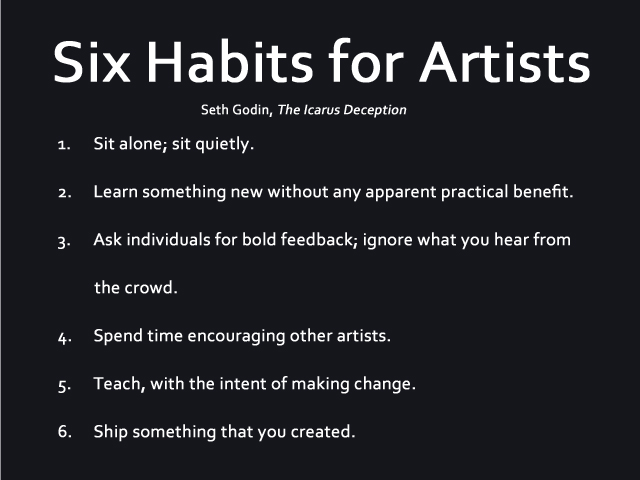
Seth Godin: Six Habits for Artists
Especially #6: Ship it.
I like Mr. Godin’s expansion of “artist” to include anyone trying to make a connection (full definition here). If you are trying to create, you’ll find these six habits useful.
###
How to keep talking even after you die
Independence is more than the freedom to buy a bigger television
Those who turned a conversation about independent national rule into a document that was then signed and sent—those people are long dead. Yet these 238 years later we continue to discuss what they did, what they signed, and what they paid for their declaration of independence.
Our declaration of independence.

Who doesn’t want independence?
The conversation they began is a very human conversation and so continues today, not just in the U.S., but around the world. Blood, tears, death and life show up wherever the conversation pops.
Our part of the conversation mixes in economics and justice and race and work and a lot of big dreams for our kids. Sometimes our nationalism tells our faith what to do. And sometimes our faith dresses in flags for coercive ends. And sometimes faith and citizenry collaborate in productive ways.
This declaration of independence has spurred a very long conversation and we each participate in our own way. Sometimes I wonder if our independence is only about getting bigger televisions. My hope is that we will come to increasingly relish our freedom. I also hope we’ll pay enough attention to add useful bits to the conversation, communication bits that will continue long after we’re gone.
###
Image credit: Kirk Livingston
I dare you to watch this entire video.
Just so.
Did you do it? I did.
And life on this side of the video is…astonishing.
###
Via Kottke.org
People hate me. Immediately. (Dummy’s Guide to Conversation #21)
Can I have a conversation even if I’m in customer service?
Q: Help: I’m in customer service and my conversation partners are harried, angry and nasty. The moment I speak, they hate me and the company I speak for. Conversation is no engine for me most days.

Am I my company’s keeper?
A: I’m sure you’ve found that a quiet, buoyant response to explosive negativity is a good first step. It is nearly always good to avoid matching anger and volume with anger and volume. If you can help your conversation partner feel heard you’ve accomplished a huge thing—especially when your company really wants to hear (your firm does want to make things right, yes?). Repeating what the person said is common in customer service circles these days and is a useful tactic in the rest of life as well. Repeating what someone says without any rhetorical or sarcastic flourishes is a useful moment in saying and hearing.
What other tactics do you practice? I’d be curious to hear them.
But don’t despair: conversation can still be an engine for you, despite each day’s avalanche of problems. Here’s how: consider each conversational event a moment to serve rather than looking for “Thank you.” Because that’s exactly what this is about: how can I (company representative) help you (respected customer) get some satisfaction? There can be immense joy in helping someone. You can create your own meaning by adopting that purpose. And it really works best with no strings attached: you can derive meaning whether or not your hear “Thanks!” or “You changed my life, Mr. Customer Service Guy!”
Some of my favorite people routinely live in this subversively helpful way and their attitude is infectious, possibly even life-giving.
See also #6: Listen to other people’s stuff
###
Image credit: Kirk Livingston
Are You In—Or Are You a Loser?
Is club membership really that critical to you?
Sometimes we observe similarities between work and church. Here’s a way work and church similarly lose momentum with every conversation: making club membership their most important feature.

At work VPs and managers and employees speak in Dilbertesque code. Acronyms are just the beginning. In the medical device world, there are shorthand words for landmark studies, shorthand words for device features and benefits, shorthand words for certain technological functions. Shorthand words for the management focus of the quarter. Unless you’ve been around the team for a time, you wouldn’t understand 60% of the conversation. That’s why advertising agencies routinely hire translators when they get projects with medical device firms—they just don’t get the gibberish these smart people are talking.
At church we put on holy language and use words that make us seem like we are in the know. We deliver these words calmly as if they were on our minds all the time. The language of doubt is mostly unwelcome in this setting—this is where the faithful come for their weekly booster shot. And so language becomes subterfuge.
The problem with insider language at work or church is that it sets up participants for failure again and again. In both settings, many of the folks in the conversation don’t understand the very words they are saying—and don’t even realize they don’t understand. Or maybe they realize it but the insider current is so strong they are afraid to admit their lack.
Plain speech is a subversive force. Not only does plain speech out those not in the know, it actually forces those who think they know to explain or realize they know less than they thought. Plain speech is a force for progress because it breaks down hidden barriers and destroys a primary rhetorical tool for those who want to sit on their knowledge and keep it for themselves and to protect their kingdom.
This is why…again…no question is a dumb question. The simplest questions often carry great power.
As organizations (like work and church) realize they need to evangelize and draw outsiders in as a matter of survival, insider language must die.
Insider language is dead!
Long live language!
###
Image Credit: Kirk Livingston
Team Leader As Artist: Let Your Team Crop Your Problem
What does your team see?
Photographers routinely crop and display just the section of the photo they want their audience to attend to. Cropping—possibly the easiest, most straightforward thing a photographer can do—changes the information the photo provides. Cropping also changes the feeling the viewer gets.

The right crop can stir emotion.
Most photographers work at getting composition right and so avoid cropping. Henri Cartier-Bresson famously accomplished that. Alec Soth gets this done too—though his process seems mysterious. The success of their composition looks like an invitation into another world, something frozen in time. Something clearly different from our own daily life.
That is the memorable artistry of the photographer.

Teams can be very gifted at cropping. Since we all naturally see a problem from a different perspective, collecting those perspectives in an open discussion can do a lot to reframe a problem into a most excellent opportunity. For a team to function this way, there needs to be a premium on open discussion. It helps if team-mates learn to value each other’s opinions. Listening and assigning value to each other’s contributions can be learned. I would argue it starts from the team leader (or manager/VP/CEO) and work its way down. Valuing each other’s perspectives (or not) is very much a part of corporate culture. But value can also move from the other direction: I’ve had teammates who valued different perspectives and taught the rest of us to find great joy in listening and considering.
Seth Godin routinely reframes art to include “making connections between people or ideas.” Some reading this will create art today by running a meeting that will make it possible for all around a conference table to hear a new thing. Their process for creating this art will be an examination of a problem that gets cropped from five or seven different perspectives. The result will be a well composed opportunity that has emotive power for each of the people at that table.
What art will you create today?
###
Image credit: Kirk Livingston
Medtronic, “Accounting Fiction” and Irish Performatives
How do you say “Fridley” in Irish?
To those who live as if words are worthless and refuse to see the role of systems in building wealth, let us now gaze on Medtronic’s deal to buy Covidien. What does $42.9 billion get you these days, besides a cohesive portfolio of medical devices and a bunch of intelligent workers and systems? Smart people are speculating it also buys freedom to spend foreign profits without worrying about more taxes, which may amount to a roughly $20 billion future spending spree.
Of course corporations will seek the best deal for making money—that is the project of corporations—and will surprise no one. Do Minnesotans worry a beloved company born and bred in Minnesota is growing up and leaving home? Of course. But the significant investment Medtronic has made in their operations in the state should cause worriers to back off a bit. A quick driving tour through Fridley and Mounds View reveal a rather permanent corporate presence.

How can you control chaos and churn?
But then—of course—stuff happens and things change. Which produces anxiety in hard-working people.
What I find interesting is that while the deal involves a significant exchange of money, it also changes a key definition that then dodges a set of tax requirements. Note this: becoming an Irish company is mostly in name only. The StarTribune quotes Eric Toder of the Urban-Brookings Tax Center as describing the newly formed Irish company an “accounting fiction.” So while Medtronic will always be a Minnesota company, it will become an Irish company. And there is money to be saved in being an Irish company. By cutting this deal—by pronouncing these words in international legal documents—a new thing happens at Medtronic that will please shareholders and worry local workers. JL Austin might call that corporate speech-act a performative. And there is no question that performative will change things in the real world.
[Full disclosure: The author has worked for Medtronic and continues to consult for Medtronic.] [At least the author did until posting this.]
###
Image credit: Kirk Livingston
Northern Spark 2014: Don’t Freak
Go, by all means. Just don’t freak out…

…at the…

weird stuff.

Northern Spark: June 14 9:01pm – 5:26am, Minneapolis
Worth every minute.
###
Image Credit: Kirk Livingston

 conversation is an engine