Archive for the ‘philosophy of work’ Category
Writing with Sheet Metal (ShopTalk #2)
The Pull of the Factory Floor
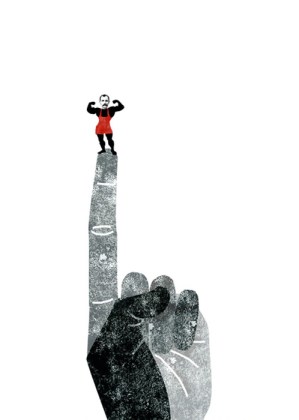 As a copywriter I spend my days in front of a pair of computer screens. Writing. Yes, I have meetings with clients and colleagues, brainstorming sessions and updates and phone calls. But mostly I remain planted before my computer, sorting through masses of information, ordering data that came with competing priorities and generally figuring out new ways to present the right facts to the right people in a way that causes a reaction.
Then there are days I visit a particular client’s factory. It’s a factory with a whistle that blows, union members who take 15-minute breaks, safety glasses and focused workers at benches doing macro and micro tasks. It’s a factory that stamps and welds metal, where electricians wire metal carcasses as long and tall as a semi-trailer. This factory is lit so everything is visible and produces a hum of activity across the concrete floor, which is the size of several football fields.
Why give so much detail? Because many who read this—myself included—spend our days in offices. But a factory floor is a different sort of place—a different world, with a different set of priorities and where production is king but craft sits near the throne.
I like this factory floor because it is different from an operating room, different from a cath lab, different from a conference room during an endless PowerPoint presentation, different from a row of cubicles and different from the Livingston Communication Tower (high over St. Paul). There is an irresistible, energizing activity on this factory floor that flows out of the scores of workers. But maybe that energy also comes from my past, because I grew up watching my dad craft furniture from oak and walnut. Maybe that’s where I absorbed the notion that producing a solid piece someone might actually use is a great way to spend your time and a fulfilling thing to do.
In this ongoing discussion of what makes for fulfilling work, I want to trace fulfillment down a different thread. This thread places the writer in a team with a goal of productivity. The writer and the team are focused on this goal of shipping something real and substantial. At the same time this team is also sort of doing life together—because in the middle of work there are the discussions about the rest of life. For a writer, this team-ness is a different way of spending the day and not to be missed.
Don’t take this as a romantic view of factory work. Instead, see it as the reality of the life situations where your craft takes you to meet a need.
###
Image credit: Yael Frankel via 2headedsnake
College Majors to Avoid + Rebuttal
And back to the work itself
 Good design often has this effect on me: it makes me want to find and do the work I am meant to find and do. Moving quickly through the many architecture or art or photography blogs out there also reminds me of what vision looks like when carried out. Vision alters our perceptions of the physical world and sometimes alters the physical world itself. And that is no small thing.
Yesterday I found myself in disagreement with the Burnt-Out Adjunct (whose too-infrequent posts I eagerly await and enjoy) who wrote that liberal arts studies should be more corollary than central to a college degree. Pisspoorprof was reflecting on another of these “ten worst” articles that pop up from time to time. This time it was Yahoo! Education touting the Four Foolish Majors to Avoid if you are trying to reboot your career.
Liberal arts degrees were the #1 opportunity killer with philosophy a close #2 opportunity killer. By the way, I cannot help but note that the entire article is an advertisement for the continuing services of Yahoo! Education.
As a holder of an undergrad degree in philosophy I both agree and disagree.
- Yes: no one hires a college grad to resolve deep-seated teleology questions (one does that on one’s own time). But to his credit, the VP at Honeywell who gave the OK to hire me (lo these many years ago) did question my stance on freedom vs. determinism.
- No: How about granting a bit of perspective? We need people who can think outside the present job parameters. And we desperately need people to challenge those parameters. Educating people to acquiesce by default is not what we need (though it is a short-term path to cash). Liberal Arts (and especially philosophy, let me say) can help this happen. Yes that sounds like the standard line from any college admissions staff says. Yes it is what professors say as they pass each other in the hallowed halls. No you don’t need a college degree to challenge the system, make a million bucks, make a difference or be homeless.
But studying things that don’t make money has a way of making us more conscious of all that is going on around us. Will it eventually make money? Maybe. Maybe not. But we need people with larger vision who can paint or write or photograph or build a different way of looking at things—however that happens.
What do you think?
###
Image credit: Studio Lindfors via 2headedsnake
Chris Guillebeau & World Domination
The Art of Non-Conformity
I’m halfway through Chris Guillebeau’s “The Art of Non-Conformity” and enjoying it greatly. It’s a very easy read. Even so, Mr. Guillebeau manages to challenge all sorts of commonly accepted ways we wander through life, from corporate culture to the rhetorical jujutsu of the bosses and authorities in our lives to how we decide what is most important. In every case, he invites me to ask my own questions rather than blindly accept whatever is laid before me. But it doesn’t read like a philosophical tract or evangelist’s preachment—it is simply stories from the lives of different non-conformists, which he then applies to the mundane stuff of ordinary, daily life. To surprising ends.
Mr. Guillebeau’s honesty pulls you in and keeps you hooked. He shows successes and failure, which makes the entire project feel more doable.
His book (and blog) place travel high in his own list of life’s important stuff and you cannot help but get the bug yourself. But I also like his ongoing conversation about what success looks like. Maybe success looks like a Porsche. Or maybe it looks like a month in Kuala Lumpur. Or maybe it looks like time to write every day. Or maybe it looks like helping orphans in Africa. Or like time to care for aging parents. But it whatever success looks like, Mr. Guillebeau is certain it is your decision—not anyone else’s.
Which brings me to one his central pivots: the notion of world domination. It’s really a sly way of rejecting the values we receive by osmosis and asking what it is we are really trying to accomplish in life. You dominate the world when you replace and live by your own definitions rather than hefting someone else’s.
Give it a read.
###
John: In the Can or Canned?
Termination Tuesday Is A Loser for Everyone

Or leaping off the can?
Monday’s StarTribune story by Thomas Lee on Termination Tuesdays at Best Buy contained this jewel of a quote by a survivor:
“Whenever someone leaves their desk, we think that person just got laid off, when he or she might just be going to the bathroom,” said one surviving employee who requested anonymity because the individual was not authorized to speak to the news media.
I worked like at a place like that for a time. With astonishing regularity we would be in a meeting, the door would open and the director of sales would pop his head in long enough to say,
“John Smith is no longer with the company.”
Any question (“Where is John Smith?” / “Where did John Smith go?” / “What happened?”) was met with the same phrase repeated:
“John Smith is no longer with the company.”
And sure enough, post-meeting, John Smith’s desk was cleared and his car was gone from the parking lot. In my year and a half with the company, this happened at least a dozen times.
It was unnerving.
I understand the confidentiality issues, but some sort of communication would have been helpful. Of course, among the survivors, there was all sorts of whispered communication, rumors, speculation and “Who’s next?” The regularity of employee disposal caused everyone to freshen their Plans B, C and D. With no explanation, loyalty to the firm was tenuous at best. When I finally left the firm, I asked the director of HR what it was like to fire so many people. She rolled her eyes and said it was the worst thing she ever had to do. There was a whimsy to the job destruction that had nothing to do with industry consolidation.
I’ve seen consolidating industries as well. It’s just as unnerving, though the communication is dour though more straightforward. I started with Honeywell just before the axe started swinging and many thousands lost their jobs—but at least we all saw the axe swinging closer and closer.
Whether job destruction happens through managerial whimsy or industry consolidation, employees walk on thin ice for so long that work, relationships, craft and loyalty all submerge.
Unfortunately, that is the guiding business ethos of the day: employees are another capital expense. And when things get tight, well….
My only plea would be for as much open communication and dialogue in a company as possible. And it doesn’t hurt for employees to continually sharpen their craft as they ask, “What next?”
###
Image credit: dotroom via 2headedsnake
Please Write This Book: How To Be Properly Peripheral
A word for the 99%
Not everyone can be at the center. Not everyone is the leader, the big cheese, the boss. Some dwell on the fringe. Work, neighborhoods, any given party, hey—even families have members who are more comfortable sidling toward the exit.
In these posts I’ve written that the church is better off not being in the center of things: we do better speaking in from the periphery. Give the church power and it behaves like anyone with power: making the rules and silencing the voices that disagree.
But purposefully peripheral? That’s a hard case to make in our culture, where fame is everything. Especially since most of us struggle with a mild solipsism: do you or your pet poodle or your Prius remain when I walk out of the frame? I’m not so sure. I only know what I know because I am at the center of everything.
Consider: the leadership industry devises all sorts of ways to help people pull themselves up by their own bootstraps so they become the center point, the pulpiteer for their organization. The respected voice, influencing others, perhaps (sinister hope) controlling others. That’s the favored spot—am I right?
But purposefully peripheral? There’s a pretty compelling theological argument for looking for ways to serve rather than control. Please write the book about how that argument unfolds for the 99% of us who are workers rather than rock stars. Please write about how our small daily actions have an impact. Please give me a vision for how the quiet, mostly unnoticed work is really the glue that holds society together and is also—quite possibly—the neurotransmitters of divine action. Tell me again why listening trumps talking most of the time.
I’d read that book.
I’d buy that book.
###
Image credit: Ed Fairburn via 2headedsnake
Dan MacPherson: “Employees [will] make up their own reality”
Days of Whine and Poses
“At least you have a job.”
That used to be a compelling argument for paying attention and doing the work—but not so much today.
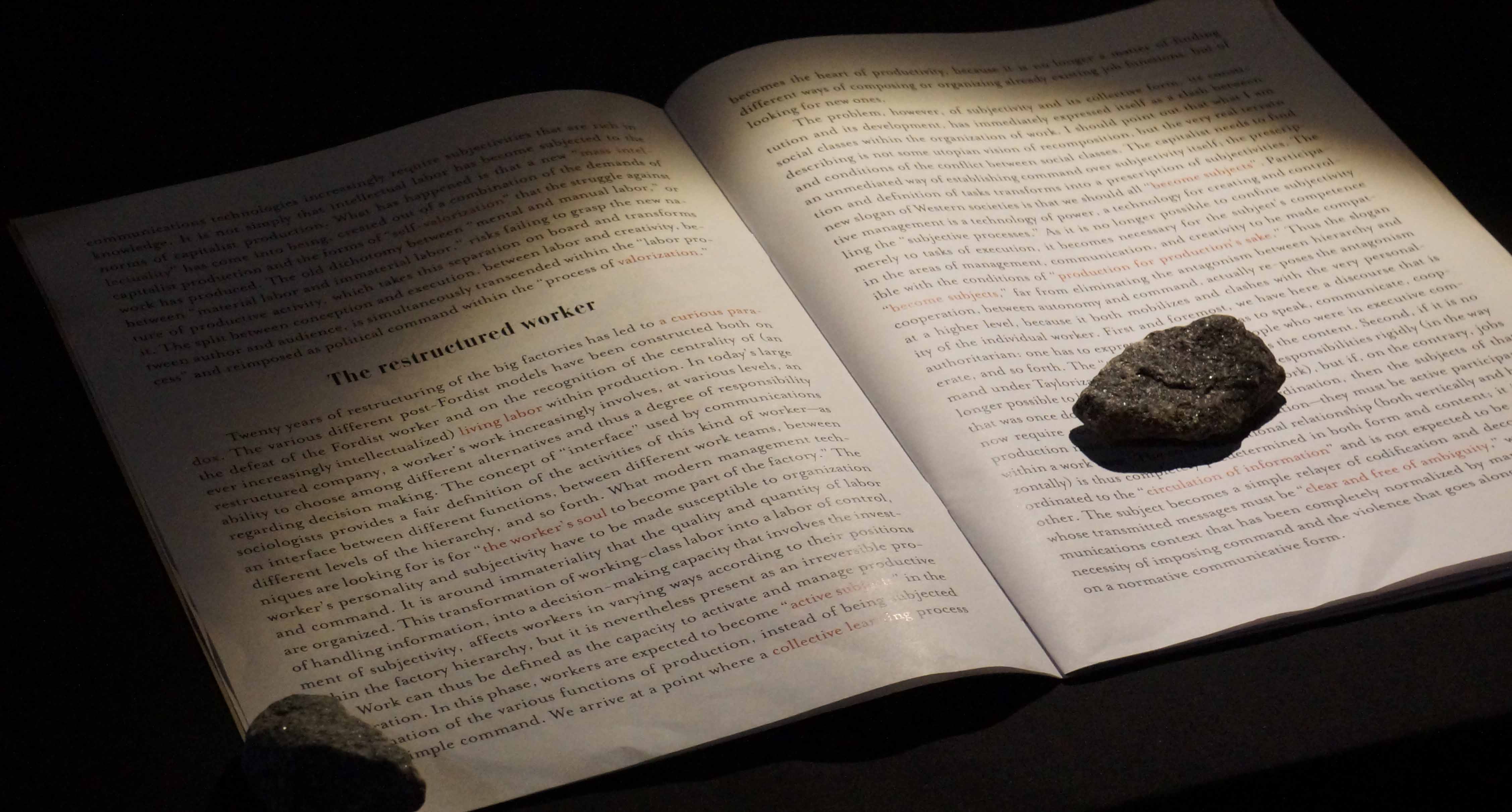
StarTribune columnist Neal St. Anthony recently teased out a few details about our work attitudes. He cited statistics about employee engagement from the National Employee Engagement Study conducted by Modern Survey:
Employee disengagement among U.S. workers rose this spring to a record 32 percent, MacPherson said of the semiannual National Employee Engagement Study. Another 36 percent are “unengaged’’ — or not fully committed on the job.
Meanwhile, the percentage of fully engaged employees fell to 10 percent this spring, down 3 points from last fall. The remaining 22 percent of us working stiffs are “somewhat’’ into our work.
St. Anthony talked with Dan MacPherson, a founding partner with Modern Survey, to get behind the numbers. MacPherson laid blame for disengagement on both employees and bosses—which seems reasonable. And then MacPherson did a good job of filling out the picture of why these things are so. The column is worth reading. And this quote caught my attention:
“It takes three to five years to change an organization,” MacPherson said. “If senior leaders don’t communicate effectively, employees make up their own reality.”
Three to five years to change an organization seems optimistic. And for those bosses still using power poses and monologue to enforce their will—I would argue such communication is near the heart of our problem with disengagement. Maybe we are just beginning to get a sense of exactly how vision for our day-to-day work oils the cogs that keep everything running.
MacPherson is dead right that vision will emerge, one way or another. The question bosses and employers should be asking is “What true thing can I contribute to that vision?” and perhaps, “What do my employees already know about this emerging vision?”
###
Image credit: Kirk Livingston
Power Pose vs. Aggressive Emptying
Sunday Story for Monday: the Counter-intuitive Ways of Sheep among Wolves

The self-made man with his mind-crane.
Can words spoken from a low power position influence others?
This older Harvard Business School article (Power Posing: Fake It Until You Make It) describes how simply snapping your body into a power pose can have a physiologic effect. Read about the small study (N=42) by Cuddy, Carney and Yap here. Striking a pose for two-minutes stimulated higher levels of testosterone (hormone linked to dominance) and lower levels of cortisol (so-called stress hormone) in the study group. People literally felt more powerful and less stressed after their pose.
Every human dreams of more power. More power translates to being respected. Maybe power looks like speaking and being heard as one with authority. And perhaps with more power we’ll become benevolent despots bestowing good unto others as we stride through our own personal kingdoms.
The promise of more power is intimately tied with many of our messages about leadership development. Industries and institutions will always buy more technique about leadership development because, well, who doesn’t want to be perceived as capable and full of power?
In stark contrast, there’s an old story about how Jesus saw the authorities of his day use their power for their own aggrandizement while offering little help to the harassed and helpless crowds. So he organized and commissioned his own set of spiritual paramedics to go to the harassed and helpless.
Just before these spiritual paramedics hit the streets to proclaim and heal and cast out demons and raise the dead, Jesus told them how little personal power they would have. They would not be received well. Despite their hopeful message they would be beaten and tortured, and hauled in front of councils, governors and kings.
And that’s how it played out: powerful messages in powerless packaging.
Was there something in the powerless packaging that actually helped people hear the message? Powerful words and actions delivered by powerless, peripheral people could not be enforced or made into law. There was little outside incentive to listen. And yet what they said and did endures today, these many centuries later.
Tell me again: why is it we all seek power so eagerly?
When Constantine turned Christianity into the law of the land, the message lost much saltiness. Does my lust for power come from wanting to help people or just wanting them to play my game by my rules? Are there any truths I have to deliver today that might be helped by “aggressively empty” versus a pose of power?
###
Image credit: Kirk Livingston
Overheard: “I’ve never felt more effective.”
Every Day We Create Conditions Around Us
My friend had finished his Ed. D but had no luck finding a teaching position. We blamed it on the glut of Ph.Ds and the poor economy and higher education cost-cutting and whatever. And yet as we talked he said this memorable phrase which I’ve rarely heard anyone voice: “I’ve never felt more effective.” In fact, my friend had continued with the same work he had been doing for the past two decades, but something was different. Yes he had expanded responsibilities and slightly-widened authority—but it still was not the final vocational resting place. Or was it?
Walk with me.
 There’s an old, old story about a warrior-king who wanted to build a house for God. But God said, “No—there’s too much blood on your hands.” So the warrior-king laid up stocks of all sorts of precious materials so his son could build this house.
Warrior-king died.
Poet-philosopher-son king took his place and commenced building the house for God. But the Poet-philosopher-king understood no building could house God. The best he could do was to make a place where people could come and seek God. The Poet-philosopher-king understood that despite his power and wealth and position, there was much of life still outside the control of even the most powerful person around.
Back to my newly doctorated friend: though he had not found the permanent faculty position of authority or leadership he wanted (yet), his old work yielded a fresh effectiveness. Why is that and how?
Feeling that you are in a place of effectiveness is a rare and memorable event—at least from my perspective. Much of life is spent wondering if what we do impacts anyone at all, let alone feeling effective at it. Sometimes we see results from our work, but not nearly as often as we might like.
I wonder if the best any of us can do is to work at creating conditions around us that help others walk as they are meant to walk. The Poet-philosopher king created a space where people could cry out to God with their needs. My newly doctorate friend bundled his expanded learning/vision into his old work found new ways to help the students he spent time among.
Maybe seeking out some fabled position of effectiveness is less the answer than finding ourselves effective where we live right now today this moment.
###
Image credit: Kirk Livingston
I Don’t Have To Work. I Get To.
On Seth Godin’s 5000th post
 Seth Godin is a sort of apostle of forward. His posts routinely help me rethink why I do what I do and why I don’t do what I could. He is a spreader of ideas and a harvester of pithy phrases and a stone-by-stone mover of mountains. Today’s post is typical and there is a joyous bit about blogging in the middle that bears repeating:
My biggest surprise? That more people aren’t doing this. Not just every college professor (particularly those in the humanities and business), but everyone hoping to shape opinions or spread ideas. Entrepreneurs. Senior VPs. People who work in non-profits. Frustrated poets and unknown musicians… Don’t do it because it’s your job, do it because you can.
Do it “because you can” is wonderful way to approach any day. It gives fuel for the work and shines light for colleagues. I recently heard our son repeat a phrase that is often voiced around the People’s Republic of Kirkistan: “I don’t have to work, I get to.” His career is taking off and it is great fun to witness.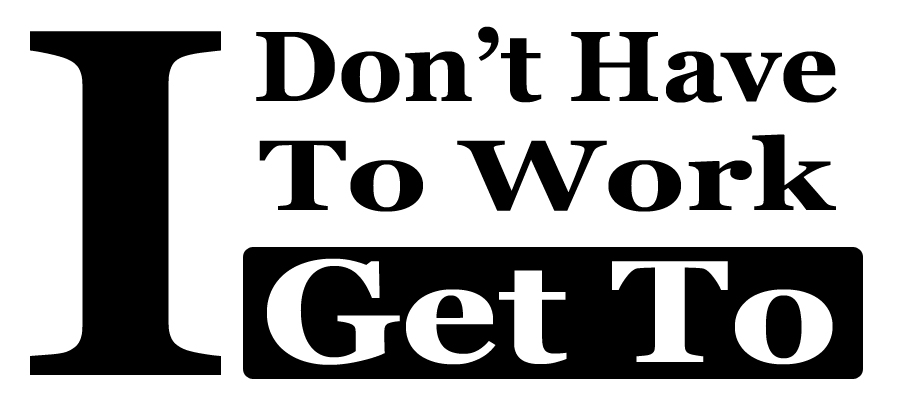
To find joy in your work is no small thing. I consider such joy a gift from God.
###
How to Hack the Bully’s Monologue (Dummy’s Guide to Conversation #16)
Resist the rhetoric of control
Every person has worth. Every person has something meaningful to communicate to us and vice versa.
But sometimes the guy in the corner office just wants to yank your chain. Sometimes your colleague comes in your cube too close and berates you for something that riles only her. And sometimes these work contexts make you question your worth. Today we call this bullying and officially frown on it, though bosses of all stripes let their primordial managers get away with it as long as they post results.
 In the face of the bully’s monologue, we may need to set down our goals of understanding and hearing each other. We may need to pick up tools that will help protect us from the bully. And especially as our culture talks more about innovation, we must recognize that the enemy of innovation is the bully who uses monologue to quell thinking and drive over dissent.
- The hack begins with dropping sycophancy. Just because the VP of marketing is telling you a personal story about his cabin doesn’t mean he isn’t trying to put you in the low place he wants you. There’s no need to continue to play the prop: the underling enamored by all the person in power does.
- Be present. Don’t go to the Bahamas while the bully drives his verbal tank into position.
- Stand. Even if sitting, assume a mentally poised place to challenge.
- Challenge. Is there another way of looking at the perspective the bully shouts? What is the truth here? Speaking fast and loud does not make something true.
- Know two things
- You are a person, too. A person of value.
- That language can be encouraging or damaging. Every communication encounter has a shaping effect on both conversation partners. Don’t let the bully continue unchecked.
- Turn the other cheek. Yes: quite. Back to Jesus the Christ who knew something about handling the bully. He knew the most effective thing long-term was to offer the bully even more. Not in every case, but dealing with the bully from a place of peace and, yes—faith (in God)—may just cut power to the BS generator the bully madly operates. This counter-intuitive step holds much promise for moving forward as a human.
Some reading this may think no modern/post-modern workplace has bullies like this. You could not be more wrong. It is interesting that the tools used to shine a light on the bully’s madness are also effective in ordinary conversations.
How do you handle the bully’s monologues?
###
Image credit: Used with permission from Paul Rivoche via 2headedsnake

 conversation is an engine