Archive for the ‘philosophy of work’ Category
What Do You Need To Move Forward?
Applause? Permission? Donuts?
Twice in the past week I’ve asked myself this question.
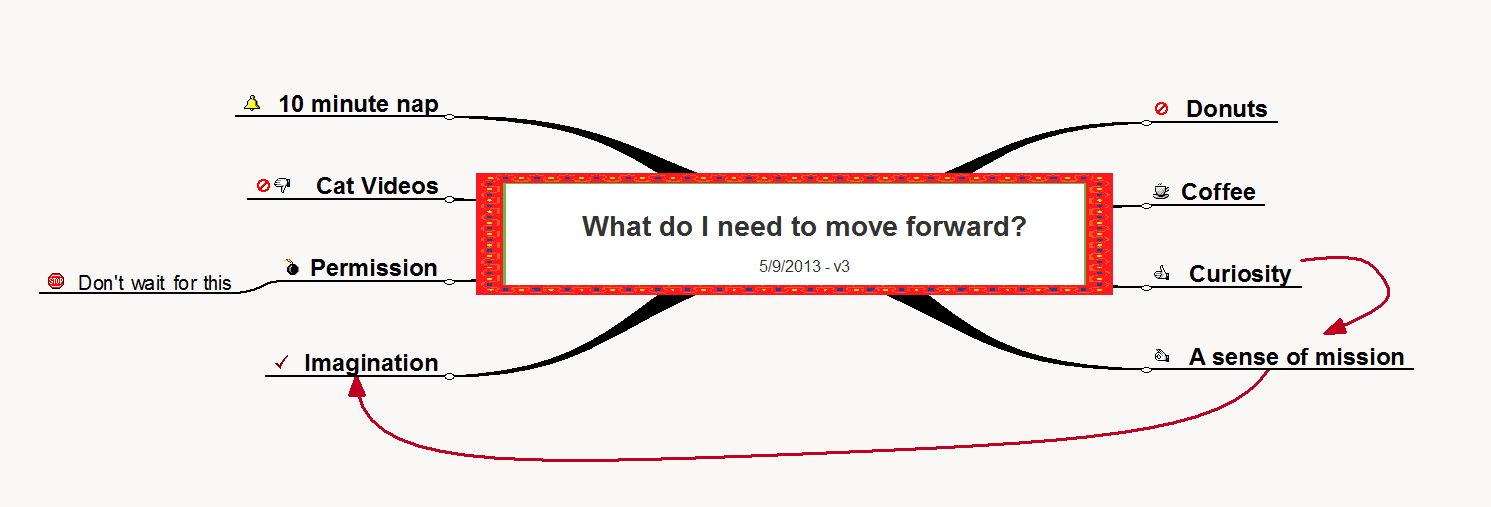 In one case I had just started a large writing project requiring all sorts of information that is not available and will not be available any time soon. My topic is partly in a shipping container in the Pacific, partly in a guy’s head in Scotland, partly in a set of computers in Minnesota and mostly nowhere near complete. But the need is approaching and my content must move on a parallel path with product development. A very specific audience needs very specific information.
In another case the blank page itself kept reminding me of the limitless intrigue of cat videos and TED talks. There’s nothing like a blank page to send you to all the advertising blogs and newspapers you’ve not checked on the web lately.
In both cases a conversation helped me mend the tracks to send the idea and task trundling forward. As I heard myself describing what I was trying to do with the idea and what I needed to complete the task, I realized I have the tools before me right now. There is nothing holding me back.
Waiting for permission to move forward is nearly as fruitless as waiting for someone to applaud your work or tell you what to do.
We move forward and the work has a role in showing us how to do it.
###
Image credit: Laurent Millet via 2headedsnake, kirkistan
Marissa Mayer May Be Right: Show Up (How To Talk Series #1)
You can’t talk if you’re not there.
With your colleague, maybe with your spouse when you left the house. Maybe your sister on the phone, the friend in London using Skype. Nothing happens when you don’t show up.
 Today we continually fine-tune our understanding of showing up: we show up with a tweet, with a blog post, with a telephone call. We show up by email (and sometimes our explanatory emails mark us absent). And then there is actual, physical, atoms and genes-on-the-scene showing up. But even that is not so clear, because despite standing here as you jabber, my mind is seated on the couch reliving that scene from Terminator (was it II?) where the semi-truck-trailer shoots off the bridge to land in the concrete spillway to continue chasing our heroes.
Maybe this is part of the “Why?” behind Marissa Mayer monkeying with the Yahoo! work-from-home policy—to help people be present:
Mayer defended her decision by first acknowledging that “people are more productive when they’re alone,” and then stressed “but they’re more collaborative and innovative when they’re together. Some of the best ideas come from pulling two different ideas together.” The shift in policy affects roughly 200 of Yahoo’s 12,000 employees. (reported by Christopher Tkaczyk, CNN Money)
I hope and believe collaboration and innovation are at least partially behind the Yahoo! change (which is to say, I hope the change is not a retrograde movement toward tighter control of knowledge workers and the corporate monologues they produce). There is some truth in the move: we cannot collaborate without being present. Also true: there are a lot of ways to be present when the collaborator is not physically there just as there are a lot of ways to be absent even while your carcass sits upright at a desk.
So today, choose to show up. Signal your decision with active listening skills. Refuse to be put off by anti-collaborative rants and power plays—say what you need to say to contribute. Refuse the director’s feigned emotion over this or that decision and tell the truth.
Show up today. It feels way better than hiding on the couch and watching your internal TV.
###
The Boss Problem: When Does Your Purpose Become Mine?
Tell Me About It.
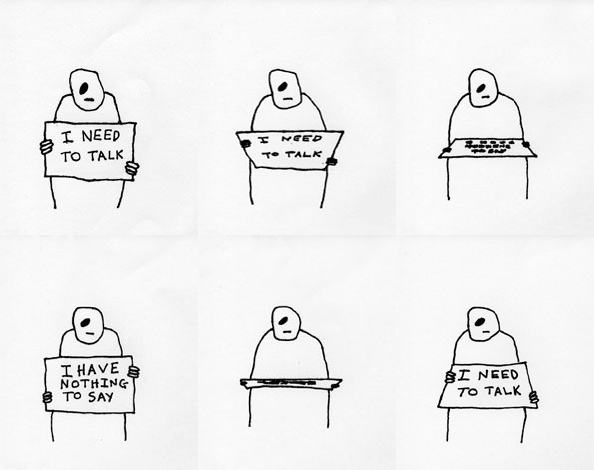 One of my bosses gently chided me for my language: I kept saying “they” in reference to her boss and the leadership structure and the stated purposes of the medical device company we both worked for. She was exactly right: I did not use “we” because I felt separate from the decisions being made and the direction chosen. It was not a conscious choice on my part; I was just reacting to all the pre-conscious activity that happened outside my engagement. My language, which seemed to choose itself, was the telltale.
The boss problem is how to engage employees (or a team) with the problems and purposes at hand.
“What’s the problem?” you might say. “We pay these people so they should do with that boss says.”
That’s true, they should. And they likely will perform at some level, though giving an employee a reason for doing something is a step toward improving performance. Better yet: if the employee feels ownership, that they are personally involved in this task, that they have something at stake, perhaps that condition generates the best performance.
But getting someone to feel ownership for a task is something of an art. There is also an inherent compassion to it: a boss must understand that transferring ownership starts with a shared purpose that sits prior to her command. Sharing ownership begins with the relational approaches in the team long before the purposes and problems come in view. Sharing ownership brings risk for the boss—his reputation is at stake as well. Words by themselves—though always the beginning point—cannot accomplish the transfer if the boss does not believe it. Employees and teammates come equipped with highly-attuned BS indicators and can spot a fake before a word is spoken.
But isn’t sharing ownership the only reasonable solution when fully-grown humans are involved together in a work process?
###
Image credit: thorelimo via 2headedsnake
Work Matters. And Show Beats Tell.
Tom Nelson Vs. Wendell Berry Vs. Your Work Horizon
 Not so long ago I heard Tom Nelson speak about his book Work Matters: Connecting Sunday Worship to Monday Work at a Bethel University event. Reading his book confirmed what I noted after hearing him: that preachers often talk about work from an abstracted viewpoint that collects themes from the Bible for a positivistic spin on what many consider the nasty business of business. I’ve tried to understand this phenomenon and I’ve come to suspect it has to do with the horizon anyone brings to their work: if you work but are really on your way to seminary or some transcendent mission, your horizon is 3-5 years, give or take. But if you work and your work is your life work, you have a different set of questions that are not exactly urgent, but are incredibly important.
Those questions are not easily addressed by a set of principles or a preacherly communication event. It’s not that Nelson’s book is wrong. It presents solid thoughts that are good to remember during one’s workday, though the preachy voice is there, the one that happens when oral delivery lands on a page. This voice puts a light, happy, totally-enjoined and engaged touch on every human encounter—which is not how real-life relationships work. Perhaps that voice more than anything provides makes the topic feel trite. Maybe I tuned out because of that voice.
If you were asking questions about why work matters, you can do no better than to pick up nearly any story or other piece of writing from Wendell Berry. Berry doesn’t just tell why work and faith and life fit together. Berry’s fiction shows people enmeshed in lives of work. Yes: he shows older agrarian communities. But he doesn’t show them in the abstract. He shows people who have a basic dignity—an understood dignity, not given by a preacher or unearthed from long silence. Berry’s characters are often in their work for the long haul, and their work becomes part of their identity. That’s a very long horizon indeed. Through their work they understand that they are doing a thing that brings order to the earth.
In my mind bringing order to chaos is a thing our work can do that is closely related to the stuff God does. Bringing order to chaos is a good way to spend a day.
###
Image credit: Metropolitan Museum of Art via Old Chum
Why I Want To Do What Others Don’t (Shop Talk #6)
Guest Post from Kayla Schwartz

From The conchological illustrations, by George Brettingham Sowerby, London, 1832.
[A few of us have been discussing what fulfillment looks like for a professional writer. The entire discussion was in a response to a question from Kayla Schwartz, a professional writing student at Northwestern College. Check out these six essays filed under Shop Talk: The Collision of Craft, Faith and Service for more on that. Kayla’s back with this guest post that contains a few of her thoughts and conclusions.]
“Technical writing? That’s so…interesting.”
This is the response I usually get when I tell people what I’m studying. As a professional writing major, I’ve done journalism and PR writing, but I’ve been most drawn to technical writing.
Why? I had not given it much thought. Most people think of technical writing as boring or tedious. So why pursue it? What really drives technical writers?
As I’ve thought about these questions and talked to technical and other professional writers who’ve been at it much longer than I, I’ve gleaned a few potential answers.
- It’s useful. Some people find a lot of satisfaction in their ability to help others understand things. They feel they are making a difference.
- It’s necessary. Technical manuals may not always be read by customers, but they are a necessary step in the process of distributing the product. There is satisfaction in contributing to a company’s success.
- It’s interesting. For people who are naturally curious, technical writing offers an ideal situation: learn about new ideas and products, and get paid for writing about them.
- It’s lucrative. Yes, some people are just looking for something that pays the bills.
All of these are valid reasons to do technical writing. However, none of them really expresses my motivation (although the last one is starting to look pretty good when I think about my student loans).
I’m pursuing technical writing because I genuinely enjoy it. I like creating an organized, easy-to-follow document. I like figuring out how to use words effectively and concisely. I’m a bit of a perfectionist and don’t mind spending time on “minor” details. I suppose I enjoy learning about new things or knowing that I’m helping others, but ultimately, it’s a way to do what I love.
Maybe this makes me the exception among technical writers, but I hope not. Technical writing isn’t for everyone, but for those of us who enjoy it, it can be just as satisfying as any other career.
###
Image credit: George Brettingham Sowerby via OBI Scrapbook Blog
Why Work Matters—And Why Few Pastors Can Understand This
Here’s a Dancing Boston Traffic Cop Who Digs His Job
Yesterday at a Bethel University “Work Matters Gathering” I heard Tom Nelson speak on why work matters, which also happens to be the title of his new book (Work Matters: Connecting Sunday Worship to Monday Work). Nelson’s book would seem to invite working people back into the conversation about how faith fits with everyday life. Several things I appreciated about the talk (I’ve not yet read the book, but it is on order) include the theological and historical underpinnings he identified. In particular: the central role of work in the Genesis creation story, the recognition that work is bigger than just getting paid—it has to do with how we contribute to the world, and that at several points in faith history we’ve had a far richer understanding (and praxis) of work than we do here and now in the US of A.
I was also pleased he cited Wendell Berry a good half-dozen times.
There’s much more to say about all that.
But one thing I wonder about: Mr. Nelson discovered that all of the people in his congregation actually spent most of their time at work, not at church. People who work—which is most of us—have known this for forever. People who work and have faith have largely been on their own to sort out how to build meaning into their lives of work and faith.
Pastors are just starting to realize it. I doubt many will realize it in any meaningful way. Here’s why: to equip people for works of service out in the world is to simultaneously detract from building the organization we commonly picture as a successful not-for-profit church. I honestly don’t mean this in a mean-spirited way: it’s just that the religious staff is incented to pull people in, not send them out as thoughtful ambassadors (that is, not just parroting religious words and proselytizing with pat answers but deeply engaged in transformational work).
Personally, I think there is a connection between people who love what they do and the creating/redeeming stuff God wants to accomplish in the world. And I’m starting to think people who love what they do can be far more potent than a year’s worth of sermons delivered to roomfuls of devotees. Not they these are mutually exclusive, though my experience is they typically are.
By the way: is the dancing traffic cop a kind of pastor in his own circular pulpit?
###
Image credit: thebostonglobe
Taking Technical Communication Personally (Shop Talk #5)
Guest Post from Rich Bosshardt
[I invited Rich Bosshardt to respond to the question of what fulfillment looks like for a professional writer. Rich has talked about technical writing in a few of my classes and intrigued us with a note about the psychology of technical writing. He’s writing from the perspective of a working technical writer, and this is his second response.]
People who aren’t familiar with technical communication may be surprised to learn what it really takes to be a good technical writer. Having product knowledge, authoring and illustration skills, some mechanical and/or technical inclination, and a command of (simplified and instructional) language are all necessary. But there is one key ingredient without which one cannot experience ongoing motivation, success, and fulfillment in this field: the personal touch.
There is a psychology to technical writing. Anticipating and appropriately responding to the (rational and irrational) thoughts and behaviors of people is a vital skill in the toolkit of a good technical writer. One might initially think that the technical writer spends hour upon hour in isolation while hunched over a computer monitor in a corporate cubicle farm or a spare bedroom (i. e., the home office). But in reality, a technical writer must keep in mind those who use the product or service (external customers) and regularly interact with those who help create the product (internal customers).
My external customers are the end users who purchase, assemble, operate, maintain, and store the products about which I write. My internal customers are team members, including subject matter experts, who are typically engineers and designers; and reviewers, who represent the engineering, customer service, legal, safety, test, and marketing departments.
External Customers
As an advocate for my external customer, I try to keep these two primary questions in mind as I go about my work: (1) How will the reader use (or misuse) the product about which I am writing? (2) How will the reader interact with the instructions and illustrations that I create?
But there are more questions that help put me in the position of my readers: What educational background and reading ability do my readers have? Are they mechanical? Do they have the proper tools to perform the procedure? When do they do the work themselves and when do they call a dealer for help?
To answer these questions, we rely in part on user testing and feedback from our end users. In user testing, we have had fellow employees from other departments who are unfamiliar with a product perform procedures by following a set of instructions that I prepared. The results of those tests have led to new insights as to how one might approach and engage the product, which enables me to write a more effective set of instructions. But busy schedules and workloads often prohibit us from conducting more than an occasional user test. Feedback from real end users is valuable, but it is rare as well.
Internal Customers
Though the technical writer is an advocate for the end user, the final product serves many more masters than merely the end user. The publication that results is a compromise of multiple interests. The subject matter expert wants to showcase the product features or have the writer insert an instruction to cover for a minor design flaw that is otherwise too costly to change; the market manager wants to sell the reader accessories for the product; the legal and safety representatives want to protect the company from liability by inserting page after page of safety admonitions; and the customer care representative wants a rewritten procedure because his or her department has received more than the usual number of customer complaints.
Being the writer but not the owner of the publication, how do I then chart a course for completing the project through the cacophony of the differing requirements of my external customers? And how do I produce an intelligible and helpful work that ultimately meets the needs of my internal customers?
Satisfaction by Means of Service
Serving my internal and external customers well brings satisfaction, and serving both types of customers simultaneously requires that I keep both my goal and the manner in which I achieve that goal in mind. The goal of my work requires that I continually keep my external customers in mind; it guides me in what I should be doing in my work: to serve valued end users by helping them understand the product and have a safe and positive experience whenever they interact with it. The manner by which I achieve that goal requires that I continually keep my internal customers in mind; it guides me in how I should be doing my work: to serve and show respect to valued team members who create the product (the subject of my writing). It may include serving and showing respect to those who may neither respect me nor my profession.
I serve my external customers best by making their needs the goal of my work; I serve my internal customers best by addressing their needs in the manner in which I work to achieve my goal. How I perform my work, no matter what it is, makes all the difference. It is when I serve in the spirit of Christ, the Servant of Servants, that I find satisfaction in my work, whatever and wherever that may be.
###
College Majors to Avoid + Rebuttal
And back to the work itself
 Good design often has this effect on me: it makes me want to find and do the work I am meant to find and do. Moving quickly through the many architecture or art or photography blogs out there also reminds me of what vision looks like when carried out. Vision alters our perceptions of the physical world and sometimes alters the physical world itself. And that is no small thing.
Yesterday I found myself in disagreement with the Burnt-Out Adjunct (whose too-infrequent posts I eagerly await and enjoy) who wrote that liberal arts studies should be more corollary than central to a college degree. Pisspoorprof was reflecting on another of these “ten worst” articles that pop up from time to time. This time it was Yahoo! Education touting the Four Foolish Majors to Avoid if you are trying to reboot your career.
Liberal arts degrees were the #1 opportunity killer with philosophy a close #2 opportunity killer. By the way, I cannot help but note that the entire article is an advertisement for the continuing services of Yahoo! Education.
As a holder of an undergrad degree in philosophy I both agree and disagree.
- Yes: no one hires a college grad to resolve deep-seated teleology questions (one does that on one’s own time). But to his credit, the VP at Honeywell who gave the OK to hire me (lo these many years ago) did question my stance on freedom vs. determinism.
- No: How about granting a bit of perspective? We need people who can think outside the present job parameters. And we desperately need people to challenge those parameters. Educating people to acquiesce by default is not what we need (though it is a short-term path to cash). Liberal Arts (and especially philosophy, let me say) can help this happen. Yes that sounds like the standard line from any college admissions staff says. Yes it is what professors say as they pass each other in the hallowed halls. No you don’t need a college degree to challenge the system, make a million bucks, make a difference or be homeless.
But studying things that don’t make money has a way of making us more conscious of all that is going on around us. Will it eventually make money? Maybe. Maybe not. But we need people with larger vision who can paint or write or photograph or build a different way of looking at things—however that happens.
What do you think?
###
Image credit: Studio Lindfors via 2headedsnake
Bottledworder: Writing in spite of the daily (Shop Talk 3.1)
Words Create Something In the World
 May I steer you toward a blogger I’ve recently discovered? This generous writer visited a number of obscure blogs (including Conversation is an Engine) and commented. Many of us followed back to her blog (lesson learned on growing an audience).
Bottledworder wrote Writing in spite of the daily on January 20. It’s a post that points out the concentration and isolation needed for creative writing. She also writes of how much a privilege writing is—with which I agree. Down in the meat of her essay she disparages making a living through “useful” writing:
“useful” varieties of writing where writing is the medium to achieve something else, not the end-goal.
I use “disparage” lightly and with affection, because it is clear writers of all sorts are heroes in Bottledworder’s world—and I could not agree more. Still, her comment hits at this notion I’ve been thinking and writing about: does writing/creative fulfillment come only from digging down in the isolated depths of one’s own psyche?
 That still seems to me only part of the story.
And for proof I continue to point to the exercises in creativity my writing has contributed to with companies and agencies, in places where we’ve joined as a team. Maybe those team/financed experiences don’t exactly duplicate the joy of writing something pulled from the depths of my soul (and that is a primary joy of writing, no question), but a true phrase that helps a company move forward is also a beautiful thing. Plus, it helps create something real in the world.
Again—there’s so much more to say about this. Here are a few early related posts:
- The Tradeoffs in Selling Your Craft (Shop Talk #1)
- Writing with Sheet Metal (Shop Talk #2)
- Is Your Job Fulfilling? (Shop Talk #3)
###
Image credit: bottledworder, confuse-a-cat via 2headedsnake
Mind Your Obits
This Week’s Hero: Wallace Allen (1919-2012)
The things you learn from obituaries:
Mr. Wallace Allen had been a long-lasting editor at the StarTribune (three decades) and passed away in December. During his tenure he led the way to “make the paper more accessible to readers.” He seemed to have a focus on words and design, and employed both in his passionate understanding of what a newspaper could accomplish in our culture. At 93, he continued to read the New York Times and the StarTribune daily.
Two bits from Tuesday’s Obituary stand out:
- Though he suffered various ailments, he had been able to get around with a walker. On that walker he had this bumper sticker: “Free press. Free speech. Free country.”
- And even after decades of editing he continued to edit and write in retirement. Notably, in one of his last assignments editing a newsletter at his assisted living home in Honolulu, he urged his volunteer staff to “to investigate actions by the home’s management.”
So—a commitment to finding and telling truth all the way through.
That is remarkable.
###

 conversation is an engine