Archive for the ‘social media marketing’ Category
Kristina Halvorson & The Discipline of Making Stuff Up
Content Strategy and Brain Traffic
Someone asked a perfectly reasonable question:
What is content?
Our Social Media Marketing class is composed of collegiates with a passion for writing and communicating. Whether from the Journalism/Communication school or from the English department, we’ve come together around this notion of producing content in pursuit of a vision.
So we write.
While “content” seems a rude way to talk about the deep thinking that goes into a paper on, say, the merits of determinism, it’s a term that works pretty well for less lofty/more human conversation. The kinds of conversation suited to inviting in semi-interested onlookers.
Content is the stuff we use to describe our vision for…whatever. If we’re building a coalition to alleviate homelessness, the content we produce will point to the problem, tell stories about real people, show the inadequacy of current solutions and keep offering attitudes that illustrate the need and humanity of the man on the corner with the sign. If we work for a company that makes implantable deep brain stimulators, our content will highlight the current science behind Parkinson’s disease, show current (inadequate) ways of dealing with the disease, harp on the benefits of such stimulation without hiding the downsides.
Kristina Halvorson, founder and CEO of Brain Traffic and co-author of Content Strategy for the Web will join us today (provided she can plow through 4-6 inches of new snow) to talk about the disciplines involved with making stuff up. Because that’s what content is: making stuff up. For a purpose. Making stuff up in accordance with a discipline, toward a specific end, to meet a particular business or social objective. That’s why content and writing go so well together: there’s nothing a writer likes more than stepping into a big idea and exploring the main streets, side streets and alleys and foot paths with words and images and video. Sometimes we have a map to start with. Sometimes we make up the map as we go.
Mostly we do both.
###
Image credits: Brain Traffic
Hey: Where did that voice come from?
Don’t be stung by inauthenticity
Some in my class are English majors and don’t mind wading into the waters of how words work. So when Content Rules (Handley and Chapman) talked about voice, a close reading ensued. Handley and Chapman lobby for authenticity in voice: voice is your own way of corralling point of view and word choice and rhythm (meter?) and pressing it all into service. Voice is making language work to express your words in your way. Voice is what you sound like when you talk (and we’re aiming for conversational writing in this class, so writing and talking sort of blend).
But voice is also something that gets companies and organizations all hepped up. To give your brand a personality by adopting a particular point of view (which leads to word choices/meter and etc.) is what companies and organizations seek these days. Voice helps a brand stand out from the crowd.
And one must stand out.
But this:
How can you write with an authentic voice when you are adopting the voice of the brand?
Good question, English-major-friend. Two answers come to mind:
- Sometimes we use voice in the service of some larger purpose. So we might submit our voice to the larger brand purposes and adopt as best we can the machinations of the brand voice. Some people may naturally embody a brand voice. The rest of us have to work at it. This adding and adopting is part of serving the larger goal you believe in (at best. At worst: you adopt voice to make coin for rent). This is the collision of craft, faith and service.
- If you find yourself stinging with inauthenticity as you write for your brand—look for a different job.
I’ve maintained all along that when people add their voice to a project, new things happen. Sometimes a new voice provides new electricity and a new approach to a time-worn topic. Even old-timers can learn stuff from new voices.
Of course, people must voice up.
If you don’t say what you’re thinking, the new thing just around the corner will sit there in silence—just around the corner.
###
Image credit: red-lipstick via 2headedsnake
Do The Dumb Things I Gotta Do (They Might Be Giants)
Memo to Myself: I cannot control what others think
Tell me again: why did we think we could?
Maybe you are a fan of They Might Be Giants (TMBG). Maybe you are not. I’ve just stumbled onto a wiki that attempts to decode the (typically) obscure lyrics of the two Johns.
Songs by TMBG should never substitute as sacred texts but, “Put your hand inside the Puppet Head” has something to say to those would begin to organize a community. That’s the task we’re starting this week in our social media marketing class and I’m trying to help us understand the old command and control ways of marketing have fallen by the wayside. By the way, it’s those old command and control notions that led to the monologues that made us think whatever we said was also what people heard. That has actually never been true—people will always hear my words in the context of their lives, which means mostly hearing what they want to hear.
In short, there is no puppet head. In this social media world there are transparent people who write from passion and experience. People who build communities because they want to. People who invite others in—but never force others in (a phrase that is almost nonsense today). What we can do is to assemble a clear picture of the people we want to join our party. And we can have an image of how these people interact, where they show up on the web, how active or inactive they might be in their webby habits. And from that we can begin to sort how our social media contributions might serve them and pull them toward this community we want to build. That’s the task today: Who are these people and what do they need?
By the way, there certainly are social media puppets out there: people without transparency who bark out some corporate message or ideological pap. But the blogosphere is not kind to them, because nobody out here likes being the victim of a drive-by monologue.
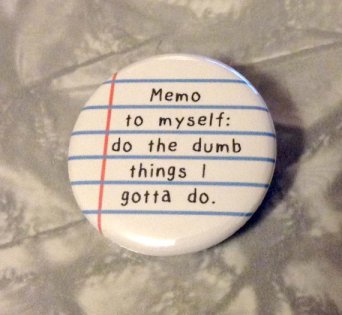 Transparency gets heard and gets a toe-hold in people’s psyches. We’re shooting for transparency and the credibility it builds.
###
Image credits: TMBG via Vimeo, Button via UnrehearsedKickline
Social Media: Not Hard. Not Easy.
Write What You Will
I’m struck by the opportunity social media presents to writers.
One of the stories I tell in my Social Media Marketing class is about the demise of The Morning Show on Minnesota Public Radio. For years I listened to Dale Connelly and Jim Ed Poole spin out their eclectic music selections and oddball humor. So did a lot of people.
Jim Ed Poole retired (and then, sadly, passed away) and then The Morning Show went away as well. Dale Connelly began a new show in a similar vein—Radio Heartland—with a blog as co-host. The blog served as that necessary conversation partner—certainly never replacing Jim Ed Poole—but keeping Dale engaged with listeners. Then, as is the way of progress and regress and corporate decisions, Dale Connelly was out of the job. Radio Heartland continued with the same eclectic music but without the oddball humor. I continue to enjoy the music of Radio Heartland.
And, no surprise, the faithful audience for The Morning Show followed Dale Connelly to his Trail Baboon blog. No music, just oddball humor. Now Dale is the news director at KFAI Community Radio in Minneapolis even as he continues to write for his still-growing audience.
I tell this story because it illustrates an opportunity about starting as a writer today. Since there are no gatekeepers on the Internet, a writer can write what a writer wants to write. A writer can take pages and pages to sort through whatever it is she or he has to say.
True: no one may show up to read it. The writing may feel like shouting into the wind, but the point is to keep going in an effort to sort what it is you have to say as a writer. Audiences form. Eventually—at least that is the hope.
But for writers just starting, social media presents an opportunity to hone a message and then tinker with the best way to present it. This process of sorting and honing and tinkering develops a set of valuable skills that are absolutely transferable to the world of commerce (and far beyond, into our creative lives). I will argue that this sorting and honing and tinkering with our messages is the lifeblood of any writer.
My students already understand this. They’ve all begun this process without any prodding from me. But we’ll push a bit on the sorting and honing and tinkering in the next few weeks.
Especially the tinkering.
###
Image credit: respectezcesingeot via 2headedsnake

 conversation is an engine