Archive for the ‘Teaching writing’ Category
Tip #9: Launch Your Idea. Don’t Detail It.
We all repackage our stories for the best effect
Writing copy can be disorienting—especially for English majors. Rather than grading on how they develop an argument and how well they follow particular usage rules, they are graded on how well their copy meets a marketing need. They are graded on how well their creativity pulls in the target audience—and how quickly. Each exercise and assignment becomes more about the big idea and the execution of the idea rather telling all the detail in an orderly fashion.
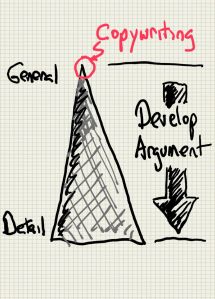 It can be disorienting because we might have mistakenly thought copy was just emotional marketing hype, the (nearly invisible) stuff that abides in much of our current messaging (“clutter,” you might say). Copywriters just toss any word in an ad, like “new” or “organic” or “protein” to get people to buy in, right?
But copywriting is more like a lab where you boil down the raw material to get an essence. Then you adjust the pheromones in that essence to get the behavior you want in the audience you seek.
Wait—that sounds manipulative.
If it is, it is a common trait and practice shared by all humans. We’re all packaging and repackaging our stories in real time. We constantly change-up our experience and knowledge and opinions as we deliver them to friends and family, prospective mates, acquaintances and strangers. It’s not a purposeful misleading, it’s just that the human condition is constantly changing and we see things differently at any given point. And we all want to be heard, so we change how we say things.
Mind you—orderly telling is still critical for copywriting. But audiences don’t make time for essays (sadly). And developing an argument is still critically important—it’s all just very, very fast.
The key is getting—and holding—attention.
Eight other copywriting tips for English majors here.
###
Image credit: Dumb sketch by Kirk Livingston
Copywriting is a Full-Contact Sport
James Young: a Technique for Producing Ideas
Today we discuss Mr. Young’s book on how to have ideas. It’s an old book and disregarded by some of my copywriter/art director friends. But I come back to it again and again. I like how Mr. Young serves up the notion of a way to go deeper than our immediate surface reaction. I like the book because he provides signposts and mile-markers along the road of getting to the heart of a notion.

Now that’s good copy.
To me, copywriting is a full-contact sport. Here’s what I mean: ideas do not come from sitting in a dark room and thinking deep thoughts. That is called a “nap.” Ideas come from a mind-body connection. Copywriting starts with gathering materials (Young’s Step #1) and then writing out the connections between those materials and the target audience’s problem or perceived need (Young’s Step #2—Masticate). This mastication or digestion step involves pages of false starts and headlines and mind-maps. It involves shuffling index cards and drawing with crayons on the walls/arms/shoes and many dumb sketches. It involves telling others your nascent point and watching their reaction (“What the…. Huh? Get away from me.”)
I particularly love Young’s Step #3—Walk Away. It’s when I go for a bike ride or a jog or a walk. Or lunch. Anything other than the problem at hand. And then—Behold—the solution pops into being. Fully-formed. Sorta. Sometimes it’s an ugly baby and needs, shall we say, a trim. But out of this process come useful ideas that get to the heart of the matter and may—just possibly—cut through clutter rather than add to it.
Check out Maria Popova’s take on Young’s technique here.
###
Image via Copyranter
What is Your Purpose with Your People?
Can You Articulate Your “Why?” and “What for?”
I’ve been gushing over Improv Wisdom lately, this 2005 book by Patricia Ryan Madson. I’m thinking of buying a number of copies to give away and wondering how I can incorporate it as a supplemental text in my next classes. The book is easy to read, memorable and full of actionable wisdom all directed at staying in the moment and building something with others. Ms. Madson—a drama professor at Stanford, improv maniac, eager collaborator and kind-hearted encourager—brings a lot of life to how we can work with others. Now I find myself ordering the primary source texts cited by Ms. Madson.
Ms. Madson has been kind enough to respond to my tweeted epiphanies when reading her book. I am impressed by the longevity and timeliness of certain ideas. Ms. Madson’s 2005 book will likely be relevant for a long, long time.
As I finish with my Social Media Marketing class, I’m reading reflections from the students. One near universal regret was not having a clearer sense of their purposes for the communities they were trying to create. We spent focused time on this early on in the class, but forming a crystal clear picture of what we want to accomplish with others is neither easily understood nor often practiced. I know this from the number of companies I’ve been in that operated every day without a clear sense of what they were trying to do with their audiences.
Students resist the tightly-formed purpose and the close definition of their audience because it feels so restrictive. It just feels easier to write anything for everyone. At least that’s how the class always starts. But at the end of the class, there are multiple confessions about how the tight purpose and close definition actually freed them to say much, much more to their target audience. This experience fits with a bit of improv wisdom Ms. Madson offered:
Rather than asking “What do I feel like doing?” when a free moment arises, instead ask “What is my purpose?”
I love this question for my class and I love this question personally. The question presupposes I have a purpose and assumes I know that purpose. The question assumes I am conversant with my purpose and assumes I am in the habit of articulating it to myself and others.
All these presuppositions and assumptions are worth pursuing. Going back to our purpose again and again sounds like bearing fruit over a lifetime.
And this: Patricia Ryan Madson should write more books.
###
Image credit: imgur
Groundswell: Your Moment Has Passed.
So 2008.
I’m done with Groundswell.
Oh, I like the book. A lot. And the argument for an empowered people (via social technologies) continues to make excellent sense. Li and Bernoff did a great service by gathering facts and stories into a rational retelling of where we are today with hearing and connecting en masse.
When I first read Groundswell, emotive moments of recognition flickered constantly. Li and Bernoff led the way in helping me understand this unfolding opportunity lodged in my computer. But those moments are not just in my computer any more. They are on my phone, in my pocket and before my eyes as I walk.
It’s the ubiquity of the opportunity that makes everything look different.
Students in my class assume forums for support will be available, they turn to product and service reviews first—why wouldn’t they? Reviews from peers have always been available. These self-proclaimed 90s kids (I guess that’s a thing) interact in most of the ways that Li and Bernoff predicted. So there are few emotive flickers from them even as I shout “Yes!” (possibly to their “Huh?” and amusement). And these students demonstrate a familiarity with technology far advanced from students even two years ago.
So…wheels turn and time goes on and books fade to triviality. I’ll suppose I’ll check out Empowered next time I teach this class. The last thing anybody needs is another old guy in their life telling how things used to be.
And this: the Groundswell moment just passed has opened on a much wider vista that seems to invite collaboration like never before. To not listen to each other is starting to feel like a cardinal sin. Not because it dishonors the human condition (which it does) but because the opportunities in working together are beginning to look massive.
###
Kristina Halvorson & The Discipline of Making Stuff Up
Content Strategy and Brain Traffic
Someone asked a perfectly reasonable question:
What is content?
Our Social Media Marketing class is composed of collegiates with a passion for writing and communicating. Whether from the Journalism/Communication school or from the English department, we’ve come together around this notion of producing content in pursuit of a vision.
So we write.
While “content” seems a rude way to talk about the deep thinking that goes into a paper on, say, the merits of determinism, it’s a term that works pretty well for less lofty/more human conversation. The kinds of conversation suited to inviting in semi-interested onlookers.
Content is the stuff we use to describe our vision for…whatever. If we’re building a coalition to alleviate homelessness, the content we produce will point to the problem, tell stories about real people, show the inadequacy of current solutions and keep offering attitudes that illustrate the need and humanity of the man on the corner with the sign. If we work for a company that makes implantable deep brain stimulators, our content will highlight the current science behind Parkinson’s disease, show current (inadequate) ways of dealing with the disease, harp on the benefits of such stimulation without hiding the downsides.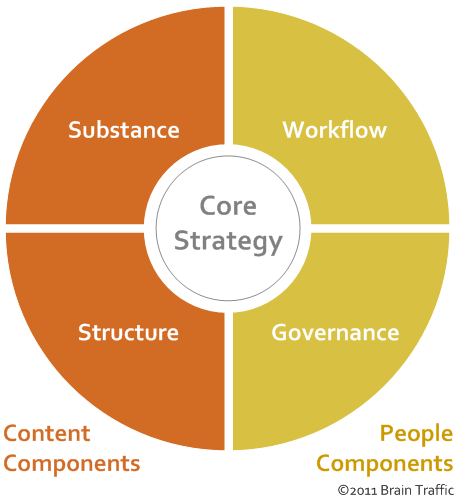
Kristina Halvorson, founder and CEO of Brain Traffic and co-author of Content Strategy for the Web will join us today (provided she can plow through 4-6 inches of new snow) to talk about the disciplines involved with making stuff up. Because that’s what content is: making stuff up. For a purpose. Making stuff up in accordance with a discipline, toward a specific end, to meet a particular business or social objective. That’s why content and writing go so well together: there’s nothing a writer likes more than stepping into a big idea and exploring the main streets, side streets and alleys and foot paths with words and images and video. Sometimes we have a map to start with. Sometimes we make up the map as we go.
Mostly we do both.
###
Image credits: Brain Traffic
Do The Dumb Things I Gotta Do (They Might Be Giants)
Memo to Myself: I cannot control what others think
Tell me again: why did we think we could?
Maybe you are a fan of They Might Be Giants (TMBG). Maybe you are not. I’ve just stumbled onto a wiki that attempts to decode the (typically) obscure lyrics of the two Johns.
Songs by TMBG should never substitute as sacred texts but, “Put your hand inside the Puppet Head” has something to say to those would begin to organize a community. That’s the task we’re starting this week in our social media marketing class and I’m trying to help us understand the old command and control ways of marketing have fallen by the wayside. By the way, it’s those old command and control notions that led to the monologues that made us think whatever we said was also what people heard. That has actually never been true—people will always hear my words in the context of their lives, which means mostly hearing what they want to hear.
In short, there is no puppet head. In this social media world there are transparent people who write from passion and experience. People who build communities because they want to. People who invite others in—but never force others in (a phrase that is almost nonsense today). What we can do is to assemble a clear picture of the people we want to join our party. And we can have an image of how these people interact, where they show up on the web, how active or inactive they might be in their webby habits. And from that we can begin to sort how our social media contributions might serve them and pull them toward this community we want to build. That’s the task today: Who are these people and what do they need?
By the way, there certainly are social media puppets out there: people without transparency who bark out some corporate message or ideological pap. But the blogosphere is not kind to them, because nobody out here likes being the victim of a drive-by monologue.
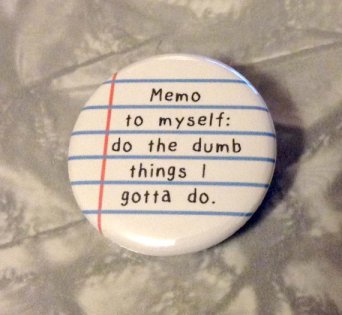 Transparency gets heard and gets a toe-hold in people’s psyches. We’re shooting for transparency and the credibility it builds.
###
Image credits: TMBG via Vimeo, Button via UnrehearsedKickline
Social Media: Not Hard. Not Easy.
Write What You Will
I’m struck by the opportunity social media presents to writers.
One of the stories I tell in my Social Media Marketing class is about the demise of The Morning Show on Minnesota Public Radio. For years I listened to Dale Connelly and Jim Ed Poole spin out their eclectic music selections and oddball humor. So did a lot of people.
Jim Ed Poole retired (and then, sadly, passed away) and then The Morning Show went away as well. Dale Connelly began a new show in a similar vein—Radio Heartland—with a blog as co-host. The blog served as that necessary conversation partner—certainly never replacing Jim Ed Poole—but keeping Dale engaged with listeners. Then, as is the way of progress and regress and corporate decisions, Dale Connelly was out of the job. Radio Heartland continued with the same eclectic music but without the oddball humor. I continue to enjoy the music of Radio Heartland.
And, no surprise, the faithful audience for The Morning Show followed Dale Connelly to his Trail Baboon blog. No music, just oddball humor. Now Dale is the news director at KFAI Community Radio in Minneapolis even as he continues to write for his still-growing audience.
I tell this story because it illustrates an opportunity about starting as a writer today. Since there are no gatekeepers on the Internet, a writer can write what a writer wants to write. A writer can take pages and pages to sort through whatever it is she or he has to say.
True: no one may show up to read it. The writing may feel like shouting into the wind, but the point is to keep going in an effort to sort what it is you have to say as a writer. Audiences form. Eventually—at least that is the hope.
But for writers just starting, social media presents an opportunity to hone a message and then tinker with the best way to present it. This process of sorting and honing and tinkering develops a set of valuable skills that are absolutely transferable to the world of commerce (and far beyond, into our creative lives). I will argue that this sorting and honing and tinkering with our messages is the lifeblood of any writer.
My students already understand this. They’ve all begun this process without any prodding from me. But we’ll push a bit on the sorting and honing and tinkering in the next few weeks.
Especially the tinkering.
###
Image credit: respectezcesingeot via 2headedsnake
Ahh: Back To Work
ListenTalk: The Promise. The Mission. The Chapters.
Dear Reader: A word, please.
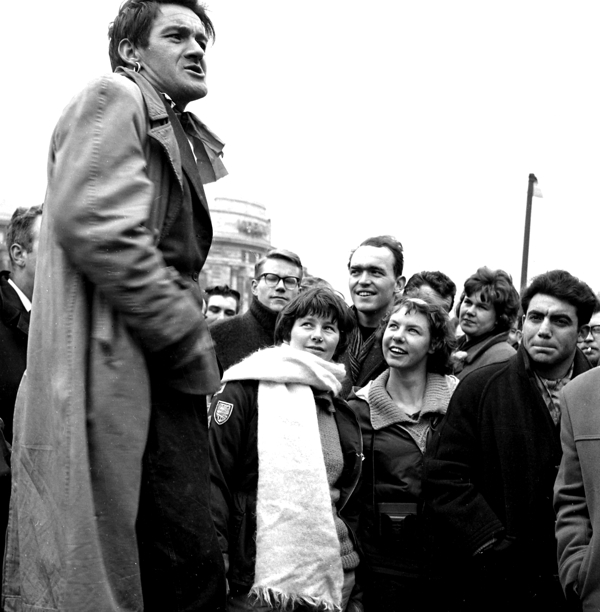
Speakers’ Corner, London, mid-1960s
Over the next few months I’ll be writing in response to a couple classes I’m teaching at the University of Northwestern—St. Paul. That means I’ll be dealing with questions and ideas that pop up in class. The classes tend to be quite collaborative and the students have interesting contributions that I may work out in this forum.
I’m also trying to work out how the notion of ListenTalk applies to the different audiences I work with as a copywriter. ListenTalk: Conversation is an Engine is built on a theological basis and is first a meditation on a new (or—I maintain—a very old) way of looking at how we spend time with each other. Over the course of the year I hope to enlarge the argument to help workers talk with bosses (for instance) and vice versa. I’d like to enlarge the argument so conservatives and liberals can put down their label (and libel) machines to engage in productive talk. I hope to work out the notion of commercial conversation so companies can begin to talk with customers in a way that treats people as rational collaborators versus emotive flesh-encased ATMs.
But first, and to bring a bit more focus on this initial argument, I present the promise and mission of ListenTalk, as well as the chapter synopses:
ListenTalk Promise:
Read ListenTalk and you will be stimulated to reconsider how even your smallest, most ordinary conversations are part of a much larger story.
ListenTalk Mission:
ListenTalk was designed to help individuals in faith communities see how God works through the most ordinary and common conversations—and to see how those conversations transform everything from personal calendars to cultural mandates.
ListenTalk Chapter Synopses:
- The Preacher, Farmer and Everybody Else. What do you expect from a conversation? Preachers preach and hope for the best. But farmers work the soil in a studied way that collaborates for growth. Meet five thinkers who have studied the ways and means and opportunities hidden under the surface of ordinary conversations. These five show that ordinary conversation is full of collaborative potential and regularly turns into some of the most important, creative and lasting work we can do together.
- Intent Changes How We Act Together. If we enter a conversation itching for a fight, that’s just what we’ll find. But we can change our intent. And one thinker shows a better way to engage in persuasion, while the apostle Paul shows God’s intent to pull us toward Him without a fight.
- How To Be with a God Bent on Reunion. The first thing to know is that conversation with God is not limited to a lifetime. Second: talking with God over a lifetime tends to change a person. Third: what does it look like to befriend, follow and serve a God whose full energy is spent on connecting with people?
- Your Church as a Conversation Factory. Peter found a way to incorporate God’s old words into a very new situation. Conversations among believers do the same, person to person, with world-changing results. How conversations emerging from within a church change everything outside the church.
- Extreme Listening. Extreme listening opens us to live in a larger story: Just ask Hannah. Five misconceptions about listening. Become an extreme listener by adopting three attitudes, four motivations and three strategies.
- A Guide to Honest Talk. How to walk your talk in three steps: 1. Show up. 2. Know this about people. 3. Join in and move out.
- Prayer Changes Our Listening and Talking. What really happens when we engage in conversation with God? Conversation with God as our model for talking with each other.
- Go ListenTalk. We are most alive when helping others see the true thing inside us. Marching orders and opportunities.
###
Image credit: Moyra Peralta via Spitalfields Life
Groundswell Plus: Please Write a Plus-Sized Book about Today’s Social Media Opportunities
Beyond Li & Bernoff’s Groundswell
Groundswell was published by Charlene Li and Josh Bernoff in 2008 (Boston: Harvard Business School Publishing). I’ve used it a couple times to frame this new opportunity and give social media marketing students a sense of the possibilities of communication beyond liking a snarky comment, link or photo on Facebook. I’ll use the text again but I’m also prowling about for newer texts.
Groundswell is a grandfatherly text by today’s standards. Published (counting fingers: 9-10-11-12) more than five years ago and much has changed. I like the book for the authors’ optimism about building and maintaining communities. And that is precisely where it is starting to wear thin. It turns out building communities is a much more complicated endeavor that works best when flesh and blood people talk with flesh and blood people. The social media piece is a nice and useful add-on, but students need to see a larger picture.
I’ve got other texts that give details about best practices and content strategy. We’ll certainly discuss the disciplines of editorial calendars and fine-tuning their understanding of their audience and tightly defining what their audiences need/want. And, as always, we’ll write and share and write and share and learn what works for ourselves.
Groundswell is firmly focused on taking full advantage of business opportunities. That’s why I first started reading it and it may be why I end up with something else next time. My students tend to be a devoted bunch: they attend this Christian college and their writing (most are English students with a professional writing focus, plus a few journalism and business majors) bubbles up from deep theological streams. Many will say they have no interest in business right up to the point where they realize they actually have to pay off their school loans. That realization attenuates their post-college work vision. One my teaching goals is to help students start to see just how much those deep theological streams can pour through the world of work with all sorts of happy results (an income comes to mind, but also making a difference in real life).
What I’d really like is a Groundswell Plus. I’d like a version of Groundswell that paints a larger picture of the community-building opportunities. Perhaps Groundswell Plus tells stories from the Arab Spring (for instance) or Ai Weiwei and points readers toward organizing for social change. Maybe this plus-sized version of Groundswell could point readers toward unearthing social problems (along with business opportunities) that might respond to collaborative energies.
Because in the end, students want to give themselves to things that matter.
Just like the rest of us.
###

 conversation is an engine