Archive for the ‘texts’ Category
When Twitter Visited Third Baptist Church
What Church can learn from Business #1: Acknowledge the Pain
Scene from a Sunday Service
Pastor Smith: We’ve jumped into the 21st century today with our projector up there tuned to the Twitter Channel! Today: don’t silence your smartphones. And you Twitterites, dial in your Twitter smart app and shoot your questions, comments and tweets to At ThirdBaptistRightNow. And remember to use the hash ticket number sign SubmitAndLove!

Acknowledge questions to unlock the door you’ve invited your audience to walk through
Pastor Smith: Open up your Bibles to Ephesians 5 and let’s get right down to the text and how wives need to submit to their husbands and husbands should love their wives.
@ElderEli: You’ll acknowledge how the passage has been abused for years, right? ThirdBaptist is just as guilty as anyone.
Pastor Smith: Now let’s start reading right from verse…what’s that? AtElderEli—I sort of mention that, but I’ll not spend a lot of time on it. Wait—let me see if I can work that in. Now, let’s start with verse…
@SingleSally: Go to the Bahamas in my mind or the coffee shop with my feet? Either way is more interesting than another sermon about marriage.
Pastor Smith: Now you stick around AtSingleSally, I can promise you’ll find something interesting in…
@ILikeBigBibles: Preach it! Submit and love!
@MsBankCEO: Before you go all gender-wars, can you at least acknowledge that in Christ there is no male or female (Gal 3.28). Seems worth mentioning.
Pastor Smith: Well now, AtMsBankCEO, this passage is pretty specific about the ancient household code, but, well. Let me think for a moment how that verse from Galatians might augment my comments about roles. But turn to verse 22 and…
@BlancheWife: You’ve got to start with 5:21! Mutual submission turns your old role argument on its head!
@BlancheWife: All that follows is an outworking of 5:1-21! Please at least acknowledge that!
Pastor Smith: Hoo boy. Preaching and Twitter make an uneasy couple. Let me do something different today. Blanche, why don’t you come up here and let’s start with an old-fashioned conversation. Just you and I and the microphone and all these fine friends out here. Let’s do something new and get your perspective…
@ILikeBigBibles: No! That’s not right. The brother should preach!
@SingleSally: You have my attention.
Consider Starting with People Rather than Texts
This is not heresy. This is basic pedagogy: when explaining an ancient text, gently help people over the hurdles by showing what it meant as well as how it has been understood over the years. Because your audience is thinking these thoughts already.
Twitter is a huge help in the work of naming the things people are already thinking. While churches are not likely to employ Twitter for anything beyond amplifying their monologue, they should begin to see that the conversations they once directed are happening without them.
Learning to listen and then getting at the truth together—that’s worth exploring.
###
Image credit: Kirk Livingston
Going to Church Today? Consider This.

expect a conversation that will help sort things
Probably someone will speak to the group—that’s typically what happens. And there will be singing. Prayers will be offered. You’ll shake a few hands. Maybe you’ll learn something new. Maybe you heart will be lightened. Your load lifted.
If heart-lightening or load-lifting happens, stop and think why. Was it because of magic words spoken from the pulpit? Not likely, as there are no magic words. But there are words that find a home in a person’s conscious thought and get absorbed there to do some work. One of the tests the old church fathers used to determine if a letter or text should be included in the Canon (our Bible today) was whether it had the power to change people—did the text speak with authority into a people’s lives? Did something happen because of hearing the text? When those old words get uttered from the pulpit today—they are not magic—but their truthiness has sticking power.
Just as likely: you meet someone who says something that affects you. Makes you think. Makes you reconsider an impending decision. And perhaps that same heart-lightening or load-lifting occurs. Sometimes we meet people who speak truth and it has the same effect.
And consider this: perhaps you go into that time expecting to hear something. What I mean is, sometimes we move into a situation actually expecting to hear something that could have the power to change how we think or act. You might call this listening. Or attentive listening. Or attenuated listening. Or listening on steroids. But whatever you call it, this is the most productive penultimate approach: listening with expectation. Then you pick up the tasty truthiness from any source.
###
Image credit: Douglas Smith via 2headedsnake
What Pulls You In Again and Again?
A Photo. A Paragraph. A Word That Helps You Understand.
 I’ve stumbled at least twice over this useful blurb about writing. I’m not the only one to find and re-find it: a number of Twitterers keep tweeting this particular blog post. It’s from the Australian writer Charlotte Wood who wrote a guest blog back in 2011 for an Australian philosopher I enjoy: Damon Young (‘The Write Tools’ #32 – Charlotte Wood). Ms. Wood wrote about her process for producing novels and how at a certain point in the process she starts to take photos as a way of capturing detail. The entire post is worth your time, but I keep rereading this paragraph:
Iris Murdoch said that paying attention is in itself a moral act. I think this is true – it is hard to dismiss someone if you listen very carefully and watch them, and enter into what they truly believe. I think this is what my photographs and notebooks are telling me: remember not to skate over the surface of an imagined thing or person or act, but really sit, and go quiet, and listen. Pay attention to everything there in the frame, and then also perhaps wonder about what is not there, and why. I think a commitment to paying attention is perhaps as good a way as any to try to understand the world. And trying to understand the world is why I read, and why I write.
Ms. Wood’s attention to detail is a source of inspiration to me. And I like how reading, writing and observing are all helping serve her goal of understanding.
###
Image credit: Kateoplis via 2headedsnake
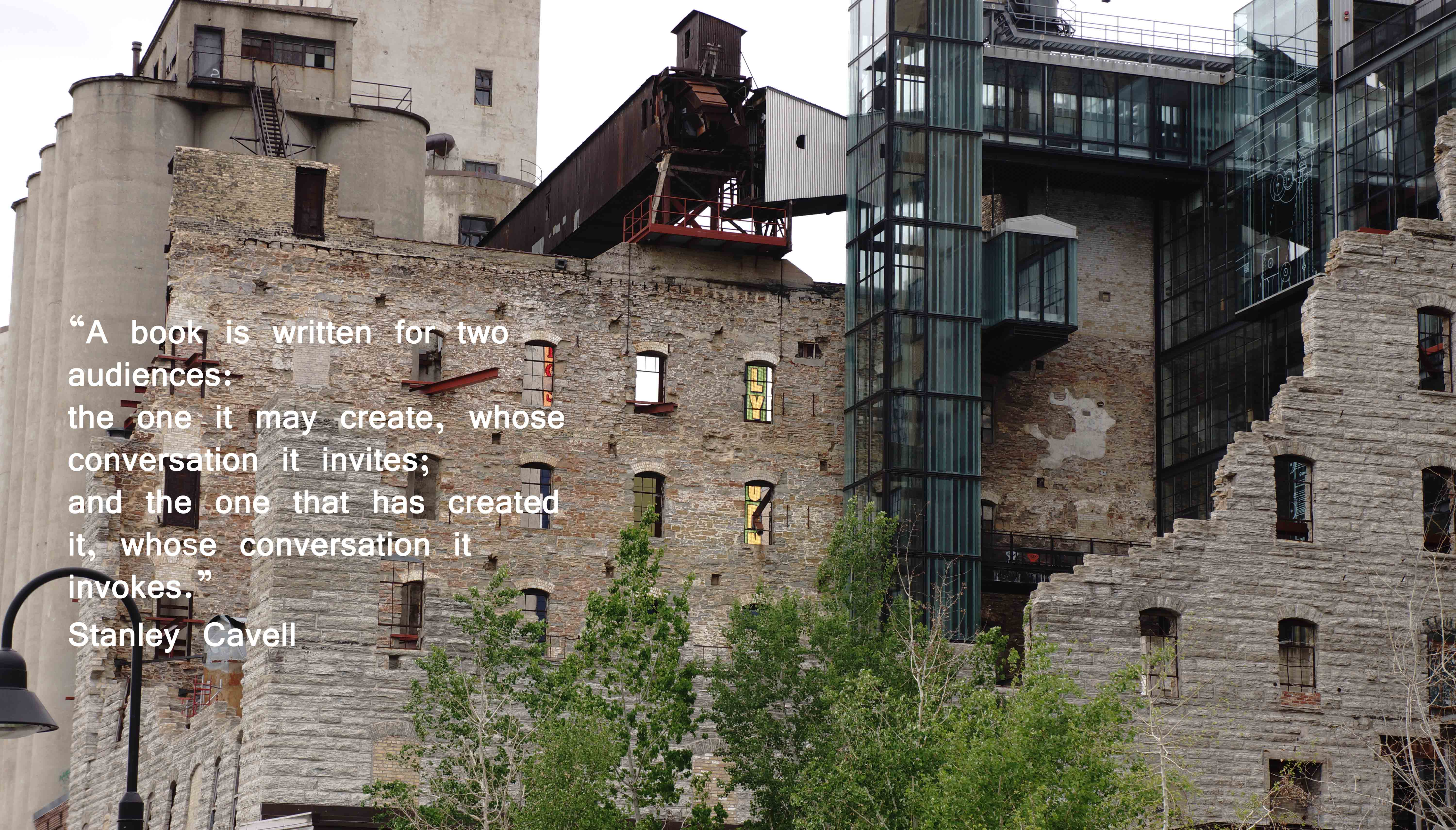
Dallas Willard: If I wake up dead, please someone tell me.
Dallas Albert Willard (September 4, 1935 – May 8, 2013)
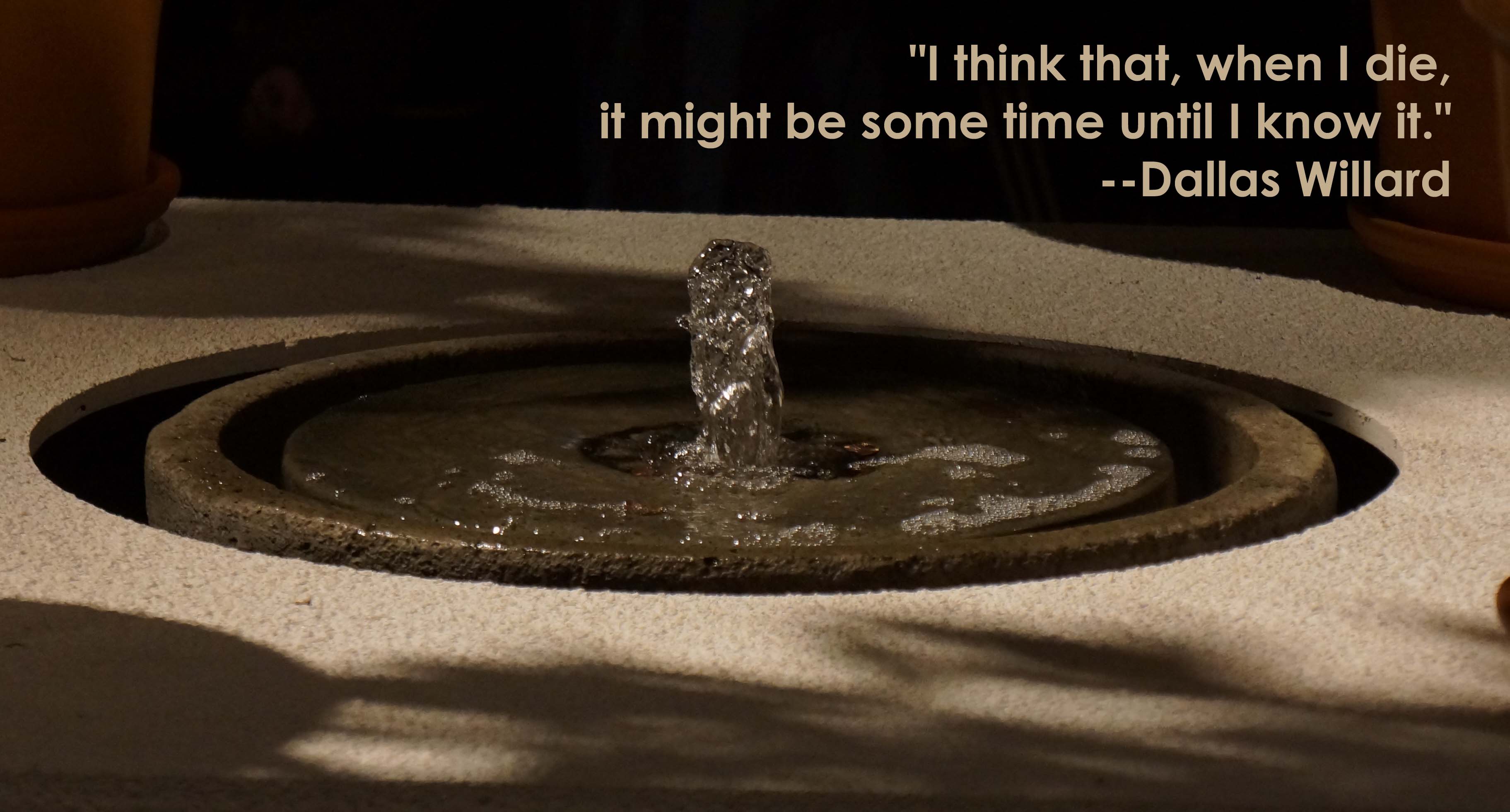 He was an improbable thinker: crazy about Jesus the Christ and a well-regarded professor of philosophy at USC. An expert in Edmund Husserl (father of phenomenology) and yet a very clear writer (despite phenomenology, which is notoriously difficult reading). Willard’s The Divine Conspiracy was a key text for me in learning about spiritual formation. His writing continues to bubble through my brain pan.
Dr. Willard combined the many unlikely things I love best. I never knew him personally, but I miss him already. John Ortberg’s tribute was perfect.
###
Illegal Inscriber: We Are Brothers
Warning: NSFL Image (Not Safe for Librarians)
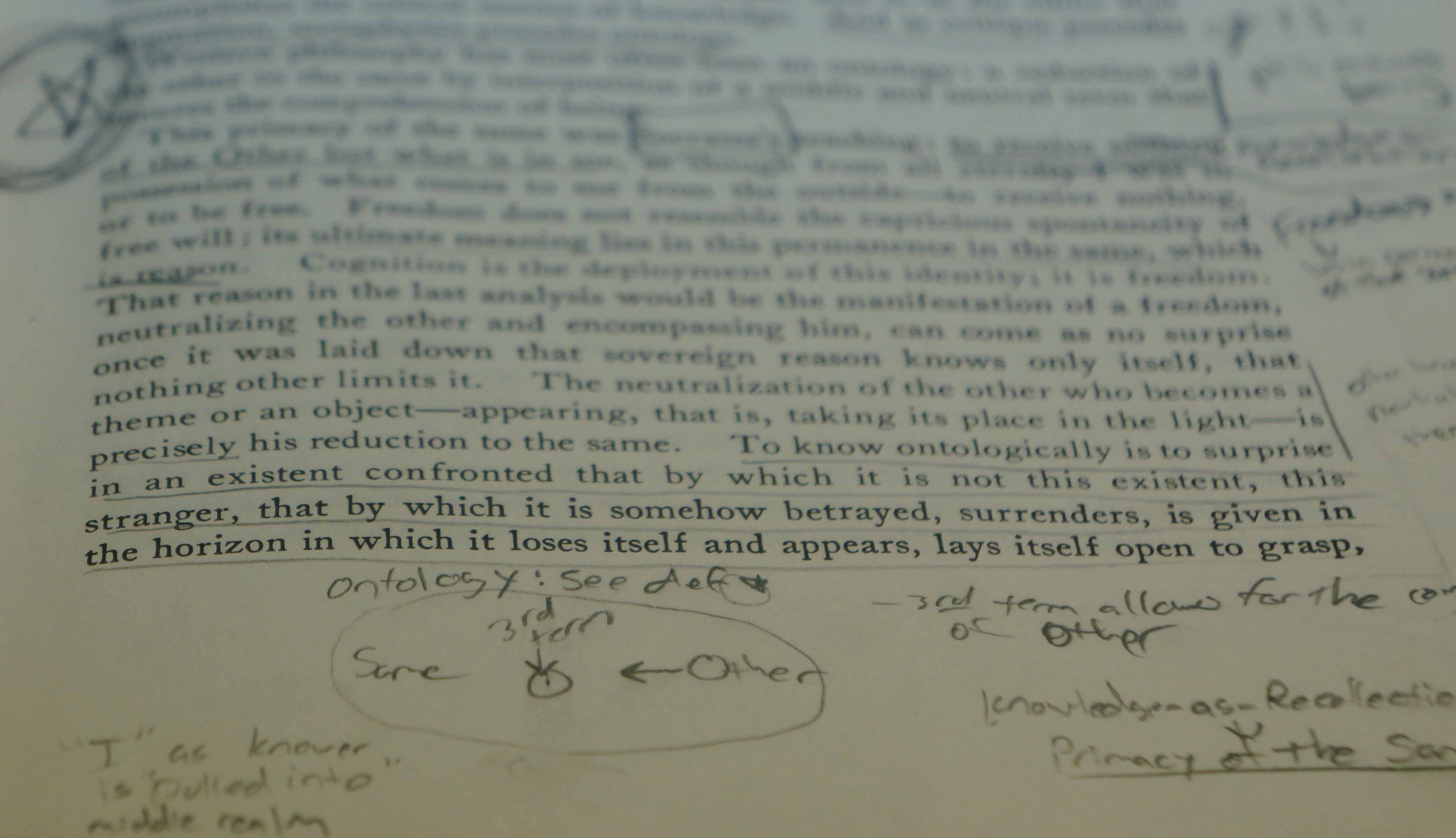 Sometimes Ramsey County goes far afield to procure my desired book through their interlibrary loan system. Not so long ago a book about Levinas written by Sean Hand made its way to me all the way from Janesville, Wisconsin. I had not thought of that working community as a hot spot for continental philosophy, but life is full of surprises.
This copy of Levinas’ Totality and Infinity came from St. John’s University in Collegeville, Minnesota. And somebody there did his thinking on paper. I say “his” because this scrawling looks like it was made with a masculine hand. I would like to buy this thinker a cup of coffee—his processing of the text is spectacular. He outlined sections of Levinas’ thought, he responded with gusto (exclamation points and double/triple underlines) to the sometimes obscure Levinasian sentences. His notations in the margins show him connecting Levinas to Hegel, Nietzsche, Sartre and Descartes. He is surprised when he finds “another way!” He offers a sad face upon realizing “the state is a totality.”
In fact the first 1/3 of the book is full of his incidental reactions and understandings, all scrawled in remarkably clear pencil in the margins. By half way through the book his interest seems to wane. The latter half of the book is free from all pencil inscriptions. Did he fall asleep in the library and miss his deadline? Did he finish his paper based “the same and the other” without ever getting to “exteriority and the face?”
I suspect so.
Even so, I’d like to have a chat with this illegal scribbler. This person has a lively mind, reaching out to make mental connections even as he reached out with graphite to record those firing synapses. Maybe this guy was even considering the poor dolt (this next other) who would pick up the text next—showing a kind of mercy on him.
I think the Ramsey County Librarian would also like to meet this scribbler. She wrote (for the tiny but loopy handwriting on the transfer label looks like a feminine hand to me) —wryly, to my mind: “pencil marks noted.”
###
How I’m Writing Today: Palimpsest
Here’s your close reading.
 These days nearly all these posts grow out of a much larger manuscript I’m working on. It’s as I were on a teeter-totter: falling with the gravitas of this larger work but then buoyed by the thought of breaking my indulgent thoughts and sentences into smaller pieces and stripping away language. Or this: pushing forward with the larger more difficult manuscript opens windows and doors in passing that frame tantalizing ideas that turn into posts.
Someone I recently read mentioned the notion of a palimpsest: an old manuscript that was erased and rewritten, because the parchment itself was valuable and endured. Modern techniques have allowed for the reading of the words that were erased.
Maybe the palimpsest is not that different with how we are with each other: our rewritten and redacted conversations help catalyze thoughts, actions and intentions with each other. Completely tangential words have the capacity to present a new and quite fruitful direction. Or waste lots of time.
Diversions present. I give chase. It’s neither a tidy nor effectual way of writing. And yet, the result is a fortuitous amount of blasting that clears away the surface…crap…and bores down toward the issue. Sometimes.
###
Image credit: gifmovie via 2headedsnake
“Today I Choose to Wear Clothing.”
You have more choices than you think
 Shirt? Yes. Pants? Why not?
Just like every day.
Just like most people.
Except for the odd nudist colony, most people clothe themselves without becoming embroiled in internal debate. Appearing clothed is one of those basic understandings we share. Being clothed is not the question. What that clothing looks like is, of course, the question that drives multi-billion dollar industries.
I’ve been thinking about the boundaries that circle our lives. Or maybe I’ll call them norms. There are expectations out there we follow without thinking. And that’s a good thing, because we might become paralyzed by all the choices before us if we did not have these norms our culture expects of us. And we also have these well-worn ways of acting that help us avoid constantly choosing. We always shower before breakfast. We always drive this route to work. We always park on this side of the lot. We always say “Yo, James” to the receptionist. These are the things we do.
But nothing says we must do it that way.
Nearly every corporate job I’ve had has involved colleagues complaining bitterly about the boss or the manager or director or the CEO. Mondays seemed to foster these discussions. Maybe we cited “golden handcuffs” or likened ourselves to wage slaves in those discussions. But in truth, we’ve been surrounded all along by truckloads, trainloads, barges full of options. An unprecedented wealth of options. But we didn’t see them because we followed the script of our workplace or culture. We didn’t see our choices because the script didn’t let on that there were choices.
I’ve been reading Wendell Berry and Jonathan Sacks—both of whom saw choices that were outside the script: pursuing contentment rather than fame or honoring the stranger. That poet-warrior-king wrote his own set of scripts that were bathed in gratefulness rather than ambition. That inveterate letter writer Paul went off script by weighing the choice of death and life for himself. Of course, Jesus the Christ guy lived the king of all scripts—something we’re still sorting out 2000 years later.
What script are you following today?
What choices are hidden from you because of that script?
###
Image credit: Gervasio Gallardo via 2headedsnake

Malala Got Shot for Just Saying
What We Say Matters
In his fascinating After Babel: Aspects of Language and Translation (NY: Oxford University Press, 1975), George Steiner speculated on the origins of languages. At first it seems like a no-brainer: given all the people and geographies and histories and wars and all that has happened over time, sure, we have a whole lot of languages. But Steiner goes all systematic through the known number of languages over the course of history and asks the rather obvious question: Why? Given that human bodies all work roughly the same way, and that we ingest roughly the same foods the world over, and the we all need air and water and sunshine and coffee (ahem)…why is it again we don’t all speak the same language? It’s a great question and his book is a readable and erudite discussion on the topic. I’m only a few chapters in, but two things stand out:

- Steiner believes all of communication is translation. Whether inside a language or between languages, we are constantly translating and decoding words and meaning. I think he is right about that: there is no end to trying to understand each other. Even couples married for decades need to translate the words spoken by the spouse to understand what it is they really meant. And then to sort out what they should do about it.
- Steiner speculated on a “proto-language,” a sort of first language from which all other languages descended. Steiner called it Ur-Sprache (p.58) and likened it to the language of Eden. A supremely powerful language that when spoken, made stuff happen. One need only think of a couple old Bible stories to get the sense of the promise of this old language: God speaking stuff into existence and Adam naming all the animals (with no committees second-guessing his naming choices).
But…alas…this language is no more.
Or is it?
Maybe we still see hints of Ur-Sprache every day, when we say things and our saying seems to make it so. Saying a thought aloud has a kind of generative effect. Not always. And with more or less effect. But still—stuff happens when we talk.
Maybe this is why people in the U.S. hold so tightly to the First Amendment of the United States Constitution. And why people all over the world agree that freedom of speech is a human right (except for despots, when speech calls attention to their efforts to rape and pillage their people). And maybe that’s why we feel almost personally violated by the Taliban in Pakistan singling out and shooting a teenager (Malala Yousafzai) for speaking her mind. It is beyond repulsive. Beyond degenerate.

###
Image Credits: Vladimir Kush, AFP/Getty Images

 conversation is an engine