Archive for the ‘texts’ Category
Endo Brochure Silent on Vital Bits—2 Skills for Tonight’s Debate
Read the White Space. Hear the Silence.
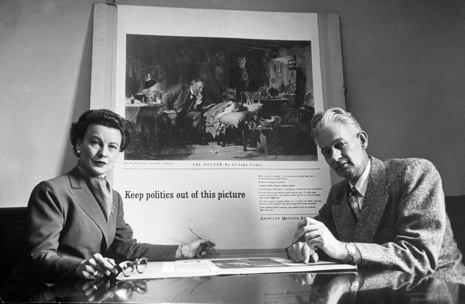
Campaigns, Inc.: My Antiheroes.
MedCity News reports on an Endo Pharmaceuticals brochure under scrutiny by the FDA. The problem was a lack of transparency about the dark side of the therapy—a therapy designed to slow the growth of prostate cancer cells, namely:
- paralysis that may result from the risk of spinal cord compression
- the increased risk of diabetes/heart attack/sudden cardiac death/stroke
In a lively debate in comments section of the Pharmalot blog, the consensus seems to be that the FDA made a good call. Commenters began by speculating this was likely more than just a slight oversight as the Endo communicator skipped regulatory/legal review in a rush to meet a deadline. Then commenters started tracing the language to the Vantas Implant website and began speculating on the rest of their messaging and promotional literature.
The debate amuses me because it is the rare product brochure that is read outside of a sales presentation. And it is even rarer for a brochure to withstand extended exegesis. That the FDA does this regularly earns my respect/awe/fear. Love them or hate them, the FDA’s dogged attention helps medical copywriters and marketers hew to the high road.
The debate also serves as a reminder of the skills needed for watching tonight’s presidential debate. It’s the white space and silence that may be most eloquent. The skill of reading the white space and hearing the silence means the audience must be equipped with the fuller argument. The FDA certainly was. But to read Jill Lepore’s recent New Yorker essay (“The Lie Factory: How politics became a business,” Sept. 24, 2012) is to come away with all the history and reasons as to why the American populace remains a happily uninformed audience. Whitaker and Baxter of Campaigns, Inc. helped set the stage for the current state of our spectatorship:
In tonight’s debate, I’m trying to break free of my usual indolence to hear between the lines (as it were).
###
Image credit: The New Yorker
Coursera Learnings: The Close Reading
Word by word, pay attention to the text
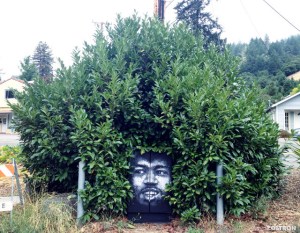 It’s actually what I did yesterday with my visceral response to the Dassault Systemes commercial from Casual Films which appears to have touched a nerve.
Not so long ago I wrote about the Modern Poetry class I’m attending with ~30,000 new friends. We’re watching Professor Al Filreis and a team of dedicated UPenn student TAs react to and discuss Emily Dickinson, Walt Whitman, William Carlos Williams, Allen Ginsberg and others. The class involves a fair amount of dissecting meanings and is lots of fun. And now we are grading each other’s close readings of a Dickinson text. The Coursera machinery for dealing with a massive online open course is startlingly easy to use and even (sort of) personal. Kudos to Professor Al Filreis and team!
For me this was to be a year off from grading college essays, but these essays are different. People from all over the globe are struggling to sort out what the assigned Dickinson poem means. Some—like me—have never worked this closely with poems. Many of us read our own meanings into the text—often this is linked with a lack of close attention to the words. Even word by word: the close reading demands the individual words add up to something. To gloss over the words is the thing that allows me to pack in my own meanings. I’ve noticed this tendency for years reading ancient texts with small groups: the farther we get from the words on the page, the easier it is to attach our pet peeves to the author’s supposed/assumed point. But the words themselves lead into or out of meaning and belief.
I was struck by one of our course readings: this poem by Cid Corman:
Cid Corman, “It isnt for want”
Naturally, there is lots to say as you go word by dash by word. But one thing—from the perspective of conversation—Corman focused on how we know something about ourselves as we stand together in conversation.
###
Image Credit: Zoltron via thisisnthappiness
Going to Church Today? Consider This.

expect a conversation that will help sort things
Probably someone will speak to the group—that’s typically what happens. And there will be singing. Prayers will be offered. You’ll shake a few hands. Maybe you’ll learn something new. Maybe you heart will be lightened. Your load lifted.
If heart-lightening or load-lifting happens, stop and think why. Was it because of magic words spoken from the pulpit? Not likely, as there are no magic words. But there are words that find a home in a person’s conscious thought and get absorbed there to do some work. One of the tests the old church fathers used to determine if a letter or text should be included in the Canon (our Bible today) was whether it had the power to change people—did the text speak with authority into a people’s lives? Did something happen because of hearing the text? When those old words get uttered from the pulpit today—they are not magic—but their truthiness has sticking power.
Just as likely: you meet someone who says something that affects you. Makes you think. Makes you reconsider an impending decision. And perhaps that same heart-lightening or load-lifting occurs. Sometimes we meet people who speak truth and it has the same effect.
And consider this: perhaps you go into that time expecting to hear something. What I mean is, sometimes we move into a situation actually expecting to hear something that could have the power to change how we think or act. You might call this listening. Or attentive listening. Or attenuated listening. Or listening on steroids. But whatever you call it, this is the most productive penultimate approach: listening with expectation. Then you pick up the tasty truthiness from any source.
###
Image credit: Douglas Smith via 2headedsnake
Risky and Risqué Reading for Christian Copywriting Students

Reading is dangerous. And profitable.
On Tuesday I start teaching Freelance Copywriting (Eng3316) at Northwestern College in Saint Paul, Minnesota. These are junior and seniors largely from the English department, but also from Journalism, Communications and Business. They are generally excellent writers and engaged students—people eager to take their faith into the street. We’ll use a few thought-provoking texts that deal with the business side of copywriting, along with the what to expect as a copywriter and how to get better at producing salable ideas (Bowerman’s The Well-Fed Writer, Iezzi’s The Idea Writers, Young’s A Technique for Producing Ideas). But I’ve become convinced the real-time critiques of working copywriters around the web are just as helpful if not more useful than our texts. It’s just that the language and images used in the critiques often veer outside the lines of nice and polite, though I would argue the critiques follow the line of conversation Jesus the Christ encouraged with regular people like me.
So.
I’ve devised a warning:
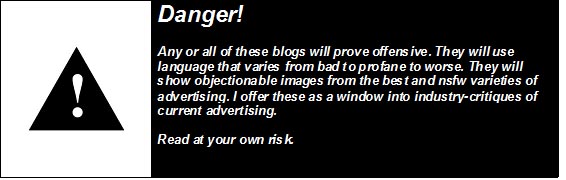
Question: Is this overkill? My goal is to help prepare thoughtful writers who fold God’s message of reunion into their communication work and live it out in a world that operates on a very different basis. I think students will understand. I’m not sure the administration will.
What do you think?
###
Image Credit: Chris Buzelli via 2headedsnake
Please Write This Book: A Year in Chesed
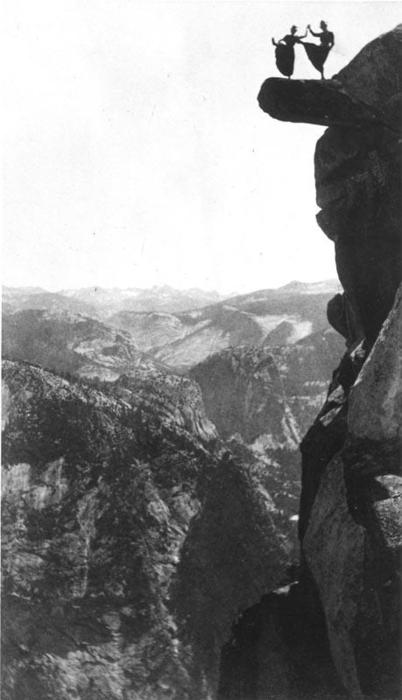
of course there is dancing
In A Year in Provence, British copywriter Peter Mayle, moved to France and wrote about this place of exceptional food, wine and beauty. Mayle provided his reader with nearly first-hand experiences of cooking, shopping and conversation. Along the way we saw hints of a different way of living.
I want to read a book that takes a similar journey, but rather than air travel to a glorious foreign country, I want the author to settle into a land devoid of anxiety and full of bonhomie toward men and women. I want the author to get there by following the thread of meaning from a very particular foreign word: “Chesed”
Google chesed and you’ll find a central Jewish value that means (for starters) “lovingkindness,” but points to much, much more. This old Hebrew word appears 247 times in the Torah and 127 times alone in the Psalms. “Chesed” has shades of meaning in the Torah, variously translated to English as: loving-kindness, mercy, favor, pity.
I imagine living in chesed is something like life in a foreign country. My glimpses of this country come mostly through the Psalmists who use the word again and again as they respond to or acknowledge God’s care. It is a word that describes a way of life that is the polar opposite of my country’s “Black Friday,” and all that consumerist orgy represents.
As you write this book, please take long, generous expeditions into this land of living in gratefulness and thanksgiving. Explore how the inhabitants of this land depend on materials and attitudes already in their possession. Please show me what contentedness looks like. Show me how they brush off the slights and insults and lack of fame because they are grounded with a deeply-rooted faith-joy in the creator. I imagine this land as anti-Kim Kardashian: Sopping with contentment. Joy. Stability. Not glamorous. Not narcissistic. Not attention-seeking. So that means your book won’t get on the news every evening. But I’ll buy a copy.
Spend a full year there. Show me what happens when the crops are not bountiful and enemies encroach. Show me chesed when taxes are due and when plans go terribly wrong.
Please write this book soon because my land is teaming with insects whose bite results in a longing for more shiny stuff and much daily fame. In the meantime, I’ll keep looking through the postcards the psalmists sent.
###
Image Credit: Via 2headedsnake
We may play the text, but it is also playing us.

“Another model, which undermined the designer’s new claim to power surfaced at the end of the 1990s, borrowed not from literary criticism but from human-computer interaction (HCI) studies and the field of interface and usability design. The dominant subject of our age has become neither reader nor writer but user, a figure conceived as a bundle of needs and impairments—cognitive, physical, emotional. Like a patient or child, the user is a figure to be protected and cared for but also scrutinized and controlled, submitted to research and testing.
How texts are used becomes more important than what they mean. Someone clicked here to get over there. Someone who bought this also bought that. The interactive environment not only provides users with a degree of control and self-direction but also, more quietly and insidiously, it gathers data about its audiences. Barthes’s image of the text as a game to be played still hold, as the user respond[s] to signals from the system. We may play the text, but it is also playing us.”
Ellen Lupton, Thinking with Type, (NY: Princeton Architectural Press, 2004) p. 73
###
Image Credit: this isn’t happiness

 conversation is an engine