Archive for the ‘Writing to build community’ Category
Mega-Church or Micro-Brew?
What’ll it be?

Are beer wars an apt analogy for churches? Maybe so. Walk with me:
My friend and I are cooking up a book proposal for how the church can use social media. But a major disagreement stands between us: Do churches really want to go where social media leads? Groundswell (Li and Bernoff), which I use as a text in my Social Media Marketing class, makes a compelling case that the end-game of social media is people participating in product development, in customer support, in sales and—generally—in decision-making. Businesses using social media only to broadcast messages (the old marketing monologue model) will be left out of the real conversation as it continues around rather than with them. Many corporate overlords resist this new communication freedom and stay out of the conversation—until forced into it.
What about churches? My friend thinks the future lies with mega-churches that typically retain control of as many outward and linking messages as they can—for the sake of efficiency. I believe nearly the opposite: that we’ll see more churches that require less control of messages so as to actually invite people to bring their voices and contribute. I see as problematic the requirement of multiple overlords, presidents, governors, lieutenants, elders, council-people—you name it—just to keep the big ship moving. Multiple overlords tend to squash multi-directional voices.
Back to beer: There will always be Budweiser and Miller. But last time I checked, that’s not where the market growth was. The growth was in the micro-brews. My explanation for that growth: people realize they want beer that tastes like beer rather than water. Same with churches, there will always be a few mega-churches around, but the real growth will take place in smaller congregations where a definite personality develops because many voices are being heard and are actually participating in directing the community. Or perhaps growth will take place in those mega-churches that make a way for spectators to become contributors with voices.
And now back to social media. I contend that social media naturally leads to a democratization of leadership and a multiplicity of voices—two genetic traits not found in the DNA of most hierarchical mega-churches. But they could be in the DNA of smaller congregations (but, clearly, authoritarian leaders exist in any size organization).
At least two glaring problems to all this:
- I’ve oversimplified my argument by casting big as bad. That is simply not true. Very big churches can be very relational and very flavorful (to push the beer analogy). And there is clearly an attraction for churches that hold firmly and broadcast the Bible’s message of the God bent on reconciliation. Maybe big churches can also admit a multiplicity of voices. I just haven’t seen it.

- Even Groundswell recognizes that only a small percentage of any online population serves as creators. A slightly larger population functions as critics. But the great majority of folks online are spectators. Test your own population here. Maybe that’s the same population that fills up the back rows of any church or college class—those who prefer watching. So while I’ve noted that social media provides the opportunity to amplify one’s voice, few actually take advantage of it. Maybe that will change. Maybe it won’t. The truth is most of us are pretty happy to not lead.
What do you think? Does social media lead to a place churches really want to go?
Postscript: I believe the opportunity social media presents has a theological component that moves us closer to the creator’s intent for communication. More on that later.
###
Jeff Nunokawa & People-Centric Scholarship
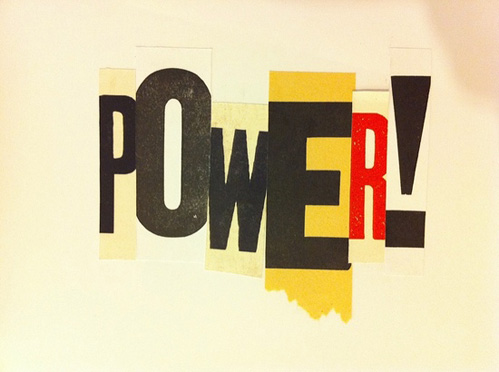 A recent New Yorker Talk of the Town feature showed Jeff Nunokawa practicing his scholarship on Facebook. Rebecca Mead’s article “Earnest” compared Dr. Nunokawa writing his first book in a windowless basement with the way he connects today with his Princeton students. His “meditations” get read because they are brief, accessible and located exactly where his audience spends their time—Facebook.
“…I like the social-media element—I want it to be sociable. It’s not that I don’t want to be a scholar, but this is how I want to be a scholar.” (The New Yorker, July 4, 2011, 19)
Something good is happening here. And the good thing is not that scholarship is dumbed-down or going away. Tightly controlled, peer-reviewed articles using insider-only language will continue as a means of advancing scholarship. But this good thing is a fresh emphasis on accessibility: making the connections so more people can get pulled into the excitement of understanding. You may call it low-hanging fruit. But this copywriter sees it as a ministry to the human race.
At the moment, the academy doesn’t reward this: popular retelling of scholarship is often not tenure-track stuff. But the institutional gatekeepers will not have the last say, as more people join these ongoing conversations.
Something good is happening. Something new. I welcome it.
###
Image credit: Scott Dadich
Verbatim: Tell Other People’s Stories
In which I learn from my students

We see better together
We just finished our Social Media Marketing class at Northwestern College. One of my favorite assignments was when the students critique their own social media efforts: their Facebooking and Tweeting and especially their blogging. Each student established their own direction at the beginning of the class complete with written goals and objectives. All for the purpose of establishing a community in just a few short weeks.
Students learn great lessons. They learn about how details and minute specificity can help their work be found by search engines (that is, by people using search engines). There is always a moment of triumph when they get their first non-class participant. They learn that a number in a headline pulls in readers. They learn how commenting on other people’s work is another way of polite conversation that also helps expand their reach. Of course I am being reminded and learning afresh all the same things. My favorite learning this time:
“I began by writing about what interested me, but I’m learning to let my audience guide the topic choice by what they comment.”
This is a mature understanding. She went on:
“I’m realizing that this blog is not about what I know and can provide, but about what the community of writers can share with each other.”
Writing our commonality has a way of inviting others in. It is a way of telling a story together. We talked about “psychic income,” which we defined as the intrinsic reward we get from helping someone else and how that helps others participate to build the story and the community.
Her comment also speaks directly against the notion of a self-absorbed generation. Here’s a person learning to put the needs and interests of others ahead of her own. Not that she was any more self-focused than any of us: we’re all struggling to fathom how to set aside our personal, angsty issues to see what’s going on in others. Telling other people’s stories is precisely the beginning of drawing together a community.
###
Photo Credit: xplanes.tumblr.com
How Could this Book be More Interesting?
I’m about to go fishing with my Listentalk book proposal (via www.ChristianManuscriptSubmissions.com). How could I make the summary (below) more interesting? Be honest. People respond to these posts by email, on Facebook and occasionally right here at “Engage.” Vent your spleen. I’m listening.
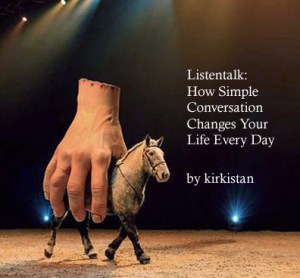 Listentalk: How Simple Conversation Changes Your Life Every Day
Why does one conversation make you scan the room for escape while the next sends you breathless to register to run a marathon—though you hate exercise? Listentalk: How Simple Conversation Changes Your Life Every Day shows how humble, mundane conversations have the power to turn our life direction every single day, by:
- Reminding us of the pivotal conversations that have shaped and sculpted our own lives. Like the chance comment to your 18-year-old-self from an acquaintance about a “school you should check out,” which sent you a direction that ended in law school, marriage and being appointed as a judge (true story).
- Showing how God purposefully composed the human condition so that while we are limited, we are limited together. Conversation has a way of bumping out our human limitations in extraordinary ways, so that my lack of understanding leads to a discussion that sheds light on a key topic but also opens an opportunity to pursue the work I love.
- Exposing the component parts of listening and talking so we can better understand how God speaks to and through us
- Providing practical insights into how we can listen and speak for powerful good every single day—including wise use of social media
Today’s incendiary and vitriolic talk leaves people feeling weary and soiled. Listentalk refreshes Christian adults, Sunday School classes, small groups and college students by reminding them of the wonder, curiosity and serendipity that have been part of the deep verbal connections that have shaped their lives. These deep connections have often sprung from the unlikeliest of mundane conversations.
Listentalk tells stories of conversations that both suggest and model an extraordinary set of expectations and outcomes for ordinary talk. Listentalk helps people see verbal, visual and other-sensory conversational episodes as the powerful shaping tools they are—and provides suggestions for making them even more powerful. Unlike possibility-thinking, self-help books, Listentalk is grounded in the nature and actions of the conversing God of the Bible who expected and realized world-changing outcomes from each conversational episode. Listentalk frees readers to see daily conversation in a very different light by inviting readers to reach out in trust to each day’s conversational partners—an ever-expanding set of partners due to changing attitudes (about communication, authority and the loss of gatekeepers) and developing technologies.
Listentalk offers a primer on navigating the growing social media space as redeemed conversational partners. Creating communities of target audiences is the new marketing strategy. Leading public conversations by reaching out with dialogue that gifts and blesses is not only supremely Christian, but supremely strategic.
###
On Intersubjective Finitude
 I think I just made that phrase up (really: Google says “No results found for “Intersubjective Finitude”). What I mean is that the human condition is chock-full of limits: we have limited energy, we age and parts droop or just stop working, finances are always ¾ empty (partly because we always want more than we have). Look: we still have to sleep every day because we simply run out of steam! The human condition is all about these limits.
I think it is purposeful.
The wonder of conversation is that it has the possibility of bumping out limits in the most surprising ways. I talk with my wife and she says something that lifts my spirits (and energy) in an unexpected way. A dinner discussion with a colleague reveals a new approach to exercise that may provide a more sought-after outcome. A haphazard conversation outside a coffee shop and I suddenly realize a next step for a vexing copywriting problem.
Our humanness bespeaks frailty and limits at every turn. And at every conversational turn, we run smack into words that would free us from momentary miseries. Multiply the effect by ten thousand in the mysterious conversations with God we call “prayer.”
I’ve been writing about it here as I get my book proposal ready to go out and seduce potential publishers.
What pivotal conversation will happen today?
###
[Image Credit: Marc Johns]
Stop Dead in Your Tracks: #3 in Dummy’s Guide to Conversation
Could Paying Attention be the New Black?
 This has happened to you: Going along. Minding your business. Dashing off small replies to the usual small talk. Maybe you hint at the plus-sized existential questions colliding and storming through your subconscious; the doubts and uncertainties that threaten to spill through your cranium as a conscious thought you even might utter. Maybe you stay silent.
But the internal roiling doesn’t let up.
“What does it all mean,” you mutter under your breath on the elevator to the 23rd floor, remembering your wife’s comment about needing more attention and your boss using pretty much the same words and your doctor stating you need to focus on exercise otherwise diabetes is around the corner. That’s when the person next to you looks up from her phone and says,
“I don’t know, but the CDC says attention deficit disorder is on the rise.”
She smiles half a smile and goes back to her screen.
It hits you: Maybe there is a national attention deficit disorder and your life reflects it. Maybe our screens and multitasking so distract us that full-on attention is rare and becoming rarer. Since we carry the multi-tasking addiction with us into every conversation (like a drunk secretly playing out the context of the next drink), we simply have no bandwidth to attend the need, the threat, or the story (it is National Day of Listening, after all) playing out before us. And suddenly you long for an hour of blissful focus.
Black Friday may be a worthy day to consider that paying attention is the new black: the fashion statement that can only be given, not bought. And paying attention to what we say to each other—really listening—may be a gift that looks more like an investment in the future of a relationship.
If The Word Fits
If the first step in the Dummy’s Guide to Conversation is to open your pie-hole, proving you are both human and alive, then the second step is to listen. And the third step is to be stopped—or at least to be prepared to be stopped. So much of life seems set to automatic pilot. The same bowl of Raisin Bran every morning. The same drive to work. The same greeting to the guard, same conversations with the same coworkers. Same words sent. Same words received.
When we have the Aha moment on the elevator to the 23rd floor next to the woman immersed in her screen, we should take note. Write down the insight. Listen to it. But don’t stop there; consider making a habit of watching for the moments of supreme attention that stop you dead in your tracks with wonder. These are the very pivot points we shoot past without even taking in the scene. And that’s too bad, because we miss an opportunity to learn something about ourselves, our culture and our future.
###
Buy a Book that Helps a Guy Help the Homeless
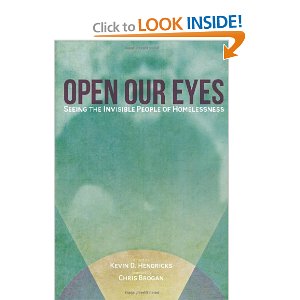
All profits go to homeless advocate Mark Horvath
I’m a fan of the work of local writer Kevin D. Hendricks. He’s used his writing skills in a number of ways to serve others, from wells to adoption.
Today he’s launching a new book–Open Our Eyes: Seeing the Invisible People of Homelessness–about Mark Horvath and his work in helping the homeless. I am not familiar with Mark Horvath’s work and I’ve not read the book, but I’m going to get a copy. I admire Kevin’s passion for help others and maybe that is a good enough place to start.
###

 conversation is an engine