Risky and Risqué Reading for Christian Copywriting Students

Reading is dangerous. And profitable.
On Tuesday I start teaching Freelance Copywriting (Eng3316) at Northwestern College in Saint Paul, Minnesota. These are junior and seniors largely from the English department, but also from Journalism, Communications and Business. They are generally excellent writers and engaged students—people eager to take their faith into the street. We’ll use a few thought-provoking texts that deal with the business side of copywriting, along with the what to expect as a copywriter and how to get better at producing salable ideas (Bowerman’s The Well-Fed Writer, Iezzi’s The Idea Writers, Young’s A Technique for Producing Ideas). But I’ve become convinced the real-time critiques of working copywriters around the web are just as helpful if not more useful than our texts. It’s just that the language and images used in the critiques often veer outside the lines of nice and polite, though I would argue the critiques follow the line of conversation Jesus the Christ encouraged with regular people like me.
So.
I’ve devised a warning:
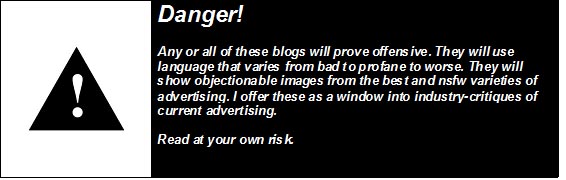
Question: Is this overkill? My goal is to help prepare thoughtful writers who fold God’s message of reunion into their communication work and live it out in a world that operates on a very different basis. I think students will understand. I’m not sure the administration will.
What do you think?
###
Image Credit: Chris Buzelli via 2headedsnake

Noah and the Other: A Hump Day Story
Here’s your Bible story for today.

Occupy Midweek
Once upon a time there was a man named Noah. He enjoyed a good conversation. He also had a sense of wanting to do the right thing as he walked upright through a strange time.
And he walked through a very strange time. Noah lived among superheroes, when the sons of god walked the earth, sexing the hot chicks (OK, the text says “they married,” but there is meat-market sense to it) and producing a super race. Men of renown. It’s all in the Bible—Genesis 6. But it was also a time of great violence. And Noah was the last man standing uncorrupted—so the story goes (except for the problem with new wine, a bit further in the story). But mostly Noah was blameless and faithful as he did the right thing. Noah’s way of living had something to do with the conversations he had.
Noah had cultivated a sensitivity unlike anyone else: he was conversant with the Being that created everything. The Bible calls this being “God” and the story that Genesis unfolds seems predominantly God’s story, though steadily unfolded through people who interact with Him and His creation. When God saw how bad things had become on earth: violence pouring from the evil thoughts that ruled every person’s heart, He said he would wipe out the whole thing. Then He said it again. To Noah. Along with a few instructions that preserved Noah and his family. You know the rest of that violent story—which is really no kids’ story at all.
“Corrupt and full of violence.” I hope that does not describe your work place today, though it is a theme carried out through the entire story of God’s interaction with the earth. But no matter how it feels today, Noah’s story is about pursuing and preserving conversational moments that move toward freedom from the violence and evil that so easily infects all we do. Living above the fray—not by willpower but by deeply connecting with this mysterious being.
It’s a strange story and not at all polite or nice. It raises all sorts of questions and highlights unsolvable mysteries we rarely speak of—a perfect story to occupy midweek.
###
Image Credit: Bechet Benjamin via Iconology
What does a “social” church look like?
What Does a Social Anything Look Like?

hey-let's unlock our solipsism
We talk a lot about “social” but often marketers and corporate communicators practice the same old monologue and one-way messaging characteristic of the last century—they just shrink and divide their messages into packets of 140 characters and broadcast them through the channels people happen to be listening to at the moment.
For most of us “social” means only broadcasting through relatively new channels. We mostly don’t get the listening part of dialogue. This deafness comes from a deep place: this human tendency to see ourselves and our thoughts—our messages—as the axis for all that happens in the world. How could it be otherwise, given that we experience every part of life through our senses: the world comes to us as images, sounds, tastes, feeling and odors?
Certainly that is the case with profit-seeking entities like corporations. We monologue because we want people to buy our stuff. Same with churches: leaders broadcast what they want followers to hear and act on. Same with any organization.
3 Lessons and a Revolution
I’ve just finished my third run at teaching Social Media Marketing at Northwestern College and yesterday was my favorite day: when the students present what they learned from their social media excursions and community building activities. They learned:
- That the most tautly-orchestrated rhetorical strategy falls apart pretty quickly in the face of the opinions and interests of their audience. Students become completely captivated by hearing others respond to their words and ideas. These responses are especially enticing after years of writing papers only for the professor’s eyes.
- Try-Fail-Adapt was a motto we took from our texts and nearly universally adopted. This is the way forward with building communities using social media.
- That vague “interesting” titles and headlines don’t pull readers nearly as well as solid simple titles and headlines. And that putting a number in a headline produces a bit of magic. Something women’s magazines have practiced for decades.
One notion that threaded its way through the presentations was this subversive, revolutionary aspect of working with social media. When you look beyond today’s tools as just more broadcast channels and see that people are given a voice, the world starts to tilt differently. People with a voice. A voice that agrees with leaders. Or not. Voices that speak back to power. We’ve already seen those voices collecting around the Arab Spring, Putin’s Russia and our own Occupy movements. What will that look like as people slip into ownership of the church? Because it is sure to happen there as well. Will leaders learn to lead collaboratively and by pulling people toward them? Or will leaders rely on pulpits and authority structures for their power? And how long will that tactic last?
###
Image credit: Neatorama
Dummy’s Guide to Conversation #7: Flog Your Gnostic

Let Your Newbies Speak Prior to Corporate Brainwashing
Step into a marketing meeting in any medical device firm in the Minneapolis-St. Paul area and be assaulted by a barrage of acronyms. Those uttering the abbreviations assume everyone present knows what they mean—or not. Some climbing their ladder speak precisely to show they know way more than others sitting around the room. For those, language is less about communication and more about one-upsmanship. Certain words signal a superior knowledge, a sort of Gnostic approach to the workplace that demands allegiance and, frankly, a bit of awe for all listening. When the exceptional words are spoken, a hush falls. And not just because most people don’t have a clue what was just said. But also because the words hint at some brave new insight (often just as obscure). Much of which is counter-productive to getting work done as others scramble to decode the awesome insider lingo.
Then again, what is “work”? Is work the climb up through the corporate-playground jungle bars to reach the top where the cool kids hang? Or is work about serving some need or group not immediately at hand? For most of us, work is a mix of the two. Usually we hire on because of the mission only to get embroiled in the politics. Part and parcel.
Good work begins by flogging the Gnostic. Flogging the Gnostic means slowing the flow of incomprehension with questions that penetrate to the sinew of a larger idea (or at least a benefit). Exposing the Gnostic is all about cutting to the bone of language that your true, final audience will understand. All the better if you can dissect to a simple, sticky, credible, believable idea anyone could understand.
For better or worse, flogging the Gnostic usually begins with your own inner Gnostic. Certainly you’ve felt the magnetic pull to parrot the word your boss/client just said, that magic word-of-the-moment that instantly captured attention. Better to aim right at the final audience, right through the BS, right through the acronym salad, straight to the folks you are trying to serve.
As a consultant my role is often to shun the insider language and play dumb (an easy task for me). This is the only way to build toward an actionable, sticky idea that communicates, no matter what it looks like to those playing the insider game.
Resolved: this week I will flog the Gnostic.
###
Photo Credit: August Sander via thisisnthappiness
Best Buy and Brian Dunn’s Blog: Kudos for Leaving Comments Open
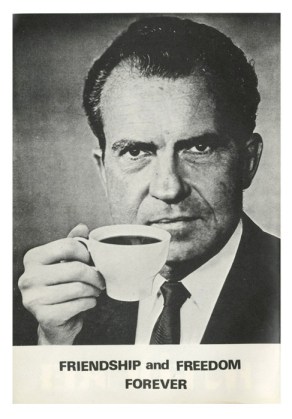 Minnesota Public Radio’s Martin Moylan reported Wednesday on Best Buy CEO Brian Dunn’s use of his blog to respond to media coverage of Best Buy’s business model. Moylan cited a recent critical commentary in Forbes magazine which received 2.3 million page views. In his blog Dunn responded to the critics but also tempted fate by leaving his blog open for comments.
Well done.
A quick glance through the comments shows all manner of agreement, disagreement, and vehement disagreement. Just like real people talking. It’s a messy mess of messages that point every direction all at the same time. And everyone can read it.
This, friends, is the future of conversation at an institutional level. Once people are given their voices back, they speak what they feel and sometimes what they know. But the act of listening is a huge hurdle and Mr. Dunn and his team did the commendable, credible thing by leaving it out in public for all to see.
We have a long, venerable history of jumping on market leaders, big notable institutions and authorities. There is something exhilarating about finding fault with those who seem to run the world, whether it’s Best Buy, Comcast, AT&T, Microsoft. Or the city council or the board of elders at church. Or elderly mom and dad. Or God. Sometimes they deserve it. Sometimes not. But the conversation is useful for lots of different purposes, including hinting at what is going on inside us.
Brian Dunn: thank you for your courage in letting people talk back. My estimation of Best Buy rose as I read the comments.
###
Image Credit: Artists’ Book Not Artists’ Book via this isn’t happiness

 conversation is an engine
Copyranter’s Dad is Dying
leave a comment »
Copyranter, my favorite, consistently profane and truth-speaking advertising blogger, today wrote about his father dying of cancer. “Asshole commenters” have been lining up to sympathize and pray and weep. All great responses.
or does prayer have much deeper capacity?
Prayer is like wishing, right?
Mention “prayer” and people mostly nod in agreement—what is there to disagree with? My colleague’s husband fell down a set of stairs and broke his neck. Her email from intensive care told the full story. People responded—as they will—with kind wishes and promises of prayer, among other things. Later she updated all concerned with the good news that he would fully recover, and went on to thank people for their positive energy, prayers and good wishes. Her update-—it seems to me—caught the primary understanding of prayer for most people, monotheists of most stripe and Christians included. Prayer, positive energy, good wishes, wishing on a star—all sort of the same thing. There is mystery in the words spoken in silence and the desire and the pain and the faith. Maybe something happens when someone prays. Maybe not. Prayer is hard to characterize.
Probe with a few questions—even among staunch believers and practiced pray-ers—and the mystery only deepens. “Prayer works,” someone might say. And they point to a prayer they prayed and then some related action that occurred. Did their prayer work? Possibly. Is there power in prayer? Maybe. And maybe not like we think. Certainly God has power—complete, entire power over all that is and ever was. And certainly God is under no obligation to fill our order, answer our requests, or even hear us—unless as He obligates himself.
We ask things of God from all sorts of motives with all sorts of expectations. The truth is we know very little about what happens when we pray. But we know prayer is the example and model the Bible holds to out for interacting with God. What does the Bible say about the connection between prayer and action?
Bible people were always talking with God. The list of praying people is extensive and includes those who were face to face with God (Adam and Eve, Moses), sometimes hand to hand (Jacob), as well as those who sat through years of silence in their prayer (Abraham, Hannah), and everyone in between. We typically think of prayer as a solitary, passive activity of last-resort. And yet the Bible routinely shows action following people praying. And not just small stuff, but game-changing action. Action that shifts a story to an entirely different place.
I’m trying to learn more about prayer. And I’m praying for Copyranter and his dad and his family.
###
Image credit: stopping off place via this isn’t happiness
Share this:
Written by kirkistan
March 3, 2012 at 1:18 pm
Posted in Ancient Text, Communication is about relationship, Prayer
Tagged with asshole commenter, copyranter, God