Mega-Church or Micro-Brew?
What’ll it be?

Are beer wars an apt analogy for churches? Maybe so. Walk with me:
My friend and I are cooking up a book proposal for how the church can use social media. But a major disagreement stands between us: Do churches really want to go where social media leads? Groundswell (Li and Bernoff), which I use as a text in my Social Media Marketing class, makes a compelling case that the end-game of social media is people participating in product development, in customer support, in sales and—generally—in decision-making. Businesses using social media only to broadcast messages (the old marketing monologue model) will be left out of the real conversation as it continues around rather than with them. Many corporate overlords resist this new communication freedom and stay out of the conversation—until forced into it.
What about churches? My friend thinks the future lies with mega-churches that typically retain control of as many outward and linking messages as they can—for the sake of efficiency. I believe nearly the opposite: that we’ll see more churches that require less control of messages so as to actually invite people to bring their voices and contribute. I see as problematic the requirement of multiple overlords, presidents, governors, lieutenants, elders, council-people—you name it—just to keep the big ship moving. Multiple overlords tend to squash multi-directional voices.
Back to beer: There will always be Budweiser and Miller. But last time I checked, that’s not where the market growth was. The growth was in the micro-brews. My explanation for that growth: people realize they want beer that tastes like beer rather than water. Same with churches, there will always be a few mega-churches around, but the real growth will take place in smaller congregations where a definite personality develops because many voices are being heard and are actually participating in directing the community. Or perhaps growth will take place in those mega-churches that make a way for spectators to become contributors with voices.
And now back to social media. I contend that social media naturally leads to a democratization of leadership and a multiplicity of voices—two genetic traits not found in the DNA of most hierarchical mega-churches. But they could be in the DNA of smaller congregations (but, clearly, authoritarian leaders exist in any size organization).
At least two glaring problems to all this:
- I’ve oversimplified my argument by casting big as bad. That is simply not true. Very big churches can be very relational and very flavorful (to push the beer analogy). And there is clearly an attraction for churches that hold firmly and broadcast the Bible’s message of the God bent on reconciliation. Maybe big churches can also admit a multiplicity of voices. I just haven’t seen it.

- Even Groundswell recognizes that only a small percentage of any online population serves as creators. A slightly larger population functions as critics. But the great majority of folks online are spectators. Test your own population here. Maybe that’s the same population that fills up the back rows of any church or college class—those who prefer watching. So while I’ve noted that social media provides the opportunity to amplify one’s voice, few actually take advantage of it. Maybe that will change. Maybe it won’t. The truth is most of us are pretty happy to not lead.
What do you think? Does social media lead to a place churches really want to go?
Postscript: I believe the opportunity social media presents has a theological component that moves us closer to the creator’s intent for communication. More on that later.
###
4 Leadership Lessons from Kick-Ass
It takes more than a costume. But a costume is a start.
 I watched Kick-Ass the other night. It had been on my list for some time, I just wasn’t sure I could handle mayhem and gore in the service of comedy. Turns out I could and did. It’s sort of a naïve movie: kid with no superpowers wants to take on the villains. Which he does, to disastrous personal effect. This got me thinking about the costs of moving our dreams into real life.
But first: my definition of leadership is likely different from yours. I’m starting to think of a leader as anyone who shows others a way forward. The leader I’m thinking of is more likely in the ranks than the spotlight. I’m not thinking of the glib vice-president with the bully pulpit of corporate position. I’m thinking of the quiet leader. I’m thinking of the driver who let me merge with a smile and a nod. That guy changed my day.
These four lessons could apply to anyone leading from within their ranks.
- Tell people what you are about. Maybe find a name or title that commands attention (or at least grabs people by the…well, throat). This is about staking an identity—so name what it is you are trying to do. Tell your dream out loud in a short way others can understand. And then suffer the consequences. Scrawny every-teen Dave Lizewski chose “kick-ass,” which is both aspirational and a slap in the face to any he said it to. Kinda genius.
- Take action. In public. Dave Lizewski began by wondering aloud why no regular people tried this work of superhero fighting crime. Soon he wasn’t content just trying on the costume and practicing Ninja moves in front of the mirror—he had to go out and do it. A knife to the gut and a few quick beatings helped him see why no regular folks did this work. But the point is that he started something that others would see. And as he failed he also succeeded (from time to time). That was the pattern and he stuck with it.
- Get comrades. It’s all comic book stuff, so no surprise Dave Lizewski was found by other real (fake) superheros. What was surprising was how well-equipped these real (fake) superheroes were with guns, ammo and know-how enough for a small army. In real life this looks like finding others doing the same thing and somehow linking with them. Or at the very least starting a conversation with them. Writers join writing groups for this reason. Civil war reenactors fight for the confederacy again and again for this reason.
- Go for love and be surprised by duty. Too often it is duty that moves me forward and love is somewhere in the background. But our teen hero started for love of justice and continued for love (or was it lust?) for the comely young woman. But the pull of duty called him back in the end when he could have walked away.
Kick-Ass is a comic book set in real life with (occasional) real life results. It’s entertaining like watching an accident happen, but the movie is strangely unforgettable. And it made me want to be more bold and public with the things I’m trying to do.
###
David Bohm: When is Empty Talk Full?

Someone may be home.
Some time ago there was an anthropologist who lived for a long while with a North American tribe. It was a small group of about fifty people. The hunter-gatherers have typically lived in groups of twenty to forty. Agricultural group units are much larger . Now, from time to time that tribe met like this in a circle. They just talked and talked and talked, apparently to no purpose. They made no decisions. There was no leader. And everybody could participate. There may have been wise men or wise women who were listened to a bit more–the older ones–but everybody could talk. The meeting went on, until it finally seemed to stop for no reason at all and the group dispersed. Yet after that, everybody seemed to know what to do, because they understood each other so well. Then they could get together in smaller groups and do something or decide things.”
—Bohm, On Dialogue (p. 19)
###
Image Credit: 2headedsnake, jeremie decalf
Jeff Nunokawa & People-Centric Scholarship
 A recent New Yorker Talk of the Town feature showed Jeff Nunokawa practicing his scholarship on Facebook. Rebecca Mead’s article “Earnest” compared Dr. Nunokawa writing his first book in a windowless basement with the way he connects today with his Princeton students. His “meditations” get read because they are brief, accessible and located exactly where his audience spends their time—Facebook.
“…I like the social-media element—I want it to be sociable. It’s not that I don’t want to be a scholar, but this is how I want to be a scholar.” (The New Yorker, July 4, 2011, 19)
Something good is happening here. And the good thing is not that scholarship is dumbed-down or going away. Tightly controlled, peer-reviewed articles using insider-only language will continue as a means of advancing scholarship. But this good thing is a fresh emphasis on accessibility: making the connections so more people can get pulled into the excitement of understanding. You may call it low-hanging fruit. But this copywriter sees it as a ministry to the human race.
At the moment, the academy doesn’t reward this: popular retelling of scholarship is often not tenure-track stuff. But the institutional gatekeepers will not have the last say, as more people join these ongoing conversations.
Something good is happening. Something new. I welcome it.
###
Image credit: Scott Dadich
How to be with a God intent on reunion?
 Waiting is one surefire method.
Our limitations lead us to ask, but then drop us until ask is met with answer.
Waiting is the reexamination mill through which motive, intent, goal and dream are ground into a gray paste to be reconfigured and reissued—or tossed. It’s a necessary process. Part of the human condition. No one escapes waiting.
Seeking while waiting is key. Seeking with others who also wait is even better.
###
Image Credit: Typeverything
The Important Thing is to Produce
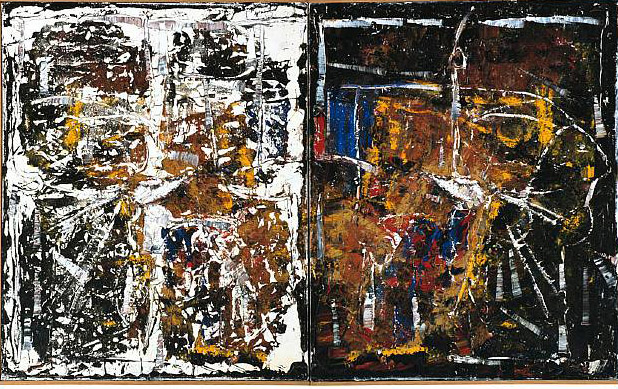
“The important thing is to produce. For instance, if someone asked me why I sketched 2000 owls, I would answer that it was to produce 10 lithos. But what really interests me is to have produced the 2000 owls.”
Jean-Paul Riopelle
###

 conversation is an engine