Try this: Be Ionic, Iconic and Ironic
Disturb Someone Today

The Minneapolis Institute of Arts manages to be ionic (columns), iconic (yes, the columns again) and ironic (colors on columns--really?)
It’s all in the mix. Start with an ancient form: a note, a letter. A poem. An email? Get the form just right and let it carry all it was meant to carry. Then bring it into today with an element that steps outside that form. The MIA does it with colored lights on the ionic pillars with are also iconic. Is the result beautiful? Not exactly. Several of us have thought a lot about whether those lights are right or wrong. We decided they are ironic.
That’s why I’m so fond of the cards turned out by Zeichen press. Old form. Old cold type. I’ve worked with quoins and frames and rollers that spread ink across a platen. Everything about the process shouts “old.” But the messages are anything but old. Their cards disturb even as they console or encourage.
How can you disturb someone’s attention by mixing up an old form with something of today?
###

When Writing is More than Writing: The Idea Writers by Teressa lezzi (Review)
Your invitation to a new way to persuade
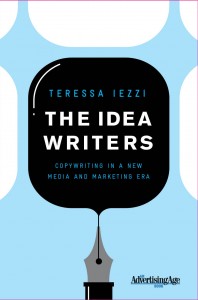 As editor for Advertising Age’s Creativity, Ms. Iezzi has a daily, close-up view of the trends in the creative world and the people behind those trends. The surprise in the book comes with the affection Ms. Iezzi has for the discipline of copywriting and the practical nature for those seeking to grow in the discipline. It is readable, informative and filled with stories about advertising heroes and insights into current campaigns. I plan on using it as text in my next class on freelance writing.
Ms. Iezzi begins by framing the story of copywriting with a look at the ground-breaking work of legends like Bernbach, Ogilvy, Reeves and others back in the 1960s. Their work was fresh in relation to what was going on around them. Indeed that decades-old work formed the basis of many of our current communication trends. Ms. Iezzi uses the legends to reinforce the importance of storytelling, which these guys got right. Storytelling is the concept that best binds together The Idea Writers, as Ms. Iezzi issues a kind of challenge to today’s batch of copywriters to push into the new ways of communicating.
Two powerful notions emerge from The Idea Writers:
- Copywriting today is much more than only writing. Maybe writing was always more pure than writing. Today’s copywriters will sketch designs, draft scripts, work out the voices of a cartoon and a blog persona. They will pitch ideas because they are closest to the energy behind the idea and because organizations run much flatter. This book helps break through the silos that are already on their way down.
- Today’s copywriters help guide brand development following new methods of persuasion. In this new age, people buying stuff have unprecedented control of brand. Today’s copywriter recognizes the stories that honor the people doing the purchasing while smartly positioning the brand as a kind of conversation partner.
Ms. Iezzi’s book is the first copywriting book I’ve read that does justice to the emerging notion of the switch from corporate monologue to personal dialogue. The only lame part of the book came when she trotted out her personal list of tiresome cliché ad ideas. Her list of six included things we all instantly know, but to say those ideas will never work again seems like a challenge. The list also invalidates the notion that we beg, borrow and steal good ideas constantly—it’s just that those ideas are more or less recognizable in a different arena.
###
Verbatim: Tell Other People’s Stories
In which I learn from my students

We see better together
We just finished our Social Media Marketing class at Northwestern College. One of my favorite assignments was when the students critique their own social media efforts: their Facebooking and Tweeting and especially their blogging. Each student established their own direction at the beginning of the class complete with written goals and objectives. All for the purpose of establishing a community in just a few short weeks.
Students learn great lessons. They learn about how details and minute specificity can help their work be found by search engines (that is, by people using search engines). There is always a moment of triumph when they get their first non-class participant. They learn that a number in a headline pulls in readers. They learn how commenting on other people’s work is another way of polite conversation that also helps expand their reach. Of course I am being reminded and learning afresh all the same things. My favorite learning this time:
“I began by writing about what interested me, but I’m learning to let my audience guide the topic choice by what they comment.”
This is a mature understanding. She went on:
“I’m realizing that this blog is not about what I know and can provide, but about what the community of writers can share with each other.”
Writing our commonality has a way of inviting others in. It is a way of telling a story together. We talked about “psychic income,” which we defined as the intrinsic reward we get from helping someone else and how that helps others participate to build the story and the community.
Her comment also speaks directly against the notion of a self-absorbed generation. Here’s a person learning to put the needs and interests of others ahead of her own. Not that she was any more self-focused than any of us: we’re all struggling to fathom how to set aside our personal, angsty issues to see what’s going on in others. Telling other people’s stories is precisely the beginning of drawing together a community.
###
Photo Credit: xplanes.tumblr.com
There’s Power in Connecting. Yet Most of us Remain Spectators.
The Stakes are Higher to Trigger Action
It’s easy to get all optimistic about how social media can changes things. That’s where Clay Shirky was when he wrote Here Comes Everybody. He cited (among many examples) how people organized using social media to demanded accountability from the Catholic Church hierarchy as the priest sexual abuse scandal opened (turns out the 60’s were to blame, and the church is all beyond that now, thank you. Somebody bought some great research!). Shirky’s book carried an optimistic tone that continually wondered at what was possible when we start connecting.
And many of us are training ourselves to read reviews of products before we buy. The thinking is that the opinion of several people we don’t know is more accurate than product advertising issued by the marketer. So smart marketers are learning to plant negative reviews along with positive.
And, of course, we’re watching people organize in Iran, Tunisia, Egypt and Syria to oust the corrupt leaders. So it’s just one small step to thinking about the awesome power we have when we connect: power to overthrow decades old monarchs, power to hold authority accountable, power to see through marketing hype.
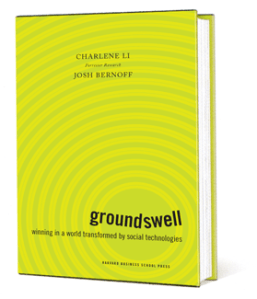
But Groundswell by Li and Bernoff helps cool that optimism to a more realistic pitch. Their Social Technographic Profile lets you pick a demographic and get a hint of how they interact with social media. And what you’ll see is that most people are spectators, independent of demographic profile. Most of us watch. From the sidelines. Which surprises no one: take any organization and you’ll find most people watching.
 The lesson is not to despair of our tendency to be spectators. The lesson is to find and create an irresistible magnetic pull around the things that are most important.
The stakes are much higher for getting and retaining attention.
###
New Medtronic CEO: Neutron Jack or Charming Nerd?
The World Needs Another Earl Bakken
 Before he was a Six-Sigma Savior, Jack Welch was Neutron Jack. Before Omar Ishrak becomes CEO of Medtronic, he was a disciple of Jack Welch and the GE religion. But the Star Tribune quotes industry sources as saying Mr. Ishrak is “…charismatic…and able to embrace, change or direct culture.”
When I was an employee of Medtronic, and even later when I served as a consultant, these were the very characteristics many remembered about Medtronic founder Earl Bakken. For many years Bakken’s signature caring, geeky optimism fueled the organization—long before the company was populated with neophyte Ivy-league MBAs and their outsized ambitions. Employees coming into contact with Bakken were uniformly energized by his caring, compassion and passion for healing.
In a very real sense, Bakken was the pacemaker of the organization.
Let’s hope Mr. Ishrak can pick up Bakken’s pace and energize the talented folks at Medtronic.
###
Schwarzenegger, Total Recall and the Offspring of Error
How does sharing mistakes affect our relationships?

Sharing can be painful
Today’s shocking revelation takes the form of a ten year old child as part of the reason for Arnold’s impending divorce. It seems the Governator worked a bit too closely with the hired help. Not that the child is at fault—and I fear for the child’s unwanted celebrity status. And this: divorce and broken relationships are not good and no child should be hidden. But there are lessons to learn.
Recently in our Social Media Marketing class we discussed how sharing failure draws readers toward us. Failing at preparing a particular facial mask, for instance helps us sympathize with the beauty enthusiast. Negative reviews at a website help offset glowing reviews and hint that the positive reviews might not just be cherry-picked. Poised to buy some spendy item, we look closely at the negatives to balance the positives. On a personal level, sharing our failures has a way of redeeming our relationships and drawing others toward us, though who knows what that might look like for Mr. Schwarzenegger and Ms. Shriver.
One of the underlying themes as we move toward this social sharing world is that companies no longer control the monologue because the monologue is now a dialogue, whether they like it or not. Letting go of control will mean less pleasant communication about our product or service will certainly surface. The question becomes how we deal with those negatives. We won’t be able to play Terminator. Instead we’ll need to share our true lies.
###
Quiet Leadership by David Rock. How to Help Someone Have an “Aha!” (Review)
Talk your friend into the answer she already knows
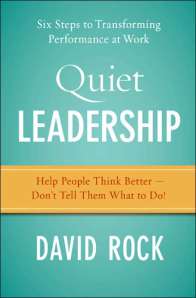 How do you help people connect the dots in their work lives…and in the rest of their lives? Turns out there is a lot we can do. And our primary tool is conversation. In Quiet Leadership, David Rock gives an overview of (relatively) recent neurological findings to show how our brains remain plastic, that is, moldable and changeable, long after childhood. It was once thought that at some point in late childhood our brains stopped—well, it’s not that they stopped growing, but seemed to create new neural pathways with less frequency. That thinking was all wrong. The truth is our brains are capable of growing new neural pathways all the time—new mental “wiring.” And by calling it “wiring,” Rock hints at the mechanics of how we help each other connect previously unconnected thoughts and motivations. He works at changing our mental wiring using questions about our thinking. Helping people find their own answers is light years more effective than telling someone what to do.
Like most books written for the business market, Rock presents a tidy set of steps to follow. Quiet Leadership has six steps. Each step has a chapter or section attached, so there is a lot of very practical, very interesting information for each. I outline these steps below because after reading the book and getting a sense of the potential, I’m curious to remember and try them:
- Think about thinking (focusing on how your conversation partner is thinking about the issue troubling them)
- Listen for potential (listening with a belief your conversation partner already has the tools for success)
- Speak with intent (Be succinct. Be specific. Be generous.)
- Dance toward insight (Conversation really is a kind of dance)
- Permission
- Placement
- Questioning
- Clarifying
- CREATE new thinking by exploring:
- Current Reality
- Explore Alternatives
- Tap Energy
- Follow up (Renewing and restoring the motivational connections by checking in later)
You may be skeptical of tidy steps. You may think “dance toward insight” is too over-the-top. I agree. And yet there is something in what Rock says that speaks to the reality of any conversation. Conversations routinely take off in crazy directions. Conversations often start with a need and we immediately feel helpless to meet the need: we don’t know all the details. Even if we did, we don’t know how our conversation partner is really thinking about the issue.
Rock provides a way to probe thinking (I like how he asks permission to probe) to not only help a person find solutions, but also to help a person be motivated to act on the solution.
I’ll use this book as I teach, with clients, and in general conversation. I highly recommend it.
###
Verbatim: Where will you stumble on mystery today?
Stuff Lingers Just Outside Our Explanations

Leviathan: Run. Or not.
Him: “Our biker friend crashed pretty bad. We went to see her in the ICU.”
Her: “All the bikers said they were praying and thinking about her. One gal wrote on the web page she was ‘sending her best wishes’.”
Him: “You know, ‘We’re sending you energy.’”
Her: “But we came in with words from the Spirit. They know we are Christians and bikers. Lots of people ask us to pray because it’s no big churchy thing. We just stop and pray for people wherever we are.”
Him: “We just try to tune in to what God is saying when people ask us to pray.”
Her: “We spent time with her. We prayed. We hung around.”
Him: “It felt substantial. Like something had happened.”
What happens in a conversation? What happens when God shows up?
###
Photo credit: Caroline Claisse for Art Observed
David Lynch, Creepy Coffee and the Power of Suggestion
Your slowest four minutes today

Just stand me in a cup, please.
David Lynch, as famous for swearing off marketing (literally!) as he is for making powerfully unsettling films, has his own coffee brand. His marketing is, well, unsettling. But it is marketing (proof: I’m passing it on. Oy! I’ve fallen for his demented plan.)
A couple days ago I wrote about how the power of suggestion helps my audience show me mercy as I show them my dumb sketches even as they fill in the blanks with their own story. It’s the power of suggestion: we cannot help but begin a story with every image we see. Writers have known this for years: using certain words and phrases that hint at something much more ominous (or much more glorious) without actually saying it. Copywriters love this tool.
In this slow-moving commercial, listen for the pauses even as you listen for the words. I found myself remembering from the video how much Barbie seemed to like me (especially ~ 1:50). Then I remembered BARBIE IS A DISEMBODIED HEAD WITH DAVID LYNCH’S VOICE.
Where and how have you been affected by the power of suggestion?
###
US to Issue Alerts by Text—Just Don’t Go all Hosni on Us
Just used for good. Honest.

Thanks, I'll keep that in mind.
We’re welcoming texts from the president, right? Amber Alerts, alerts involving imminent threats to safety or life, and messages issued by the president, as reported by the Associated Press in the Star Tribune. Users can opt in or out on the first two, but not the third. President Obama will have the ability to speak directly to us through the device in our pocket. That’s good—we want to hear from the president if some catastrophic thing happens. But wait—what if we get reassuring messages like Hosni Mubarak’s regime issued in February as reported by the WSJ? If I see “American middle-aged taxpayers beware of rumors and listen to the voice of reason. America is above everyone so protect it,” I’m going to get all fidgety.
Image Credit: P.Nguyen via Arrested Motion
###

 conversation is an engine