Go Find Yourself
Are you hiding in plain sight?
“Are you already doing who you are?”
That question barely makes sense.
Still, I like it because it combines process with self-identity and hints at motivation. To answer that question all you have to do is look at how you spend your day—and with whom—to begin to sort your priorities.
Matthew Crawford’s book The World Beyond Your Head: On becoming an individual in an age of distraction (NY: Farrar, Straus and Giroux, 2015) is not a quick read. But it is a satisfying text because he pulls back the draperies hiding some daily mysteries we live without thinking.
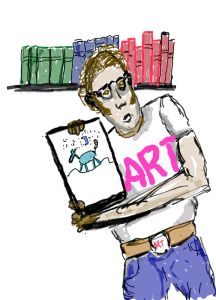
For instance, I found out I am an artist. Of sorts.
Like work.
Mr. Crawford, the philosopher/motorcycle mechanic dismantles the notion of work and rebuilds it around the cylinders of service and ability and passion. (Wait—only three cylinders? What sort of wimpy metaphor is that? Don’t blame Mr. Crawford—that’s just my take on it and I’m only ¾ of the way through the book.)
Mr. Crawford notes that we must submit to a discipline—this is important—to become useful and adept at that discipline. Sort of like knowing the rules well so that you can break them well:
- Mechanics must know the fundamentals of engines to work on them.
- Writers must know how to speel, and the must know a grammar, to right. Otherwise, misunderstood. Are they?
Mr. Crawford’s take on authority is powerfully counterintuitive: we submit to the authority of a discipline so we can work within the logic and expectations and outcomes of that discipline. Along the way, after practicing that discipline for a time, it turns out we come to understand life through the tools and foci that discipline affords.
This notion of authority is counterintuitive because we Americans like to speak ill of authority every chance we get. I may be chief among the ill-speakers. That needs to change (though, of course, speak truth to power, and so on).
Here’s the point: looking back over the disciplines we’ve come to use every day is a key to how we understand the world and how we process life. Some people understand life through their writing. Some people process life through their woodworking. Some through watercolor or costume design or clipping topiaries.
There is a link between who we are and what we do.
###
Dumb sketch: Kirk Livingston
Colbert: On Flop Sweat and Embracing the Bomb
Man in spotlight laughs with failure

Lovely death mask courtesy Time magazine
The recent excellent GQ article (By Joel Lovell) on Colbert illuminates the thoughtful wells the comedian will pull from as he starts his late night gig tonight. Is he a moral intellectual? A public thinker? A likeable guy on stage who talks with a knife? Is he a comedian with a charter to entertain?
Yes.
One revealing quote deep in the article shows Colbert’s dance with failure:
…longtime Second City director Jeff Michalski told them that the most important lesson he could pass on to them was this: “You have to learn to love the bomb.”
“It took me a long time to really understand what that meant,” Colbert said. “It wasn’t ‘Don’t worry, you’ll get it next time.’ It wasn’t ‘Laugh it off.’ No, it means what it says. You gotta learn to love when you’re failing.… The embracing of that, the discomfort of failing in front of an audience, leads you to penetrate through the fear that blinds you. Fear is the mind killer.”
What is true for improv and comedy is also true for teaching, business meetings and ordinary conversation. We just might fail. We might fail to connect. We might fail to convince. We might fail to feed the self-image we continually tend, whether that image is macho or hip or knowing or controlled.
I cannot help but wonder if our growing xenophobia—an unfortunate currency in play by many presidential hopefuls—is a response to fear of honest but hard conversations. That kind of conversations that need to happen between us. All of us.
Philosopher turned motorcycle mechanic Matthew B. Crawford’s insightful book The World Beyond Your Head: On becoming an individual in an age of distraction (NY: Farrar, Straus and Giroux, 2015) writes about the role of apprenticeships and (some) graduate programs in helping the newcomer absorb the wisdom and knowledge of the group. Growing understanding happens through didactic methods of course, lecture and the like. But much of what we know arrives as a sort of tacit knowledge—a kind of knowledge that shows up from watching others do a task.
On the way to this and many other connected points, Crawford points out again and again that we need the conversations and the interactions with others in order to understand who we are. We need interactions within our tribe—yes—but we also need the interactions outside our tribe. These can be clarifying interactions: they help us understand what we know and what we believe about the world.
All this to say:
- I look forward to Steven Colbert’s masterful comedy/public thinking.
- I want to grow at hard conversations—even if they gut the self-image I so carefully tend.
- I/we need to embrace the people who are different rather than push them away. They have powerful things to teach us—and that is part of the collective wisdom of our U.S. of A.
###
Mythical Minneapolis
Once every 100 years, you can almost see it.

###
Image credit: Kirk Livingston

Just Do It—Out Loud (DGtC#31)
But what if I’m a scaredy-cat?
I’m toying with the notion of starting conversations people won’t like. I’ve advocated and agitated for having the difficult conversation:
- Even if I don’t know all the answers,
- Even if I don’t have all my ducks in a row,
- Still, start the conversation.
It’s a faith thing: faith that pressing thoughts into words and sending them clanging out at a conversation partner will have a positive effect. The faith part has to do with hoping we’ll get through it and still have a relationship.

My friend is a hospital chaplain. He and I have talked several times about the sort of sacred space he tries to step into at the bedside of a dying patient and family. It’s typically a quiet space, through deeply-charged with emotion. He comes to listen, he says. Platitudes and easy answers are not part of his game plan.
At these moments, just before the end, all sorts of unsaid stuff gets suddenly said. Confessions. Sorrow. Hopes and dreams. Oddly, even the very most mundane, ordinary things—weather, lighting, parking, “the soup is too salty”—are also said. But these ordinary words have more to do with human connection and presence than transferring information. The words themselves communicate far more than Webster’s dictionary would allow.
“Sometimes people just need to hear themselves talk,” said Dave, the chaplain.
So he listens.
And the process of letting-go unfolds.
You’re Doing it Wrong
Surely we’re doing things wrong if we hold our most important thoughts in stasis until we show up at a loved one’s deathbed. Or until we wake up on our own deathbed. There’s got to be room for saying what’s really on our minds, even if uncomfortable, even if potentially relationship-threatening. I suspect that saying our important stuff out loud is sometimes a work of fierce determination. There are times where we must force those words up the esophagus and out through the lips.
Saying our most important stuff will not happen on Facebook or Twitter. Those spaces are loaded with an image we’ve carefully primped. We are agreeing and agreeable in those places.
No—I want to cultivate those raw conversations. I’m thinking of those conversations that happen after driving 1700 miles together. The conversations that happen at the end of a long evening talking with friends.
Is it possible to bring those kinds of conversations into regular life—even if they make people uncomfortable? Even if it goes against my grain as a people-pleaser? Those are the conversations where growth can happen.
What have you left unsaid today that really needs to be out in the open?
###
Image credit: Kirk Livingston

Why we don’t know what we don’t know
“As I was telling Mrs. Kirkistan…”
Our unguarded responses in conversation often point a way forward. It’s just that we don’t realize it until we’ve said it. And even then, it may take us recollecting that statement, in yet another conversation, to an entirely different person.

Sometimes we carry our own answers
Example: sometimes I think writing is the stupidest thing to do on earth. This is not my standard line with writing students. But sometimes I swing low, like after I finish a big project and stop to calculate the return on (mental) investment.
Note to self: Never stop to calculate the mental ROI on a writing project. Just keep writing.
I was describing to Mrs. Kirkistan how it is I’ve come to believe writing is the stupidest way to spend your time—bar none. In that conversation, after several (verbal) paragraphs about all the frustrations of writing and why I’ve come to despise it, I found myself defending the process and telling of the delights of writing and what I want to do next.
How did I just travel from one conclusion to another within 90 seconds?
It’s almost like opening a water tap in a long vacant house: you let the water run until it is cold, then you drink. I know with writing you have to write a lot of dreck before you ever get the useful and true stuff. Same with verbal conversations: sometimes we just talk to fill up the space between us. And then sometimes the true thing just spoken—that thing that landed between us—is the very answer to an unasked question.
We unwittingly answer our own question.
But, this: we need to listen so we can hear what we already knew.
Moral: make sure there are some unguarded responses in each day. And listen to those unguarded responses to help sort what you don’t know.
###
Image credit: Kirk Livingston

 conversation is an engine