Things to do while waiting.

Photo Credit: FreeDigitalPhotos.net
Active waiting: when you’ve done all you can to move in this new direction, but God needs to open the door. Where to stand while you are waiting? Check out Finding Solid Ground in Slender Times at the The High Calling. org.
The Pleasures and Sorrows of Work [Book Review]
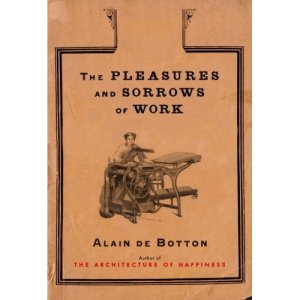 Alain de Botton (The Pleasures and Sorrows of Work, (NY: Pantheon Books, 2009)) is the guy you want on your next trip. He sees things the rest of us pass over as invisible: the electrical pylons running zig zag across the countryside, the huge grey warehouses plunked into industrial areas, the airplane junkyard in the California desert. And then he does one better by somehow inviting himself in to hear about the work and workers who made or use these invisible objects. All this curiosity is in the service of the question: What is it people really do all day with their time? And could I really understand even if they told me?
De Botton reveals the glories of tuna, from the Indian ocean to a grocer and table at home in London; the secrets of shipping (ships, warehouses, labyrinthine but well-timed world-wide movement); biscuit (cookie) production, rocket science, accountancy, painting and other things. Each a fascinating journey into the work practices and one psyche of the worker and artist.
De Botton seems to understand much, especially about the joy of finding meaningful work and the despair of having meaning sucked away. Where solitary baking for oneself or one’s family can be a joy, when the process is set on an assembly line with each stop isolated and optimized for the biscuit factory floor, when responsibility has been removed from each individual worker, it is up to the bosses and managers to re-inject purpose back into the work. Much like slipping niacin and riboflavin back into the stripped- down biscuit recipe.
Always entertaining, de Botton doesn’t mind climbing up on his soapbox from time to time to deliver mini-sermons about the nature of work. De Botton’s “School of Life” espouses the return of the secular sermon, so it is not surprising The Pleasures and Sorrows of Work does not mention the Creator’s involvement in our work. That’s too bad, because there is much to commend the (Biblical) notions that we were made to work, that when our work is harnessed to serve others (versus fulfilling our demand for meaning) we can find moments of transcendence. Plus the added bonus of the truth of the Biblical notion. De Botton does, however, offer robust hints about our current obsession with finding meaningful work. Namely, we add to the pressure when we expect our work to fulfill us. Another criticism may be the occasional flights of fancy de Botton takes as he verbalizes what may or may not be occurring in the minds of these workers.
A very entertaining read. Highly recommended.
###
Busking and the Urge to Hone Your Craft
Meet Rob Firenix. He’s a British showman, part juggler, part fire dancer, part street actor and stand-up comic who has traveled and worked in 55 countries. I met him last weekend in Windsor, Ontario at the International Busker Festival.

Rob Firenix is Captain Underpants
While Windsor city workers remained on strike (14 weeks plus), garbage piled high around garbage cans with parks and museums going to seed, Mr. Firenix and other buskers honed their craft for free (at least until they passed the hat), depending on delighting the crowd to earn their keep. It’s worked for the last eight years for Mr. Firenix.
With a background in corporate theater and experience choreographing large shows, he found he loved the freedom of performing live before audiences on the street. Pulling from another earlier job of working with people with disabilities, Mr. Firenix wants to make things accessible for everyone. It’s this attention to making the show easy to understand that also brings in the levity.
“I love it when people can have a laugh.”
One of the best parts of busking is “speaking directly to his audience” said Mr. Firenix. He is constantly tweaking his show to see what laughs he can get and how he can go further in delighting his audience. His current show is a character-based performance (“Captain Underpants”) that often features a pair of audience members in the ridiculous tights as well.
Was his craft comedy? Or was it the juggling or firedancing?
“The show is the craft,” he said. “Getting people to stay and enjoy the show is the craft.” He explained that a crowd may watch a person juggle for three or four minutes, but there has to be something more.
“It’s all about presentation.”

Willing Audience Members. In Tights.
As a communicator, I found myself in awe of Firenix and other buskers who worked on their craft out in the open, depending on impulse generosity for their bread. It’s a gutsy way to go about work—especially poignant in a city on strike because of limited post-retirement benefits. It says he is serious about the craft, that honing the craft is not a luxury but a necessity. It also points to the presentation as something of primary importance: people need to be engaged and stay engaged or they walk away.
Buskers also show there can be more to work than money.
###
Corpse of the Month
 I saw this bumper sticker a few years ago (8/11/2004) but just ran across it again today in my favorite quote pile.
Care for the Communicator’s Soul
![517geRI9byL._SS500_[1]](https://conversationisanengine.space/wp-content/uploads/2009/07/517geri9byl-_ss500_1.jpg?w=300&h=300 "517geRI9byL._SS500_[1]") As a communication manager for a medical device company, my colleagues and I understood the company would push as far as you would go, using every last drop of your energy. Oh sure, there was talk of work/life balance—that would be the official line. But the reality was that expectations constantly ratcheted up and, depending on the ambition of your director/VP, an imbalance toward life (versus work) was not well received. Given this set of conditions, where does the communicator get the courage to take care of themselves?
As a communication manager for a medical device company, my colleagues and I understood the company would push as far as you would go, using every last drop of your energy. Oh sure, there was talk of work/life balance—that would be the official line. But the reality was that expectations constantly ratcheted up and, depending on the ambition of your director/VP, an imbalance toward life (versus work) was not well received. Given this set of conditions, where does the communicator get the courage to take care of themselves?
I thought of how to combat this set of conditions recently after conversations with two talented friends who had been sprinting through their work lives for the last two years—both of them at a medical device company notorious for burning personnel down to the nub. Two answers come to mind: craft and spirit.
Craft
In Shop Class as Soulcraft: An Inquiry into the Value of Work (NY: Penguin Press, 2009), Matthew B. Crawford makes the point that the trades are actually intellectually stimulating (writing from the standpoint of a philosopher/motorcycle mechanic) while the work of knowledge workers more often approaches the work of clerks as actual decisions and craft move up to the corner office or out of the office altogether. I think Crawford is right. I suggest that finding a corner of one’s work life to practice one’s craft may have a healing effect on the soul. For me it had to do with getting back to handling sentences and spinning out arguments with words that served clients and their worthwhile activities. But another friend’s craft is directly related to helping members of an organization live up to their gifts and the organization to its stated vision. Doing what we’re meant to do has a healing effect.
Spirit
There really is no one who will shepherd your soul at work—unless you have a pastorally-gifted person in the cubicle next to you. On the other hand, the gift of conversation is one of the deep joys of working with great people. And there is nothing like an honest conversation to refresh the soul. Of course, I’m not talking about the catty cynicisms that pass in gossip around the coffee station—those rob the soul as surely as the micromanaging boss. Our spirit is refreshed by honest conversation—it’s part of how God made us.
If we can carve out time to practice our craft and watch out for our spirit (and, perhaps, even the souls of the people around us), we may find ourselves with the courage to say “No” to running on empty.
###
Iran Protests Demonstrate Our Deep Need for Dialogue

Down with one-way messaging!
I’ve been talking with different folks about a theology of communication—how we’re made to dialogue rather than just politely accept one-way messages delivered from on high. The protests in Iran are a living and vivid demonstration of this very thing. People are finding each other to protest twisted election results and the government doesn’t like it. And yet—shouldn’t anyone in a position of leadership begin to expect this very behavior? The protests demonstrate Clay Shirky’s argument (Here Comes Everybody) that these new social media tools allow people to find each other, not just without the benefit a hierarchy of bosses and managers and leaders, but in direct opposition to the bureaucracy. Just think how this will continue to work its way out when we’re not threatened by government action. Searching and organizing will become the new norm. Maybe they already have.
###
The Power of “Search”

We search for what we know is important.
This one simple function has changed the way I personally create and access information. With a few keystrokes I can locate any particular word on my computer. This is great because often I can remember only one word of something I’ve read or written, and I certainly cannot remember which document it was in. Contrast the power of search with the old ways of keeping information in tight categories so that if I needed something, I followed a trail of folders which would (eventually) lead to the right document. I gave up on tracking actual physical pieces of paper long ago. “Search” not only saves time, it ends up being more precise.
Clay Shirky, In Here Comes Everybody: The Power of Organizing Without Organizations makes the case that the power of search is changing the way we organize and access information and the way we organize and access each other. We can come together now as we search out common problems and interests. Shirky contrasts these new ways of organizing by showing how complicated organizations have become: the larger the organization the more complicated the structure required to track work, direct workers’ movements and facilitate clear communication. Shirky offers a fascinating discussion of where org charts came from (they helped railroads establish clear communication so west-bound and east-bound trains could share the same track). There will always be org charts, but will they tell the whole truth? With this new “freedom to find,” large companies are beginning to see lines of authority blur. We will (also) always have bosses, but bosses will not always have the power of superior knowledge. I wonder how those relationships will change over time? One of Shirky’s points is that nimble new organizations are already taking advantage of this non-organizational way of organizing. He points to Flickr (versus Corbis) as an example of an organization that depends on user-generated organization as a successful model for the future. The contrast between Flickr and Corbis is not completely fair because of the differing goals of the two organizations.
Of course, we hear endlessly about how Facebook, LinkedIn, Twitter, and the other various social media are changing the way we connect. And we know from personal experience how Google has become our first source for answers to questions. The future of communication—where who we listen to will have less to do with lines of authority or the budget to develop clever messaging and purchase media—and more to do with how we access information. As we search on interests, hobbies, problems, solutions, vocation, avocation and whimsy, we’ll bypass gatekeepers, generate more word of mouth (physical and/or computer-mediated), and quite possibly, more truth.
###
Don’t Let the Door Hit You on the Way Out (and Don’t Burn any Bridges)

Don't burn your bridge
There’s a flurry of lay-off activity these days over at a large client I’ve worked with for a number of years. I know because I’ve heard about it from a few different folks. I also know because lots of those I’ve not talked to are buffing their LinkedIn profiles and adding contacts like crazy. The rate of contact additions I see tells me these folks are not expecting to make it through the current set of axe swings. One guy told me they were expecting marketing to lose 30% of their people. One never knows how true these things are, but it is reason to take action.
In the medical device community I spend a lot of work time in, you never know if the fresh kid who started last year will be the director of marketing next time you come calling—so it only makes sense to not burn bridges on the way out. Friends—keep your options open as you welcome the next phase of your work-life.
###
Steal Our Ideas: Ok.
I’m designing a college writing course for aspiring copywriters. This site looks like a promising resource.
Read about “Building a Generous Brand”
Check out John King’s article about Building a Generous Brand in Ad Age. This is a positive step, when an agency as forward-thinking as Fallon starts considering how brands can “give back.” This is also an excellent way of thinking about the dialogue that consumers really want to have—versus the dialogue marketers wish consumers wanted to have. Is this more evidence that the days of one-way messaging are going away? The danger is that the generous brand becomes just another manipulative gimmick. But in this new dialogical age, such chicanery will be found out, posted and soundly dressed down.
###

 conversation is an engine
