Tom Scharpling: “A problem never comes without a gift in its hand.”
On creating for love not profit

Everything has worked to my benefit, even the things that felt, at the time, like they were working against me. A problem never comes without a gift in its hand. You may not even be aware of it until five years later.
–Mike Sacks, Poking a Dead Frog: Conversations with Today’s Top Comedy Writers.(NY: Penguin Books, 2014) 277
###
Image credit: Kirk Livingston
How to Focus. And Why.
Sometimes it’s hard to see past the niggly imperfections of the day.

Fie on the dirty windscreen.
What glories have we missed?
And sometimes we use other tools and attitudes and conversations to get clarity.
###
Image Credit: Kirk Livingston

Start at the Top. Again. (Copywriting Tip #10)
Tell Yourself the Story
Imagine holding a long piece of tangled fabric. You hold it high above your head because you want gravity to gradually unravel the twists and tangles. Maybe you shake it. Probably you smooth it out: starting at the top again and again and work your way down the length to get the fabric straight or flat.

Many threads to unravel.
What works for fabric also works for a complicated idea. Sometimes the only way to unravel a complicated topic is go back again and again to the beginning, flattening and shaking out the twists and turns as you retell the story.
I’ve recently finished up a complicated article about our changing health care system. The article had lots of moving parts. It was not a long article, just dense and in need of translation: from jargon-filled, industry-speak to human.
Time and again I found myself stuck in the middle and staring at the screen: so many bits and pieces to fit. Absolutely stuck and wondering how to line these parts up so they make sense (and so they are sorta interesting for the target audience). Because in the end we read one word after another. We read in a linear way, even though the story may compose itself in our brainpan in non-linear chunks.
The only way I could get myself unstuck was to start at the beginning again. Back to that very first paragraph, and work my way through. Sometimes I would modify that paragraph to fit what was next. Sometimes I would modify what was next to fit the lede. But the only way forward was through the beginning.
During National Novel Writing Month I found myself doing this, mostly as a way to find out where the story was going and how it could possibly move forward. It was a way of telling myself the story hidden in the words already written. There are one thousand ways to write the story and some will present as we retell it to ourselves. And so we pick one.
Sometimes retelling the story again and again is the only way forward, because it leads to understanding:
By the way, a wonderful book about locating the story of your own life is Parker Palmer’s Let Your Life Speak. Check it out.
###
Image credit: Kirk Livingston
George Saunders: How do you energize someone?
Sometimes it will be a word.

Bright bits among the ordinary.
George Saunders, on the odd little Zen parables he heard growing up. Told for laughs, they also carried deeper hints about how to live and what is important in life:
My whole childhood we lived next door to this family I’ll call the Smiths. We didn’t know them very well at all. At one point, Mrs. Smith’s mother, who was in her nineties, passed away. My dad went to the wake, where this exchange occurred:
Dad: “So sorry for your loss.”
Mrs. Smith: Yes, it’s very hard.”
Dad: “Well, on the bright side, I suppose you must be grateful that she had such a long and healthy life.”
Mrs. Smith (mournful, dead-serious): “Yeah. This is the sickest she’s ever been.”
My dad came home just energized from this. I loved his reaction.
–Mike Sacks, Poking a Dead Frog: Conversations with Today’s Top Comedy Writers (NY: Penguin Books, 2014), 241.
###
Image credit: Kirk Livingston
Beer, Soda, Daughter: What to pick up? What to put down?
Fatherhood’s tricky questions.

Makes a guy laugh–or is that a grimace? More on laughter here.
###
Image credit: Kirk Livingston
How Art Gets Created (Homage to Howie Becker)
I
followread and follow Keith Sawyer. Here’s an excellent post from him combining art and collaboration.

My approach to creativity was deeply inspired by Howie Becker’s 1982 book Art Worlds–a close analysis of the work done by painters, sculptors, and photographers, of course, but also all of the other roles necessary to get art done and to get it valued, sold, and talked about. Becker made a convincing argument that art doesn’t come from the solitary artist in the studio; there are many other people involved. They remain hidden only because we aren’t looking for them–we believe so much in the romantic myth of the solitary lone genius that we look right past everyone else involved in the collective creative process.
Basically, Becker believes that Yogi Berra was right: you really can observe the most by watching.
This quotation comes from a fascinating portrait of Becker in the latest New Yorker magazine. Becker is now 86 years old and spends most of his time in Paris…
View original post 287 more words
Sam Amidon Owns His Process
And wait for the story about sleeping on the fuzzy brown donkey.
Yesterday I wrote about owning your process. Sam Amidon owns his process: check it out. He’s an original.
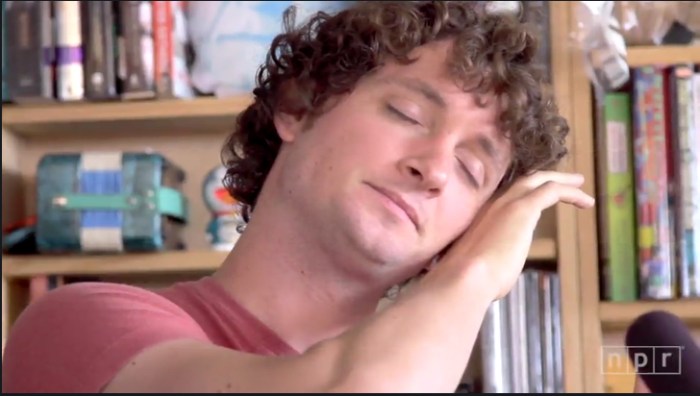
Click to play.
Plus Bill Frisell as back-up guitarist! What?
###
Own Your Process
Ownership Sparks Creativity in Art & Work & Life
One key differentiator between working for the man (every night and day) and working for yourself is ownership. Working for yourself you own the beginning, the middle, and the outcome.
Especially the outcome.
Some of my favorite colleagues over the years—the very ones who advanced in whatever they worked at—found ways to own the process. These were the ones not content to follow orders. Instead they made the work their own, found their own way, employed their skill and imagination. I’ll argue that owning the work sparked their creativity to accomplish the task. And I’ll argue that ownership looked like responsibility for the outcome. So despite working for the man, they took ownership, made their own meaning and became, well, the man.
Over at Dumb Sketch Daily I’ve been producing a dumb sketch every day for the last 39 days. I was sorta proud of this dumb sketch:

Then a commenter suggested abstracting it, which I tried, given my limited art understanding and abilities (here):
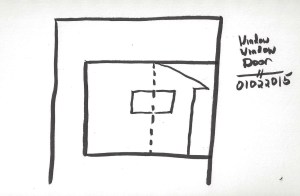
You can see the result is…simple. But it is my own (not that anyone is lining up to take credit). The commenter’s comment helped me continue my odyssey toward learning to see.
My only point is that developing new skills requires a certain elasticity. We try new stuff and get it wrong again and again and again. And we keep failing until maybe, one fine day, it turns out sorta OK.
A lot happens when we take ownership for developing our own skills. And a lot of good can come from taking responsibility for our client/boss/friend’s desired outcome.
###
Image credit: Kirk Livingston
The Talking Part of Writing
Talking Through the Valley of the Shadow of Death
When it comes to brand new, unpaged ideas (that is, not yet written), J.K. Rowling is right:
But at some point every idea needs to make contact with an audience. Writers want their idea fully-formed with beautiful plumage before they exhibit it to anyone (lest someone call my baby ugly). Copywriters know this is not possible when it comes to collaborative writing—writing that serves some mission or purpose for an organization or cause—which needs client eyeballs as a part of the process.
Because Lillian Hellman is also right:
And Nora Roberts is especially right:
There’s the writing. And then there’s the fixing. I often think of the fixing as equally creative as the original writing. Great and wonderful things happen at the fixing/revising stage.
There is a point in every copywriting project where it must be discussed. It must be read aloud. And the key is—especially with new clients—fail faster.
I recently made a category error with a new client and I’m wondering how high a price I’ll pay. Rather than insisting on an early reading and sharing first thoughts when the bar was low, I let my content slide through several holidays until the deadline is an approaching storm and the bar is high for the copy to be right on the first reading.
Which it isn’t: it’s full of questions.
Which is almost always the case with a new client. Especially if the topic has a lot of moving parts.

So lesson learned (again): insist on failing faster and earlier.
###
Image credit: Kirk Livingston

 conversation is an engine