Back Off Howdy.
Some toys are too friendly.

Toys you hoped to forget, now showing at the Minnesota Historical Society.
###
Image Credit: Kirk Livingston
Lack of Imagination and the Middle Mind
Curmudgeon Curtis White May Be Right About ‘Merica
Two friends sat with another friend in a hospital room.
With their friend plugged into monitors and IVs, with frequent interruptions by staff and generally surrounded by unyielding clinical protocols—the best conversation these two friends could muster was…silence.
What to say with someone so needy and so plugged in? How to name the thing their friend was experiencing? Could they talk about his condition and/or prognosis, or was it better to talk about something different entirely?

One friend, the artist Nicolas Africano,
pointed to a length of clear plastic tubing suspended above us, “That amber light is beautiful.”
The other friend, Curtis White responded:
And there in fact was a tiny amber light in the middle of the tubing, a little light I hadn’t noticed at all. It was bright like an isolated star. It triangulated us. Suddenly, the situation changed for me into something completely other than it had been the moment before. We’d been translated. Reordered. Nicholas’s comment reconstellated us. I had a powerful feeling that everything has just been changed utterly and made—what other word was there for it?—beautiful. I smiled, suddenly happy. I looked at Nicholas in awe. And I thought: “You can do that?!”
This is the framing story for Curtis White’s The Middle Mind (NY: HarperCollins, 2003), which is not an easy book.
It was hard for me to stick with it right up until it became hard for me to put down. White comes across as an elitist, academic know-it-all who seems to enjoy pointing out the dark side of everything I hold dear (Terry Gross a proprietor of the middle mind? Really?). Although he insists he is not interested in “high/low culture distinction,” it wasn’t until my second time through the book that I began to understand how his framing story (the amber light in the hospital tubing) is a call to use imagination to see things differently.
White’s “middle mind” is a form of management, a strategy used by leaders in entertainment, academic orthodoxy and political ideology that prevents people from finding their own way. The middle mind management strategy offers up a set of topics that look and smell like genuine thinking, but in fact, are designed to keep an audience from stepping outside the boundaries. Perhaps White’s notion of the middle mind is something like how we get our kids to go to sleep at night: “Would you like to brush your teeth before or after you put on your pajamas?” (See what I did there? Putting on pajamas and going to bed was not one of the choices. Sneaky.)
 White indicts everyone from journalists to entertainment to business. He castigates the American public for lack of imagination to see outside the news cycles and ridiculous sound bites and a two-party political system. The book is more than ten years old, so was written back when the drums of war we being beaten with particular urgency (then again, when is that not happening?). Ten years on, there are legion more opportunities for middle mind observations. Facebook and “following” and Twitter and, our celebrity worship—there is no end of examples.
There is much to disagree with in Mr. White’s book (for instance, his sweeping dismissal of faith). But his underlying notion that we need to get back to the work of using our imagination to interact with our institutions and work and leisure is a valid call to action and worth considering.
###
Image credit: Kirk Livingston


No, Really: What does a Philosopher do?
When Adjuncts Escape
Helen De Cruz has done a fascinating and very readable series of blog posts (Part 1, Part 2, Part 3) tracking the migration of philosophical thinking from academia into the rest of life. As low-paid, temporary workers (that is, “contingent faculty” or “adjuncts”) take over more and more university teaching duties (50% of all faculty hold part-time appointments); smart, degreed people are also starting to find their way out of this system that rewards increasingly narrowed focus with low pay and a kick in the butt at the end of the semester.
Ms. De Cruz has a number of excellent interactions with her sample of former academics (at least one of whom left a tenured position!). I love that Ms. De Cruz named transferable skills. What would a philosophy Ph.D. bring to a start-up? Or a tech position? The answers she arrives at may surprise you.

Why the Nichols Station Apartments look different.
I’ve always felt we carry our interests and passions and skills with us, from this class to that job to this project to that collaboration. And thus we form a life of work. Possibly we produce a body of work. We once called this a “career,” but that word has overtones of climbing some institutional ladder. I think we’re starting to see more willingness to make your own way—much like Seth Godin described his 30 years of projects.
The notion of “career” is very much in flux.
And that is a good thing.
Of particular interest to me was the discussion Ms. De Cruz had with Eric Kaplan. Mr. Kaplan found his way out of studying phenomenology (and philosophy of language with advisor John Searle!) at Columbia and UC Berkeley to writing television comedy (Letterman, Flight of the Conchords, and Big Bang Theory, among others). If you’ve watched any of these, it’s likely you’ve witnessed some of the things a philosophical bent does out loud: ask obvious questions and produce not-so-obvious answers. And that’s when the funny starts. It’s this hidden machinery that will drive the really interesting stuff in a number of industries.
Our colleges and universities are beginning to do an excellent job dispersing talent. That thoughtful diaspora will only grow as time pitches forward.
###
Image credit: Kirk Livingston
“Good to Know” and a Failure to Communicate (DGtC#23)
I’ve said too much already.
If you hear this, you’ve said too much. You’ve said more than someone wanted to hear. “Good to know” is a polite way for your listener to indicate, “Please. Shut it.”
Why do we say too much?

Maybe we are excited about a topic. People will often have mercy with this motive. Sometimes the excitement rubs off. Our favorite professors and speakers demonstrated their enthusiasm for a topic by going on. And on.
Maybe it is a nervous tic that flows from fear of awkward silence.
Maybe we are hiding our tracks, like the alcoholic filling up verbal space to avoid the obvious question. Maybe our rush of words is like throwing everything at the wall to see what sticks, to throw our interrogators off our track.
Maybe we’re signaling dominance. Stringing together buzzwords at a rapid pace is a time-honored tactic in corporate meetings where you have no clue how to respond. The tactic usually ends in promotion because higher-ups read “kindred spirit” in your fast mumbling. Maybe our club or church or group listens for key words to show who is in and who is out, so our rush of words is a frantic attempt to show we are in.
“Good to know” is a proper, dismissive response to much of the advertising done to us: superfluous, out of step with regular life and an obvious pitch for our pocketbook.
But when we hear “Good to know,” it may be worth stepping back and getting momentarily meta, and thinking, “Oops. I might have misjudged this person’s interest. How can I get back to connection?”
Connection is the place to be. Connection gets along well with enthusiasm and does not mind probing into track-hiding. But connection does not abide dominance.
See also: How be a verbal philanthropist (#14)
###
Image credit: Kirk Livingston
Cure for the Common Blahs (Millman + Godin)
Take Two Books and Call Me In a Week
I’ve been reading Seth Godin’s The Icarus Deception (NY: Penguin Books, 2012) and Debbie Millman’s How to Think Like a Great Graphic Designer (NY: Allworth Press, 2007). Both books convey hope that work can look different—more personal and more meaningful—than any corporate recruiting brochure can ever let on.

@JamesVictore : “Although I used that word ‘perfection.'”
Mr. Godin’s message is consistent with his blog and other books: find a way to not submit to corporate overlords and their pre-packaged (wonderful) plan for your life. Make your own way. Along the way he hints that owning your work can happen in a variety of ways (even if working for the man). I’ve always appreciated Mr. Godin’s sense that art is about making connections and doing new things that spring from one’s brain/desire/compulsions/passions applied to a real-world problem. I would argue that kind of passionate living can happen in a big company or on your own—but we must all keep a sharp eye out for when life and work become rote ruts (which require re-routing).
Ms. Millman’s book is an absolute delight to read because it consists of 20 conversations with designers whose work has set them apart for years. People like Stefan Sagmeister, Neville Brody, Paula Scher, Emily Oberman, Bonnie Siegler, Paul Sahre, James Victore, Massimo Vignelli and Milton Glaser. The genius of 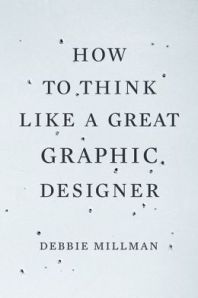 Ms. Millman’s book is two-fold: asking penetrating, questions (1) and then standing aside (2) to let each designer spool out their answers in the way they choose. I’m certain each question and answer was edited, but Ms. Millman’s book gives a sense of hearing the very crux of what drives each person’s creativity in their own words. Their answers provide lessons in the habits of artists, how to combat the woo of popularity and the lapses into isolation. Some of these designers have succeeded and failed and succeeded and failed—so look also for lessons in starting over from scratch.
I’m no graphic designer—maybe you aren’t either.
And I’m no artist (perhaps you are?), but Godin + Millman together provide a satisfying set of snapshots that keep anticipating the very personal work your problem-solving can accomplish. The advice and hope from each book make me want to look for problems to work on that take advantage of what I love doing.
Both books present forward-looking ways of relentlessly defining, redefining and doing your own work. And make no mistake: again and again it is the work itself that pulls these talented people deeper into their talent and continued relevance.
What is your work today?
###
Image credit: Kirk Livingston
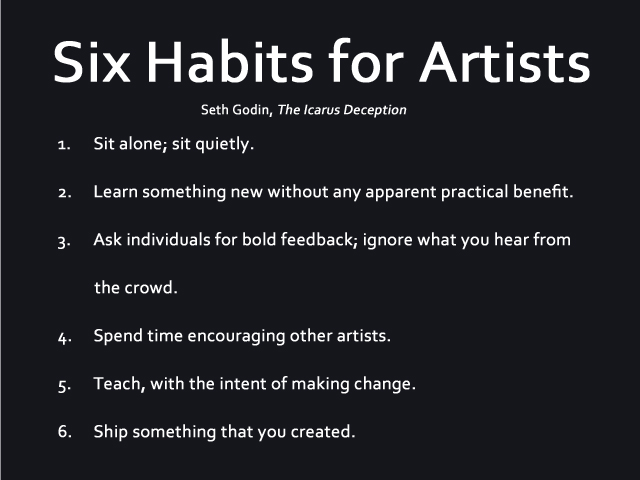
Seth Godin: Six Habits for Artists
Especially #6: Ship it.
I like Mr. Godin’s expansion of “artist” to include anyone trying to make a connection (full definition here). If you are trying to create, you’ll find these six habits useful.
###
How to keep talking even after you die
Independence is more than the freedom to buy a bigger television
Those who turned a conversation about independent national rule into a document that was then signed and sent—those people are long dead. Yet these 238 years later we continue to discuss what they did, what they signed, and what they paid for their declaration of independence.
Our declaration of independence.

Who doesn’t want independence?
The conversation they began is a very human conversation and so continues today, not just in the U.S., but around the world. Blood, tears, death and life show up wherever the conversation pops.
Our part of the conversation mixes in economics and justice and race and work and a lot of big dreams for our kids. Sometimes our nationalism tells our faith what to do. And sometimes our faith dresses in flags for coercive ends. And sometimes faith and citizenry collaborate in productive ways.
This declaration of independence has spurred a very long conversation and we each participate in our own way. Sometimes I wonder if our independence is only about getting bigger televisions. My hope is that we will come to increasingly relish our freedom. I also hope we’ll pay enough attention to add useful bits to the conversation, communication bits that will continue long after we’re gone.
###
Image credit: Kirk Livingston
Land of Wonders: Tim Hortons and Quebec City and William Shatner. But not Poutine.
Happy (Belated) Canada Day!
Before we go all party-crazy for our (U.S.) Independence Day, let us pause to consider Canada (Canada Day was July 1).
It is good to remember the forts and bulwarks and cannons in the only walled city in North America—Quebec City—were built to repel attacks…from us (that is, U.S. of A.).

‘Murica just over that water.
Here’s a video celebrating those quirky, polite people to the North.
And of course, William Shatner, singing “O Canada”

Isn’t it time to build a Tim Hortons-themed embassy in Minneapolis?
###
Image Credit: Kirk Livingston

 conversation is an engine