
Repeat, I say, Repeat Others’ Words
Weird Kid’s Trick that Boomerangs (Boomerangs!) in Your Own Brain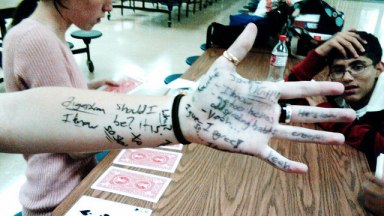
Someone told me about Lifehacker not long ago and I’ve been trying all sorts of the suggestions that flow through their stream of articles. But Melanie Pinola’s recent article “Make Better Conversations by Repeating the Other Person’s Words” caught my attention both for what she wrote and how the Lifehacker community responded:
If you want to be great at making and continuing conversations, you have to be a good listener. Barking Up the Wrong Tree’s Eric Barker points out one way to do active listening that hostage negotiators use to build rapport: repeat the last few words your companion said.
She goes on to give a very few specifics about repeating the last two or three words–it is enough to make you think about your own conversations. But the commentary that pops up after the article is almost as compelling as the article itself, with different folks chiming in by parroting the last two or three words. It’s actually not that easy to differentiate true interest from sarcastic banter. It’s all sorta hilarious.
Of course, kids learn repeating words early as a way to drive parents and siblings to the hard edge of sanity. I did it. My kids did it to me. But the surprise is that repeating others words—when not done with ill will or as a bit of customer service trickery, is quite cyclical: what you say again and again finds its way back into your own brain.
I have a client meeting today and I know that at some point I will repeat what my client says. Aloud. It almost always happens. It’s a basic part of understanding—it lets the other person know I am listening and it also gives me a chance to try on the words/concepts my client offers, to see if they make sense coming from someone else’s mouth.
We need more active listening in this world—but less repeating as a parlor trick.
###
Image credit: crazytales562 via Lifehacker

How to Hold God Accountable
3 Surprises About the Almighty

There is an old story of a wealthy man whose seven sons and three daughters continually held rounds of parties. The sons and daughters would meet at one son’s house to eat and drink. Next day they all met at the next son’s house for more food and drink. And so it went, day after day until all had hosted. Then they began again.
The wealthy man was pleased at their joy but worried that some son or daughter might curse God in a fit of exuberant boasting or perhaps just deep in her or his heart. So he took steps: after every cycle of feasting and drinking, he would rise early in the morning and make offerings. In this way he consecrated his children.
The wealthy man was known far and wide for his wealth but also for being a blameless and upright man. Everything seemed to go the right direction for this man and his family.
Until it didn’t.
In this old story, the man absorbed a one-two punch: he lost all this wealth and his children. Then he lost his health. Like any absorbing movie, that’s where the story really begins.
You may recognize the story of Job. A lot of people read themselves into Job’s story: things are going well and then whammo—the winged monkeys descend outa nowhere. And then as one professor liked to say, you are left to “sit with” the problems, the questions and the profound distress, scraping your sores with broken pots. If you can make it through all 42 chapters of Job, you’ll notice some surprises.
- Surprise #1: Job’s pals comforted him with arguments any of us if-we-do-good-we’ll-receive-good theorists might use. In each case they were sorta right but mostly wrong.
- Surprise #2: Life is full of a fair amount of un-knowing. Well that’s no surprise. But it’s worth repeating in our culture where we demand black and white answers to most of life’s vexations. Sometimes stuff happens and we never really know why/how/who/what.
- Surprise #3: God can be held accountable—at least as far as our questions go. Which is not to say we’ll receive answers. But the questions…it’s the questions that spur conversation. And in Job’s story God was interested in the conversation.
Wait–stay with me:
This third surprise is tricky and I’ve added a gloss that does not quite ring true. We may want to hold God accountable for the bad stuff that happens, but there are a lot of reasons why we cannot (just) do that. We could talk more about that and have a thrilling conversation. But what I can say after living with Job for a couple months is that conversation with God is, well, it just may well be everything. The most important thing. The central thing—especially after the winged monkeys and sitting with job loss or death and the scraping of open sores with broken pots—the central thing may be this conversation.
###
Image credit: Lara Shipley and Antone Dolezal via Lenscratch
Wing Young Huie On Seeing
When is a photo more real than what you saw?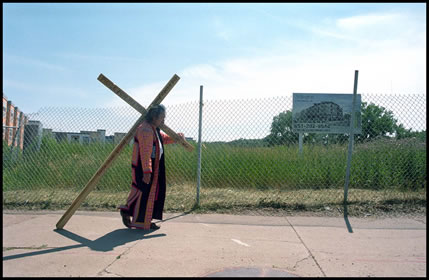
My photos make me question “real.” The eye is tricky and perception is problematic: what I believe I saw was different from the photo I took and the photo I (clumsily) retouched. Which of the photos was real—or was real something entirely different?
That’s why I’m happy to find people who let me see things in a new way. Wing Young Huie is one of those people. His The University Avenue Project is remarkable in that he successfully reframed this long, rather desolate (at times) urban street in a way that helps me see individuals and their hopes. People pictures—sort of honest and gritty pictures. But pictures of real people.
I like photographs that are real, a curious concept in the Photoshop era. Almost all of the images we see on a daily basis have little authenticity. They most serve to reinforce that status quo, driven by marketing and entertainment forces that fundamentally form our perceptions of each other, and ourselves. (Wing Young Huie, The University Avenue Project, p. 125 )
Wing Young Huie clearly has a lot to say about the persuasion industries. And what he has to say is good to hear (at least for this copywriter). But his work also cuts deeply into how we see the people around us. Wing Young Huie’s photos allow me to see afresh something so ordinary as to be invisible. 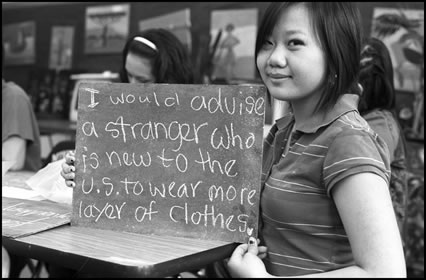 The way he puts people and situations into the frame is almost exhilarating at times. The individuals, the mix, the chalkboard questions answered with raw honesty—the photos peel away all sorts of misconceptions and stereotypes. Even Wing Young Huie’s process feels real.
And that feels to me like a good work.
Learn about Wing Young Huie’s process here.
###
Image credit: Wing Young Huie
Montana!
I’ve been inspired by photo blogs like Shoot Montana (now Run Toward the Light), Photography Journal Blog , Decaseconds | HDR Photography and retireediary (among others) to try make my mediocre photos a bit less mediocre.
Passing through Montana recently I shot this:

I tried some Photoshop jujutsu and came up with this:

I like the lower shot better, but maybe I went too far.
What do you think?
No matter which you prefer: Montana!
###
Image credit: Kirk LIvingston
Thad Starner: Multiplex Don’t Multitask
What Personal Protocols Do You Observe?

Long before Google Glass, there was Mr. Thad Starner and his wearable computer. Clive Thompson in Smarter Than You Think tells the story of how Mr. Starner, a Georgia Institute of Technology professor and eventual developer of Google Glass, put the computer together himself and devised a discreet keyboard he could hold and use without drawing attention. Mr. Starner’s computer did not visually record all that was happening around him (making this less likely), but it did give him the ability to quickly query any question before him and take notes on his conversations.
Mr. Starner has been making notes on conversations for upward of two decades. Through experience Mr. Starner found that he needed to “obeys strict social protocols” around his wearable computer:
He uses it his wearable only to look up information that augments a conversation he’s having. If he’s talking with someone about the Boston Red Sox, he might pull up statistics to sprinkle in, but he’s not secretly perusing cute-cat videos. (p.142)
And he definitely did not check email while in conversation with people. That would be bad. Really bad. Anyone with a smartphone should know: bad form to check your email with in conversation with the human before you.
Mr. Thompson’s point in Smarter Than Your Think had to do with “transactive memory,” how sometimes we offshore our knowledge to a reference book or Google—or to other people. We come to depend on the knowledge of a professor or spouse or friend because we know they will indeed hold on to that information. And they’ll release it so us if we ask. So we need not try to remember it. Transactive memory is a pretty big deal when thinking about learning communities and organizations. Transactive memory is helped by free and open dialogue. Transactive memory is short-circuited by members of an organization who hold a knowledge-is-power ethic.
I like how Mr. Starner’s ethic developed over time: as he witnessed how his own computer searches took him offline from humanity. I also like how he reframed his searching to look like multiplexing rather than multitasking. Still: one person’s multiplex may well look just like multitasking.
###
Image credit: lacedartillery via 2headedsnake/generic–eric)

Wendell Berry Wrote Death Right
The Memory of Old Jack: Is it passion or habit that overtakes us at the end?
Now he feels ahead of him a quietness that he hastens toward. It seems to him that if he does not hasten, his weight will bear him down before he gets there. He reaches the door of his room and opens it….
He goes slowly across the room to his chair, an old high-backed wooden rocker that sits squarely facing the window. This is his outpost, his lookout. Here he has sat in the dark of the early mornings, waiting for light, and again in the long evenings of midsummer, waiting for darkness. He backs up to the chair, leans, takes hold of the arms, and lets himself slowly down onto the seat. “Ah!” He leans back, letting his shoulders and then his head come to rest.
For some time he sits there, getting his breath, grateful to be still after his effort. And then he rises up in his mind as he was when he was strong. He is walking down from the top of his ridge toward a gate in the rock fence. It is the twilight of a day in the height of summer. The day has been hot and long and hard, and he is tired; his shirt and the band of his hat are still wet with sweat….
He does not know why he is there, or where he is going, but he does not question; it is right. Under the slowly darkening sky the countryside has begun to expand into that sense of surrounding distance that it has only at night….
Slowly the glow fades from the valley, the sky darkens, the stars appear, and at last the world is so dark that he can no longer see his legs stretched out in front of him on the ground or his hands lying in his lap; he has come to be vision alone, and the sky over him is filled and glittering with stars. Now he is aware of his fields, the richness of growth in them, their careful patterns and boundaries. In the dark they drowse around him, intimate and expectant.
And now, even among them, he feels his mind coming to rest. A cool breath of air drifts down up on him out of the woods, and he hears a stirring of leaves. He no longer sees the stars. His fields drowse and stir like sleepers, borne toward morning.
Now they break free of his demanding and his praise. He feels them loosen from him and go on.
(Wendell Berry, The Memory of Old Jack, excerpted from Chapter 9)

This is the only way Jack’s story could end. Though, of course, this is not where Jack’s story ends. Pick any story by Wendell Berry and you’ll find the dead very much alive in the memory of the living—just like in real life.
The Memory of Old Jack is another immersive reading experience from Wendell Berry. I’ve never been to Port William (no one has, as far as I understand fiction), but I feel like I grew up not far from there. Mr. Berry presents a way of life that lies just on memory’s periphery for many of us—toward the far end of what we once knew. For others, there will be no memory of such a way of life. It will seem like pure fiction.
One wonders whether memory does not come flooding back in just this way, more real than our many screens today, until in the end it simply overtakes us. I think something like that was behind Dallas Willard’s comment on death.
I hope someone told him.
###
Image credit: Mark Peter Drolet

 conversation is an engine