70 Sheets. 700 Signals.
My $1.25 Grist Mill
For years I’ve kept notes on conversations with clients.
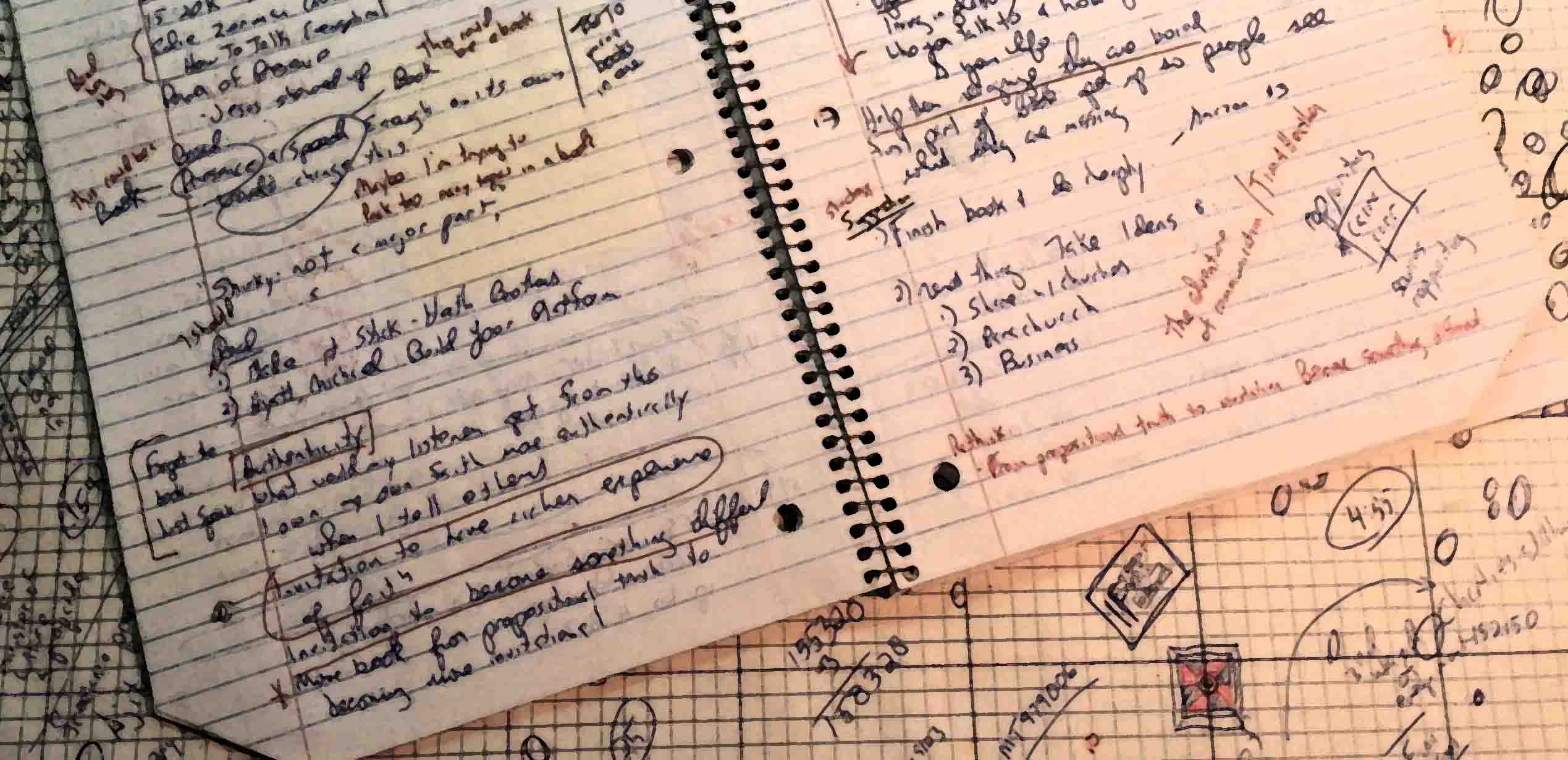
Anyone in business (or anyone in the business of getting something done) knows the value of accurate notes from a conversation. These quick jottings record promises made, delivery dates, special circumstances and conditions.
As a copywriter, I’m also poised to record quotes from my client or team: small summary statements, overview quips, self-proclaimed “dumb” analogies and tangential jokes. These little asides often prove valuable to solving the communication or marketing problem we’re gathered to work on. It’s curious how often the seed for the solution is in the conversation we had that defined the work we would do to solve the problem.
I know this because I often look back through my notes. I go back using a red pen and highlight notes that are proving critical (that’s right: reviewing notes in real-time is productive. Reviewing notes after the work is done is even more illuminating.).
Just today I found myself paging back through my notes looking for a particular conversation and stumbled on another conversation I had forgotten. And that forgotten conversation announced in red ink the precise answer to a communication question I’ve been asking for the last six days.
What good fortune!
###
Image credit: Kirk Livingston
When you lose your job you step into the space between
Movement toward “What next?”
A batch of colleagues lost their jobs in a fit of corporate downsizing. Smart, talented, loyal people who invested years are now asking “What next?”
Same old story for my generation. Happens all the time. Rarely pleasant.
I believe standing on the corner scratching your head and saying “Now what?” is a great place to be. Granted: few of us ever choose to go there. Most of us prefer what we’ve been doing. Even if we hate what we had been doing, it beats not knowing what’s next.
Over at Coracle Journeys, Judith Hougen has a lovely, timeless essay on liminal space—that place we move through when we leave the concrete and known and venture forward. Her entire essay is exceptional, short and worth the read:
Catholic priest and author Richard Rohr explains liminal space: “It is when you have left the tried and true, but have not yet been able to replace it with anything else. It is when you are finally out of the way. It is when you are between your old comfort zone and any possible new answer….These thresholds of waiting and not knowing our ‘next’ are everywhere in life and they are inevitable. If you are not trained in how to hold anxiety, how to live with ambiguity, how to entrust and wait, you will run…anything to flee this terrible cloud of unknowing.”
Job loss is one step toward liminal space. It turns out there are many, many routes to the corner and “What now?” Graduating, moving to a new city, loss of relationship, aging. It’s a long list that parallels anyone’s list of top ten most stressful life events.
This “terrible cloud of unknowing” is only a distant, rumored threat when you are 19 and invincible. But each decade is a corner that provides more and closer glimpses of the cloud. It’s all part of the package deal that is the human condition.
Read the full essay at Coracle Journeys.
It will encourage you.
###
Image credit: Alex Prager via 2headedsnake

Now is the Perfect Time to Bike Minneapolis
“Minneapolis ranks second in bike commuting, with our old nemesis taking top honors”

Aaron Rupar at City Pages recently pointed out that 6.1 percent of Portlandians bike to work, compared to 4.5 percent in Minneapolis. While that puts Portland ahead in commuters, Minneapolis is a biking paradise that continues to climb in bicycle usage.
If you’ve not spent much time on your bike, these waning days of summer are spectacular—especially as the leaves change. You’ll see all sorts of things you never noticed from the surface roads.
Do yourself a favor and take a spin this weekend.

###
Image Credits: Kirk Livingston

Westgate Centre: The New Old Face of Affliction
Jihad, Jabs, Jobs and Job
Affliction is the bad stuff that happens. Today affliction looks like Westgate centre in Nairobi. It also looks like colleagues laid off after five, ten, 35 years of high-performance work for a company. Affliction can look like old age, like a shoulder with a pinched nerve, like legs becoming less-than-steady. Affliction looks like a chronic condition (heart, pain, fatigue). All the stuff that showers down on individuals and groups. All the bad and regrettable stuff, minor and major. All the stuff we would never choose (in a million years).
My new favorite old guy is Job. I’ve been dwelling with the story of his life and times and find his persistence, presence and engagement remarkable. One of Job’s friends, in a fit of knowing what to say (which passed for all the players in this drama) said this about Job’s affliction:
[God] delivers the afflicted by their affliction and opens their ear by adversity. He also allured you out of distress into a broad place where there was no cramping, and what was set on your table was full of fatness.
Elihu, the young buck who waited for all the old guys to finally shut up, also didn’t get it right. His words did not adequately describe the complex of Job’s predicament. Still his words (quoted above) contain wisdom: looking for deliverance in the middle of the affliction. In the end, his words proved true: Job sat at that table. And Job was thoroughly changed when he did so.
Is there deliverance in the horribleness at Westgate centre? I’m praying so. Is there deliverance after a loyal career? Yes, though the former careerist will be changed in the process. Is there deliverance from pinched nerves, unsteady legs, chronic conditions? Is there deliverance from old age? No. And Yes. And ultimately…yes.
And justice? That’s the very large conversation Job insisted on having—right up to where he fell silent. But affliction: is it somehow a way forward?
###
Image credit: Philipp Igumnov via MPD
Copywriting Tips for English Majors #8: Work Past Your First Thought
Instant believability is a must + clowns are not a message
This ad is like a DVD scratch that hits at the climax of Inception: all plot and story get stuck and there is no movement forward.

Copyranter offers a mini-lesson in copywriting from this ad from Kazakhstan. Too many times we go with our first gut idea without knowing how the pieces fit. When the pieces do not precisely fit the message is lost.
Check out Copyranter’s list of questions/thoughts about the ad.
###
Via copyranter
When Twitter Visited Third Baptist Church
What Church can learn from Business #1: Acknowledge the Pain
Scene from a Sunday Service
Pastor Smith: We’ve jumped into the 21st century today with our projector up there tuned to the Twitter Channel! Today: don’t silence your smartphones. And you Twitterites, dial in your Twitter smart app and shoot your questions, comments and tweets to At ThirdBaptistRightNow. And remember to use the hash ticket number sign SubmitAndLove!

Acknowledge questions to unlock the door you’ve invited your audience to walk through
Pastor Smith: Open up your Bibles to Ephesians 5 and let’s get right down to the text and how wives need to submit to their husbands and husbands should love their wives.
@ElderEli: You’ll acknowledge how the passage has been abused for years, right? ThirdBaptist is just as guilty as anyone.
Pastor Smith: Now let’s start reading right from verse…what’s that? AtElderEli—I sort of mention that, but I’ll not spend a lot of time on it. Wait—let me see if I can work that in. Now, let’s start with verse…
@SingleSally: Go to the Bahamas in my mind or the coffee shop with my feet? Either way is more interesting than another sermon about marriage.
Pastor Smith: Now you stick around AtSingleSally, I can promise you’ll find something interesting in…
@ILikeBigBibles: Preach it! Submit and love!
@MsBankCEO: Before you go all gender-wars, can you at least acknowledge that in Christ there is no male or female (Gal 3.28). Seems worth mentioning.
Pastor Smith: Well now, AtMsBankCEO, this passage is pretty specific about the ancient household code, but, well. Let me think for a moment how that verse from Galatians might augment my comments about roles. But turn to verse 22 and…
@BlancheWife: You’ve got to start with 5:21! Mutual submission turns your old role argument on its head!
@BlancheWife: All that follows is an outworking of 5:1-21! Please at least acknowledge that!
Pastor Smith: Hoo boy. Preaching and Twitter make an uneasy couple. Let me do something different today. Blanche, why don’t you come up here and let’s start with an old-fashioned conversation. Just you and I and the microphone and all these fine friends out here. Let’s do something new and get your perspective…
@ILikeBigBibles: No! That’s not right. The brother should preach!
@SingleSally: You have my attention.
Consider Starting with People Rather than Texts
This is not heresy. This is basic pedagogy: when explaining an ancient text, gently help people over the hurdles by showing what it meant as well as how it has been understood over the years. Because your audience is thinking these thoughts already.
Twitter is a huge help in the work of naming the things people are already thinking. While churches are not likely to employ Twitter for anything beyond amplifying their monologue, they should begin to see that the conversations they once directed are happening without them.
Learning to listen and then getting at the truth together—that’s worth exploring.
###
Image credit: Kirk Livingston
Op-Ed Wars: Putin on Obama. McCain on Putin. Rouhani on Conversation
Words are The Best Kind of War
As far as wars go, this one is easily sustainable. And we all have a vested interest in sustaining it, because when we’re talking (even combatively), we’re, well, talking.
Just talking. Not bombing. Not spying (well, OK, probably still spying). Not releasing nerve gas on civilians (well, OK. Some of us can talk and still gas/butcher/jail civilian populations). But talking directly to our various populations is at least different than cold-warring it. Talking is the opposite of the silent treatment.
Talking accomplishes stuff: McCain’s sharp criticism of Putin comes on the heels of Putin’s criticism of Obama’s Syria plan. And Obama’s Syrian plan floated out with words and met all sorts of ridicule and resistance and ire and…success (or at least the beginning of movement toward success).
What if more of our conflicts started in our enemies op ed pages, long before we took action?
What I like most about all this talk is the corollary comments that come out when McCain or Putin or Rouhani poke their sharp sticks in the eyes of the audience. The audience responds bringing up all sorts of truth and innuendo and implications that may apply or may not apply, but all of which allows us to think together. All this talk allows us to stay engaged. Engaged audiences are a good thing.
Keep talking Mr. Putin. Say on, Mr. McCain. Let’s grab a chai, Mr. Rouhani. You are right: “constructive dialogue” is a great win for everyone. Even if Iran is on a PR spree with their new reasonable-sounding president. Let’s jump on this bandwagon. We’ll need to move to the next step, of course: if Iran’s nuclear program is truly for fuel only, then allowing third-party inspections will be not big deal, right? Inspections could begin to put the rest of the world at ease about Iran’s seeming bomb-making proclivities. On the other hand, the US also needs to offer movement toward transparency: we’ve certainly hid plenty. Being a superpower should not make us bullies—we need to play by the same rules.
Yes. Let’s chat.
We may not believe everything each other says, but talking is a start.
###
Image credit: Times of India
Colbert on Cheerios: “Be gone, nefarious demon loops”
Dining with the Dead
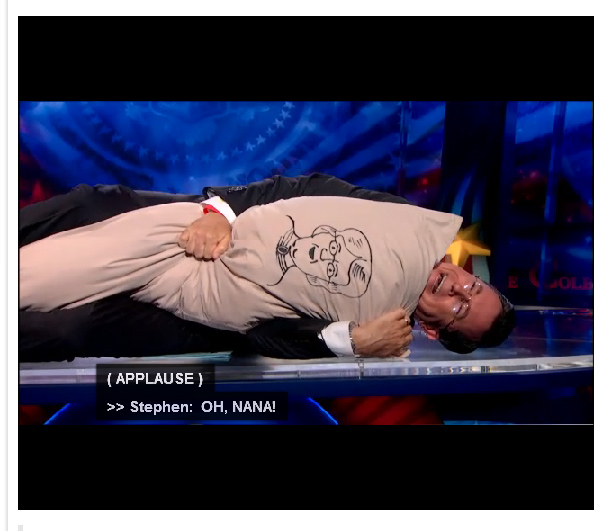
Thanks to Jim Hammerand at Minneapolis/St. Paul Business Journal for pointing out Colbert’s unique response to an innocent Cheerios ad.
This is worth your 4:19 minute time investment (OK, plus one, maybe two :30 second spots).
###

 conversation is an engine