Ownership Begets Engagement
Is it busy-work when you steer your car?

Still hard to beat the old Soviet work posters for sheer motivational energy
My client needs to keep operators engaged over an entire eight-hour shift. Steve explained how training goes: the first part of the shift passes with new operators entirely engaged. All the moving parts are fascinating and mesmerizing. But after the first three hours, or the first five hours, when the process seems trouble-free, boredom sets in. Nothing unusual happens. Operators start to look away.
It’s when the boredom sets in that danger starts to rise.
Despite redundant built-in safeguards and automated alarms, the process could easily suck in a digit (for instance) and then an arm and then well, it can quickly become a nasty business. Or more likely, a small knot escalates very swiftly to ruined product.
So: vigilance. But how to help employees stay engaged?
It turns out there are all sorts of small tasks required to run the machine. Routine checks performed on schedule, walking up and down the football-pitch sized machine can help ward off those nasty moments. Those nasty moments are not inevitable.
Keeping people engaged is a challenge because it is a much broader topic than just for operators at a manufacturing plant. We all deal with it.
When I teach I try to change things every 15 minutes. From discussion to exercise to small groups to video. “Let’s move our desks together for this next section,” I might say. And just getting up and moving is sufficient to bring to get a college student’s mind back from the Bahamas (if only for a moment).
There are certainly tricks that can seem to encourage engagement. But longer-term, I would argue that ownership is the best secret-sauce for building engagement. When the operator feels she owns the process, that it is hers, she watches very carefully. Same with any employee: let them own their process from inception to outcome, and they become very engaged. Take away their ownership with micro-managed short orders, and you lose the engagement. My most engaged students are those who understand how the assignments and class discussions mirror the real process outside of class. Their understanding and perspective on the small tasks helps them own the process.
###
Image credit: via Copyranter
Please Write This Book: How To Be Properly Peripheral
A word for the 99%
Not everyone can be at the center. Not everyone is the leader, the big cheese, the boss. Some dwell on the fringe. Work, neighborhoods, any given party, hey—even families have members who are more comfortable sidling toward the exit.
In these posts I’ve written that the church is better off not being in the center of things: we do better speaking in from the periphery. Give the church power and it behaves like anyone with power: making the rules and silencing the voices that disagree.
But purposefully peripheral? That’s a hard case to make in our culture, where fame is everything. Especially since most of us struggle with a mild solipsism: do you or your pet poodle or your Prius remain when I walk out of the frame? I’m not so sure. I only know what I know because I am at the center of everything.
Consider: the leadership industry devises all sorts of ways to help people pull themselves up by their own bootstraps so they become the center point, the pulpiteer for their organization. The respected voice, influencing others, perhaps (sinister hope) controlling others. That’s the favored spot—am I right?
But purposefully peripheral? There’s a pretty compelling theological argument for looking for ways to serve rather than control. Please write the book about how that argument unfolds for the 99% of us who are workers rather than rock stars. Please write about how our small daily actions have an impact. Please give me a vision for how the quiet, mostly unnoticed work is really the glue that holds society together and is also—quite possibly—the neurotransmitters of divine action. Tell me again why listening trumps talking most of the time.
I’d read that book.
I’d buy that book.
###
Image credit: Ed Fairburn via 2headedsnake
On Being: One Shining Moment for Talk
Krista Tippet, David Gushee and Frances Kissling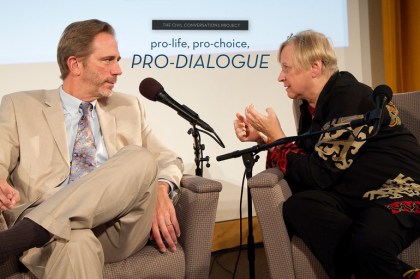
On Being recently broadcast a 51 minute conversation entitled Pro-Life, Pro-Choice, Pro-Dialogue. The recording includes a bunch of great moments and thoughts about communication and conversation as David Gushee and Francis Kissling each have their say and then tell what they’ve gained from the other side of this deeply divided topic.
I need to listen to the entire conversation again.
But toward the end of there was a moment where Ms. Tippet asked about the paradox of passionately clinging to what you know is true even as you reach out to understand what your opponent/conversation partner says/thinks/feels. There is a growth that happens, a change. It is not a giving away of passion or the rightness of the cause, but a deep concern that emerges. Here’s Mr. Gushee:
…after the Princeton conference in 2010 I felt clearer [about the] the position I had going…. But also I was more clear about the intelligence and the love that motivated the people on the other side too. And I respected that…. (~43:30 to 44:01)
There is a mistaken fear about dialogue that says if I engage with another person who does not believe like I believe, I run the risk of losing what I believe. But most people find the opposite to be true: passion grows deeper and something else is added: an understanding care about the other person. The passionate divide may remain, but surrounding that divide is care for another. And that begins to change everything.
This seems to me a shining moment.
A moment many of us could pursue.
###
Am I a constructivist?
Not sure. So I’ll jump.
There’s an old notion—an image, really—of jumping off a high point and building wings as you fall. That’s the image Paul Watzlawick offered as he began his account of constructivism in The Invented Reality (NY: Norton, 1984). Constructivism is a way of thinking about how the world works and how we know anything. Constructivism would say we invent reality as we move forward, as we talk and walk and work. Wikipedia’s entry on constructivism as an educational theory seems like a reasonable synopsis. I definitely cannot buy into the whole thing (few “–ism’s” are entirely believable), but there are pieces of constructivism that ring true:
- My growing theory of a conversation has elements of constructivism: what happens between us as we talk is a new thing constructed on the spot (and, frankly, from past conversations and experiences). Our communication and relationship morph with each engagement.
- Aphorisms and self-fulfilling prophecies do have a certain amount of power in anyone’s life to adjust expectations if not experience—give or take/depends/your mileage may vary.
- In writing, my argument or story unfolds entirely dependent on my word choices. Outcomes change before my eyes as I write, not just in fiction, but also as I sort through a business problem.
One wants to be very careful—of course—about agreeing entirely with any particular -ism. In philosophy and theology, to agree to one thing is to disagree with another, and sometimes unwittingly. All the threads are connected, so when you pull on one, something unravels on the other side of the garment. I can see from just this little glimpse that constructivism might be hostile toward the notion of a central truth in life, which would not fit with my theological commitments. Constructivism also has wise-cracks to make about the determinism/free-will debate raging in my brain. And yet, there is some truth to the constructivist way of seeing life.
What do you think? Are we all making it up as we go?
###
Image credit: Dustin Harbin via 2headedsnake
Mr. Dallenbach: I, Too, Overcame a Pike’s Peak Drive
My Non-Time-Trial in an Old & Underpowered Minivan with No Stirring Music
And that night I dreamt: I couldn’t quite park my speedboat on the top of the garage.
I and the speedboat went over the garage roof and into the river.
And down.
And down.
I died in my dream—is that even supposed to happen?
As I went down and down in the water, Garrison Keillor’s voice started telling stories about the portraits on the wall.
Portrait after portrait neatly lit as I continued down my watery hallway.
Were these my relatives? Other Pike’s Peak drivers from Lake Wobegon?
Why is death linked with Garrison Keillor in my subconscious? Does it have anything to do with Mr. Keillor’s forthright rejection of my unasked-for parody commercials?
I woke with a steely resolve to not drive Pike’s Peak in a minivan again.
###
Image Credit: AdFreak
Let Us Never Speak of This Again: “Obviously”
One Word That Cannot Be Rehabilitated
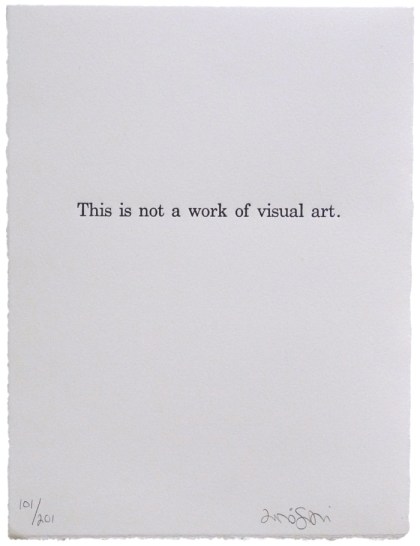 It’s rarely obvious when someone says “obviously.” It may be obvious to you, stuck away in the cinema of your mind, but it’s probably not obvious to me. I don’t see what you see. I haven’t had your experiences. You have not had mine. All those experiences color the lens of our understanding.
“Obviously” is almost always misleading. It nearly always leads to some untruth (just like when your financial planner says “Trust me on this.” That is your cue to run—fast—the other way.)
“Obviously” is condescending. When I say it, I am surprised that you don’t see what is so clear to me. Maybe I think less of you precisely because you don’t see what I see. It’s all so obvious. What do you mean you don’t see it?
If language is about making meaning together and some words can be reshaped to hold the meanings we need to communicate, this isn’t one of them. “Obviously” is a dead-end in a conversation. It seals off further dialogue because of all it assumes about the people present. If I say “obviously” to my conversation partner and she doesn’t get it, I’ve put her in the awkward position of needing to admit she doesn’t see what I see. And that inhibits dialogue. “Obviously” is another power word that hints at more knowledge/style/panache than it delivers.
No one can ban a word. And some words can and should be taken to rehab. But I’ll turn my back on “obviously” and walk away, never finding reason to utter it again.
###
Image credit: Alfred Steiner via 2headedsnake

Take this Word to Rehab: “Out”
A Meditation Beyond Gay
 A few days back I posted There’s Something About Out (Out Always Informs In) and noticed a slight uptick in hits. My theory: the uptick had to do with the word “out” in the headline and subhead, a signal word for the LGBT community. Walk with me as I argue the value of “out” is beyond ownership by any particular set of people and is useful for anyone trying to communicate to those outside their immediate peers.
One lesson to be learned these days is the walls that traditionally provided sharp borders for any community are falling quickly. Social media opens a rolling window into nearly any group—if you know the right search keywords. With keyword searches we expose what poets and writers are doing, what glass-blowers and comic-con enthusiasts and copywriters and geocachers are up to. The corollary is that if you are in a tightly-delineated group with high walls, there has never been a better time to begin to explain yourself to those outside, because someone is likely peering in.
Out is more and more important—especially since we battle xenophobia (fear of strangers) on so many different levels: acute and generalized, nationally, locally, in Congress and on the street. Fear of strangers ought to be decreasing given increasing frequency, but it seems the opposite is happening.
In my copywriting practice I often help clients organize their thoughts for those outside the organization. How difficult can that be? Good question. The truth is that we all get caught up using shorthand, insider terms that have less to do with communication and more to do with identifying others who are part of our tribe. Real communication happens when we make our ideas and ourselves accessible to those not from our neighborhood or company or tribe or sect.
The challenge of “out” is communication beyond our self-inscribed language borders. First we need to identify the borders (and possibly our tribe). Then we need to know what’s important and remarkable that someone outside would care about. The challenge of “out” is to step outside our circle with honest, clear language that also happens to make us vulnerable. But those things that are important to us are worth sharing.
Other words in need of rehab: fellowship, strategy, and maybe “lovingkindness.”
###
Image credit: Corrado Zeni via 2headedsnake
The Genius of Aldi OUS
“I don’t like tea.”
I’ve been on a jag of watching Aldi commercials lately. A couple days ago I posted this. And then there’s this odd man with his peculiar fondness. But this is one of my favorites:
Does Aldi in the US make commercials?
###

 conversation is an engine