What Your Village Looks Like Right After Assad Bombs It
Frontline: Syria Behind the Lines
It is a practice of the regime to target [bomb] groups of men.

I won’t muck the works with my comments, but this first-person account of a village being bombed shows, well, you can judge for yourself. Be forewarned: this is graphic. Listen for the rhetorical twists and turns from the videographer’s commentary and the crowd.
Given this was from PBS, I assume it is real footage. If someone knows better, please tell me. Kudos to Olly Lambert for filming this and making it available.
God have mercy.
###
The Naked Anabaptist by Stuart Murray
What’s on the other side of imperial Christianity?

How do you think of church? Many readers of this blog find the church experience painful and reductive: at best irrelevant. At worst, dangerous agitprop. Other readers soar. I’ve been on both sides and I prefer soaring.
Church is an institution forged from a less-than-stable amalgam: people and Other. People are the weak link. But people can also surprise.
On several occasions I have written critically about church (like here and here and here and here plus about a dozen other places on this blog—just type “church” in to the Search bar to the right). For me lately, most churches resemble all the other CEO-driven marketing machines in our culture. But this marketing machine sits at the local level pulling in spectator-consumers to fund the local brand.
Yes that sounds cynical.
But just read through the New Testament and compare the multi-voiced organizations that sprung up with any of the big box affairs we love in this country. Those small communities in the text were chock full of the risen Christ and were spinning changed participants out (and back in and out and in. And out). Notice that growing spectators was not their goal and participation in shaping the organization and experience was expected.
But this book makes me less cynical: The Naked Anabaptist. Tracing a history back to the sixteenth century dissenters (who died for taking Jesus seriously, often at the hands of reformers), the book gives a fresh take on our waning years of Christendom (that is, the curious intertwining of culture, power and religion that started with Constantine in the 4th century establishing Christianity as the state religion and continued to today, give or take).
Many lament the loss of cultural power of Christianity in the U.S.
Not me.
My reading of the gospels puts the poor and weak and needy at the center of what Jesus intended. His was/is an ethic markedly different from the mandates we pursue that force a top-down approach. And The Naked Anabaptist hints at what the church could look like if it were not a univocal marketing machine. Murray’s seven core convictions lay out a compelling picture. And it is not a picture with one pastor/president/CEO at the top. The book probably gives more shortcuts to Anabaptist thinking that some Anabaptists would be comfortable with, but it is thought-provoking and vision-building.
Woodland Hills in Saint Paul, Minnesota is considering joining the ranks of Anabaptists. The church came to the conclusion after realizing the kinship they had with the doctrines. But I wonder: can a mega-church be a multi-voiced church?
###
Axis Mundi: Levittown
Surely not everything.

An exhibit by Holly Laws (artist) and Charlotte Meehan (playwright)–Flaten Art Museum, St. Olaf College.
###
Speaking of Bold Declaratives: Allan Peters’ Blog
Believe: Babies! Bikes!
 A few days back I wrote about the transformative power of saying what we believe (versus saying only what we are against). For some time I’ve been following Allan Peters Blog because it is a smart look into the design world and also sheds light on design in the Minneapolis/St. Paul area. I look forward to seeing his work at ArtCrank Saturday.
And there is something else about Mr. Peter’s blog that pulls me in.
It’s no secret that I’m a fan of Jesus the Christ and I like hearing people chat about their relationship with this One. So speaking of declarations, check out Mr. Peter’s barking bold birth announcement (which won a Silver at the 2012 Adfed “The Show”). Even if religion gives you the willies (it has the same effect on me), check out the artfulness of this announcement: letterpressed into some ritzy paper: click here and scroll down to get a sense of his process.
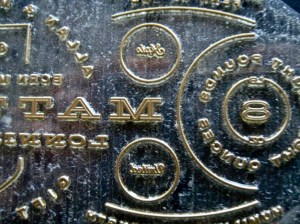 If you don’t follow Allan Peters’ blog—maybe it’s time you start.
As an asker/seeker/knocker, I am constantly sorting through out how faith fits with the desire to do good work, even persuasive work in a multi-cultural, multi-voiced world. Part of the answer surely has to be finding artful ways to demonstrate (and say) what we believe. Mr. Peters has accomplished this.
###
Image credit: Allan Peters’ Blog
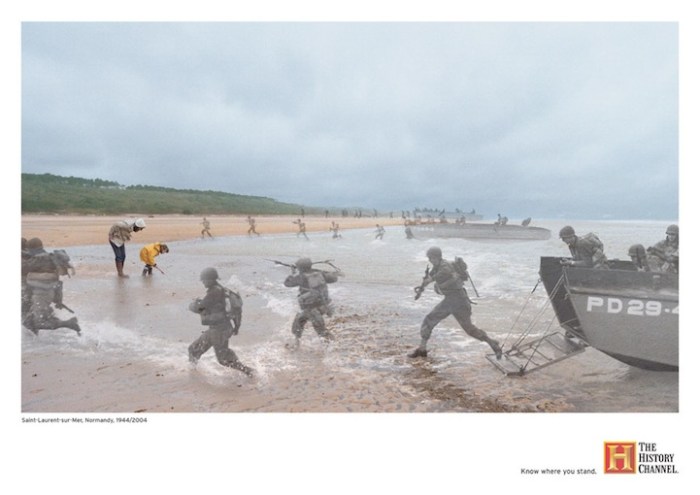
The History We Carry
What do you see in your old haunts?
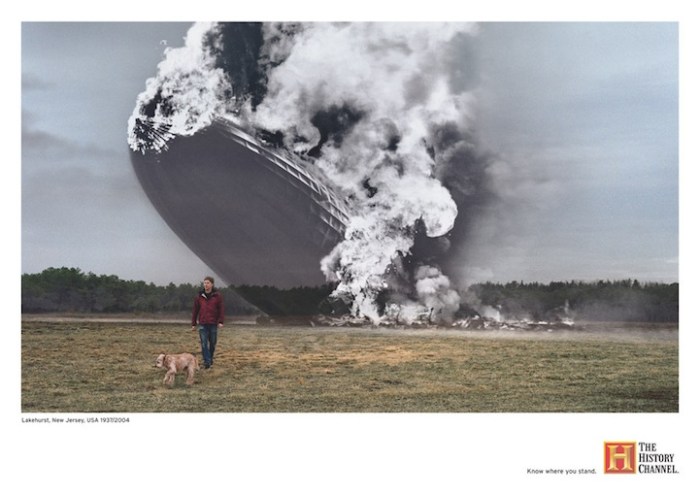
Thoughtful images for the History Channel. Photographer Seth Taras.
###
Image credit: Seth Taras via MyModernMet/thisisn’thappiness
The Office: Neither Crib Nor Playpen. Not Preschool. Not Kindergarten.
The Role of the Declarative in Every Day Life
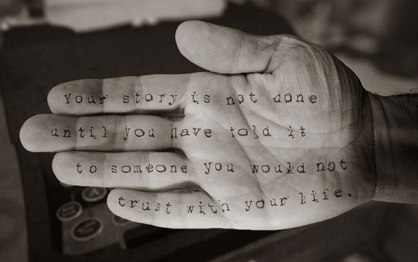 This has the power to change you: say what you stand for rather than saying over and over what you are against. To declare what you stand for is to say a positive about yourself and your situation in life. Declaring takes courage because others will disagree, they may say “That’s not true!” Others may despise you for saying what you think, they may not believe and many will simply find your declaration irrelevant.
But you must say it anyway.
Declarational speech expresses us at work as agents of truth. –Robert Sokolowski, Phenomenology of the Human Person (New York: Cambridge University Press, 2008)
Corporations and organizations are at their best when their people take ownership of processes. Taking ownership means making that process one’s own. Remember in school when the teacher said “use your own words” versus cribbing from the encyclopedia? (An encyclopedia was a set of “books” made of “paper” that sat on a “shelf” gathering dust until a “report” was due) That process of using your own words is the very reason for the staying power for your odd assortment of facts from childhood.
Taking ownership and using your own words is the same process that makes you a grown-up human today. A necessary condition of taking ownership is that the result will look different from what someone else might have done. If you are a boss and chide your employee for doing things differently than you, stop and rethink your relationship with the work and the client and your employee.
No organization can grow—no people in an organization can grow—if they are not using their own words to say what is happening.
###
Image credit: Gregory Norman Bossert via Wofford College/thisisnthappiness
Don’t Provoke Me. Wait: Do.
The Power of a Question to Shape Discovery

Mrs. Kirkistan and I have been chatting about those people in our lives who show up with questions rather than answers. These are folks who wonder “Why?” and “How?” about the most ordinary, obvious things. We typically have great conversations with them even as they challenge, occasionally infuriate and often delight us. And quite often their questions and the acts they take to resolve those questions have a way of working into my brain through the week. And I find myself asking questions as well.
I treasure these friends.
I’ve been trying to understand a complicated philosopher whose writing was famously obscure. I recently came across two of his interpreters whose comments helped me flesh out the larger setting for this philosopher’s comments. Mr. Peter Dews and Ms. Diane Perpich helped me understand that there is more to Emmanuel Levinas than the Other and ethics as “first philosophy.” Ms. Perpich, in particular, has helped me begin to see that the stringent obligation Levinas puts on our encounter with the other may function less as an ethics manual and more as provocation. This makes terrific sense when I start to work out the details of my obligation to others (as Levinas might suggest). His comments become directional rather than prescriptive.
But even with the insights from Mr. Dews and Ms. Perpich, there is something about Mr. Levinas that moves beyond directional-only. His provokements have a way of landing at the most inopportune times: making me question the bosses’ speech in the conference room or the story of the revered leader. Making me wonder at my own treatment of others, from driving to the simplest conversation.
Such provocation seems a good thing—perhaps I’ll be shaken from my comfortable rut.
###
Image credit: marikapaprika via 2headedsnake
Your Product: Light of My Life
You Complete Me.
 Am I right? The magnetic power to draw citizens off the street. The hushed tones in the presence of greatness. The loving gaze. This car will change your life—perhaps it already has?
The fawning devotee image is standard fare in our media diet. Models perpetually doing homage to the product at the focus of all attention. Chevy, Toyota, Cadillac—who doesn’t make ads like this? Product as hero. Forever. We see this everywhere.
Somersby recently turned the Apple experience on its head by grabbing the dead-earnest communication style to appropriately ridiculous ends. It is perfectly reasonable to poke fun at the high places certain brands have taken in our lives.
Can we get beyond product as instrument of life change? True: it is possible that some consumers (that is, those who have already chosen to purchase a car/beer/computer/whatever) may look with unbridled lust toward their purchase, this object of their desire. But is it possible to promote a product without making the (thoroughly ridiculous) promise that it will indeed change your life?
Maybe not. Because quickening desire has always been at the heart of selling, and nothing quickens desire (and loosens the wallet) like showing the person you will be once you buy this car/beer/computer/whatever.
Maybe so—and this may be what is behind the eventual victory of online advertising: product messages that follow our search patterns and interrupt us with the key to what we’ve already been seeking.
Maybe both. Because desire follows a need or want. And we want what promises to make us different. Better. Smarter. Hipper. Advertising will always make these promises and will find ever new ways to get the message to us. And because we self-identify as “consumers” we’ll probably never run out of the optimism that buying stuff will change our life
It’s just that the loving magnetism of the Chevy image seems, well, juvenile. It’s a credibility issue.
###
In Minnesota We’re All From Somewhere Else
Somalis are the latest. Not the last.

One look at the housing stock in the Phillips neighborhood and you can see the early builders had working class intentions. They built for families, close together, filling up the slim South Minneapolis lots. These were not lavish homes, except for a few on the main thoroughfares like Park or Portland. This neighborhood, like many in Minneapolis, housed people from afar. Waves of people from all over the world, over a couple hundred years, people with a purpose and that purpose was to make a life.
Having spent a decade in Phillips, I’ve seen first-hand how newcomers find their place. I’m pleased that Minnesota tends toward being a good place to settle. Not perfect. Not flawless. Not without unrest, but good. I just finished Ahmed Ismail Yusuf’s Somalis in Minnesota, which tells the story of a current set of transplants finding their place. It is a good tale, particularly because a casual walk through South Minneapolis reveals this immigrant experience swirling all around you. In fact there are malls around Minneapolis that could have been lifted directly from Somalia. Where entrepreneurs are making a life for themselves.
Yusef’s book shows how it is that communities develop. The Somali-American experiences seemed to start in San Diego in the early 1990s, but then branched to Marshall, Minnesota and Minneapolis because of job opportunities (at first) and then because others had already come. Today Minnesota is home to the largest Somali population in the U.S. (~60,000 in 2010, according to the Minnesota Historical Society).
The Somali experience in Minnesota is a fresh taste of our own history. It’s heartening and I’m glad for this city’s large heart.
And this: I realize we’re not all from somewhere else–and telling that story will be another good conversation.
###
Image credit: Fred Anderson via the Groveland Gallery via StarTribune
You need a vacation. Yes?
Here’s your mini-vacation, courtesy Jakub Polomski

So tranquil. So restful.
Now—back to work!
###
Image Credit: Jakub Polomski via Let’s Travel Somewhere

 conversation is an engine