
The Case for Believability
Is Deeper than You’d Think—Especially for Those Outside Your Tribe

We believe words in context
I try to help clients understand the limits of their messaging. After we get past the glory of the features (many would stop there and pronounce their marketing “Done!”), we get to benefits. That’s a good place to hang because we are facing outward: how this product/service will help their customer accomplish X. For my medical device clients, after getting beyond the glory of the features, our conversation turns to the benefit promises that can ring true and still be within the legal and regulatory parameters, and still be within what the journal articles support. And still make emotional sense to their intended customer.
Beyond benefits and features, a message is believable because it comes from a much deeper place of fit and truth. A message becomes believable when it suddenly snaps in place with the other factors we already know. The best copywriting does this: it offers words (really ideas) that help place the benefit message into a frame that suddenly makes all sorts of sense.
That snap is why we believe anything. Words “ring true” when we see how they fit our context, where we live. So when we want someone to believe us, we find ourselves building out the context so they can see how and why this idea fits. This is time-consuming when you are talking with someone from outside your tribe, because they don’t see things the way you see them. They have not been inculcated in your doctrine of how we see things around here.
I guess that’s why it’s easier to mostly hide in my tribe.
###
Image credit: Christopher David White via 2headedsnake
When You Know Too Much
You should shut up
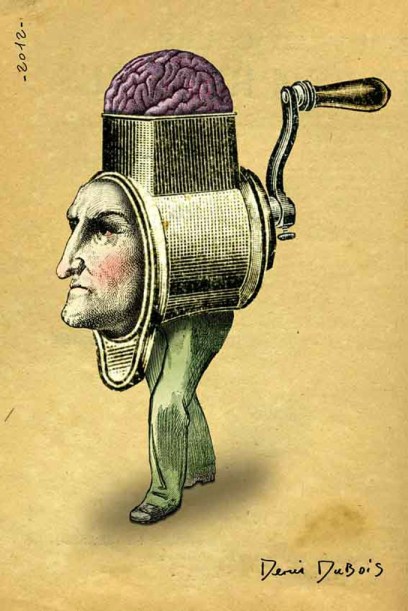 Sometimes you are in a meeting and you know more than most people in the room. I’m not writing about an ego trip here or an exalted view of self. I’m writing about a function of age and experience. You personally have wrestled with the three topics circling the meeting’s agenda. And most of that wrestling was two decades ago. You know the people and stories and ethos the leader is referring to from deep study of your own—and you reached your own conclusions about five years ago. You’ve been there. And you’ve done that. I’m sounding like an old guy.
That’s the time to take action: Shut up.
Not entirely, but show some restraint. Why? It’s tempting to say you should shut up to hide what a cranky old codger you are. It’s also tempting to say “Shut up” to give the neophytes an opportunity to make their own mess of things. But neither of those tell the whole story.
In a meeting yesterday a group of us talked about a set of communication (and theological) issues revolving around reaching out to a growing population of immigrants to the Twin Cities. I said too much—I realized this on the slick, snowy drive home. But then I realized: no, honest discussion is exactly the give and take, the push and pull, the misunderstanding followed by dawning group understanding. That is the way of human communication. It’s mostly messy.
Here’s the point: every communication event is fresh. Even cranky old geezers who know too much can learn, because the players are different and the times are different and frankly, new stuff is happening. All. The. Time.
So: bring your experience to the table, by all means. And steel yourself: results will vary.
###
Image credit: Denis Dubois via 2headedsnake
If I Had a Parking Lot (The Parking Lot Movie)
That’s Fecund Ground for a Philosopher
If I told you there was a documentary about a parking lot and that you would not be able to stop watching it, you might disbelieve me. And yet. There is. And you can’t. It’s called, The Parking Lot Movie.
You can’t stop watching because of the cast of characters who each take their turn tending the unheated little hut that serves as the outpost for payment. They charge people 40 cents, or a dollar, or eight bucks and the world of the parking lot revolves around this simple transaction. The attendants are students, and recent grads and grad students. They are philosophers and professors and musicians and slackers and bikers and skateboarders. What they share in common is lots of reflection about the transactions they have with the public. These guys have lots of time to think.
This overeducated bunch connects the dots of culture from the seeming-lowest point on the food chain of work. They think about how people park and about how the car make and model and even the license plate reflect on the driver. They think about the irony of having to pay to park that lumbering, expensive SUV. They think about what it means to be a parking lot attendant, mostly. And the camera catches these comments, along with the transactions and events that drive them to the comments.
The only way to get this parking lot attendant job at the Corner Parking Lot across from the University of Virginia is to know somebody. And that fact is one key to the whole interesting film: it’s the little community of irrepressible attendants trying to sort out life together that turns a mundane job into a joyous window on life. But more than that, the guy who owns the Corner Parking Lot—Chris Farina—has a way of working with people, mentoring actually, that helps each attendant grow into the person they are meant to be. He’s boss, but he’s a parking lot visionary who has figured out how to help each attendant have ownership over the parking lot. And maybe their life.
This is a great film on its own. But I can imagine using it in a class when talking about collaboration or community—it’s a perfect illustration of both. And with the shop talk caught on camera and in context, it is a delightful and an all-too-quick 74 minutes.
###
On This 1st Day, Consider the 7th
How can freshly-sliced time call to you?
 It’s Monday and that is bummer enough. But take a minute and think with me about how time works—it may make a difference for next weekend. We’ll do this by looking at The Sabbath by Abraham Joshua Heschel.
Heschel’s The Sabbath feels like an old book though the first printing was only in 1951. (Some of you will say, “Yeah: old.”) But the thoughts, the pacing and even the language mark it as something way older and way more out of sync with our current urgencies. In this case, the medium mirrors well the topic, which is a day set apart—a day out of time. [One note: My understanding is that the Jewish observance of Shabbat extends from Friday sundown to Saturday evening. The Christian observance of Sabbath is a Sunday. It’s not the exact time I want to look at, but the concept.]
There is no end to the mystery Rabbi Heschel presented as he talked about the observance of the seventh day as a day of rest. Many of us innately understand the point of Sabbath though few of us practice it. We get that a day away from work is a good thing. We can be convinced that not working for a time makes us sharper for when we are working. For us—especially in the U.S. around Christmas—the Sabbath is a useful day for practicing our American religion of acquisition. But maybe there was some wisdom in those old out-of-sync rules that forced merchants to close for a day.
The heart of Heschel’s book is a quote from the Torah, where God rested from all his work on the seventh day and called that day “holy.” Many of us associate that word with church and religion and boring sentimental stuff. But Heschel’s first interesting point is that it was a day that was holy. Not a place. Not a thing. Not a people. But a day. And that day recurred. Every week or so. (Well, every week).
That a slice of time would be separate and somehow different is a wildly different way of looking at life. Especially as we push toward always-on-24/7/365 connection. It raises the expectation that something different can/should/will happen in that time slice devoted to rest. Heschel does a heartening job of building out the possibilities—indeed, that is his point: time devoted to, well, transcendence. But with a God-shaped denouement.
The second interesting thing Heschel said is that rather than seeing the day of rest as a reward for a week of hard work, this freshly-sliced time becomes an anticipated climax to the week. All of our thinking, our relating and collaborating, all the working pieces of life somehow move toward this festive laying down of the keyboard/pen/steering wheel/hand truck in rest. So…not a reward for a week’s work but the week’s work serving to outline the great difference of a day set apart to contemplate and celebrate relationships.
There’s lots more to this, of course. And generations of smart people have written volumes on the topic. But just laying a different story arc on this week’s work may make this Monday different.
###
Image credit: laurabfernandez via 2headedsnake
What is Remarkable—in Your Industry?
Connect the Dots for Your Clients and their Customers
 Over at the Same Rowdy Crowd, Joe Loveland wrote about the best and worst of the Blogosphere. One of the points Loveland made is that the blogosphere is less about creating and more about aggregating. Nothing new there: we’re all curators today. But in aggregating, we are also connecting the dots for ourselves and for each other. This actually is a value-add: because I get to see how you are thinking about life today. Which also points to the ephemeral side of social media. Like tweets, blog posts are mostly of the moment. Meant to be read and discarded, much like verbal conversation: as we announce something, it is gone. That is the nature of sound.
Blogging and tweeting (and etc.) are simply tools of remarking. My working definition of “remarkable” is that a thing is remarkable when I choose to tell someone about it. Bear with me: there’s more to this. If I remark on something to someone, I think they’ll care. And I think they will find it interesting. I won’t remark on something to a friend if I think they’ll not care or if I think they will find it boring (like my 10-year-old friend thought me yesterday).
So the work of social media, in many ways, is that of connecting the dots by remarking on things we think people—our audiences—will find interesting. And along the way we show our expertise (or reveal our shallowness) even as we invite our audiences to think with us about one slivery facet of a topic. One small thing. One small thing that is of today.
It is this one small thing, this one slivery particular that has the power to pull in the outsider. This is because we can become fascinated by the inner workings of someone else’s world. It is the momentary pulling aside of the curtain that both reveals what is inside and draws others in.
Over at Clarity Coverdale Fury they are running a series of posts on the conscious consumer. Rob Rankin remarked about how his wife rented a dress for a Christmas party rather than buying one. He called the organization she used the “Netflix of fashion” and went on to hint at how this model of commerce will intrude into yet another industry. That is interesting and remarkable and a nice connection for most any audience.
One challenge of communication today has to do with finding those remarkable things you can share with insiders—and industry outsiders—which they will find interesting. It’s a language challenge. And a focus challenge. But since the days of monologue and the bully pulpit are long gone, this is our invitation.
###
Image credit: via Frank T. Zumbachs Mysterious World
Talking Philosophy with a 10-Year Old
Why not talk about something more interesting like dragons or flying?
 I like reading Emmanuel Levinas. He’s mostly opaque, but every once in a while his writing opens on a breathtaking view and is just what I needed. If I had the opportunity to explain why Levinas matters to an interested ten-year old, I would say that we have a problem with other people. And the problem is that we mostly don’t want to hear from them. I could use an example from their life: you don’t want your mom to interrupt your fun: when she calls you in for dinner, you go in only reluctantly. One problem with the will of the other is that we don’t welcome distraction from our preoccupations. But it is not just that, it is that we really don’t want to even interact with some other who might have authority over us.
10-Year-Old: “Oh. You just don’t want to do what other people say. Does Levinas tell you how to avoid doing what others tell you to do?”
Kirkistan: “Not exactly.”
10-Year-Old: “Does he tell you don’t have to do what they say?”
Kirkistan: “No. It’s more like you suddenly want to do what the other person wanted because you really, really loved them.”
10-Year-Old: “Like maybe if my grandparents were in town and asked me for something and I wanted to do it for them because they are so nice?”
Kirkistan: “Yeah. Maybe like that. And maybe you found yourself really interested in the experiences they had, partly because they are such good storytellers and they make everything sound so exciting. You like their stories and can almost imagine being there.”
10-Year-Old: “So my grandparents are cool and I want to get to know them because they are nice and tell interesting stories. So what you are really talking about is why it is important to hear from other people and why we should care.”
Kirkistan: “That’s right.”
10-Year-Old: “So why did you start be talking about stopping what I thought was fun to do something I had to do?”
Kirkistan: “Well, I might have been a bit confused. But also because sometimes I close my ears to people who are trying to give me a gift. Something I really need. Say you are at the grocery store with your parents. It’s Saturday. And there are sample ladies on every aisle. There is lady offering free ice cream in the frozen aisle. And another man making pizzas in that aisle. And another with little chicken nuggets and another handing out crackers and cheese.
Kirkistan: “But say you really didn’t want to go to the grocer. You really wanted to watch cartoons. So you went to the grocer reluctantly, but you took your iPod and listened to music the whole time. You walked behind you parents, music turned up. So you didn’t hear the sample ladies calling out to you. You kept your eyes on the floor so you didn’t see them either.”
10-Year-Old: “That would be bad. I like ice cream and chicken nuggets and pizza. It’s like I had missed all the really good stuff while everybody else got something. I’d have gotten my way but I’d have missed out on the very best stuff.”
Kirkistan: “That’s why Levinas is important. He helps us start to see and understand why it is we should care about the people around us: what they know. What they bring to our conversations. What they have to say about this and that. Even people who don’t seem to have anything to say—even those people can surprise us with lots of interesting things.”
10-Year-Old: “OK. Well, why don’t you just listen to people? I listen to people and learn things all the time. That isn’t hard to do. It is super easy to listen to people. It’s not like you have to do anything. You just listen.”
Kirkistan: “Well, that is great advice and I want to follow it. My answer to you would be that as you get older, you start to think you know a few things. We get to thinking we know the patterns of how things work and we figure we know pretty much how anyone will respond in any given situation. Anyway, all I’m saying is that it gets pretty easy to think you know what most people will do or say in any given situation. The surprise—if you can call it that—is that quite often people live up to our expectations. They do what we think they’ll do. Not always. But often. Then the question becomes, “Did that guy say that because I expected him to say it?” “Did I have a hand in turning this conversation this way?”
10-Year-Old: “You’re pretty boring aren’t you?”
Kirkistan: “You might be right.”
10-Year-Old: “Why don’t you write about something interesting like dragons or warships? Why don’t you write a book about how to fly?”
Kirkistan: “Great suggestions. I really want to write a book about how to fly. I think that this is the book I am writing.”
###
Image Credit: Mid-Century via thisisnthappiness
Success Looks Like What You Measure Every Day
Success also looks like what you say in ordinary conversation
What are your gauges of success?
 Does success look like sitting behind the big desk in the corner office? Perhaps it looks like podium in front of a collection of esteemed colleagues. Or maybe success looks like owning your own company or cabin or cabin cruiser or cabinet full of liquor.
We all hold these success images in our brains, even if we’ve never actually explained them to ourselves, let alone anyone else. And yet those images shape where we go.
It’s worthwhile asking where those images lead. Where does your picture of success lead your work or writing or relationships? Keep that question abstract, at a level that cannot be measured and which shows no progress, forward or back, and the image still has power to direct, but more like a mirage.
But when we assign numbers to our image of success, and when we look at those numbers daily, things start to change. Especially when we have taken our big dreams and broken them into day-sized goals. Then our progress (or lack) is obvious. Now we see clearly because the numbers on the scale don’t lie. I’m a numbers person—I measure all sorts of stuff, from writing goals to minutes of exercise (I wish I could write “hours”) to weight (Oy!). Those numbers remain as a cold slap in the ego.
Today I found myself explaining to a new friend one goal for this blog and for the work I do: I’d like to connect work and faith in a way that I’ve not seen before. I’d like to recognize work as much, much more than a platform for verbal persuasion. The old models of integrating work and faith seem more about dropping preachers into the hostile, alien territory of commerce so they can set up a church service. As a boss, I would not welcome such integration (we’re here to work, after all).
Instead, I’d like to convince all of us that the work itself is chock full of rich meaning and is actually part of why we were put on earth. I’d like to connect our work to how we were made to our service to others (in agreement with the inveterate letter writer), which all connects back to the One who put us here.
I’ve just told you my (still abstract) image of what success looks like. I maintain that telling our image of success is another kind of measuring stick. Even if the person we tell never holds us accountable, we have said it aloud and now we know for sure one more dimension of that far off land called success.
###
Image credit: 2headedsnake
Dialogue is a Scenic Bypass: Dummy’s Guide to Conversation #12
Conversations Are Peaks You See From
 Monty Python funnyman Michael Palin has a series of travelogues that have entertained the Kirkistan household recently. Palin’s trip through the lands that were once Yugoslavia brought back memories of that brutal war even as the screen showed a land seemingly resurrected from all-out destruction.
Get the series from Netflix.
Palin does more than just comment on what he sees. Around Sarajevo, he traveled with a team going over the land inch by inch (literally, almost using a toothbrush) to clear mines that remain. Palin also traveled with a team of puppeteers doing shows at local schools to warn kids not to walk in the woods. A walk in the woods brought a high likelihood of getting blown up by a mine. No one walks in the woods around Sarajevo.
The videos are from 2007 and I hope it is safer today in Sarajevo.
Not long ago I wrote about dialogue as a place. A conversation yesterday reminded me of how quickly I can find myself in a different land, suddenly seeing things from an altered perspective—a sort of mountain top view. A view I had not anticipated, but that revitalized me deeply. I was talking with an author about her experience of writing for an academic audience versus writing for a more popular audience. She mentioned her faith that an audience will show up. To me that statement is a mark of true faith.
Our conversations are not unlike the people Palin meets. Even if we are talking with those we think we know, we can be surprised by the different perspective that suddenly dawns on us. Perspectives that can change everything. But, like Palin, we need to be on the lookout for the new thing. Can we cultivate an openness to seeing things differently? And can we honor how the person before us sees things differently?
###
Image Credit: tonsofland via 2headedsnake

 conversation is an engine