Asking New Questions: the Shropshire Iron Bridge
Could questions fuel personal and corporate goals?
 Toward the end of Free: The Future of a Radical Price (NY: Hyperion, 2009), Chris Anderson cited an example of a bridge in Shropshire, England (p. 213). This bridge was built at the beginning of the Industrial Age (1779), just when builders were shifting from timber to iron as a construction material. But the thinking had not yet shifted to where builders realized iron could be used differently than wood. As a result, the bridge was “wildly overdesigned,” made with iron elements cast separately, and thousands of metal planks fastened and bolted together after the fashion of wooden structures. The bridge is still around today, though much reinforced over the years.
The builders didn’t realize this new material required a very different approach to bring out its strengths. Iron cast in larger sections could take advantage of natural strengths. Small iron castings fitted like wood negated those strengths.
Anderson used the bridge and the bridge-building techniques as an analogy to understand Free. The entire book is a masterful (and thoroughly readable) argument for why the free-to-many-and-paid-by-a-few model works for so many companies today. Anderson also dived into the history of free, along the way citing Lewis Hyde’s The Gift, (a favorite of mine) which describes how gift economies work (hint: gifts tap our genetic pre-disposition toward reciprocation, that is, giving back).
Leaders Lead. Followers Follow. Will Followers Lead?
The point is that new materials, just like new tools, invent or allow or conjure new ways of working. And rather than trying to do the same old things but with newer stuff, we need to sniff out the new goals and new methodologies. In particular—given social media tools—I’m curious how leaders and followers will connect on shared goals.
We’re now well beyond telling each other how to use social media—we’re thumb deep in using all sorts of apps for personal communication. And those tools are quickly working their way into commerce (I nearly always read reviews of products before I buy), into travel, into politics and into our work lives. I would argue the new tools change the way our faith lives work, especially in relation to leading and following.
I keep returning to a phrase I ran into earlier this week, from Dassault Systemes:
Wise leadership looks for game-changing questions. And those questions come from anywhere—from up, down or outside the organization. It is these questions we’ve not yet addressed that will help us understand the new tools, methods and (even) goals and direction.
###
I Believe Your Story. God Have Mercy if it Proves False.
Sucker turns scrapper when story unravels

Duped is Dangerous
The woman shouting optimistic, full sentences from the top of the dune (that story here) highlighted my own willingness to be entrapped by a story. Although I have much of the cynic/skeptic in me, my basic approach to communication is to believe what is in front of me. This bit of openness (or blindness, as the case may be) allows me to enjoy stupid movies. Example: I watched and even finished Fast Five the other day. Fast Five is nothing but a string of car chases. In Rio. That’s it. I guess there was gunplay and corrupt officials and a few pretty girls. But the cars steal the show and the vault (I’ve said too much).
The movie never really asked me to believe it. From the beginning it was just a string of car chases.
Mrs. Kirkistan costumes theater productions. We often talk about what happens to actors the first time they put on their costume: they inhabit the clothing in a very visible way. The actor in costume becomes the character before your eyes. You believe, partly because the actor now believes all the more.
In the same way, we also talk about what happens when the costumes in a staged production are wrong. It’s not just that the production looks bad; it’s that the believability is sucked from the room and the play turns sour. The ill-fitting or badly adapted costume shouts, “This is a fiction.” Of course, the audience knew this already, but they had suspended disbelief. Until now.
And when the story unravels and proves false, you feel duped.
Duped is Dangerous
No one wants to be sold something. No one wants to be taken advantage of. And when we find we have been sold a bill of goods (as the cliché goes), our cynical/skeptical knob gets turned a notch or two. Sometimes we even become enemies. This is true for advertising. This is true for the company line the CEO utters from the podium. It is true for the pastor’s manipulative reading of a text from the pulpit. It is true for the talkative salesperson at the AT&T store. People turn when duped: loyal employees, devoted congregants, potential customers—each has the capacity to become the opposite when the truth is revealed.
Keeping things believable is tough work and a big challenge all the way through a communication event. Maybe that is why evangelizing for something you don’t fully believe is so hard if not impossible.
###
Image Credit: assorted schmidt via thisisnthappiness
It Turns Out Time Is Not So Flexible
My Wife Demonstrates Use of a “Clock”
 I’ve always joked that I live in a time warp. Time actually moves backwards as I drive to my next meeting (which is not a confession of speeding, please understand).
I am of the tribe who refuses to leave what I’m doing to get to the next thing. In my mind—as I remain at my keyboard—myriad mental time and distance calculations convince me that of course I have plenty of time to get to that meeting. My watch is set ten minutes ahead so I am only five minutes late to things. (That’s a reasonable margin, right?) Of course there will be green lights. Certainly there will be no traffic—I count on it. Naturally I can shower/shave in five minutes and be ready. Absolutely.
As it turns out, my wife is able to use a clock. And she timed my five-minute shower. And then she asked me if I could take a shower and eat breakfast in five minutes.
“Yes,” I said. “Of course.”
“Twenty minutes,” she said.
“What’s that?”
“Yes.”
So, here’s my new deal with the universe: I’ll give myself thirty minutes to shower and eat breakfast. And not just because my wife has had something to say about this for 27+ years. Perhaps peace with Mrs. Kirkistan—in this area—would be useful.
Yes.
I’ll get started right away.
Just let me finish this thought.
###
Image Credit: Ryan Todd via thisisnthappiness
Coursera Learnings: The Close Reading
Word by word, pay attention to the text
 It’s actually what I did yesterday with my visceral response to the Dassault Systemes commercial from Casual Films which appears to have touched a nerve.
Not so long ago I wrote about the Modern Poetry class I’m attending with ~30,000 new friends. We’re watching Professor Al Filreis and a team of dedicated UPenn student TAs react to and discuss Emily Dickinson, Walt Whitman, William Carlos Williams, Allen Ginsberg and others. The class involves a fair amount of dissecting meanings and is lots of fun. And now we are grading each other’s close readings of a Dickinson text. The Coursera machinery for dealing with a massive online open course is startlingly easy to use and even (sort of) personal. Kudos to Professor Al Filreis and team!
For me this was to be a year off from grading college essays, but these essays are different. People from all over the globe are struggling to sort out what the assigned Dickinson poem means. Some—like me—have never worked this closely with poems. Many of us read our own meanings into the text—often this is linked with a lack of close attention to the words. Even word by word: the close reading demands the individual words add up to something. To gloss over the words is the thing that allows me to pack in my own meanings. I’ve noticed this tendency for years reading ancient texts with small groups: the farther we get from the words on the page, the easier it is to attach our pet peeves to the author’s supposed/assumed point. But the words themselves lead into or out of meaning and belief.
I was struck by one of our course readings: this poem by Cid Corman:
Cid Corman, “It isnt for want”
Naturally, there is lots to say as you go word by dash by word. But one thing—from the perspective of conversation—Corman focused on how we know something about ourselves as we stand together in conversation.
###
Image Credit: Zoltron via thisisnthappiness
Two Inane Commercials. One Purposefully So.
“Perfect place to build a town” defies believability
The folks at Casual Films tell the story behind making one of the dumbest commercials I’ve seen in a long time. In their work for Dassault Systemes, the filming is cinematic, the visual effects are stunning, the soundtrack and entire setup is urgent and important. But in the short form of the clip, when the supposed explorer speaks, the bottom drops out of the story. Her words—and her delivery from the top of the dune—flip the believability switch that says: this is utter fiction.
If we could supply fresh water this really would be the perfect location for the new town.
Her words send me to this set of questions: Really? You’ll build a town in the desert? And you think people will come because you have fresh water? Have you really studied what it takes to build a planned town—has it ever worked? Who wants to live in such a place? And then I start thinking about colonialism and all the unsustainable projects my country has initiated over the years.
Maybe Dassault Systemes really is going to do this and icebergs in the desert really will supply nomadic tribes for years to come. I hope they are changing the world. But the actor’s long sentence yelled across the desert—heard perfectly despite the distance and the howling wind—made everything suddenly seem like a middle school play. In fact there are a couple other points where the supposed conversation sounds like a PR flack talking to schoolchildren.
Wexley School for Girls: Take Me to Copper Mountain Now
Compare what Casual Films did with what Seattle’s Wexley School for Girls did for Copper Mountain. They hammered the silly button with no pretense at believability and completely own my attention. I don’t even ski, but I want to go a place with this sense of humor.
See a fuller set the Wexley commercials here.
By the way, I find the Dassault Systemes tagline pretty compelling:
If we ask the right questions, we can change the world.
###
Via Adfreak
An Open Letter to Best Buy: Teach Sales to Hear
It’s Counter-Intuitive, but Listening May Actually Clinch a Sale

It’s OK to veer off script
Hubert Joly, I know you are trying hard to be more than Amazon’s showroom and believe me, we’re behind you! I can’t speak for everyone (hey—why let that stop me?), but all of St.MinneapolisPaul wants the Blue Shirts to win! We like you! (except, ahem, for those who don’t, of course).
Would you entertain a suggestion? I spoke to a kindly Blue Shirt yesterday about another obscure, jury-rigged set of applications that keep my Microsoft products talking together. I’m just looking for ways to get away from the fussing that enshrouds my mobile use of Microsoft. I asked open-ended questions seeking new solutions. Mr. Blue Shirt started his spiel about features and benefits—a reasonable place to begin. I drilled down with explanation and more questions. I could tell he was not catching my drift, so I searched for the key words that would help him see why his banter did not fit. The recently abandoned “activesync” turned out to be the word that unlocked introductions to the Microsoft rep hanging around 100 yards away. This gentleman ran with “activesync” and provided answers that seemed to fit my situation, but still with enough unanswered blank spaces that I knew I needed more research.
I May Be A Tough Customer
I may want more detail than other people because of my quixotic quest to make Microsoft work across my devices. I may have had too much experience with sales people saying whatever they must to make the sale (AT&T, take note). It is also possible that I need to read things to believe them. Granted.
Here’s My Point
What I need is help with complicated products. Or solid advice to give up my foolish Microsoft quest. Is that the kind of thing of I could expect from a quick conversation on the Best Buy floor? Maybe not. But if you had someone who listened, who knew what was available and who could step away from features/benefit sales script—that would be worth something to me. I’d make an appointment with that person—like I did at the Microsoft store (I’m not optimistic).
I know my cult-of-Apple friends are punching their faces now and saying “hopeless.” I’m not quite ready for the Apple tattoo on my…wallet. Ok?
###
How To Talk With Your Boss (Dummy’s Guide to Conversation #11)
3 Realizations that Change Everything
It would seem this person controls my future, given that she signs off on my paycheck every two weeks. And she is the barrier between me and climbing the ladder. And all that baggage swirls around my head every time I talk with her. But there are a few fundamental realizations that can help power useful conversation.

Realizations help you prepare
- Talk is and always will be human to human. No matter what power levels come into play, the bottom line is that conversation is about two humans uttering words. And humans have equal value. So reject power-plays and the assumed rights and privileges of authority to talk over or down to you. How to do that? Persist in your questions and answers—all the while being respectful. If Marty Buber were in the next cubicle, I’m not sure what he would say about power distance, but he would maintain (maybe in his affected tone) that I-Thou relationships are to be honored from employee to boss, even if the boss thinks of you as a tool. Marty might argue that you not throw your bosses’ low opinion back at her. Instead, respect that she is a human of equal value, and try not to put too much weight on her biweekly signing of your pay stub.
- She does not control your destiny. She is only your boss at this job. And this job is not everything, even in a down and down-turning economy, you have choices. As anyone who has been laid off or changed jobs knows, change may have immediate negative effects but unseen positives gradually resolve—positives you would never have guessed at.
- Be the person you are meant to be. This is more than saying “I’m OK. You’re OK.” And this is also more than saying “Be yourself,” though I generally agree with both (with caveats). This is about garnering a vision for the person you want to be at work and having the balls and hope to respond that way right now, even though you haven’t achieved it.
Look: jobs come and go. But let each job and the people you interact with help shape you into the person who can do the work only you can do.
Postscript: I was blessed to have three terrific bosses during my tenure at Medtronic: David Laursen, Julie Foster and Noreen Thompson. Each of them encouraged the three points above and were/are simply delightful people who saw potential at every step. So—no sour grapes here.
###
Image Credit: Albert Macone via 2headedsnake
Can the Best Creative Solutions Ever Come from Collaboration?
Not if collaboration means consensus
If you are invited to a brainstorming meeting today, consider this.
 David Straus, in his excellent How to Make Collaboration Work lists five steps to effective collaboration:
- Involve the relevant stakeholders
- Build consensus phase by phase
- Design a process map
- Designate a process facilitator
- Harness the power of group memory
I think these steps are brilliant and especially useful as a framework for collaborations large and small. At first they seem sort of obvious—but as with so many “obvious” things, further explanation quickly gets tricky. With Straus, every step is critical and has its place. Best to plan for it.
But one thing Straus does not address is how collaboration works in developing a risky communication event that requires a singular voice. I’m thinking of something as simple as a letter, brochure, print ad or broadcast spot and beyond. Anything meant to cut through clutter and gain attention.
 Though I’m a big believer in collaboration, there are times in a collaborative process when working alone gives the best results. I’ve always felt my best ideas come after having a chance to noodle a problem on my own and then come back with a few possible solutions to retrench with the art director or other team members.
Brainstorming meetings don’t afford this opportunity. And sometimes (if handled very badly) they lead to consensus talk. Any communication tool that is the product of consensus is likely to be so bland as to be invisible. That’s because what we usually take for consensus is finding agreement around some solution that does not offend any of the stakeholders. If someone says my headline is “Fine,” then I’ve lost the battle. As a copywriter, I crave a visceral reaction or a polarized response. Consensus often results in pabulum.
My point:
- A brainstorming meeting can be useful for getting a lot of different ideas. A brainstorming meeting is not useful for honing those ideas.
- Creative people can and do collaborate to achieve wildly wonderful stuff. But at points in the collaborative process, a singular voice must take command to champion the risky solution. And a singular vision needs to guide the piece toward a singular voice.
At some point a singular vision must step in to create a singular point of view and to champion a risky idea.
###
Image Credit: Bob Staake via 2headedsnake
Sunday’s Most Dangerous Infection
Hope is a worm working its way into your week
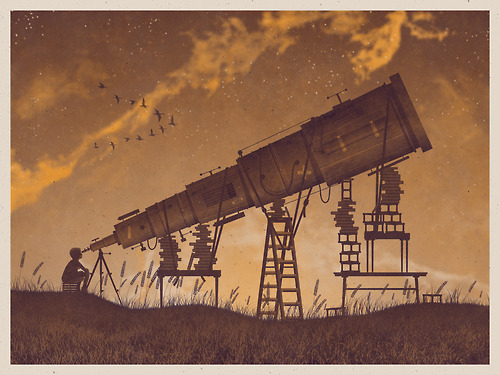
It spreads like a yawn. Involuntary. It taints the way you see everything. Like being in love. Hope is a realization working backward from the future to infect this very moment and infuse it with
Better.
 I’ve been reading Jürgen Moltmann’s The Coming of God. Moltmann is an Austrian theologian who writes about eschatology (a look at last things, or end of times). Don’t be put off by the churchy/theological word: Moltmann’s take is not the “let’s read the Book of Revelation as a blueprint for the future” way. That old way often ended by damming up life here and now so as to burst in a final damnation on everything. With believers flying the coop just before. So why worry about this world?
Moltmann’s point is that a future hope has a way of wending its way back into the scrub and din of everyday life. In fact, it is the Christian hope of resurrection that feeds a very different way of looking at life:
Just as death is not only the end, but an event belonging to the whole of life, so the resurrection too must not be reduced to “a life after death.” The resurrection is also an event belonging to the whole of life. It is the reason for a full acceptance of life here without any reservation. (Moltmann, Jürgen. The Coming of God, Minneapolis: Fortress Press, 1996. 66)
To me, that is a meaty stew that feeds my yearning to live fully in the present. And engage with people in the present (as much as my sadly-abstract soul will allow). I’ve been watching this hope work backward into my unscrolling days, changing them one by one.
###
Image Credit: DKNG via thisisnthappiness

 conversation is an engine